Economy · U.S. midterms 2026
Democrats won Congress. Trump's Canada tariffs won't automatically disappear.
The 50% tariff on a list of Canadian goods rests on a 1930 law that lets the president keep it, change it or end it. Congress can rewrite that law, but a bill would have to survive a likely veto. The faster routes run through a trade deal or a court.
Democrats won the Senate and the House, according to U.S. media projections and race calls. The new Congress sits Jan. 3, 2027. For Canadian exporters, the 50% U.S. tariff on a list of Canadian goods does not depend on who runs Congress.
There is also no data showing Canada swayed the vote. The exit polls published by CNN and NBC News asked voters whether Trump's tariffs had helped or hurt the economy, but nothing about Canada, tariffs on Canada or CUSMA.
One law, one signature
Trump ordered the tariff on July 20, 2026, under Section 338 of a 1930 law; it took effect Aug. 22. No president had cited it to impose a tariff before. The list covers around US$20 billion of goods, based on 2025 imports, the Congressional Research Service says. It has no exemption for goods that meet CUSMA rules, and no end date. It targets goods tied to disputes over alcohol, dairy and cars. Separate U.S. tariffs on steel, aluminum, autos and lumber would stay even if this one ended.
The same law lets the president "suspend, revoke, supplement, or amend" the tariff whenever he decides. He has already paused it once and changed the list twice, most recently in a proclamation of Oct. 23 that took effect Oct. 30. That gives him a direct way to end it without waiting for Congress.
Past votes don't count
Congress has voted against Trump's Canada tariffs before: the Senate 51 to 48 and 50 to 46, the House 219 to 211. Those votes were on the 2025 emergency tariffs, and none became law. The Supreme Court then ruled in February that the emergency law "does not authorize the President to impose tariffs". Trump switched to Section 338 instead. The old votes say little about this one.
What a Democratic Congress can do
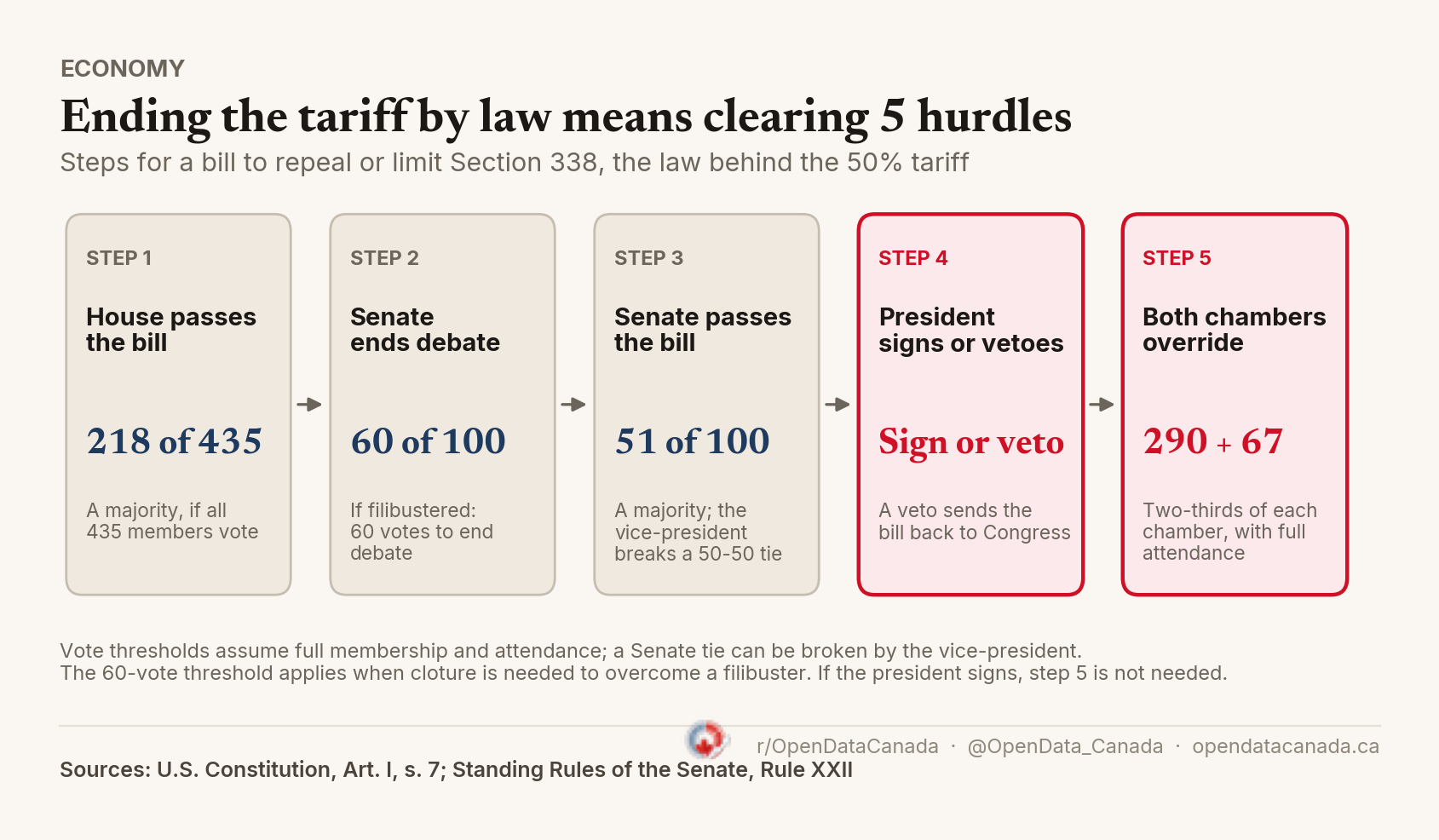
It can hold hearings and pass a bill to repeal or limit Section 338. Bills to repeal it, such as S. 5390, have been filed. But the fast-track rules that applied to the emergency votes do not apply here, so in the Senate a bill can be filibustered. Then it would face a likely veto.
Two other ways out
The courts. On Oct. 20, a New Jersey food importer, Gellert Global Group, sued at the U.S. Court of International Trade. It argues Canada's policies aren't the kind of discrimination the law targets, and that the government ignored a 30-day waiting period. Those are the company's claims, not findings. The court set an expedited schedule, with oral argument on Jan. 20, and has not ruled on the merits.
A deal. Canada has hit back with tariffs of 15% to 50% on C$27.6 billion of U.S. goods, Finance Canada said. Prime Minister Mark Carney said on Nov. 3 that "they're asking less and they're offering more, but we're not quite there." He plans to meet Trump at the APEC summit later this month. For Canada, a deal is the main lever.
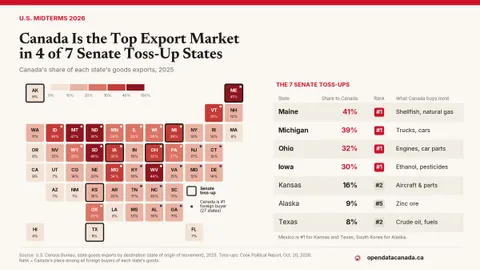
For how much the closest Senate states sell to Canada, see Canada is the top buyer in 4 of 7 Senate toss-up states.
Related: All our Canada-U.S. stories · US trade with Canada by state, all 50 ranked · How Americans feel about Canada in 2026