Articles
Explainers
When a chart, map, or visualization needs context the picture alone can't carry, this is where the longform expansion lives — usually a few pages, always with the objections engaged honestly rather than ignored.
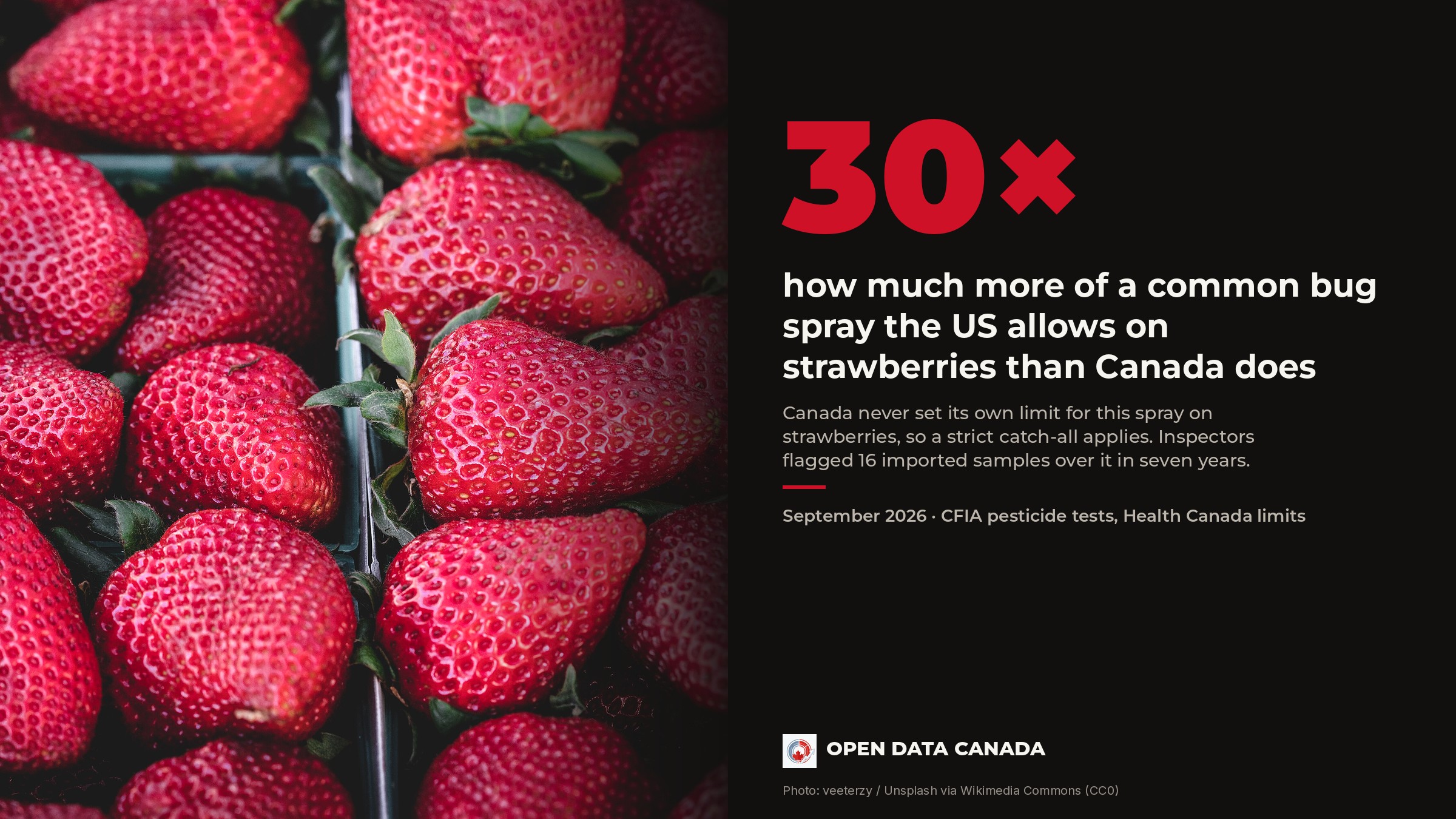
Are Driscoll's berries safe? Why some imported berries exceed Canada's pesticide limits
A whistleblower says half of Driscoll's shipments to Canada broke pesticide limits. Seven years of government tests on imported berries show why fruit can pass US rules and still fail Canada's.
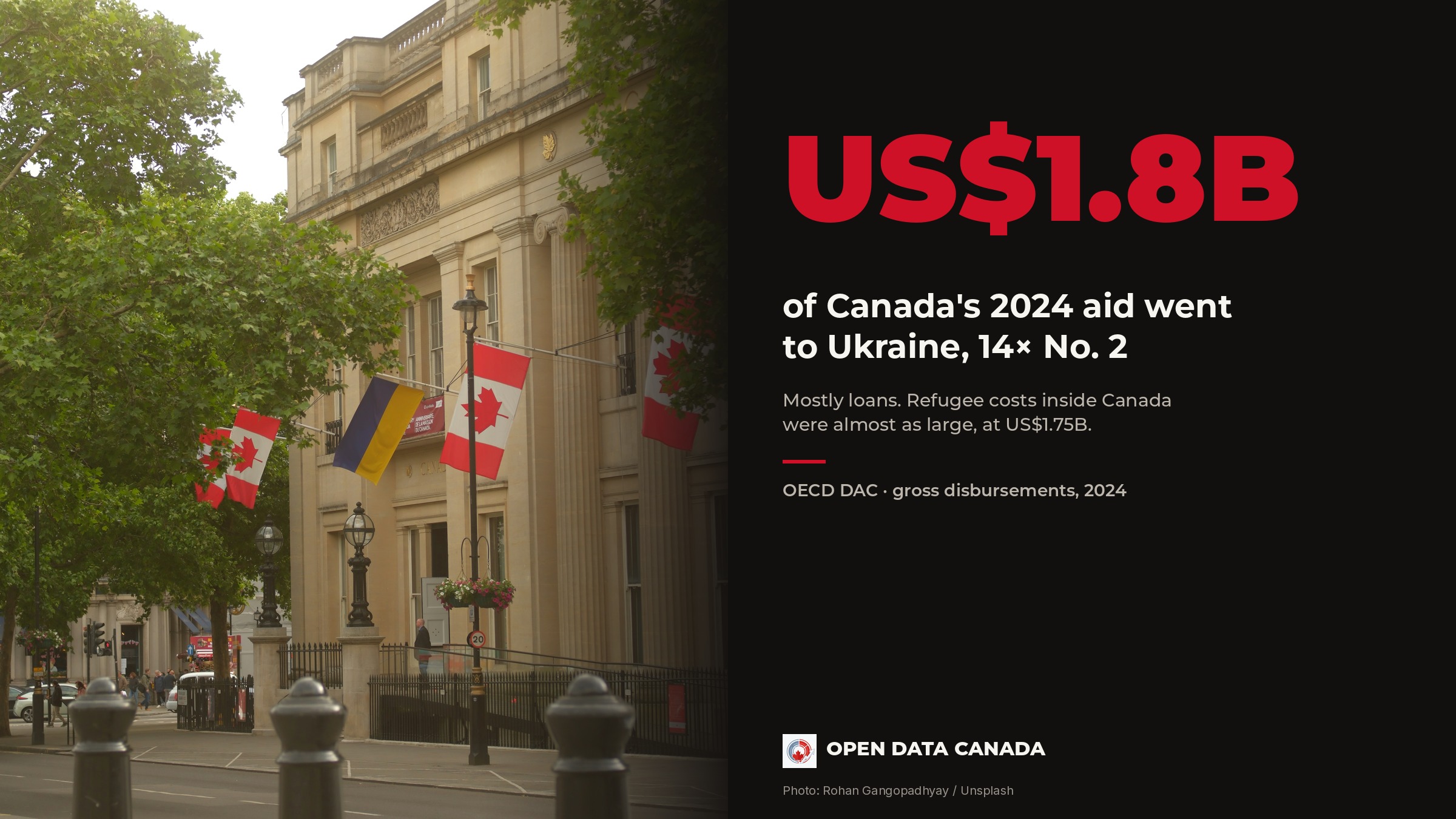
Canada's foreign aid by country: Ukraine got 14 times more than anyone else, almost all of it as loans
Canada sent aid to 135 countries in 2024, but Ukraine took 1.83 billion US dollars, more than the next 34 recipients combined. Strip out loans and Ukraine drops to sixth, behind Haiti, Ethiopia, Mali, the West Bank and Gaza, and Bangladesh. Less than half of all Canadian aid can be traced to a single country at all.

Alberta Added More People Than Ontario This Year. That Hasn't Happened Since 1981.
Canada had 41,798,407 people on July 1, 2026. The country grew by 0.46% over the year, its slowest growth since Statistics Canada's quarterly series began in 1946, and Alberta added 76,419 people while Ontario added 45,160.
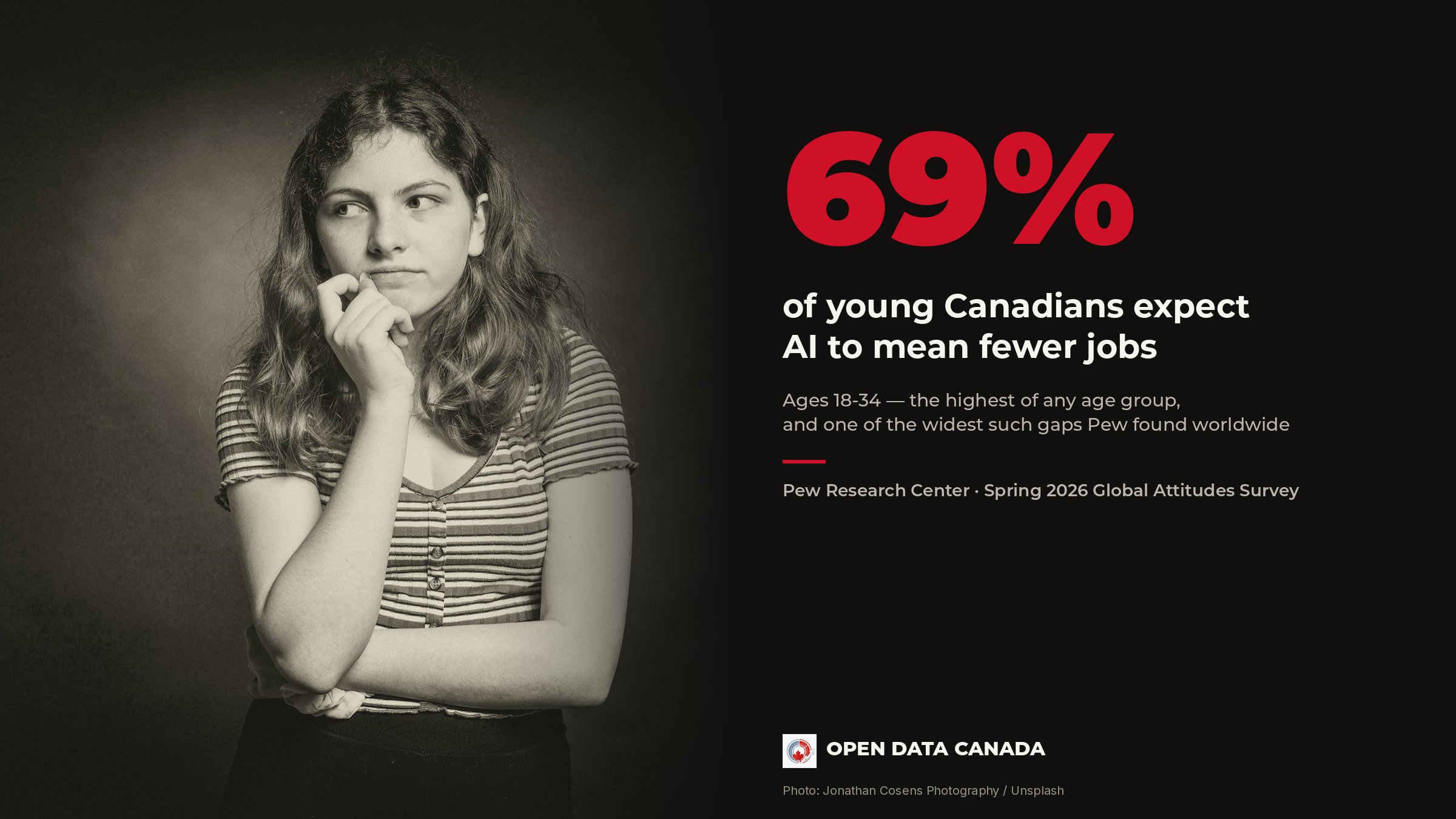
Young Canadians Are the Most Pessimistic About What AI Will Do to Jobs
69% of Canadians aged 18-34 expect AI to mean fewer jobs in Canada over the next 20 years — more than any older age group, and one of the larger such generational gaps Pew found anywhere in the world.

Lake Ontario Is Running Above Normal. Lake Superior Is Below It
Every Great Lake started 2026 below its long-term average. By September, on provisional figures, Lake Ontario was 40 centimetres above it, its 7th-highest September since 1918, while Lake Superior sat 5 centimetres under.
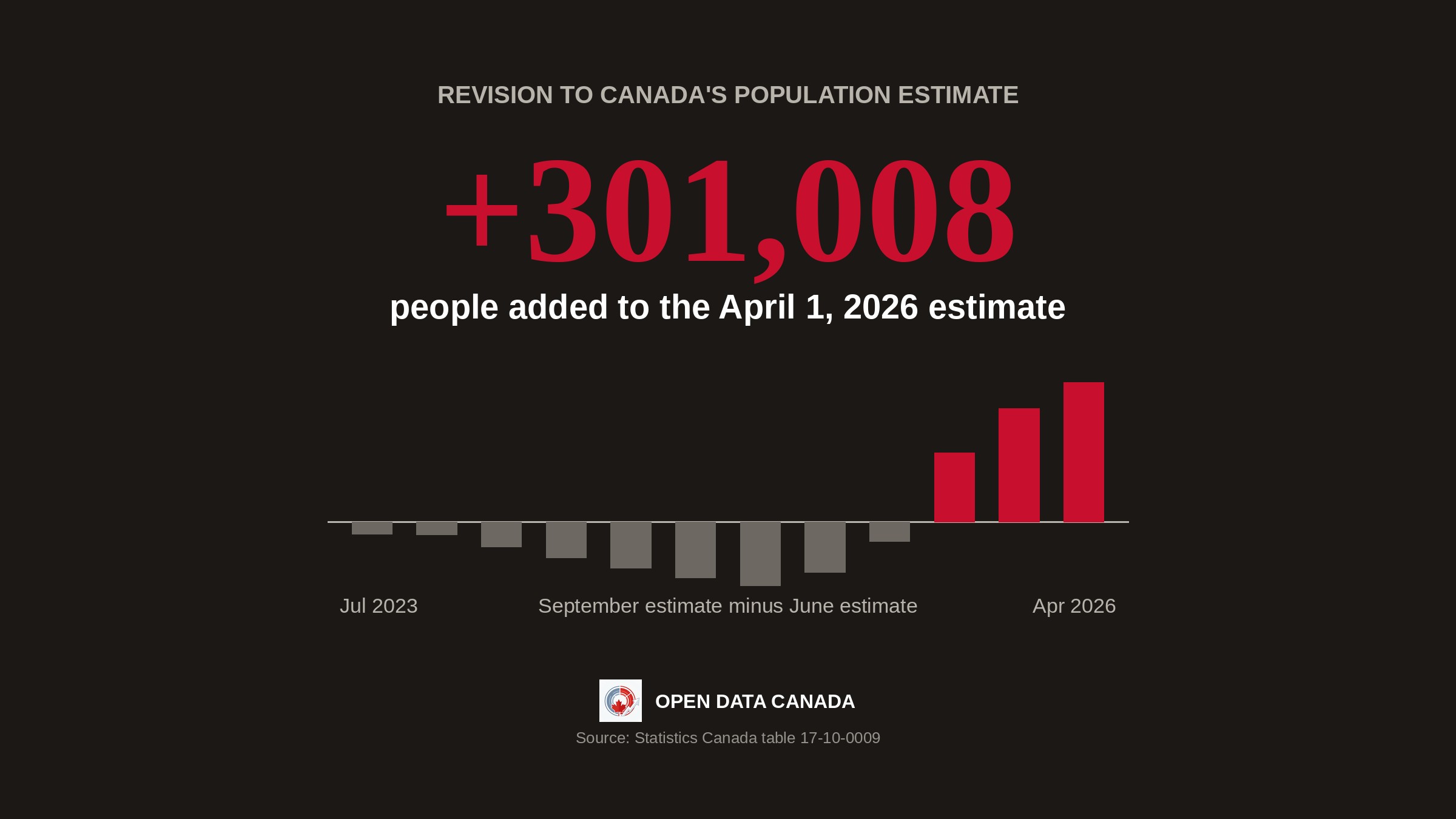
Canada's Population Decline Vanished After a 301,008-Person Revision
Three months ago, Statistics Canada's preliminary estimates showed Canada's population falling for three straight quarters. Today's revision adds 301,008 people to the April estimate, turning that apparent decline into a brief pause. Canada's population reached a record 41.8 million on July 1.
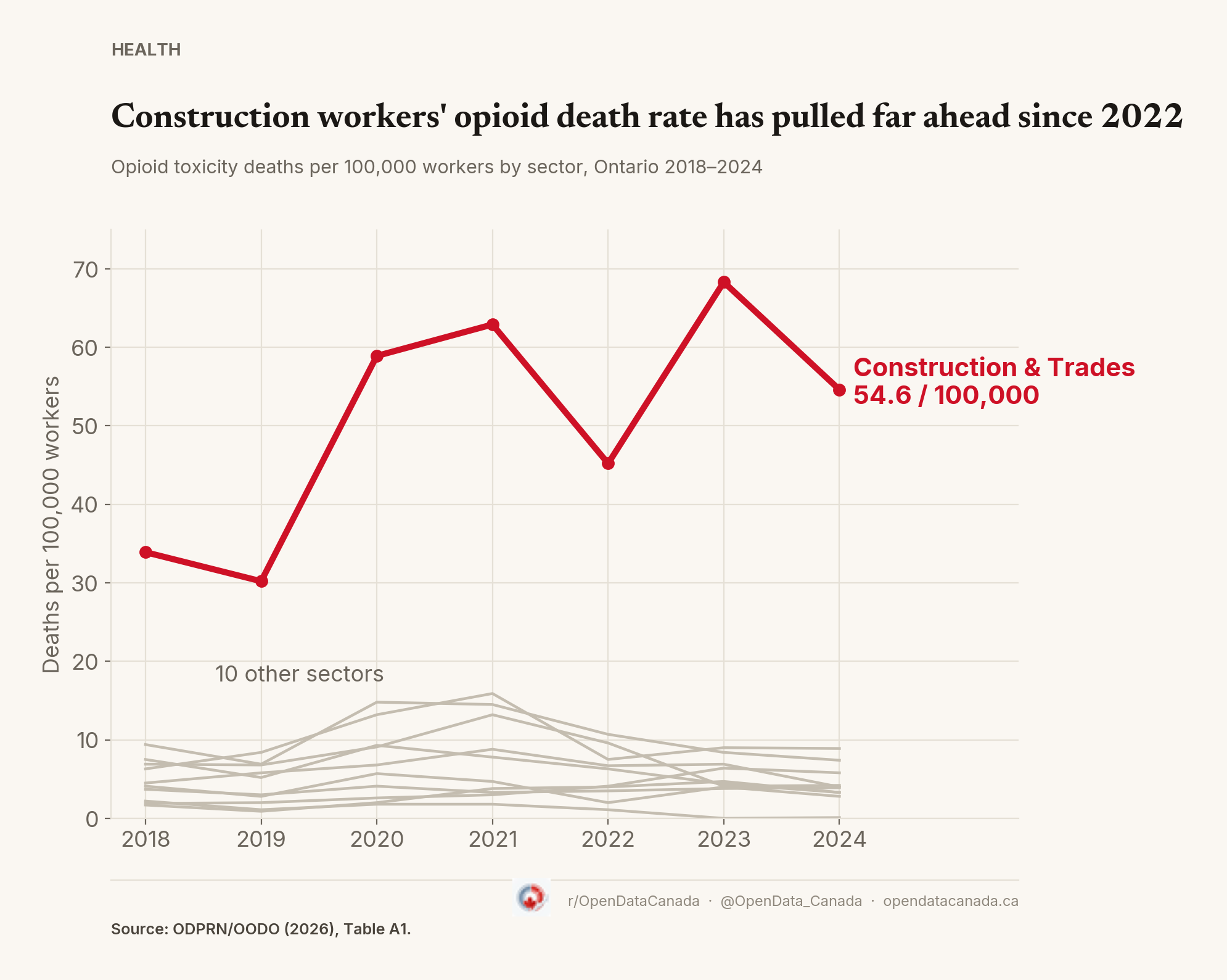
Construction Workers' Opioid Death Rate Is Now Far Ahead of Every Major Ontario Sector
A new study using linked Ontario health records tracked opioid toxicity deaths across the province's workforce from 2018 to 2024. Construction and trades workers now die from opioids at more than 6 times the rate of Hospitality, the next-largest sector, and the gap has grown sharply since 2018.

In 1981, 27% of young adults in Canada lived with their parents. The latest housing survey puts it at 55%.
Census data show the share climbing to 42% by 2011. Statistics Canada's 2024 housing survey puts it at 55%, up from 51% in 2022, about 3.5 million people.
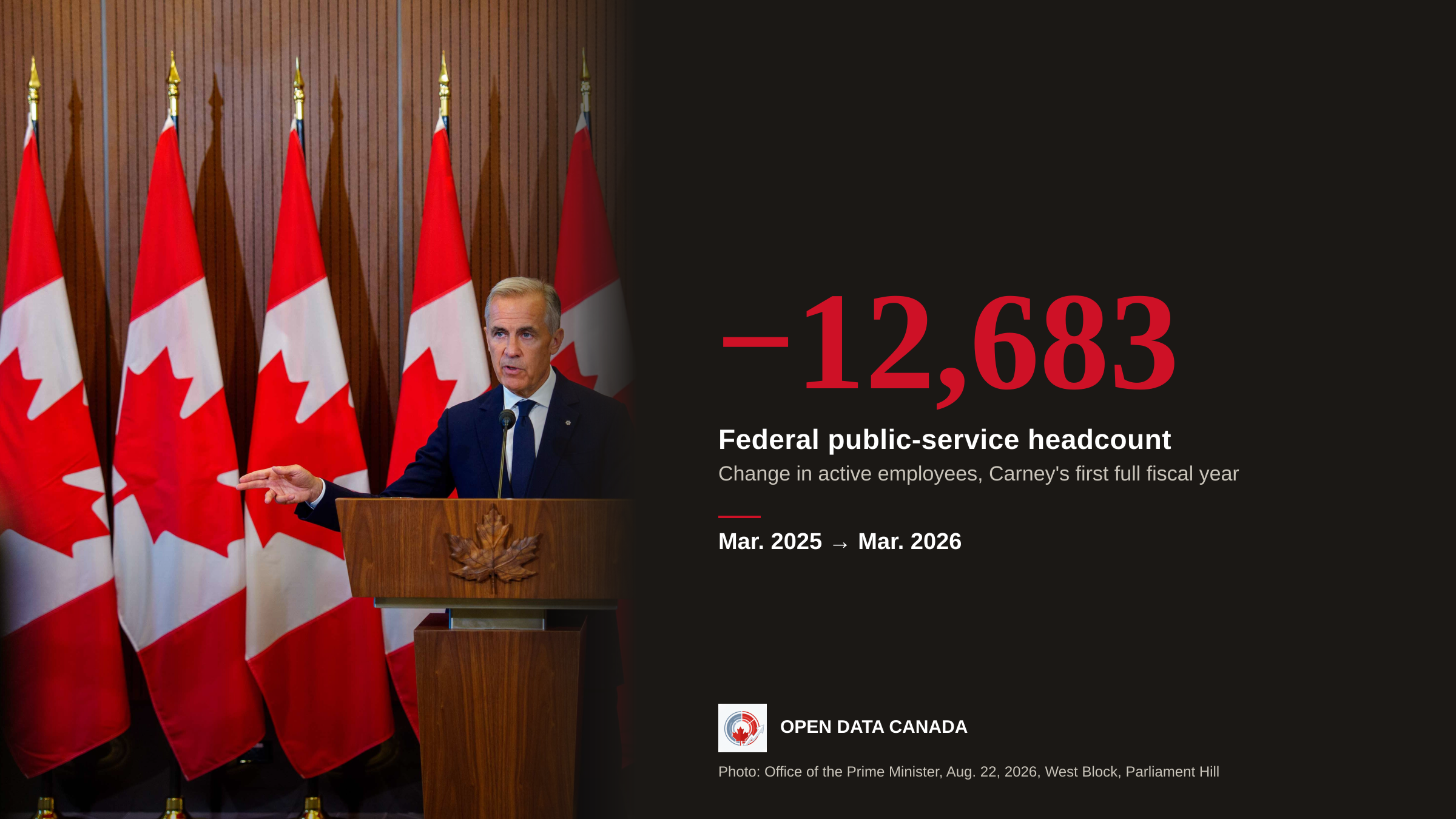
Federal public service fell by 12,683 in Carney's first full fiscal year
That's 54% larger in magnitude than the combined increase during Martin, Harper and Trudeau's first full fiscal years.
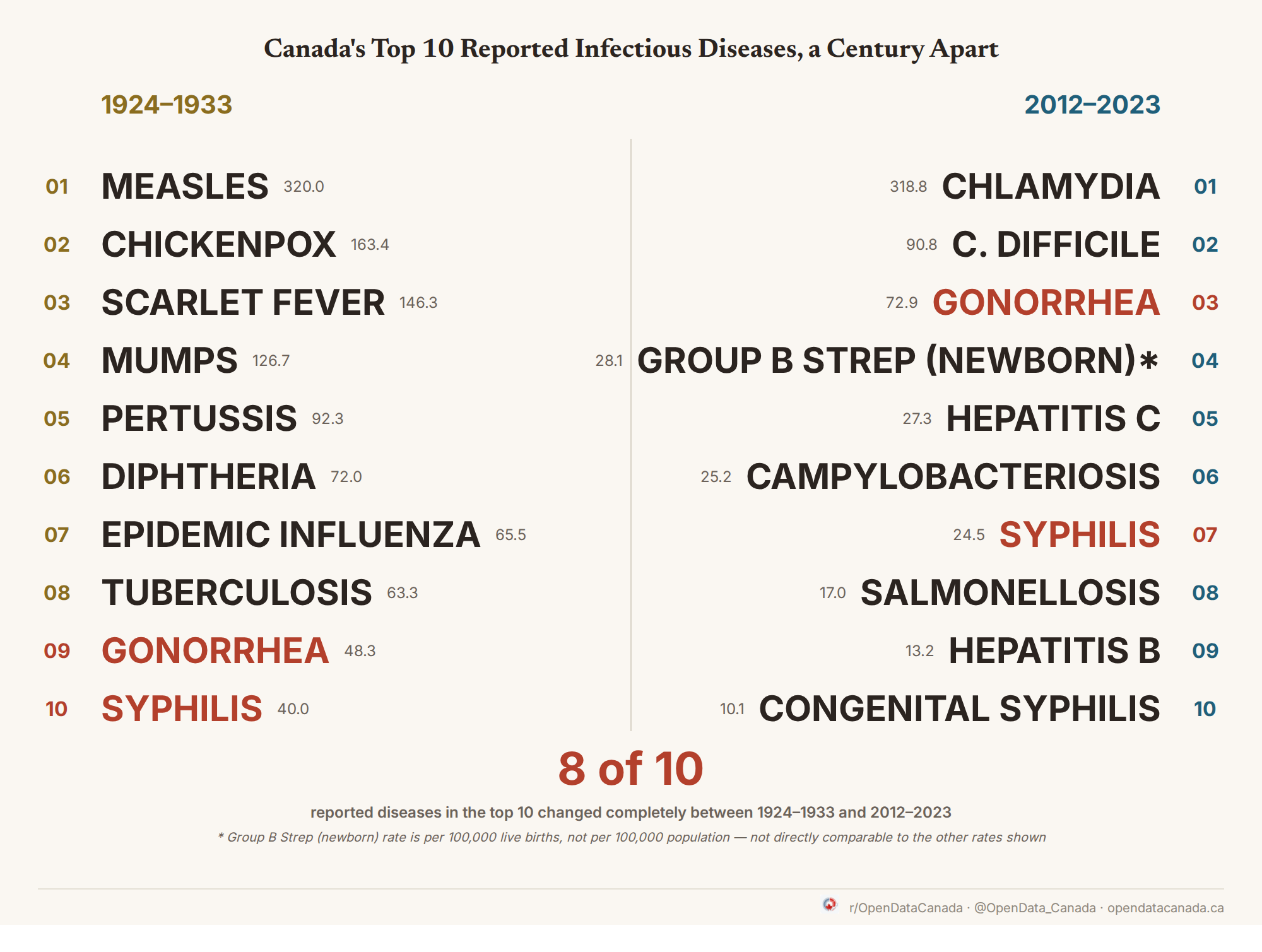
Canada's Top 10 Reported Infectious Diseases, 100 Years Ago and Today
Comparing Canada's leading reported notifiable diseases from the 1920s and 30s to the last decade, only two names appear on both lists. The disease that currently tops the list is reported at almost the exact same rate as the disease that topped it a century ago.
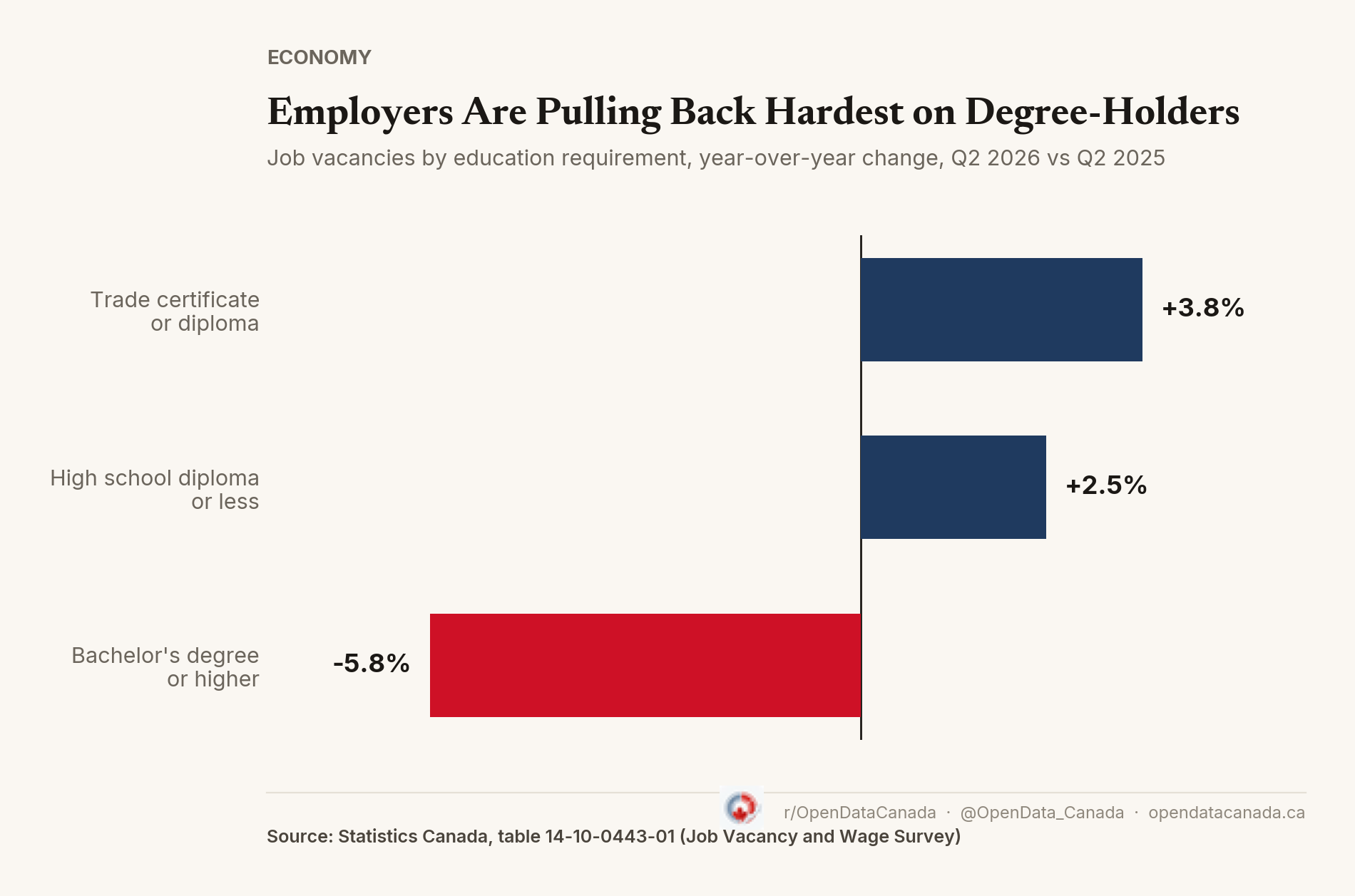
Canada's Job Market Is Changing Unevenly
Total job vacancies barely moved in the second quarter. But vacancies moved in different directions by education and occupation: down 5.8 percent for positions requiring a bachelor's degree, up 3.8 percent for positions requiring a trade certificate.
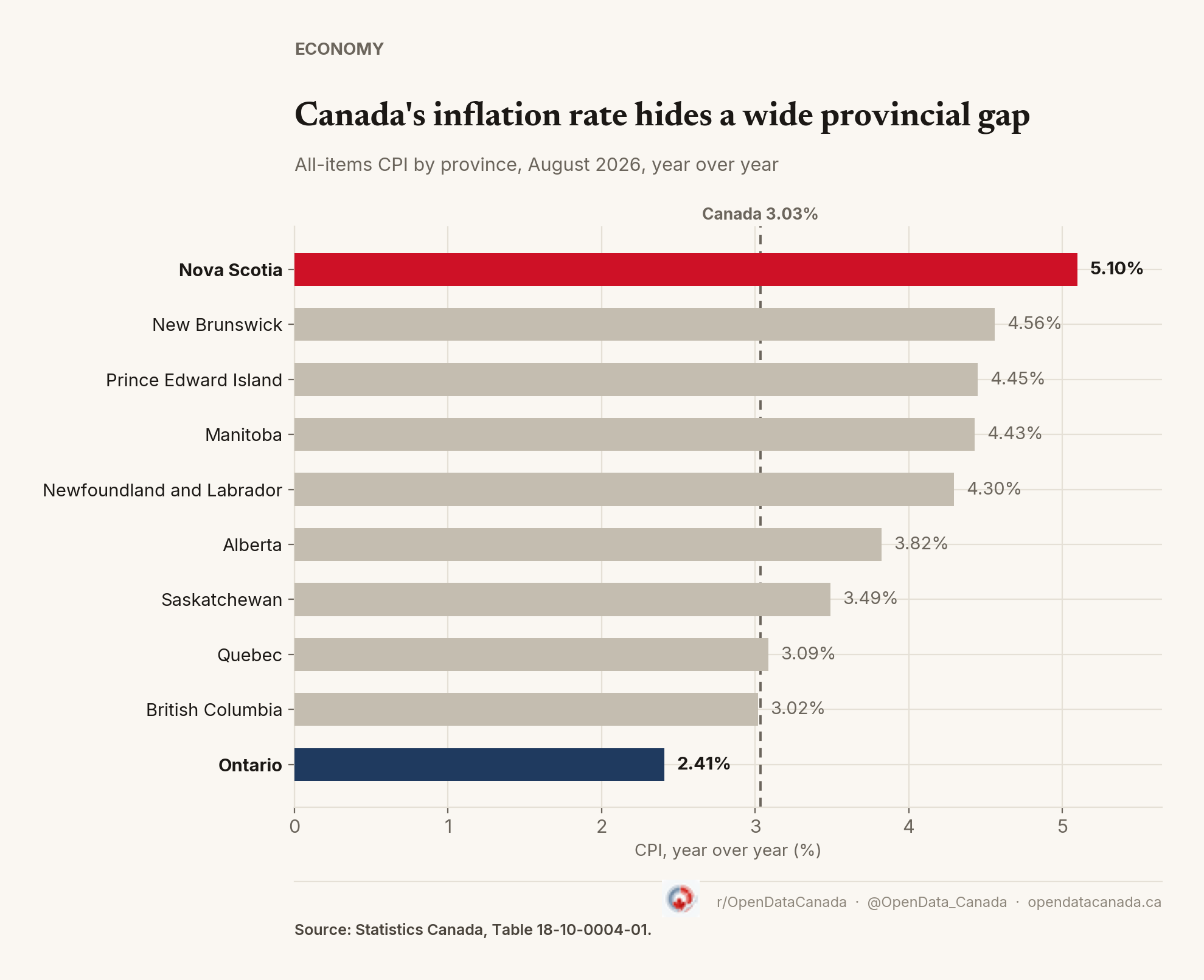
Canada's 3% inflation rate masks a much wider provincial split
From 2.41% in Ontario to 5.10% in Nova Scotia — Statistics Canada's August 2026 CPI release shows one of the widest provincial inflation gaps of the past year, and it traces back almost entirely to a single category: shelter.

89% of Ukrainians who came under CUAET are still in Canada — and 61% of Ukrainian newcomers aren't planning to go back
Two 2025 surveys of Ukrainians in Canada point the same way, most aren't leaving. The one dedicated path to permanent residence closed in 2024. Temporary status keeps getting extended, but four years after the program launched as a temporary "safe haven," no broad path to stay permanently has replaced it.
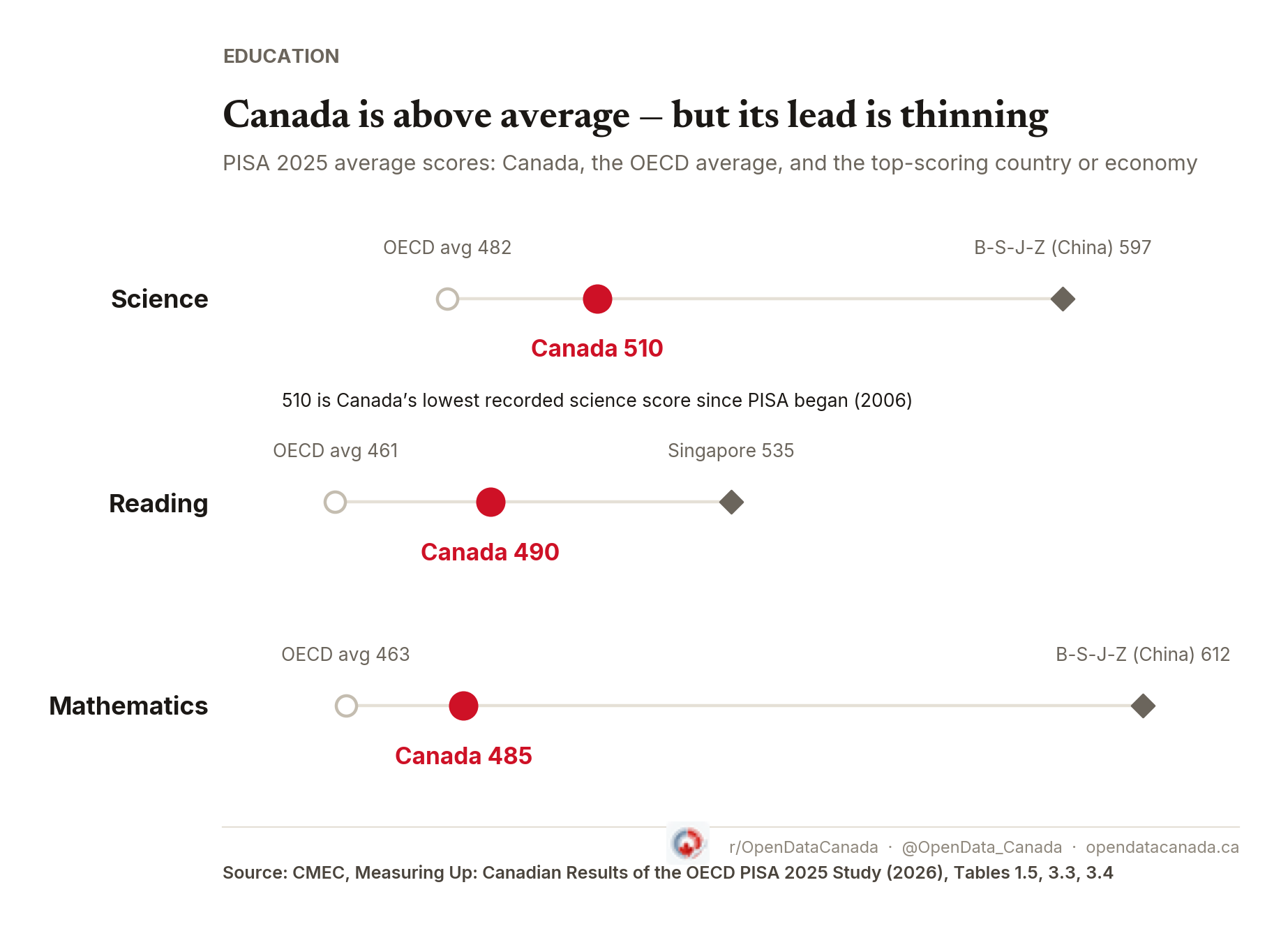
Canada's science scores hit a record low in PISA 2025
Canadian 15-year-olds scored above the OECD average in science, reading, and math on the 2025 Programme for International Student Assessment, but science, the assessment's focus this cycle, fell to its lowest recorded level since testing began in 2006, and reading and math are down sharply too. Provincial results vary by as much as 51 points depending on subject.

Women in Public-Sector Industries Were 34% More Likely to Have a First Child
A new StatCan study links Canadian women's chances of having a first child to where they work. Women in public administration, education and health have pulled far ahead of women in administrative and service jobs since 2017. Union coverage matters too, but only modestly, and income still matters more than either.
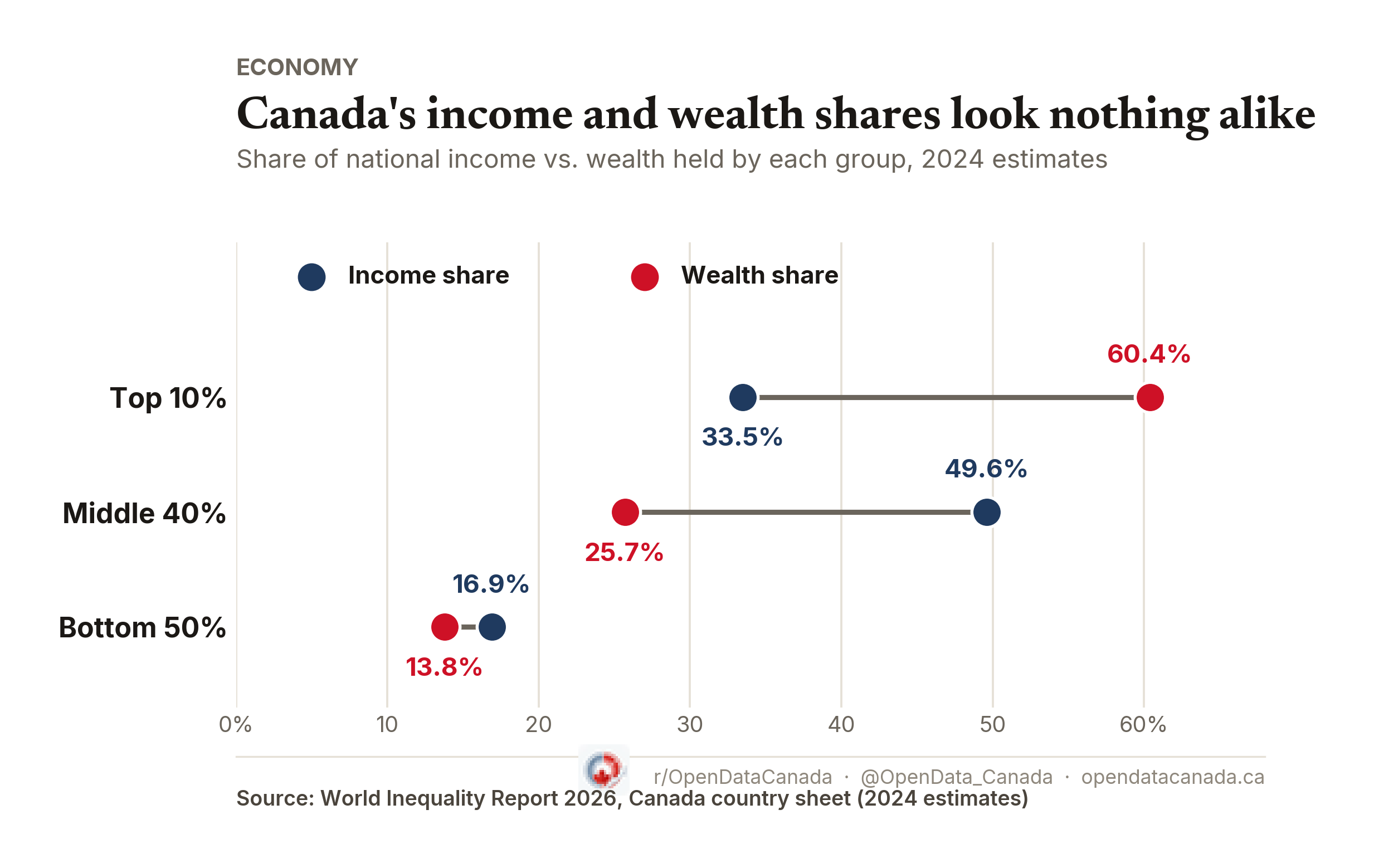
Canada Looks Relatively Equal on Income. Then You Look at Wealth.
Canada's top 10% earn 33.5% of national income but hold 60.4% of wealth. The middle 40% owns just 25.7% of wealth, the lowest share of 15 high-income democracies compared here.
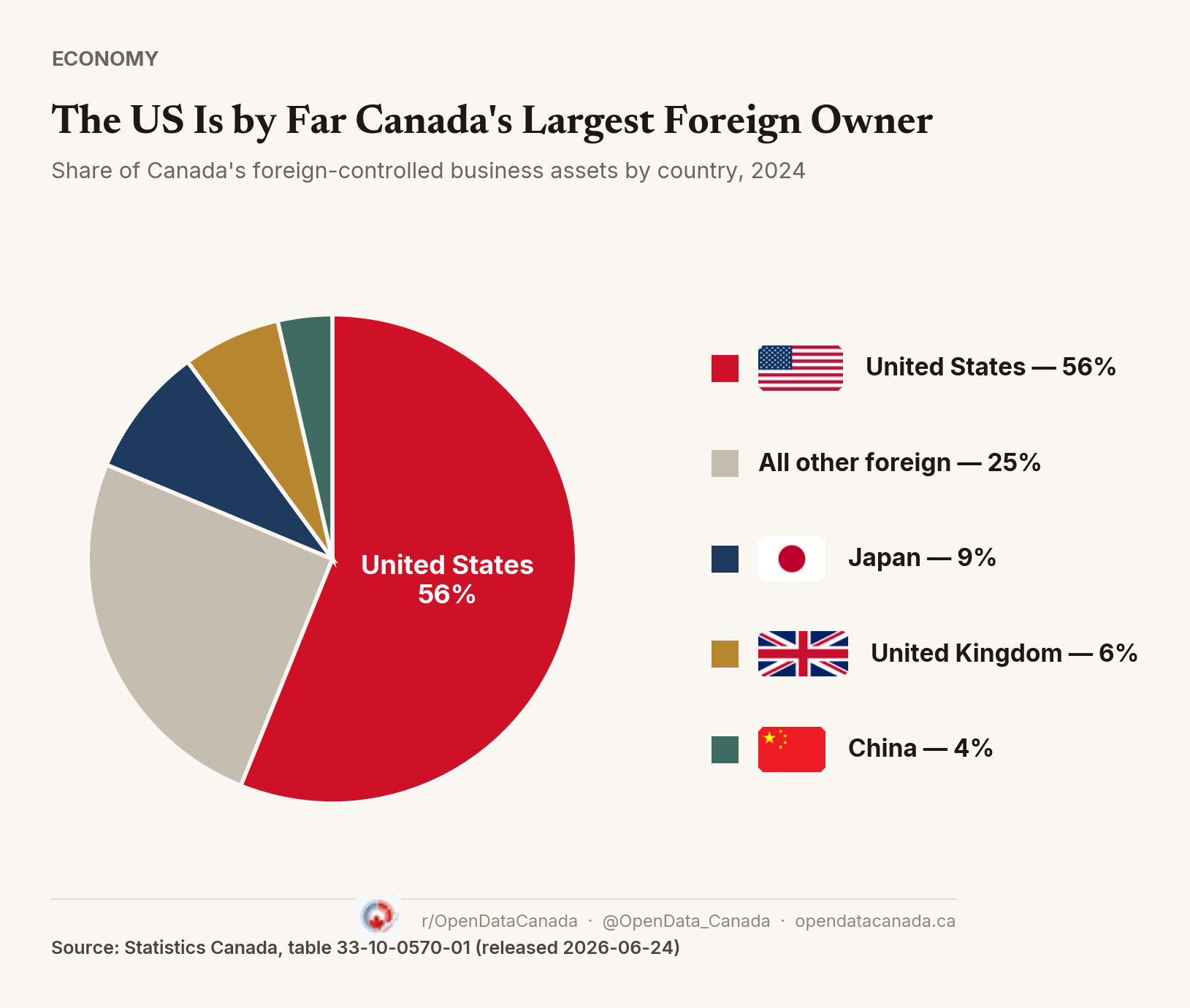
Foreign Control of Canada's Businesses Has Been Shrinking for 14 Straight Years — And More Than Half of What's Left Is American
In 2024, foreign investors legally controlled 13.9% of the assets held by businesses operating in Canada, the lowest figure Statistics Canada has recorded since the series began in 2010. Of that shrinking foreign share, the United States alone accounts for more than half.
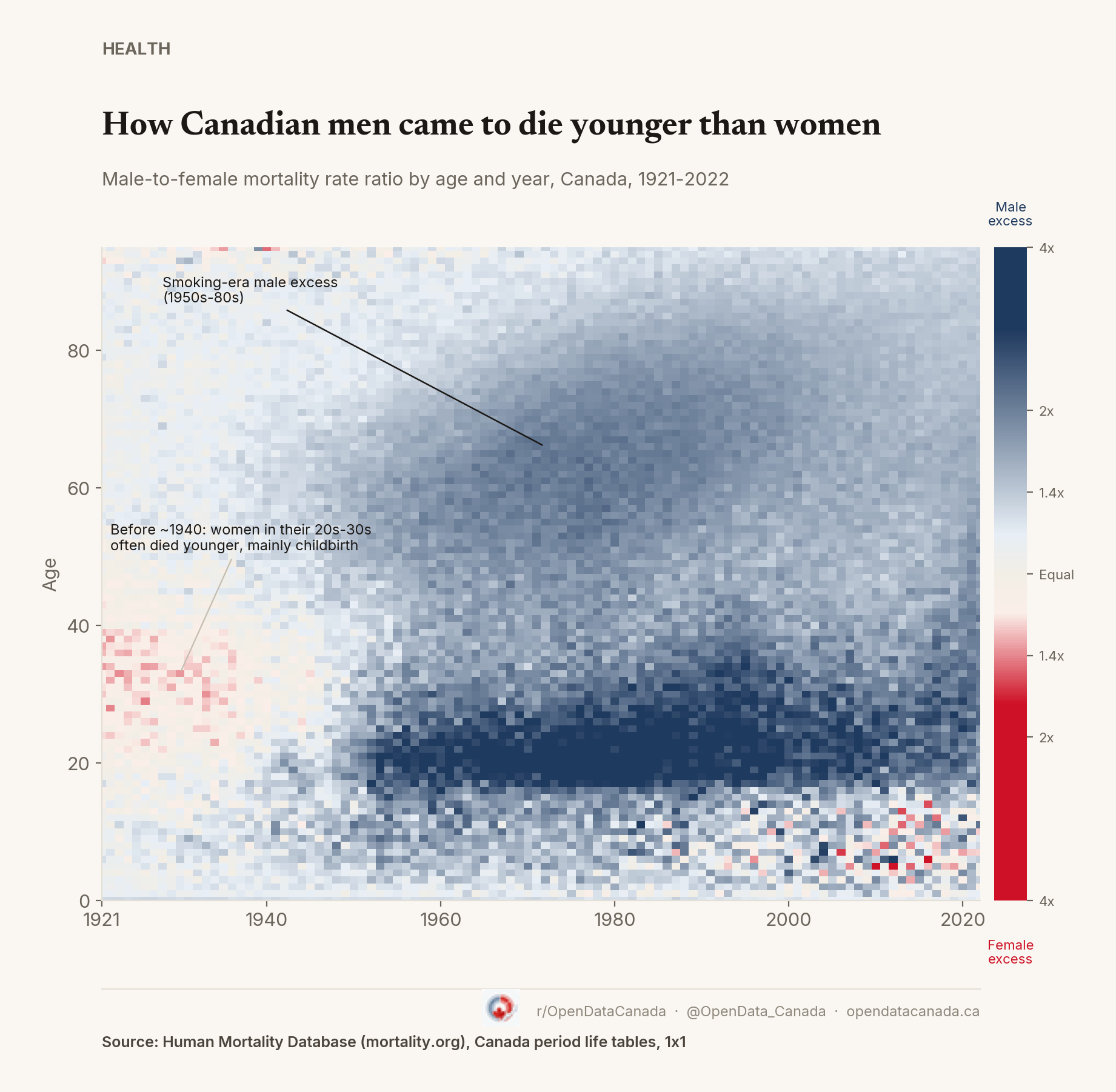
How Canadian Men Came to Die Younger Than Women
A century of mortality records shows the opposite was once true. Before 1940, women in their 20s and 30s often died younger than men, mainly from childbirth. Every year since the 1940s, men have died younger, and by the 1980s a 22-year-old man was more than four times as likely to die as a 22-year-old woman.
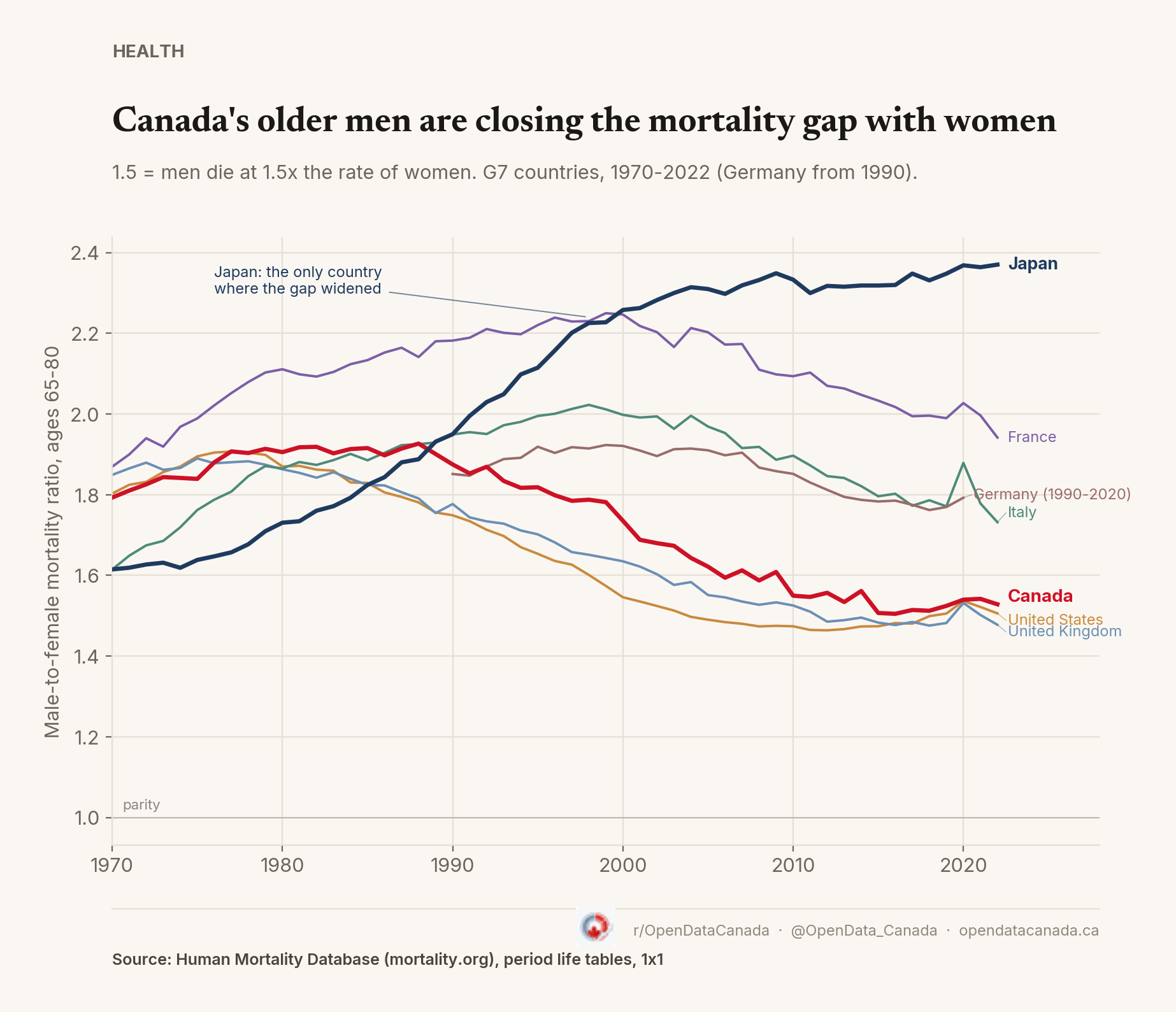
Canada's Older Men Are Closing the Mortality Gap With Women
Canada's 65-80 male-to-female death rate ratio has fallen from 1.79 in 1970 to 1.53 in 2022, the lower end of a plateau it has held since the early 2010s. Most of the G7 closed a similar gap over the same period. Japan went the other way: its ratio rose from 1.61 to 2.37, the sharpest widening in the group.
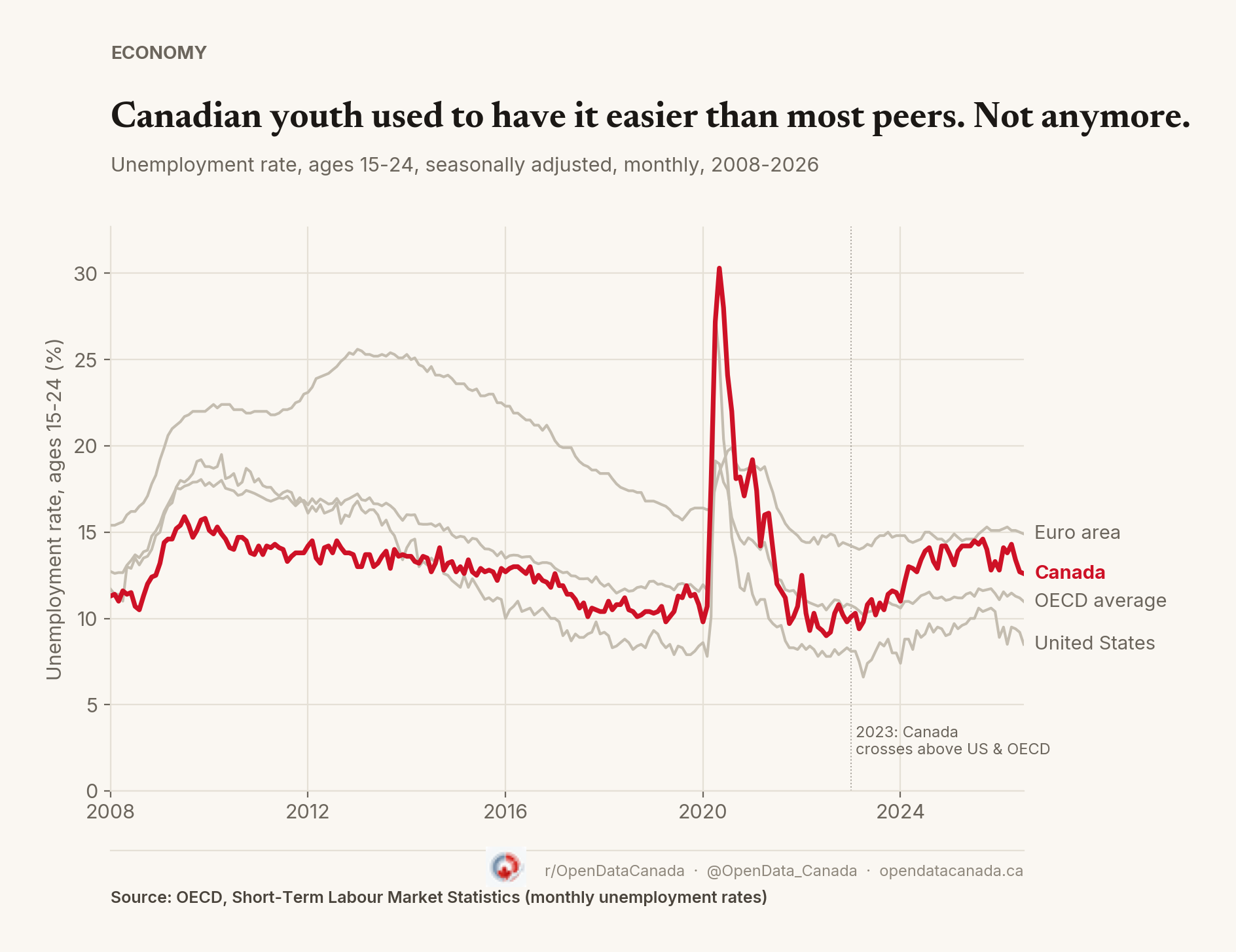
Canada's Youth Unemployment Rate Is Now Above the US and OECD Average
For most of the past two decades, Canada's youth unemployment rate sat below the OECD average. Since late 2023 that has flipped. Canadian youth are now more likely to be unemployed than their peers in the United States or across the OECD as a whole, and Statistics Canada's own numbers confirm it.

Nearly Half of Businesses Selling Soon Say They Could Shrink or Close Without a Buyer
A brand-new Statistics Canada table shows 20.3 percent of private-sector businesses in Canada plan to sell or transfer ownership within 10 years, rising to 26.6 percent among businesses more than 20 years old. Among the smaller group planning to sell within 2 years, StatCan asked for the first time what happens if a buyer can't be found: 46.8 percent called closing or scaling down likely, and 46.5 percent called selling at a reduced price, or to a less-preferred buyer, likely too.
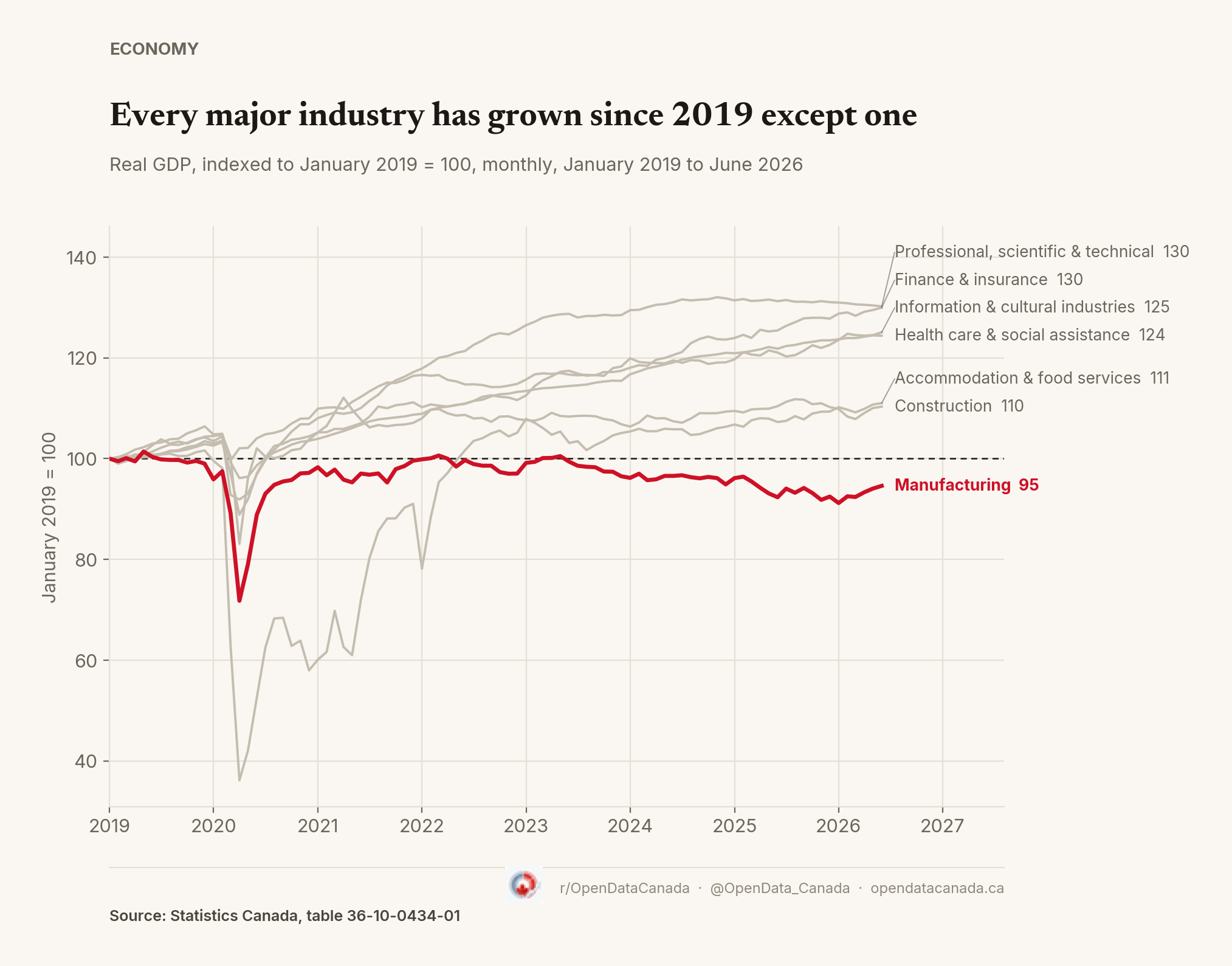
Manufacturing Is the Only Major Industry Smaller Than It Was in January 2019
Real GDP is up 14.6% since January 2019, but the industries behind that number aren't the ones you'd guess. Finance and professional services have each grown by nearly a third; health care by about a quarter. Manufacturing is the one broad industry that still hasn't gotten back to where it started.

Canada's mobile prices remain among the priciest in the G7 — and they're rising again.
Ottawa spent two years tracking wireless prices down and declared victory in January 2022. A federal price-comparison study shows Canada has stayed among the three most expensive places for a basic mobile plan among G7 countries plus Australia, at every plan size tracked, and by late 2025 the prices that did fall were climbing again.
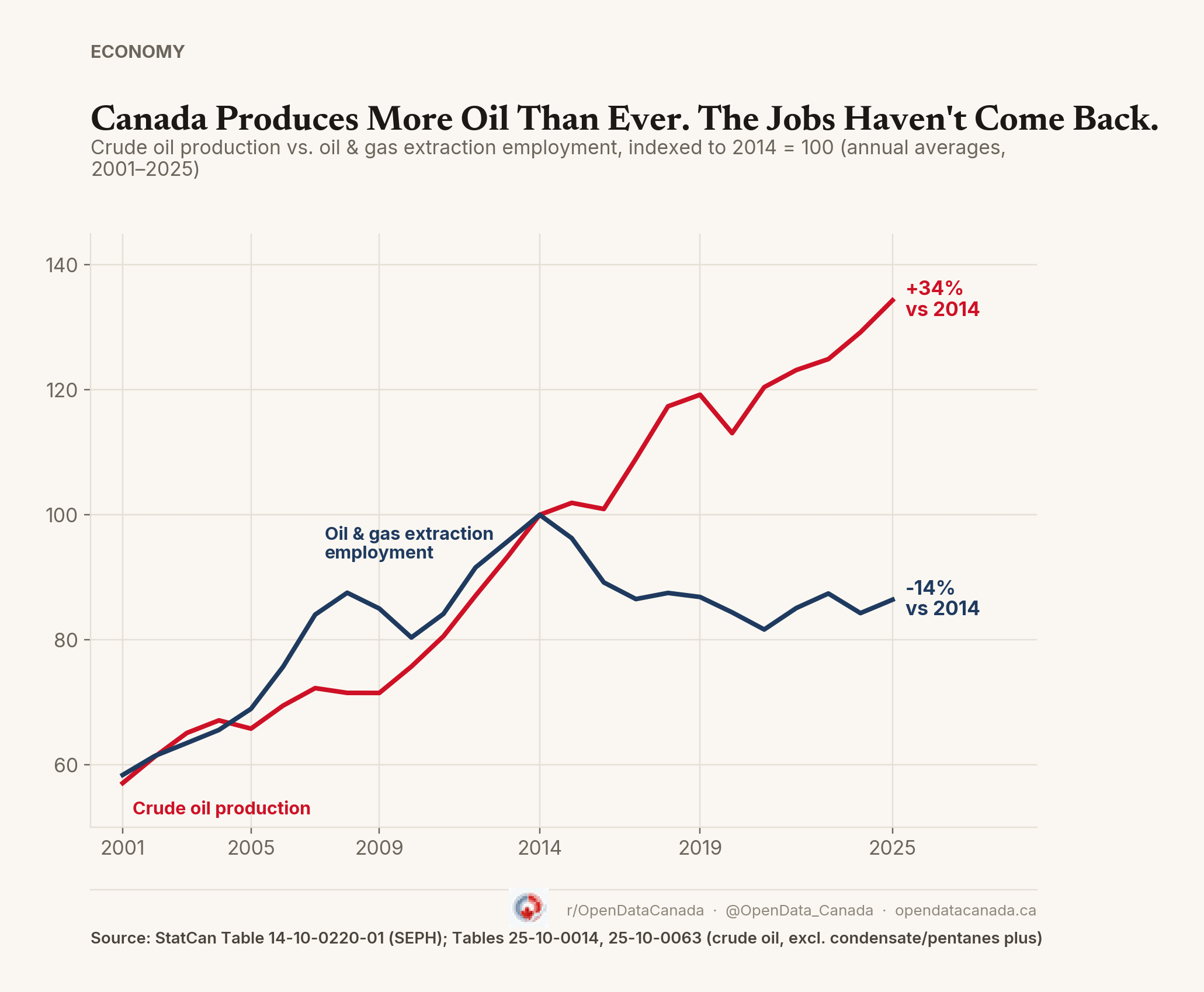
Canada Produces More Oil Than Ever. The Jobs Haven't Come Back.
Crude oil production is up 34% since 2014 and sits at a record high. Oil and gas extraction employment is down 13.6% over the same span and has never recovered its 2014 peak. Pembina Institute flagged a version of this gap in 2025; this piece extends the comparison through 2025 with Statistics Canada and Alberta Energy Regulator data, plus a separate look at oil sands capital spending.
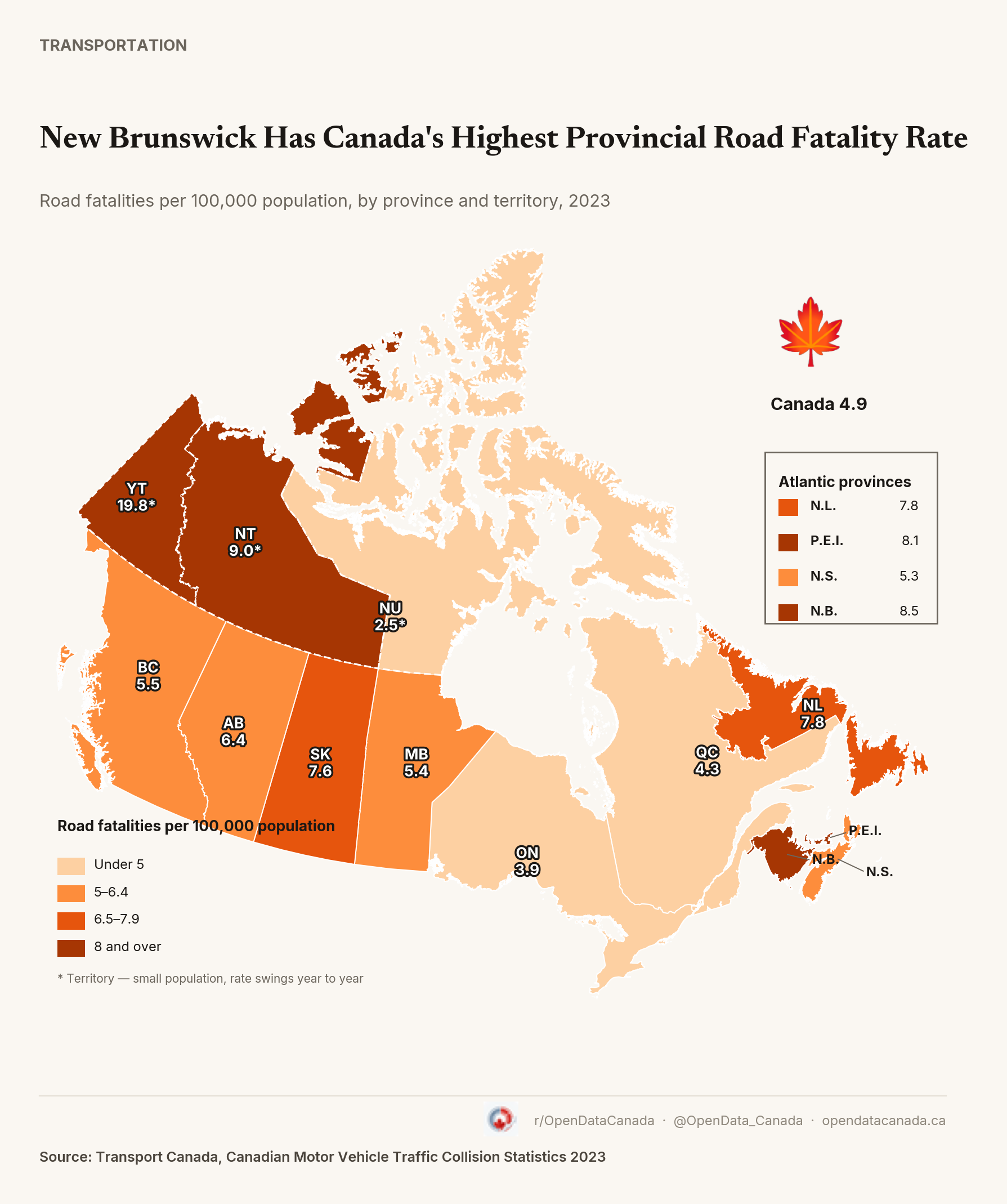
New Brunswick Has Canada's Highest Road Fatality Rate — But the Ranking Changes When You Count Driving
New Brunswick had Canada's highest road fatality rate in 2023, 8.5 deaths per 100,000 people, more than double Ontario's 3.9. Switch to fatalities per kilometre actually driven and Atlantic Canada is still worst, but the order inside it shifts, and a couple of provinces move a lot: Alberta looks mid-table by population and drops close to the national average once its driving distances are counted. Nova Scotia moves the same way.
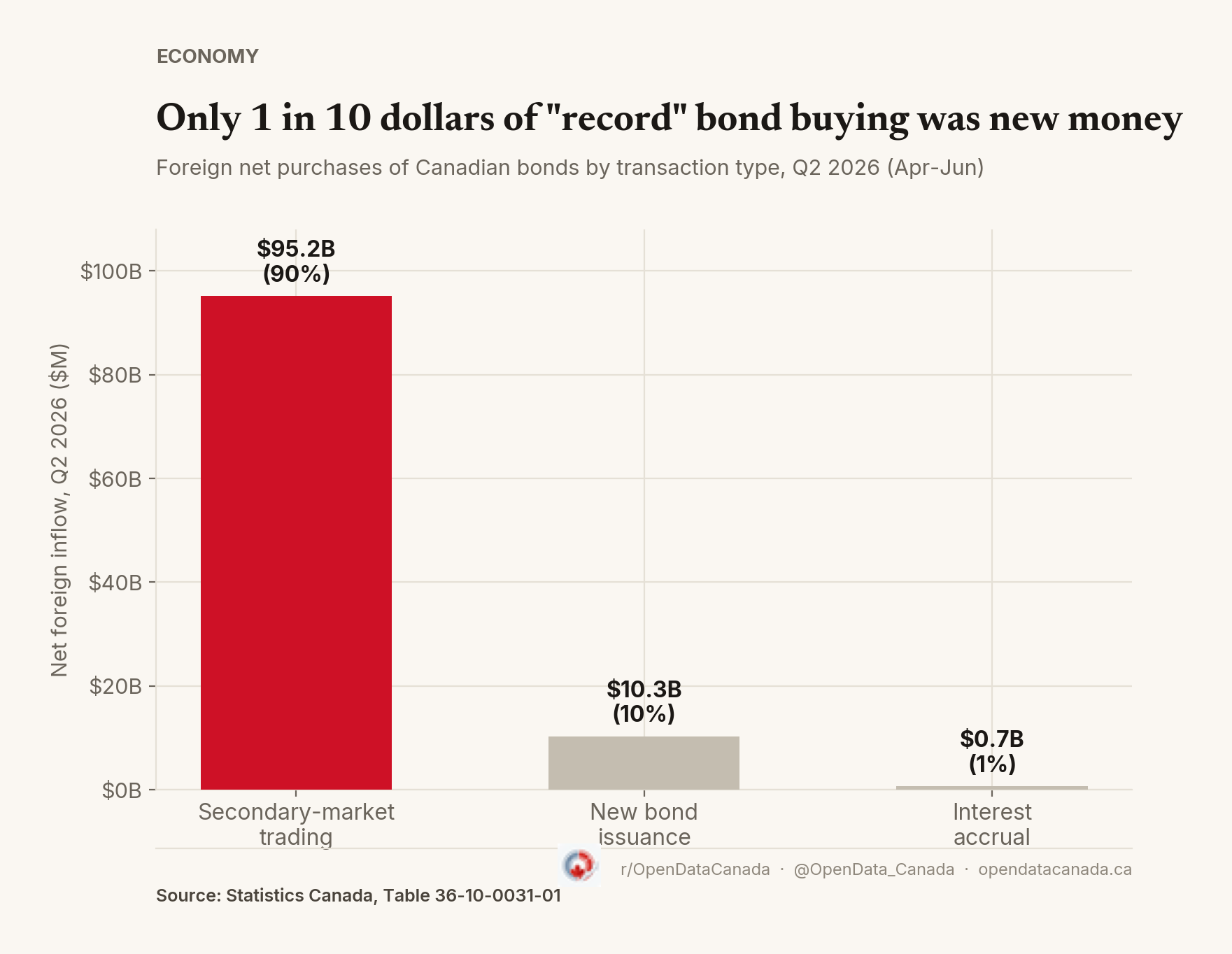
Foreigners bought 106B in Canadian bonds. Most wasn't new money.
Statistics Canada reported foreign investors bought a record 106 billion dollars of Canadian bonds in the second quarter of 2026, coverage that led with the headline number. Break the total down by transaction type and about 95 billion dollars was secondary-market trading of bonds that had already been issued — not new financing for Canadian borrowers.

What's actually delaying Toronto's streetcars
Diversions and cars parked on the rail account for 35 percent of all streetcar delay-minutes since the start of 2025, far more than mechanical failure. Crews and cars in the way combined explain six in ten delay-minutes across the full 2024-2026 period.
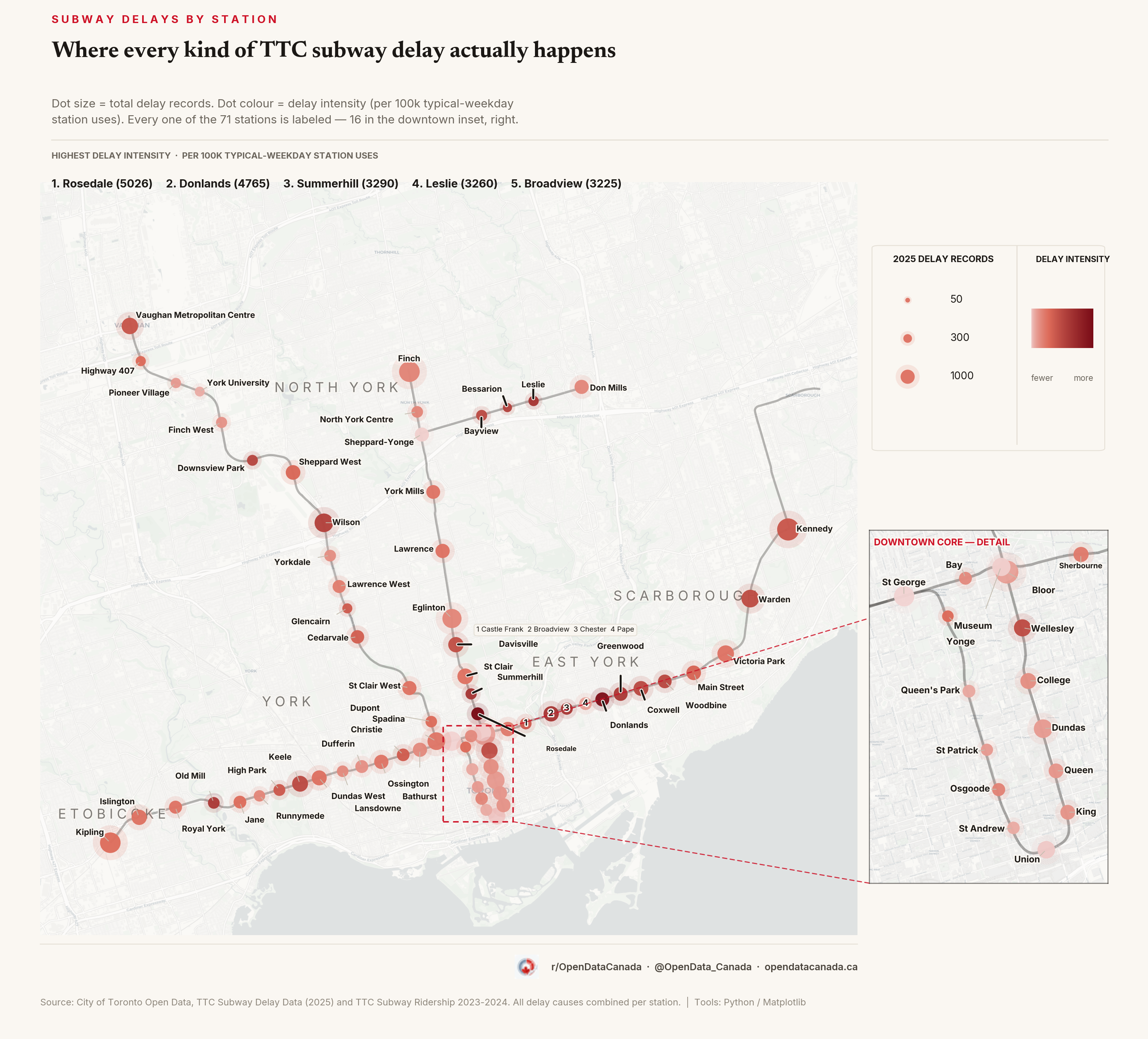
The TTC stations with the highest delay intensity aren't the busiest ones
Adjusting 2025 delay records for typical-weekday station activity produces a completely different ranking than the raw count. Twelve of the top twenty stations by this measure never show up in the raw top twenty at all.
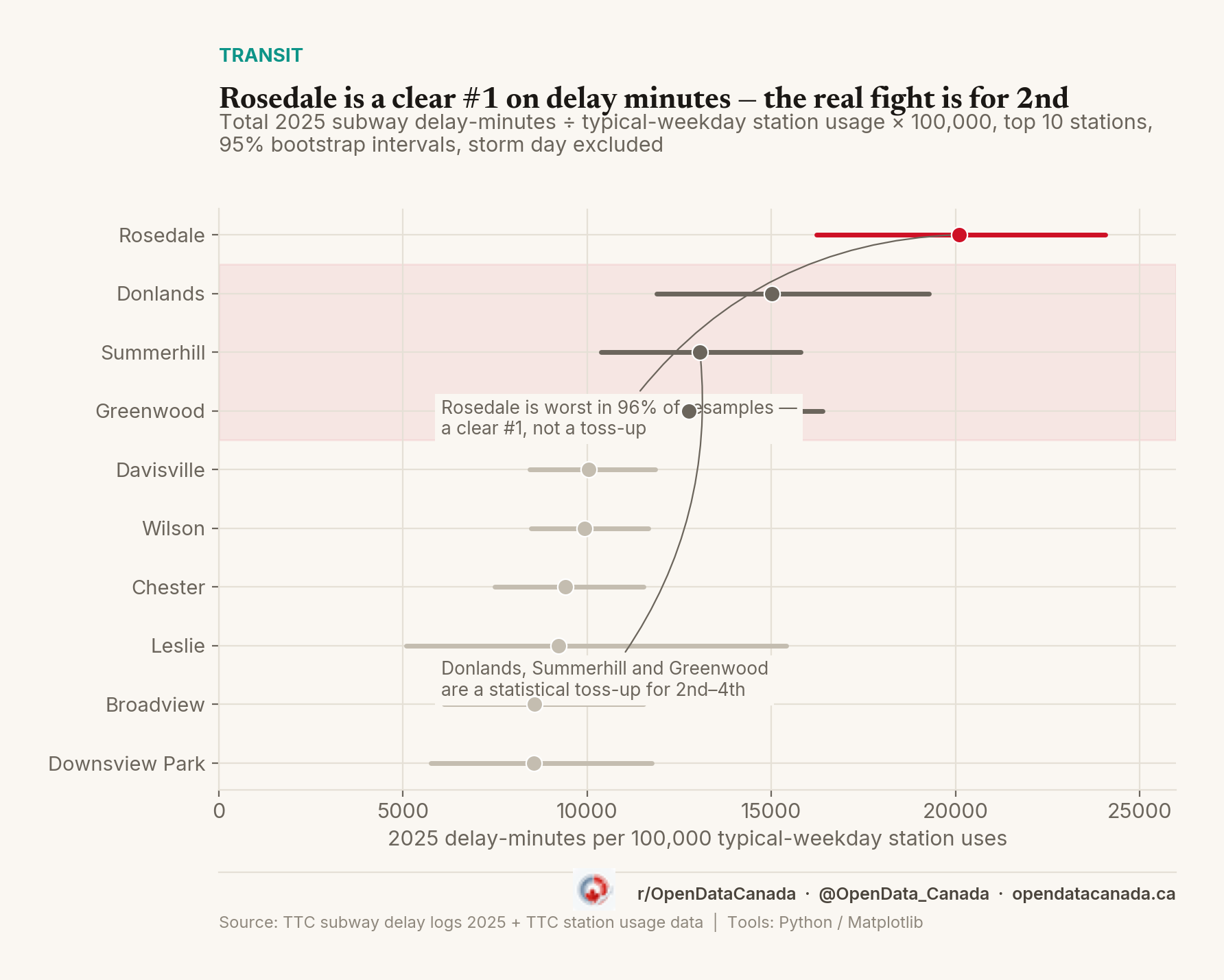
Rosedale Tops TTC Subway Delay Intensity. The Rest Is Much Less Certain
We ranked TTC stations by 2025 delay-record counts weighted for station usage. This time we ranked them by actual delay minutes instead, and ran a tougher statistical test on top of it. Rosedale, Donlands, Summerhill and Greenwood all lock in a top-five spot. The fifth is a genuine toss-up among five stations.

Union Coverage Lowest in Alberta and Ontario, Highest Gains in P.E.I.
Alberta and Ontario have the lowest union coverage rates of any Canadian province in 2025, and both have bounced back from a low point since — Alberta's bounce three times as large as Ontario's. But being lowest today isn't the same as falling fastest: Prince Edward Island actually posted the largest gain of any province since 1997, while British Columbia, not Alberta or Ontario, saw the steepest decline of the full period.

Young Canadians Are More Likely to Think AI Data Centres Will Hurt the Economy
A Nanos poll finds a real generational split on whether AI data centres will hurt the economy, 38% of Canadians 18-34 versus 28% of those 55+. Opposition to government subsidies for building them is a separate story, high at every age, with no meaningful age gap at all.
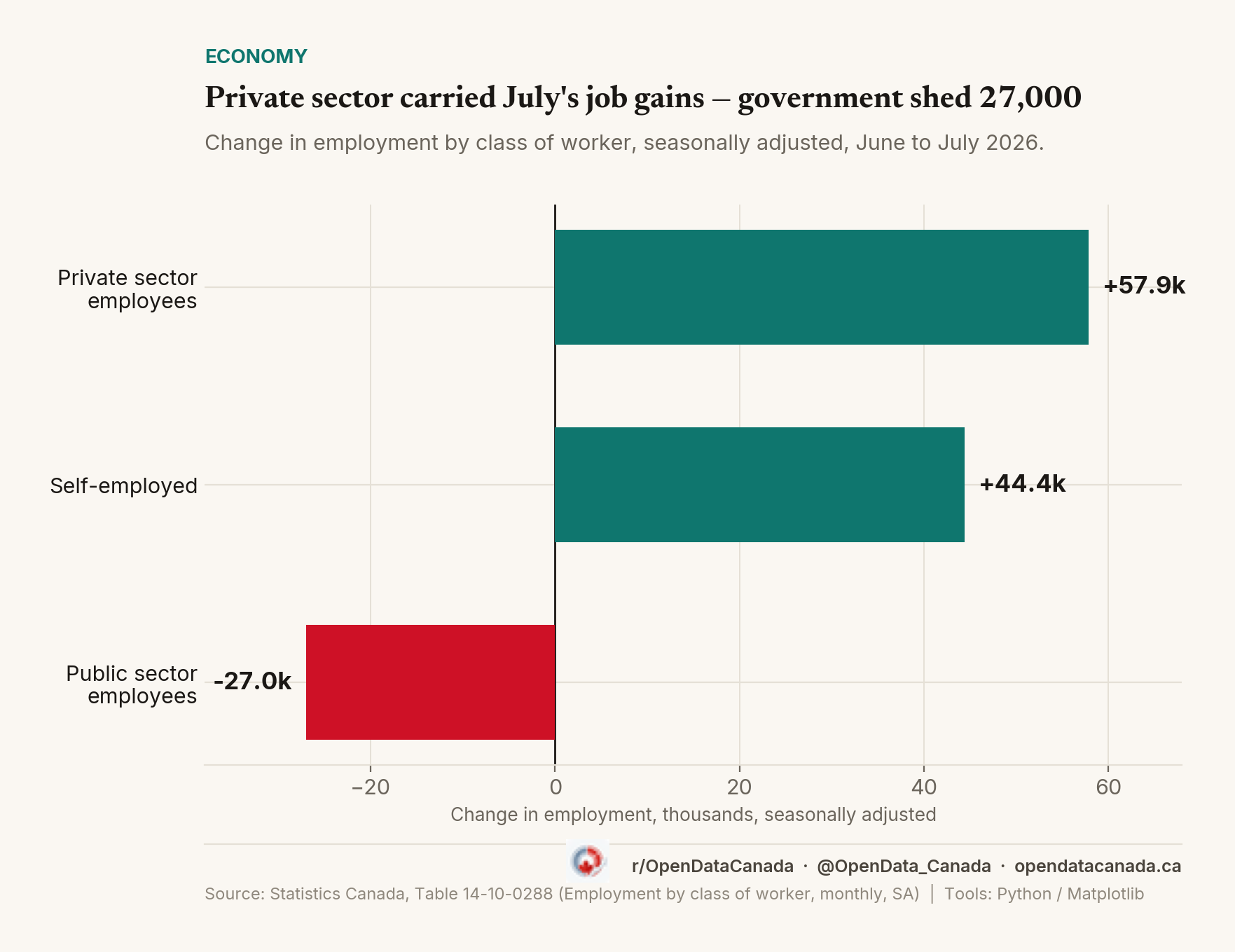
Canada added 75,000 jobs in July. Government cut 27,000 of its own.
The headline jobs number is genuinely good: full-time and part-time gains were balanced, and unemployment matched a two-year low. But almost 60 percent of July's employment growth came from people going self-employed, private employers added 57,900 jobs, and the public sector cut 27,000 — the piece no outlet covering the release reported.
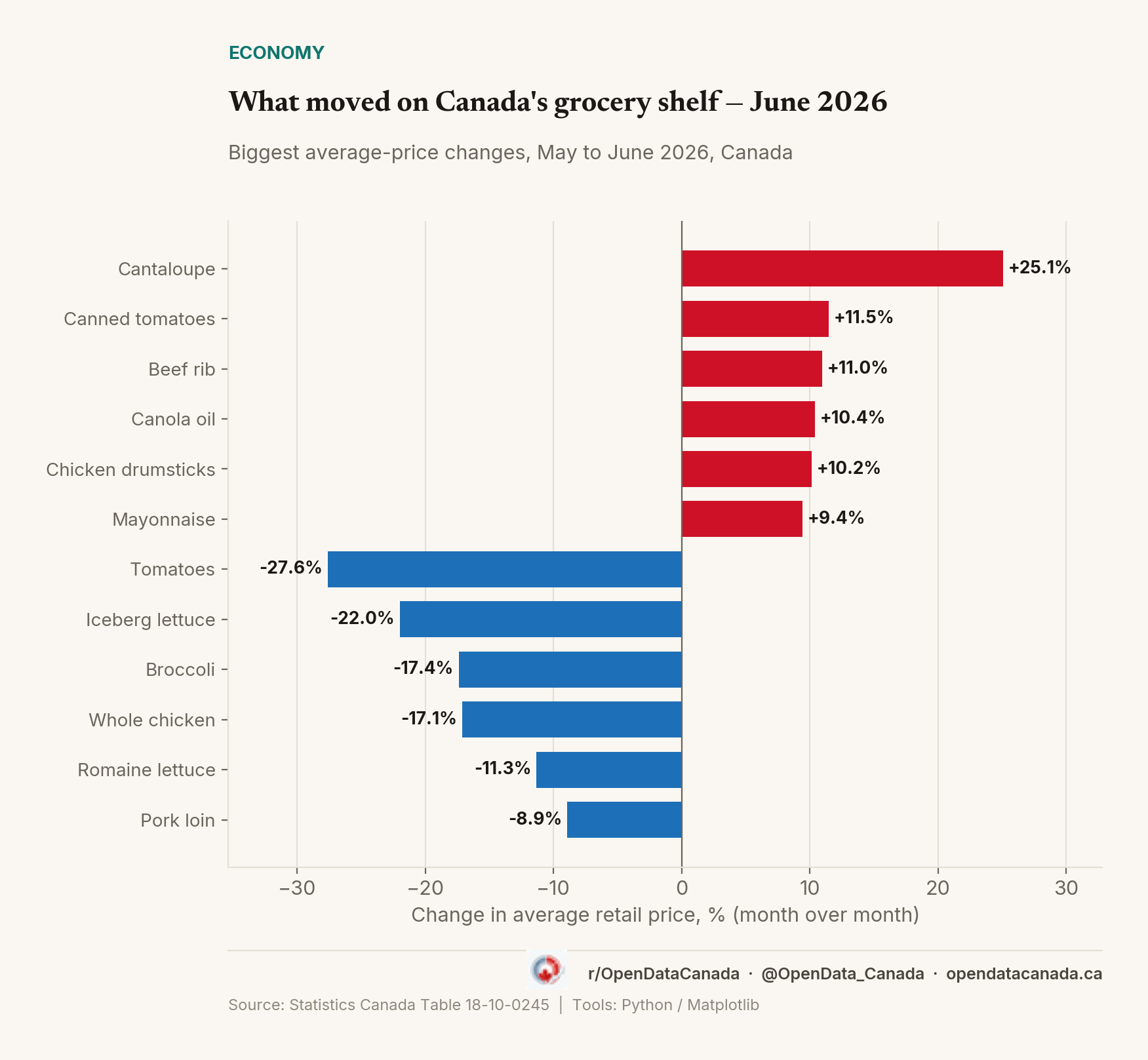
Vegetable oil is up 138% since 2020 — Canada grocery movers, June 2026
Vegetable oil has climbed 138% since January 2020, the steepest sustained increase among items StatCan tracks. Beef striploin is up 89.5% over that same stretch and 46% in the past year alone. Month to month, cantaloupe jumped 25.1% in June even as broccoli and tomatoes both got cheaper. The swings show how uneven grocery inflation remains from one item to the next.

Fraud used to be solved like a violent crime. Now it almost never is.
In 1998, Canadian police cleared 60% of reported frauds — on par with how often they cleared a sexual assault that year. By 2025, that number is 10.3%, the largest decline of any offence among the 17 major categories we examined. It's happening against a backdrop of its own: the national violent-crime clearance rate bottomed at a 28-year low in 2023 and has only partly recovered since.

Cheap EVs can't replace Quebec's lost rebate before the year is out
Quebec's EV market crashed when its provincial rebate ended in January 2025. The first 2026 numbers are in, and matching last year's total by December would take almost triple the current sales pace, more than a revived federal rebate or a new quota on Chinese imports can deliver.
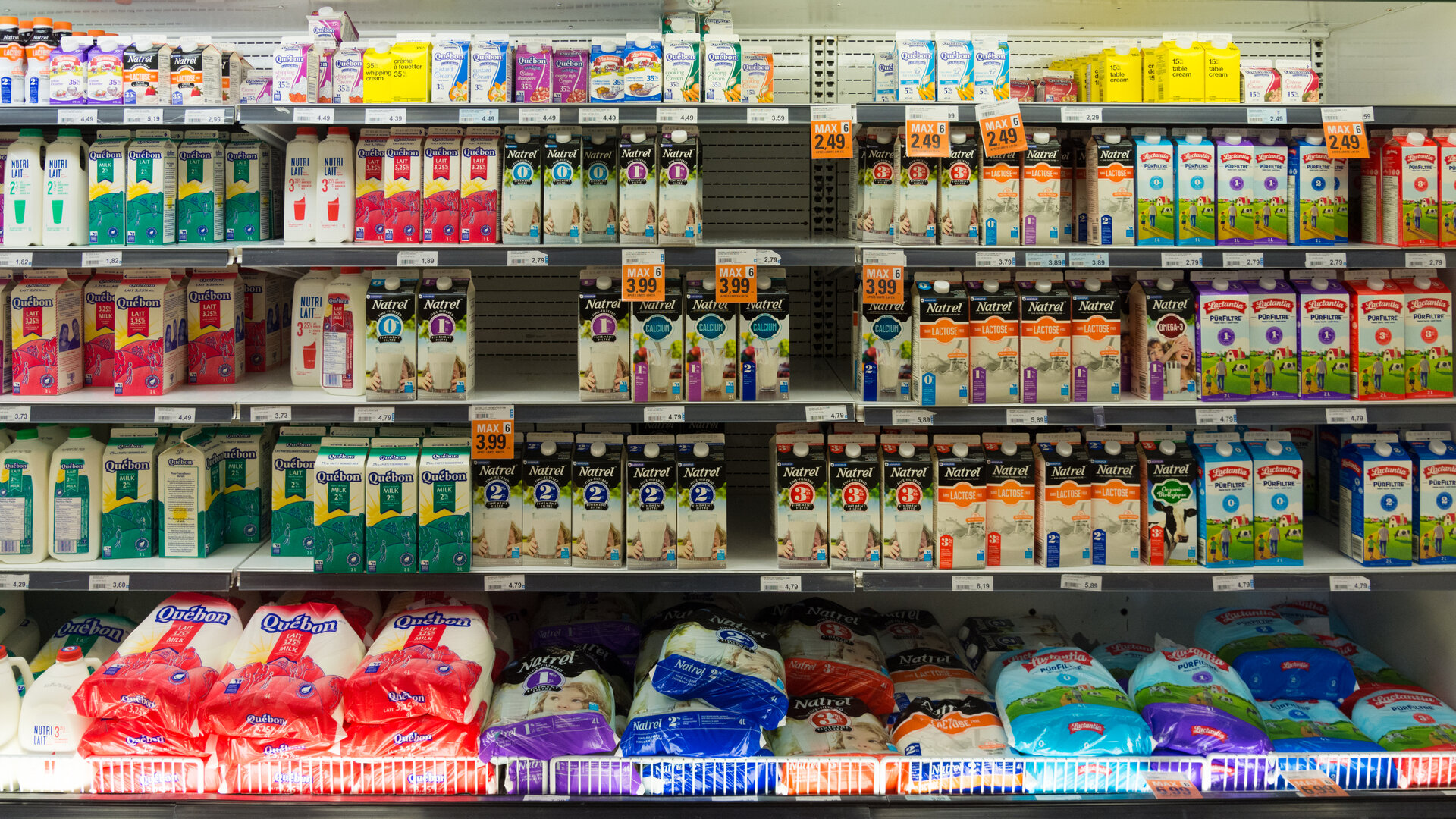
43 of 44 Canadian Social Assistance Scenarios Fell Below the Poverty Line in 2025
Across every province, Maytree modelled 44 household scenarios against Canada's official poverty line in 2025. Forty-three came in below what the basics cost. The one exception, in Quebec, reaches just 3 percent of the province's social assistance caseload.
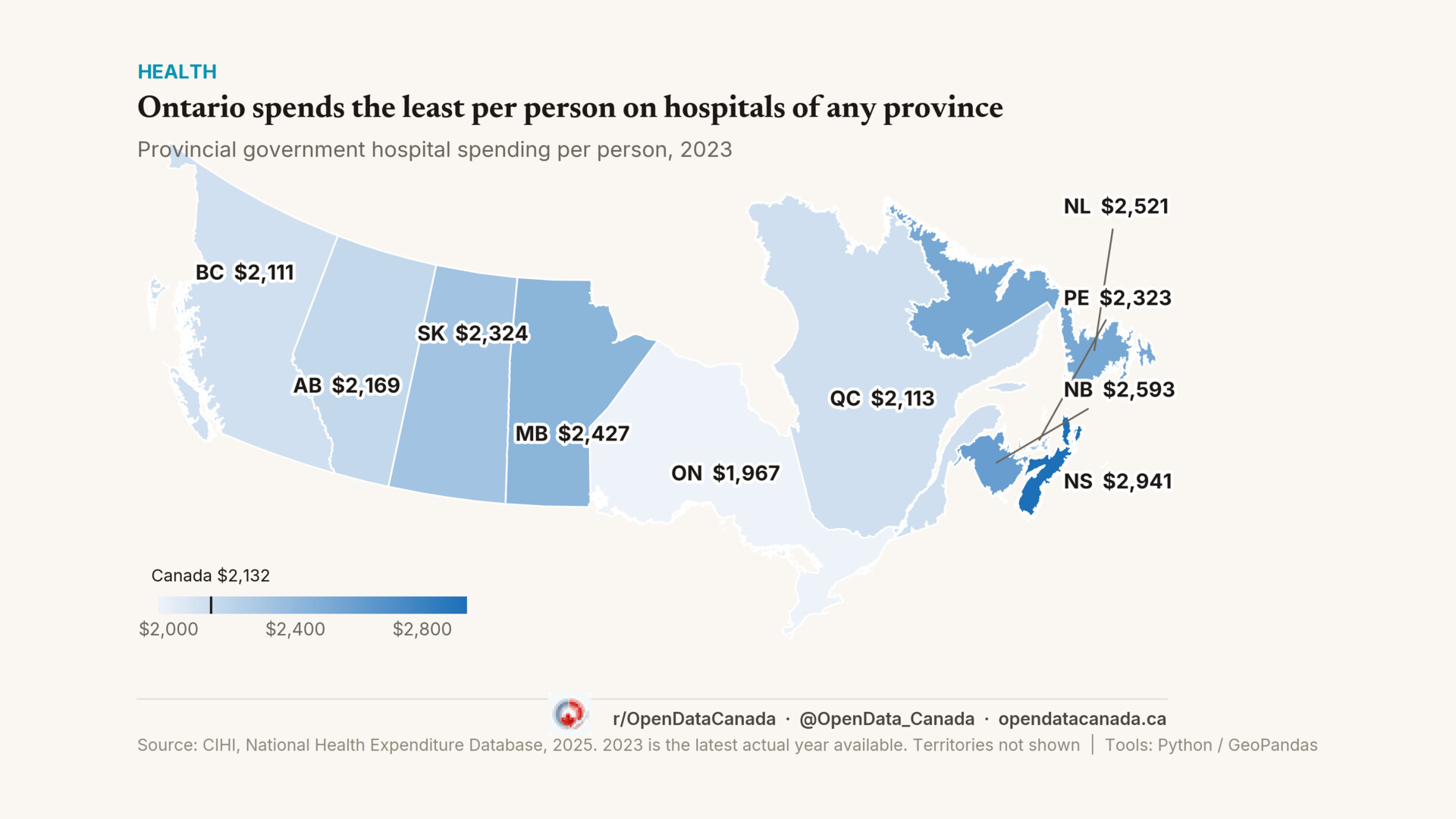
Ontario spends the least per person on hospitals. Age doesn't explain it.
Ontario's government spent 1,967 dollars per resident on hospitals in 2023, the lowest of any province and about 974 dollars less than Nova Scotia. The obvious defence is that Ontario has a younger population. Adjusting for age barely moves the number.
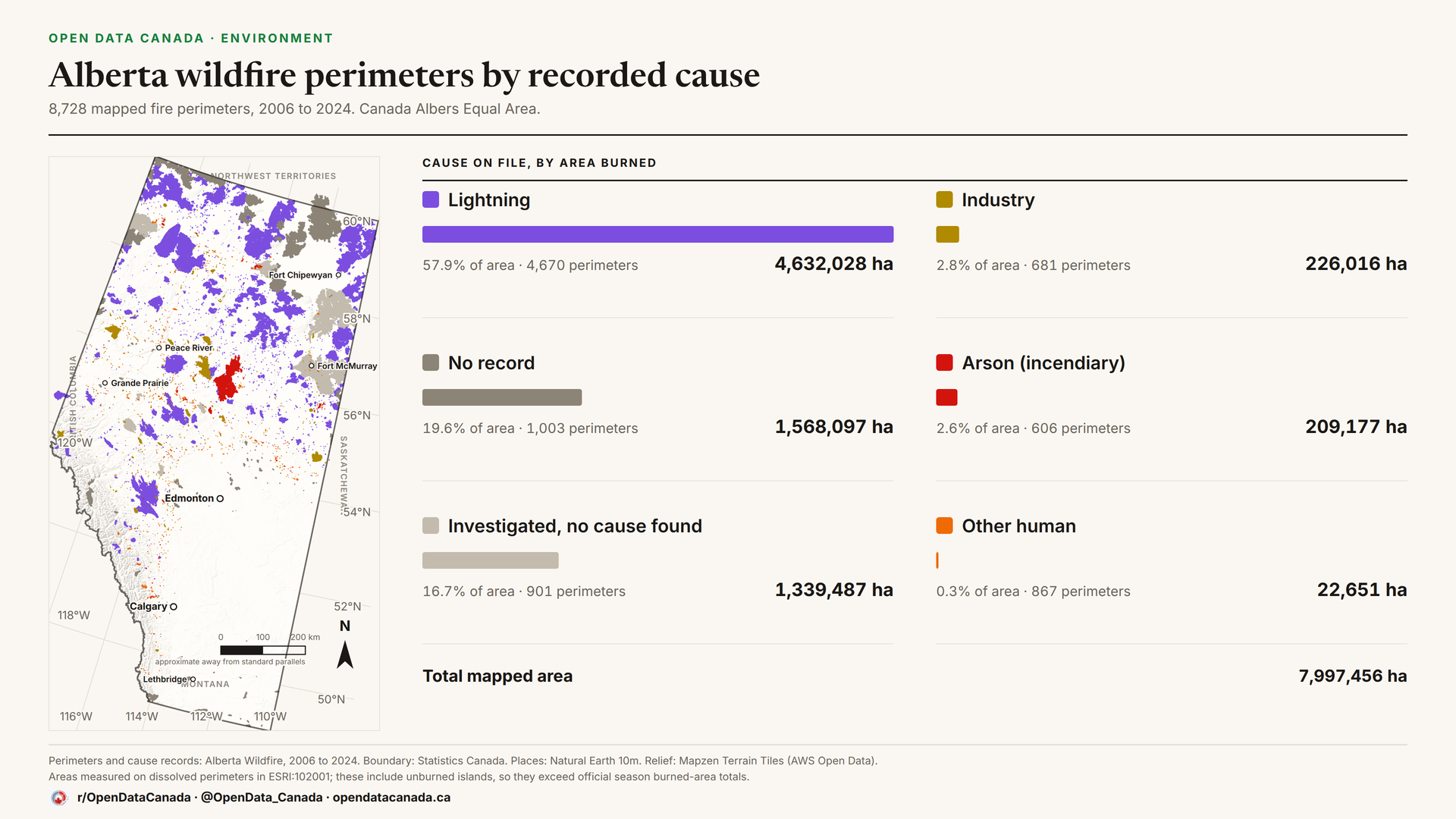
What Alberta's wildfire cause records actually show
You asked us for an arson versus lightning breakdown of the wildfires we mapped. Only Alberta publishes one. It shows arson is a rounding error by area, 95 per cent of it a single fire, and a fifth of what Alberta maps has no cause in the province's own file — though other governments hold one for almost all of it.
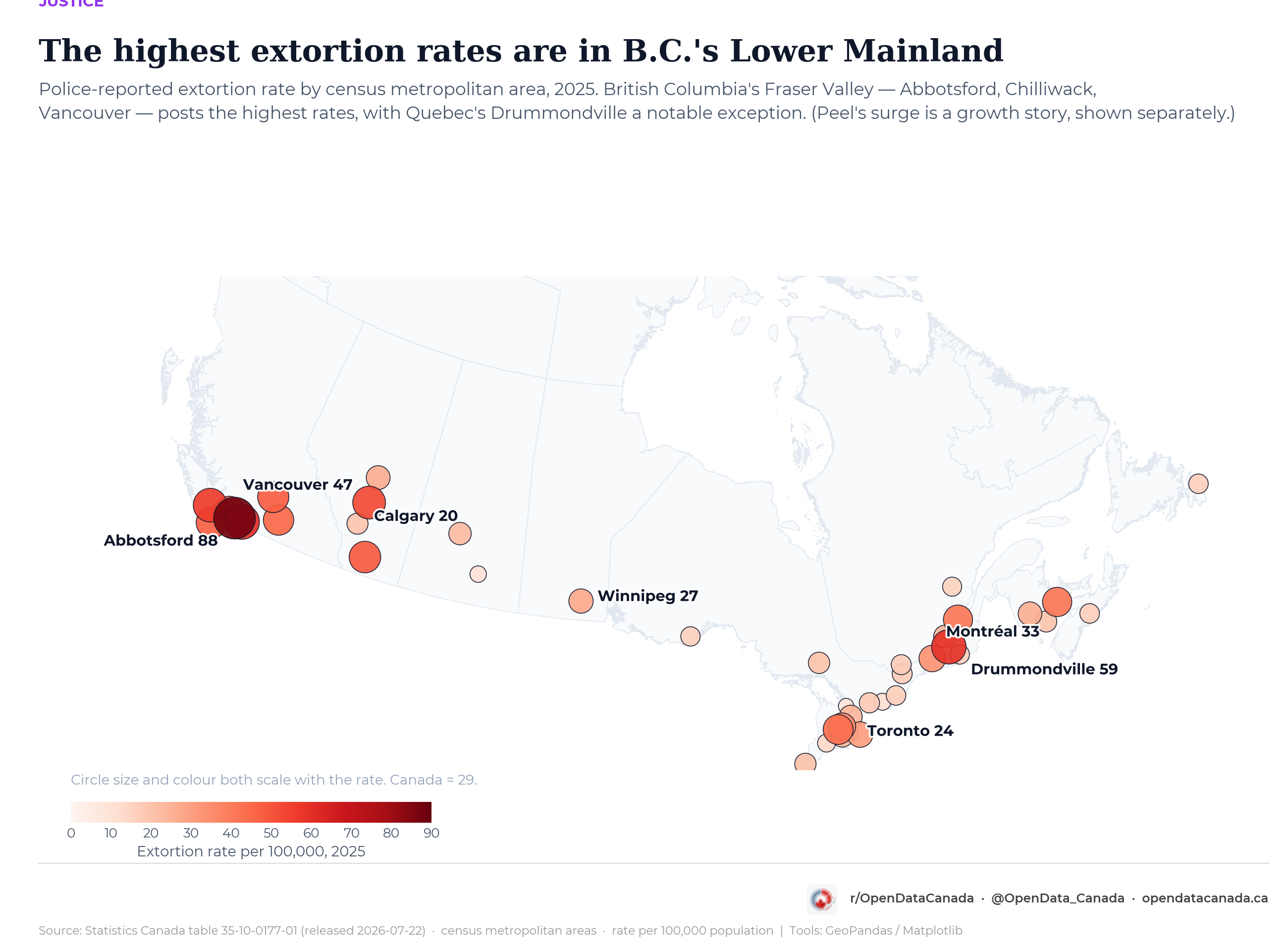
Extortion has more than quadrupled in Canada since 2000 — and in Peel it has risen tenfold
Robbery has been halved and attempted murder sits at a 28-year low, but extortion has quadrupled in a generation. It has come off its 2023 national peak, yet stays concentrated in B.C.'s Fraser Valley and in Peel, where it is still climbing.
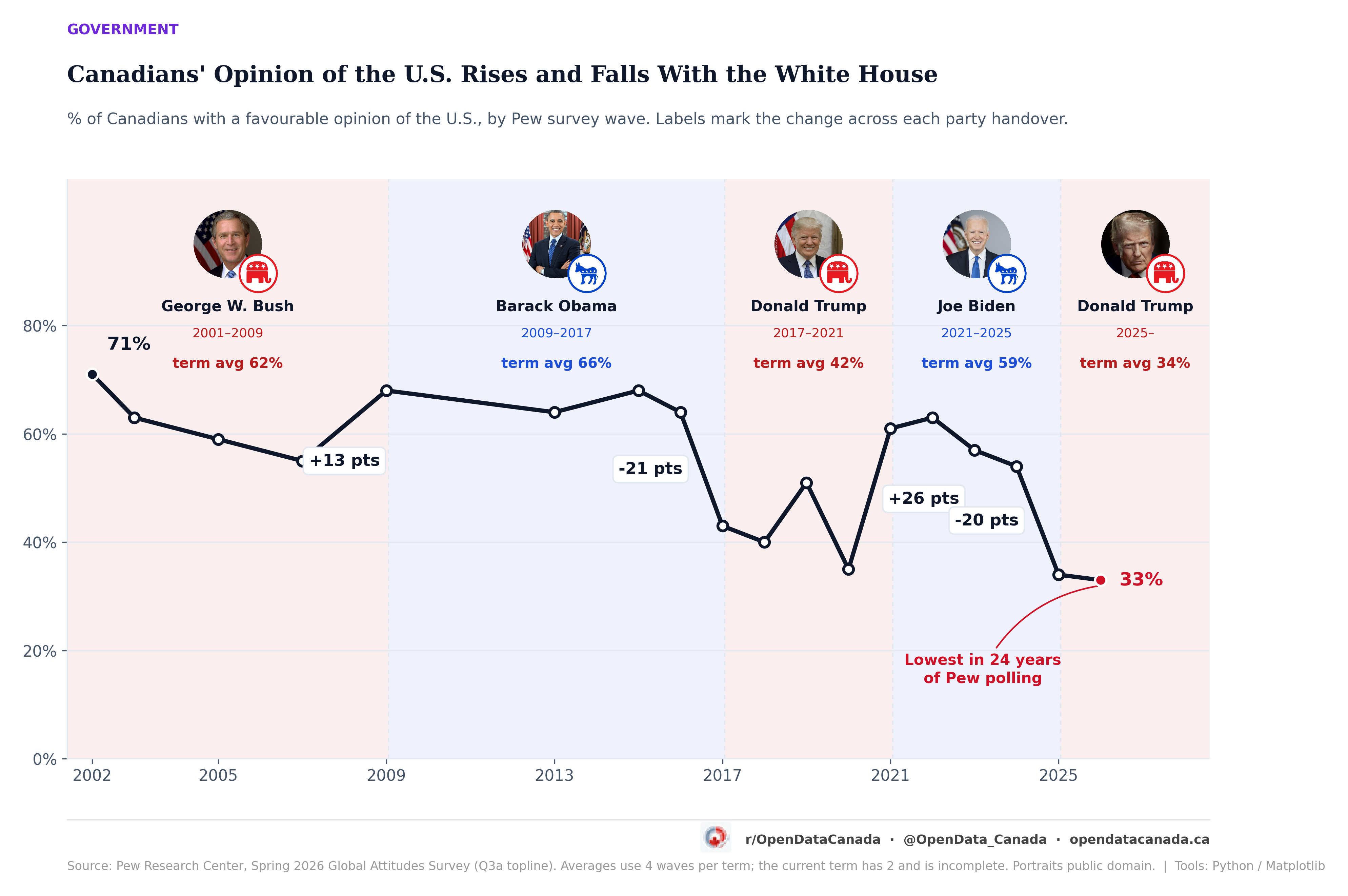
Canadians reprice America every time the White House changes hands
The three largest shifts Pew has recorded in Canadian opinion of the United States in 24 years are not wars or trade fights. They are the three most recent changes of president.

Every big Canadian city is losing transit riders again — and only Edmonton ever beat its pre-pandemic level
Six years of ridership data from the agencies' own records show one Canadian city carrying more riders than before the pandemic. Then, in 2026, every city we can measure turned down at once.

Soccer is Canada's most-registered sport. Its federal funding ranks 13th.
The World Cup Canada co-hosted ends this weekend. Federal grant records show soccer gets about 3 dollars a player in program funding, less than diving or curling, while 220 million dollars went to hosting the tournament.
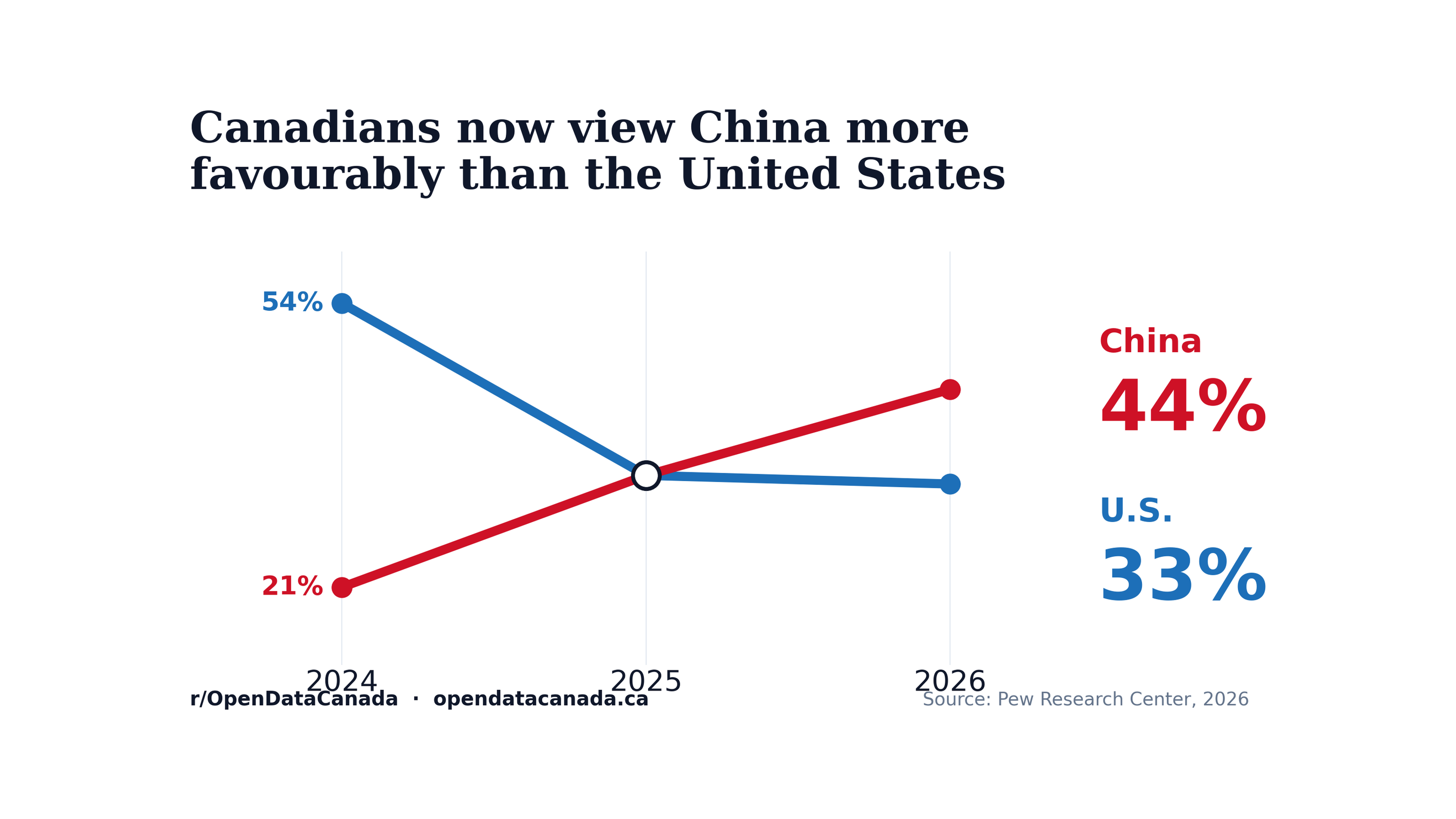
Canadians rate China above the U.S. again, and by the widest margin yet
Pew finds 44% of Canadians view China favourably against 33% for the United States, the lowest U.S. reading in Canada since 2002. It is the second time Canadians have rated China the higher of the two, after a narrower crossover in 2017 and 2018.
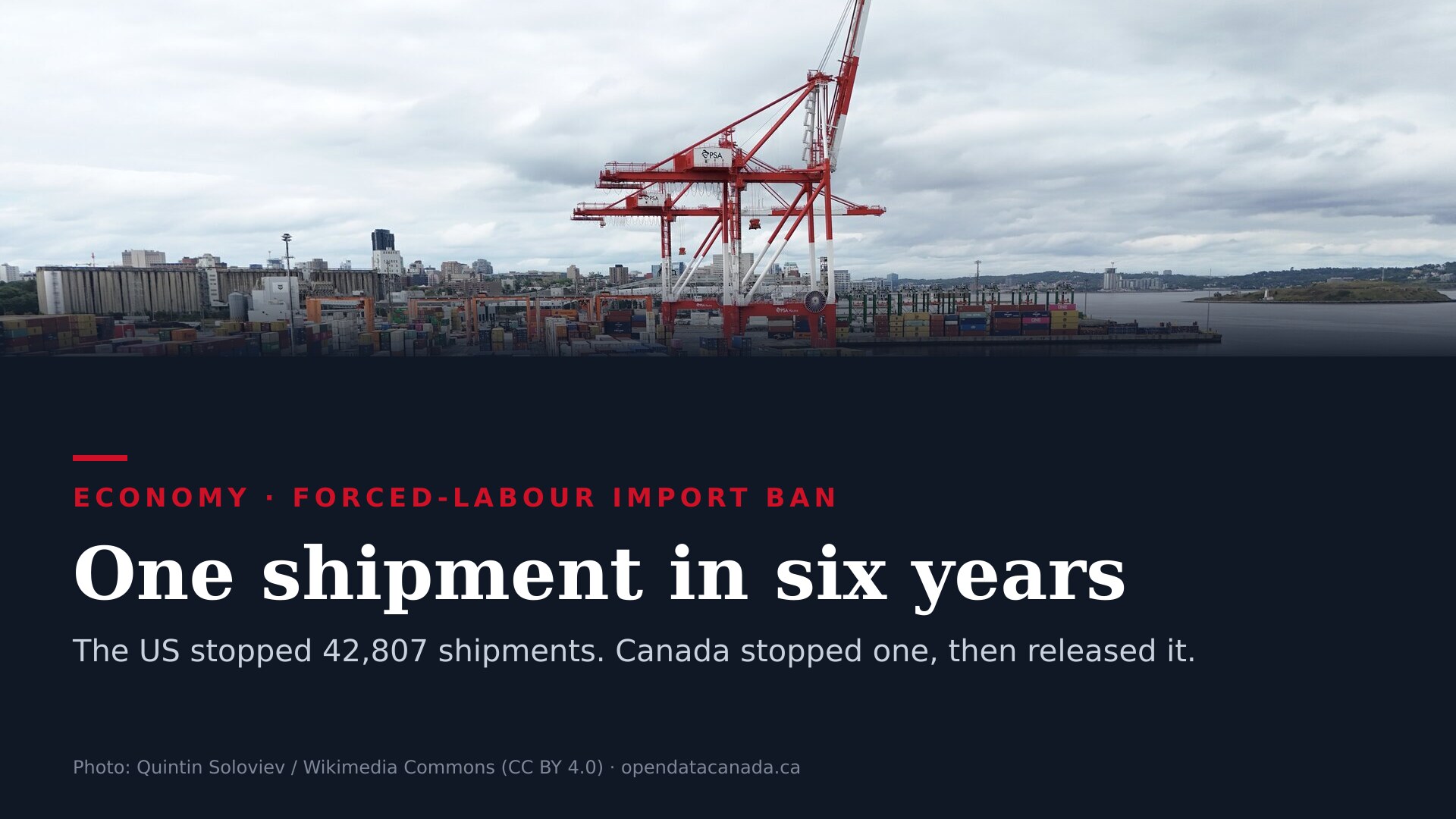
One shipment on the record in six years: Canada's forced-labour import ban now carries a US tariff
The United States has stopped 42,807 shipment lines under its forced-labour import ban. Canada, bound by the same CUSMA obligation, has one shipment on its public record, later released. Washington has charged a 10 per cent tariff over it since July 24. Ottawa's fix has been consulted on but is not law.

After 306 Million Dollars in Federal Funding, Bombardier Asks to Hire Record 40 Foreign Workers
The request coincides with 306.5 million dollars in federal funding for Bombardier's aerospace business, and lands during a technical recession, with manufacturing unemployment rising.

Seniors Are More Worried About Climate Change Than Gen Z
New StatCan survey data flips the usual climate-anxiety script. Canadians 65 and older report the highest concern of any age group, while 15-to-24-year-olds report the least.
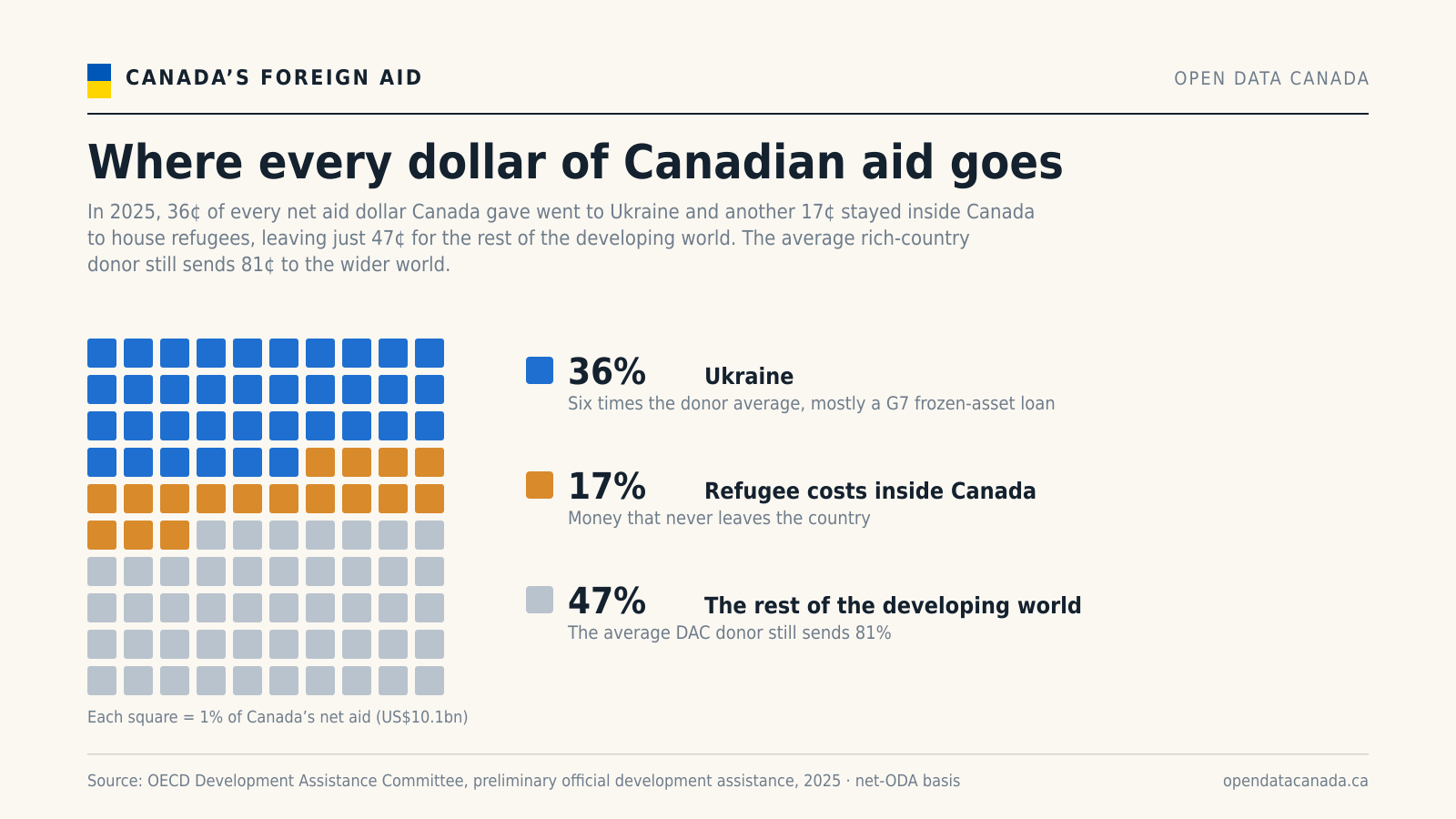
Canada spent 14 billion Canadian dollars on foreign aid in 2025: here's where it actually went
While the United States slashed foreign aid by 57 percent and the rich-country average fell by nearly a quarter, Canada trimmed just over 2 percent. Yet a look at where the money went shows more than half of it now goes to Ukraine or is spent inside Canada on refugees, leaving the smallest share for the developing world in years.
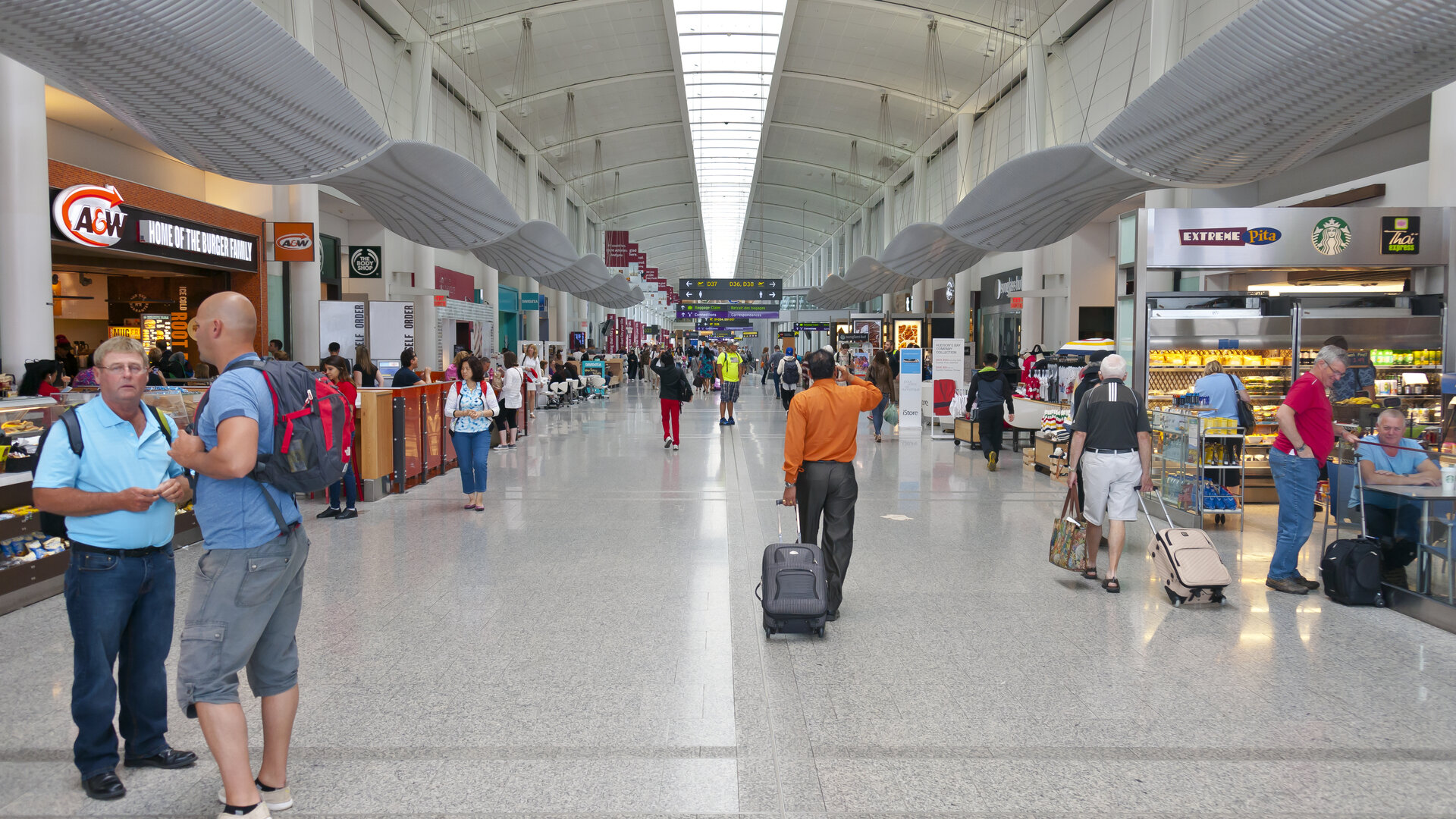
Every major Canadian airport lost US flights in 2026
The 52.8 percent cross-border collapse was mostly car trips. In the air the US pullback is milder, about 10 percent nationally, but it lands unevenly. Toronto and Vancouver carry the most US exposure. Edmonton and Winnipeg fell the hardest.

Canada's electricity grid in 2050, in one chart
The CER's net-zero scenario maps every technology from 2024 to 2050. Wind grows ninefold to become the biggest source of capacity, hydro stays roughly flat, gas keeps a smaller but real role, and nuclear stays modest. It is the regulator's modelling of one pathway to net-zero, not a forecast.
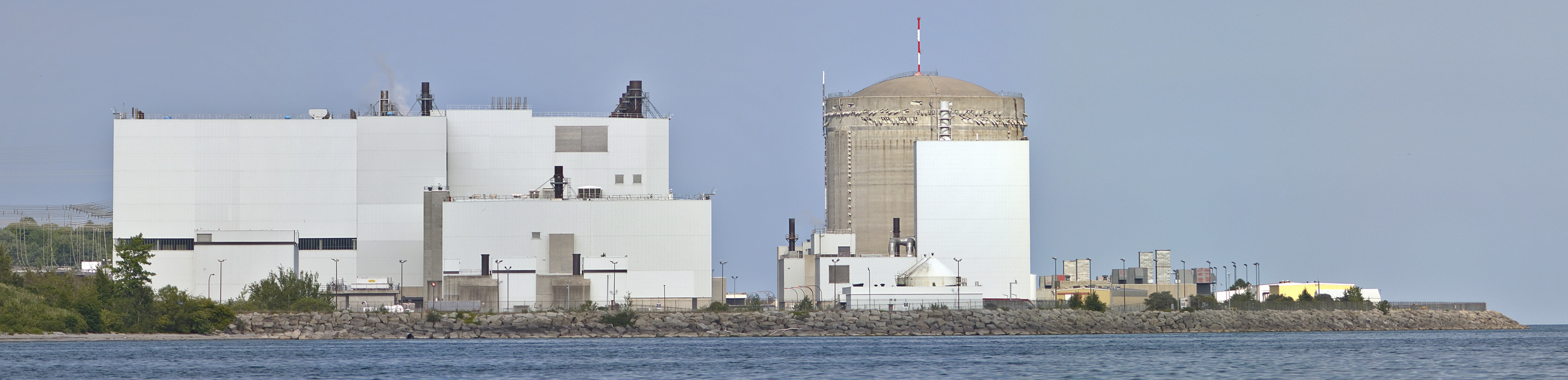
Canada's nuclear strategy is built on a number the regulator's own model doesn't deliver
Canada's new National Nuclear Energy Strategy promises to supercharge atomic power. The regulator's own net-zero model hands nuclear 5 percent of new capacity through 2050 — and assigns wind 62 percent. Ontario alone faces a potential 14.6 GW nuclear delivery gap by midcentury.
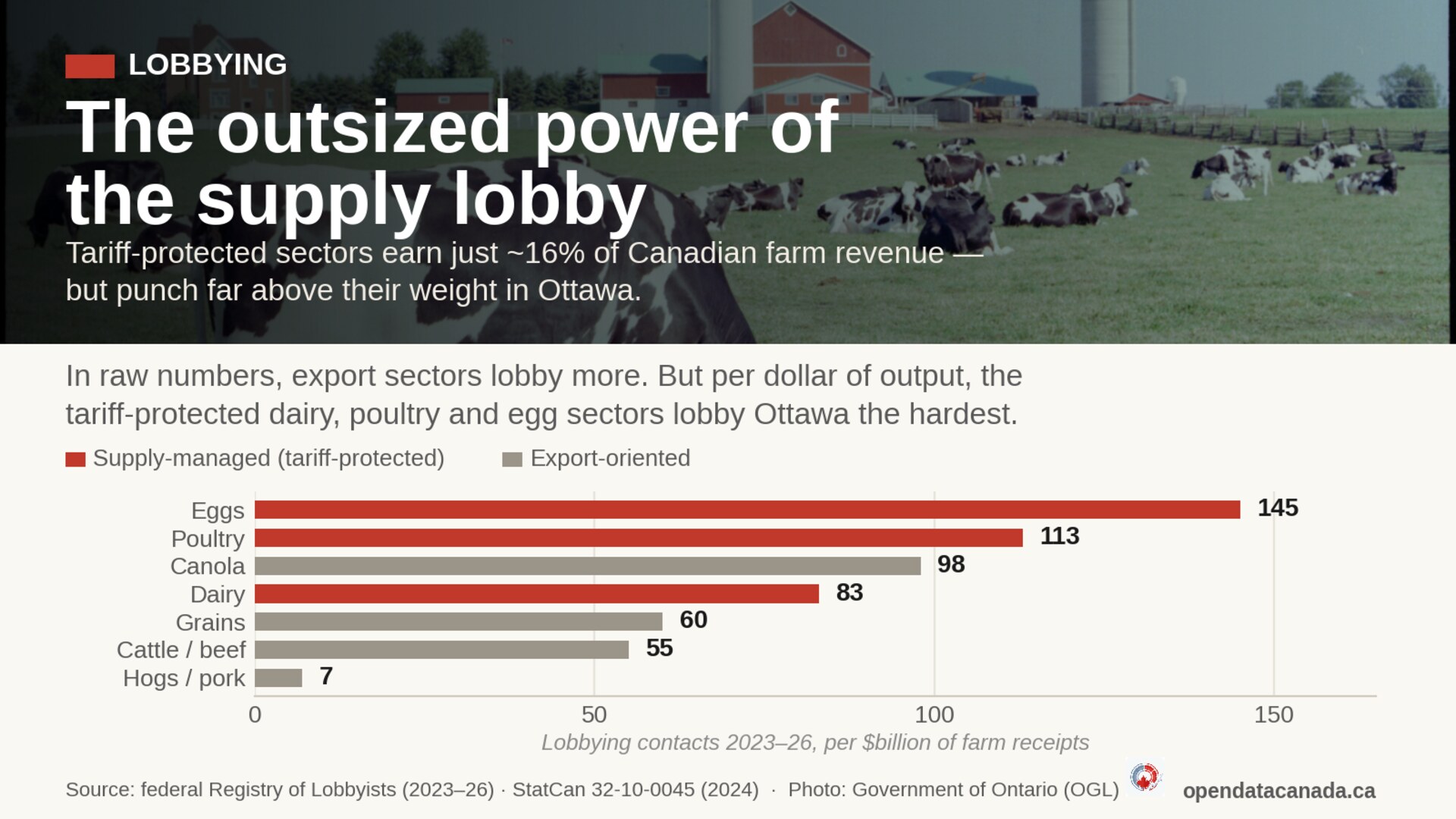
The outsized power of the supply lobby
Tariff-protected dairy, poultry and eggs earn about 16 percent of Canadian farm revenue. Measured against that revenue, they lobby Ottawa harder than any other part of agriculture, and the pace is climbing ahead of a 2026 trade review.

Ontario EI rolls surged 24 percent since 2024 — factories are not the reason
In the two years since January 2024, Employment Insurance beneficiaries in Ontario grew by nearly 36,000 to 185,010 — a 24 percent jump at nearly double the national rate. Manufacturing and utilities occupations, the ones cited most in tariff coverage, account for none of it.

Every major Metrolinx transit line is opening years behind schedule
Measured against the opening date first committed for each project, every major transit line in the Greater Toronto Area is landing three to five years late. Two have finally opened. Three are still under construction, and their targets keep moving.
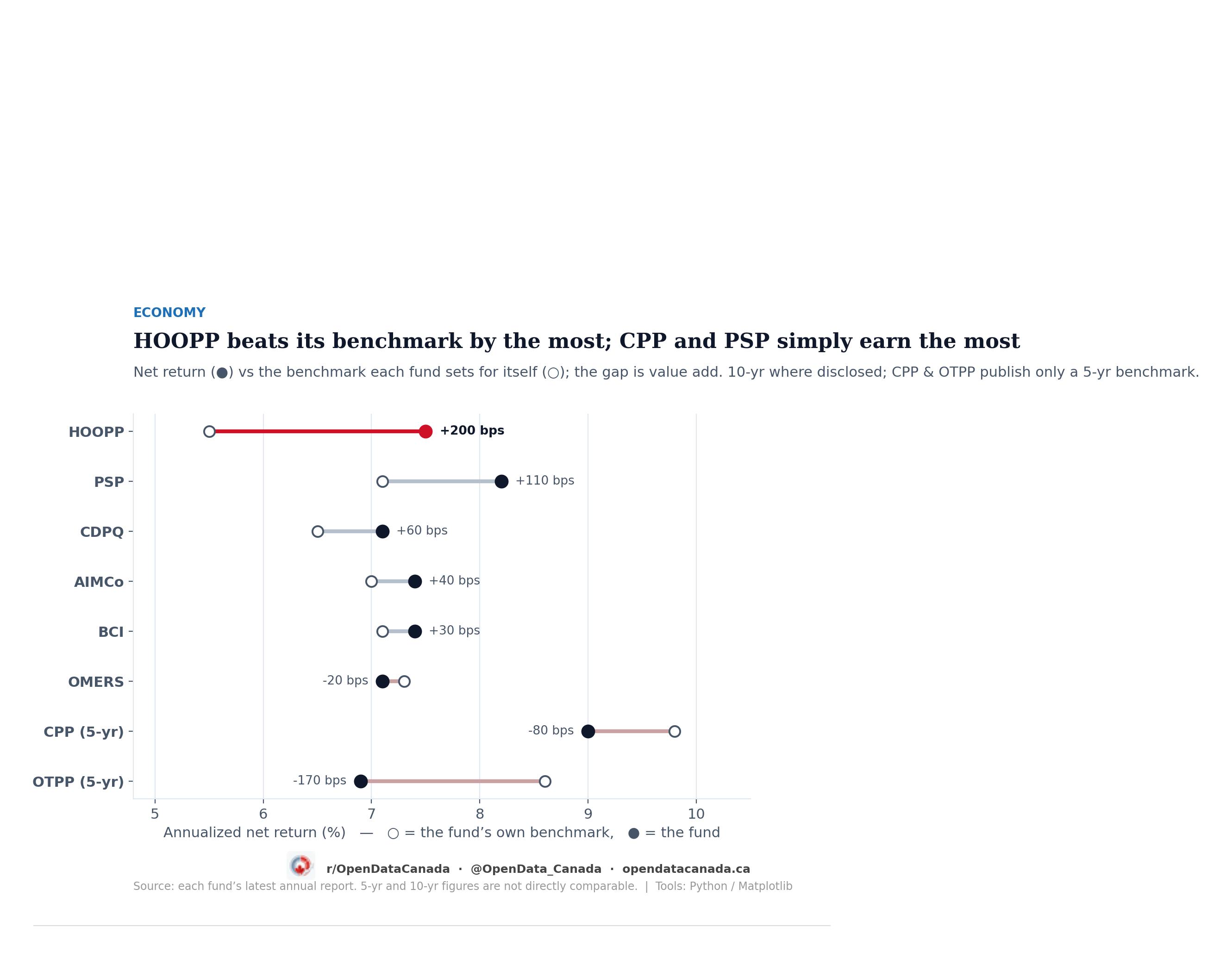
Canada's best pension fund? We ranked all 8 — the benchmark winner isn't the famous one
After Ontario Teachers trailed its benchmark, we pulled the latest annual report of all eight of Canada's pension giants and built one standardized scorecard. Over a decade, only HOOPP clearly beats the benchmark it sets for itself — by 2 full percentage points a year. CPP and PSP earn the highest raw returns. And on the question that started this — private companies — almost no fund reliably beats its own private-equity benchmark once you stop looking at a single year.
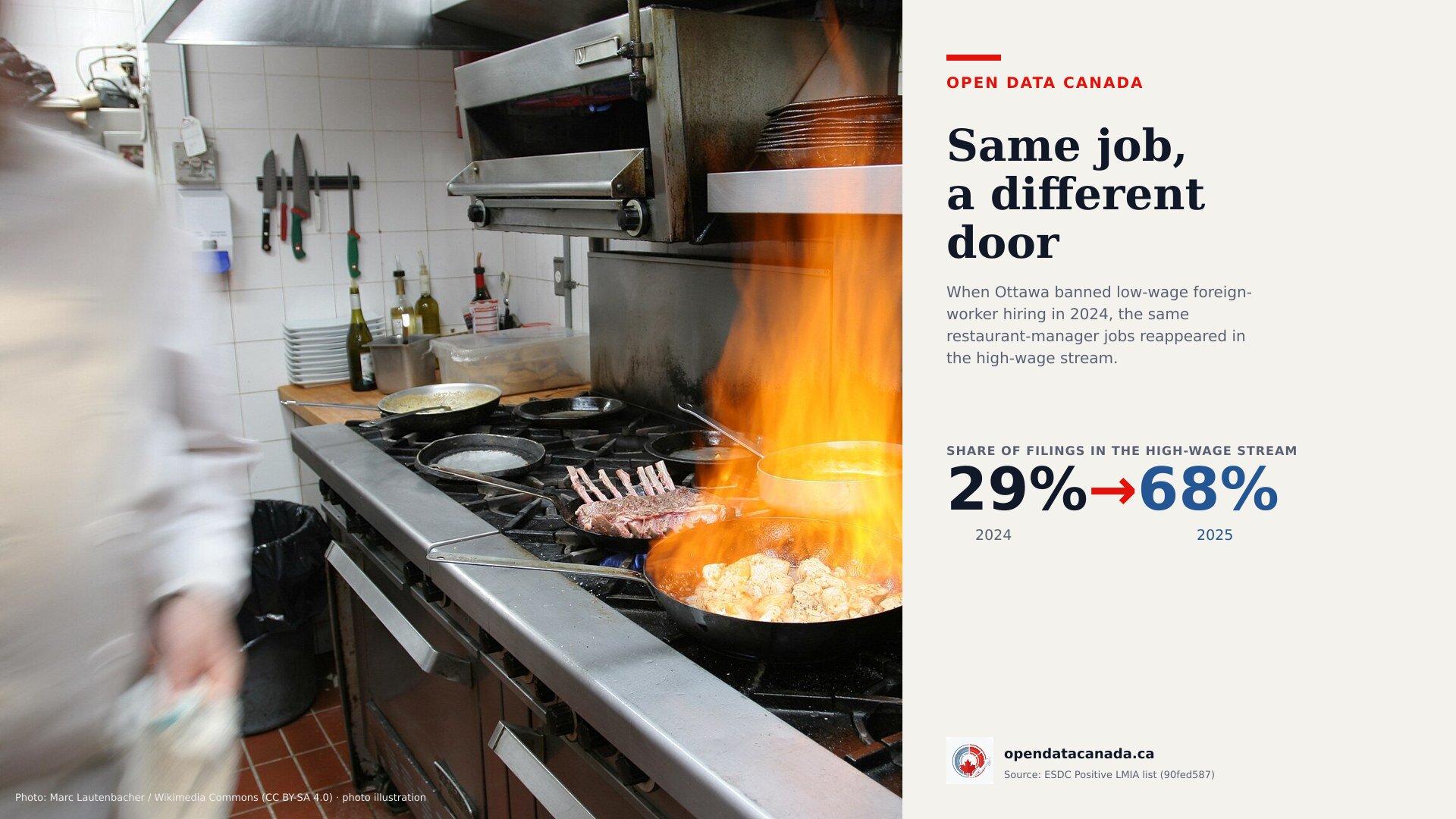
Canada TFW: How a Low-Wage Hiring Ban Pushed Restaurant Managers Into the High-Wage Stream
When Ottawa banned low-wage foreign-worker hiring in struggling cities in September 2024, approvals for low-wage restaurant managers collapsed. The same job reappeared in the high-wage stream, which the ban does not cover.
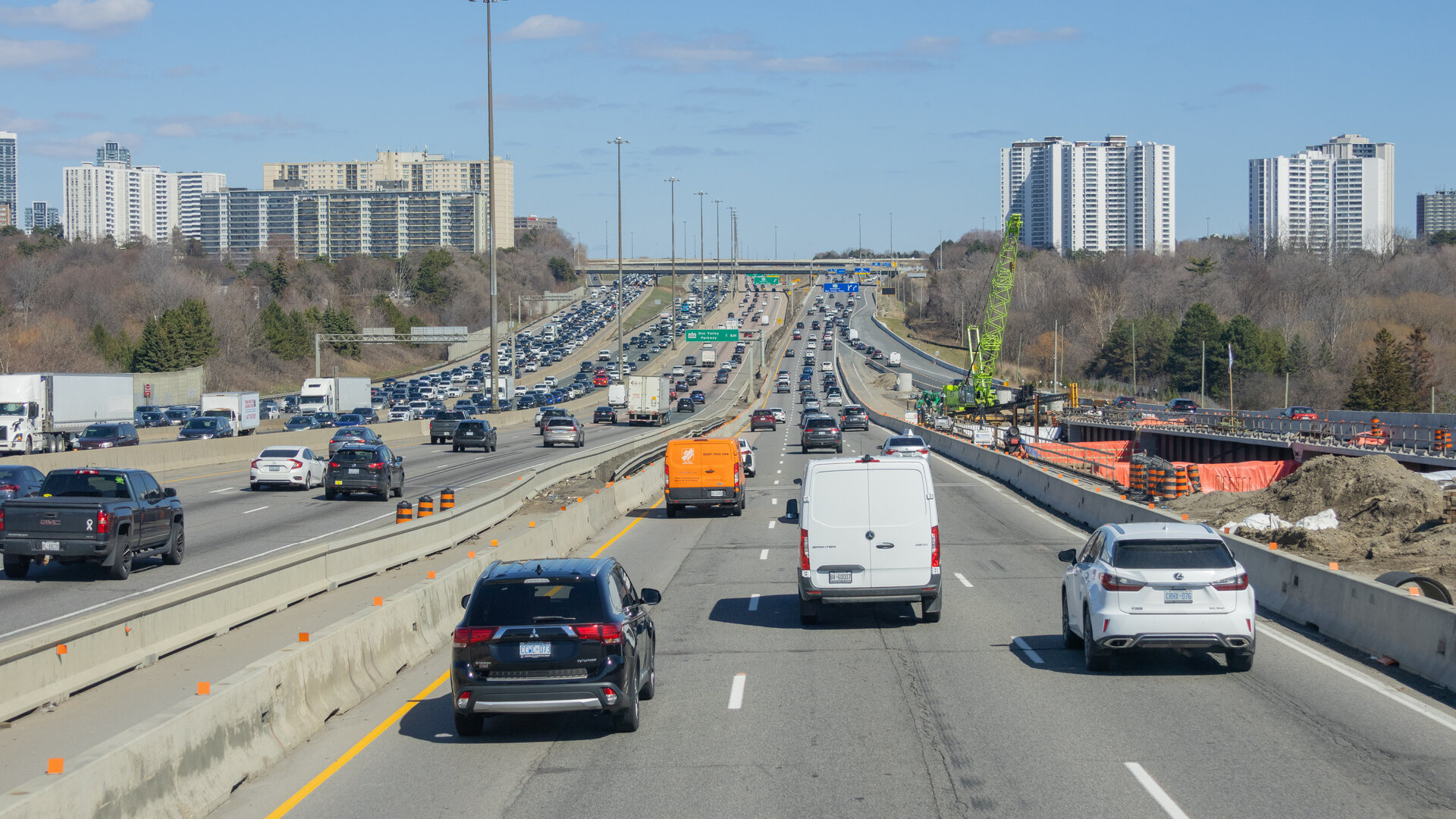
Canada's road and water networks are aging back to 2005 levels
Canada's headline measure of infrastructure health has climbed for two decades. The data underneath tells a different story: the country's roads are back where they stood in 2005, and waterworks have fallen every year since 2014. The national average hides the decline of two networks people use daily.
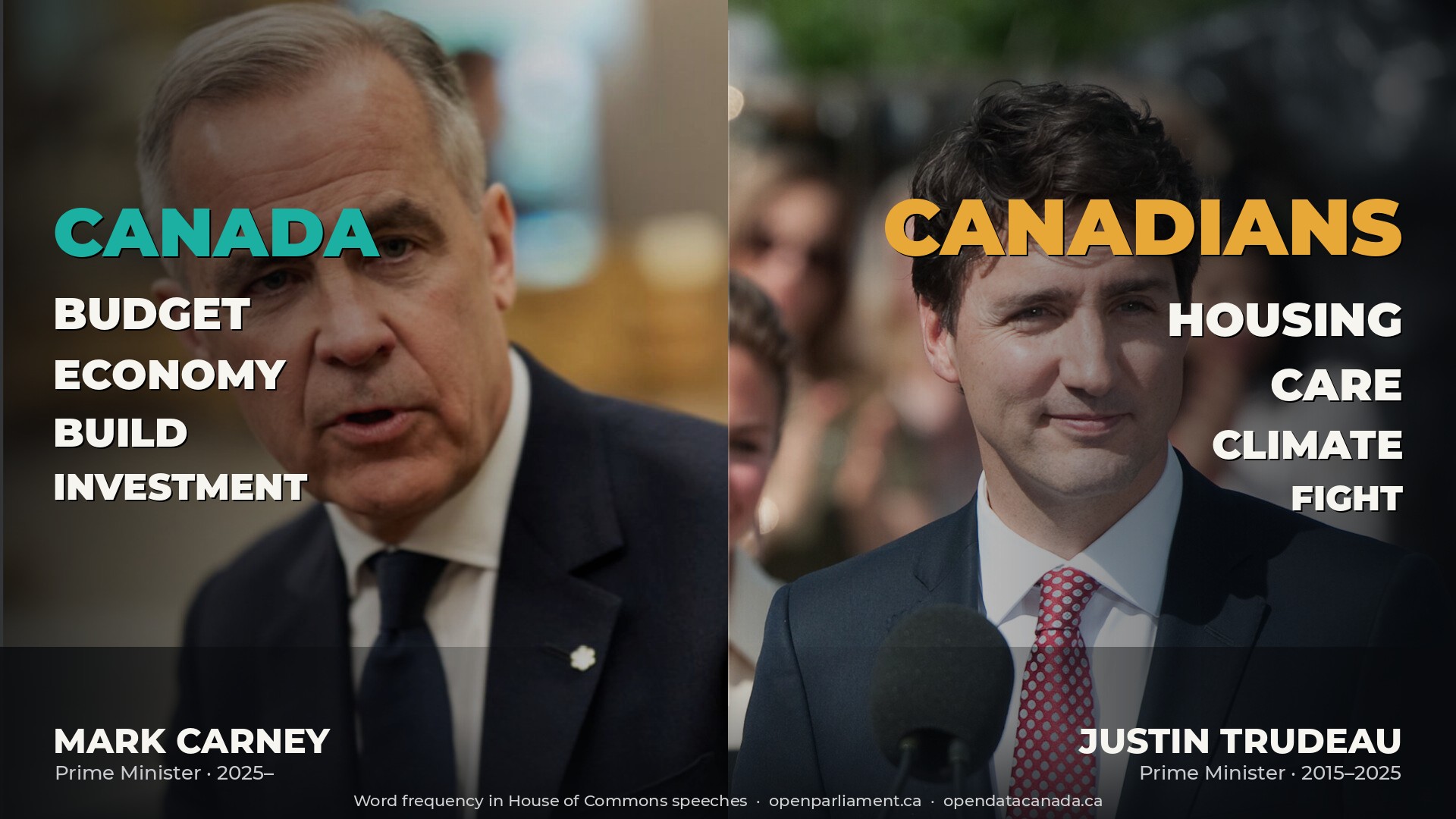
Carney talks like an economist. Trudeau talked like an advocate.
Two Liberal prime ministers, the same job, sharply different vocabularies. We counted every word in their House of Commons speeches. Mark Carney governs in the language of budgets and the economy; Justin Trudeau spoke in the language of care and climate. It shows in the words each man reaches for most.

Canadians are scared of AI. Their employers keep using more of it.
Two-thirds of Canadians want Ottawa to rein in artificial intelligence, even if it slows the technology down. Over the same stretch the share of businesses actually using AI has tripled, to about one in five. The fear and the reality have drifted apart, and the StatCan numbers on who is adopting, and why everyone else is not, tell a stranger story than the panic does.
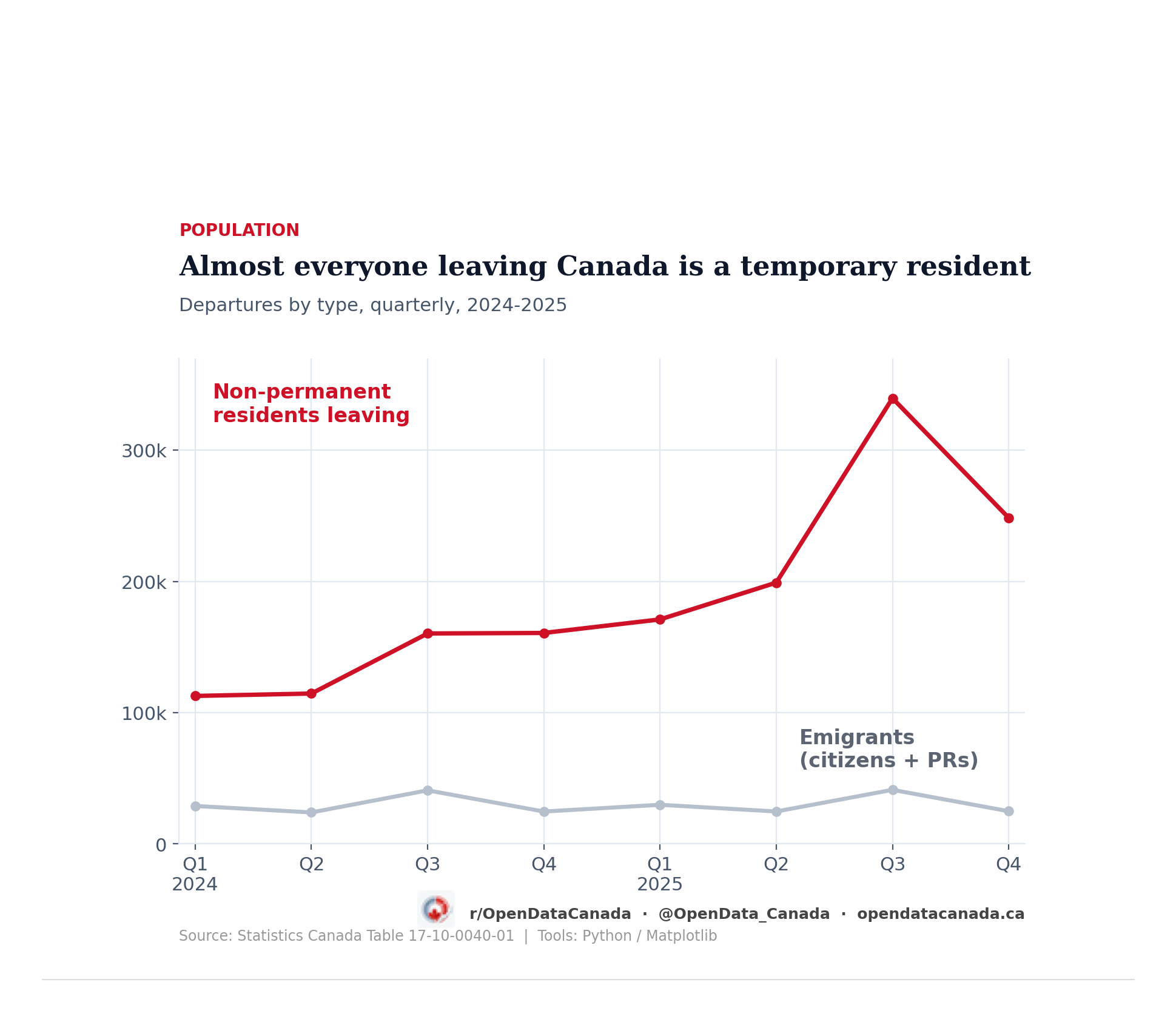
Canadians aren't leaving in record numbers
A viral headline says 120,640 people emigrated in 2025, a record. They did. But as a share of the population the rate barely moved — and the real exodus is nearly a million temporary residents leaving as their permits expire.

Asking rents fell. The rent people pay went up.
Statistics Canada says asking rents fell over the past year. It also says rents rose almost four per cent. Both are correct. One number prices the apartment you would move into, the other the one you already live in, and the difference explains most of the confusion.

CPP sold Nvidia all the way up — and it became its biggest stock anyway
Before the AI boom, the Canada Pension Plan held 120 million Nvidia shares. It spent five years selling three-quarters of them — through the launch of ChatGPT, through the greatest stock run of the decade — then bought back in near the top. The shares it sold would be worth more than fifteen billion dollars today.
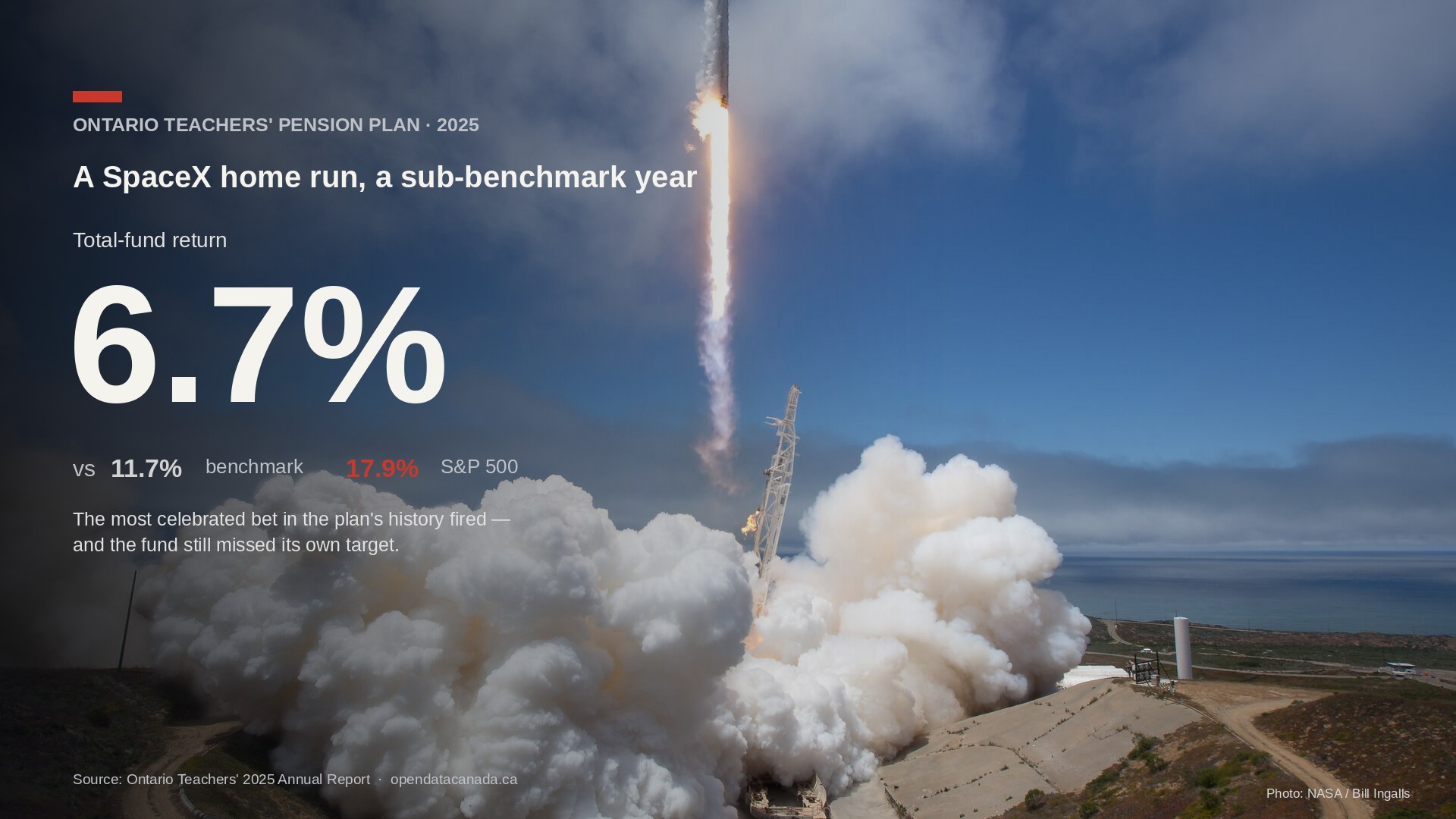
Ontario Teachers got into SpaceX early. A plain index fund still beat them in 2025.
Ontario Teachers' Pension Plan bought into SpaceX in 2019, and the stake could be worth as much as 11.6 billion U.S. dollars if the company lists at its targeted valuation. Yet in 2025 the fund returned 6.7 percent — below its own 11.7 percent benchmark and less than half the S&P 500's 17.9 percent. Its private equity lost money for the first time in 16 years. A look at what the windfall hides, and how Canada's pension giants are quietly changing what they invest in.

BC's opioid deaths are falling everywhere but one Vancouver neighbourhood
British Columbia's illicit-drug deaths fell 21% in 2025, to 1,826. But one Vancouver neighbourhood still loses people at ten times the provincial rate. Mapped by all 88 Local Health Areas.

Canada has an "entrepreneurial drought," small-business group tells MPs
Appearing before the House Finance Committee on the spring economic update, the Canadian Federation of Independent Business said more businesses are closing than opening across several sectors, for as long as 12 straight quarters. It warned that 55 percent of current owners would not recommend starting a business today, and pressed for a lower tax rate and a deduction threshold that has not moved since 2009.
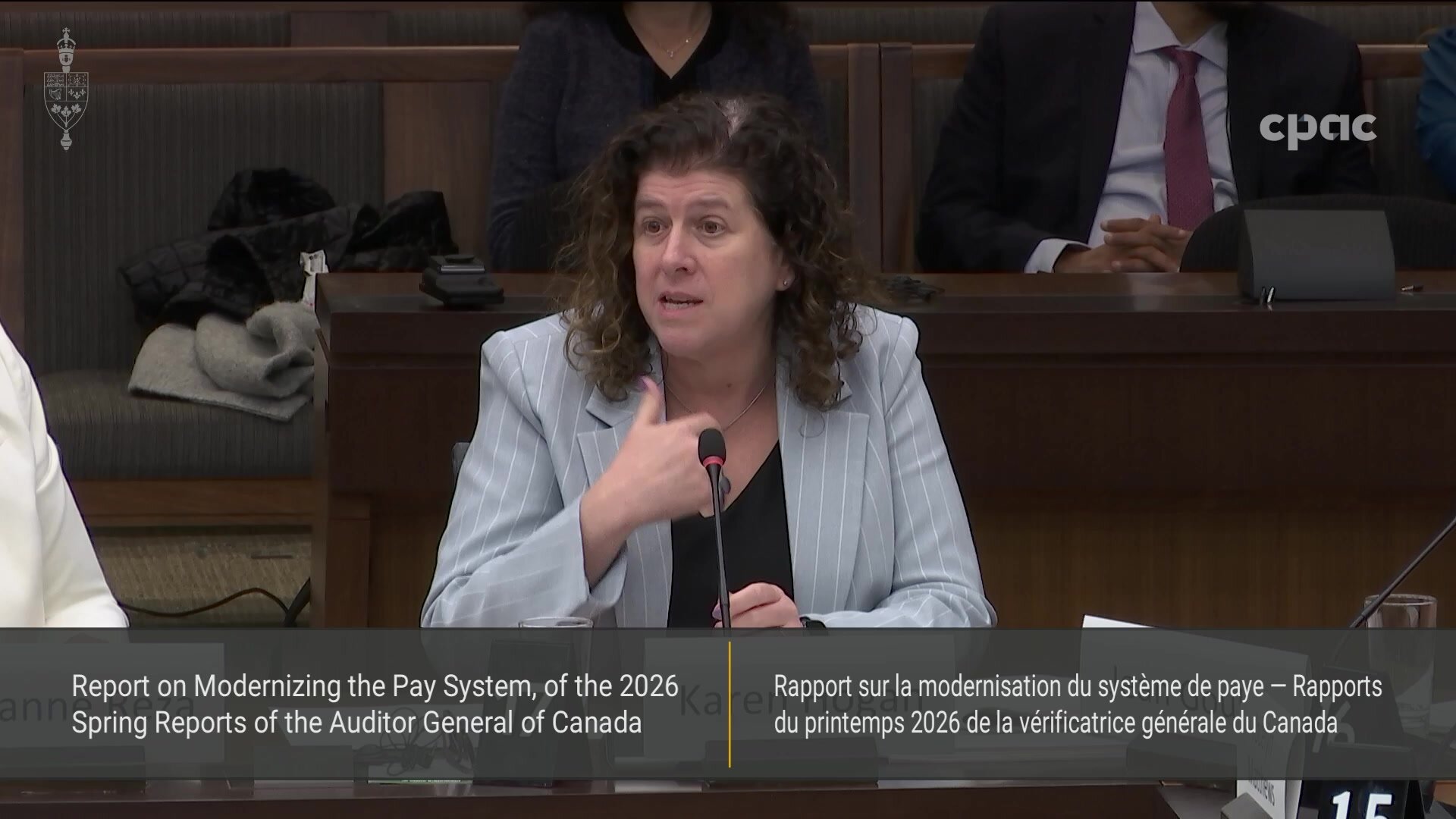
A 4.2 billion dollar fix for a problem that's two-thirds not the system
Canada is rushing a new payroll system in to replace Phoenix. But its own Auditor General told a committee that most of the remaining pay errors aren't the software's fault at all — which raises an awkward question about what the 4.2 billion dollars is actually buying.
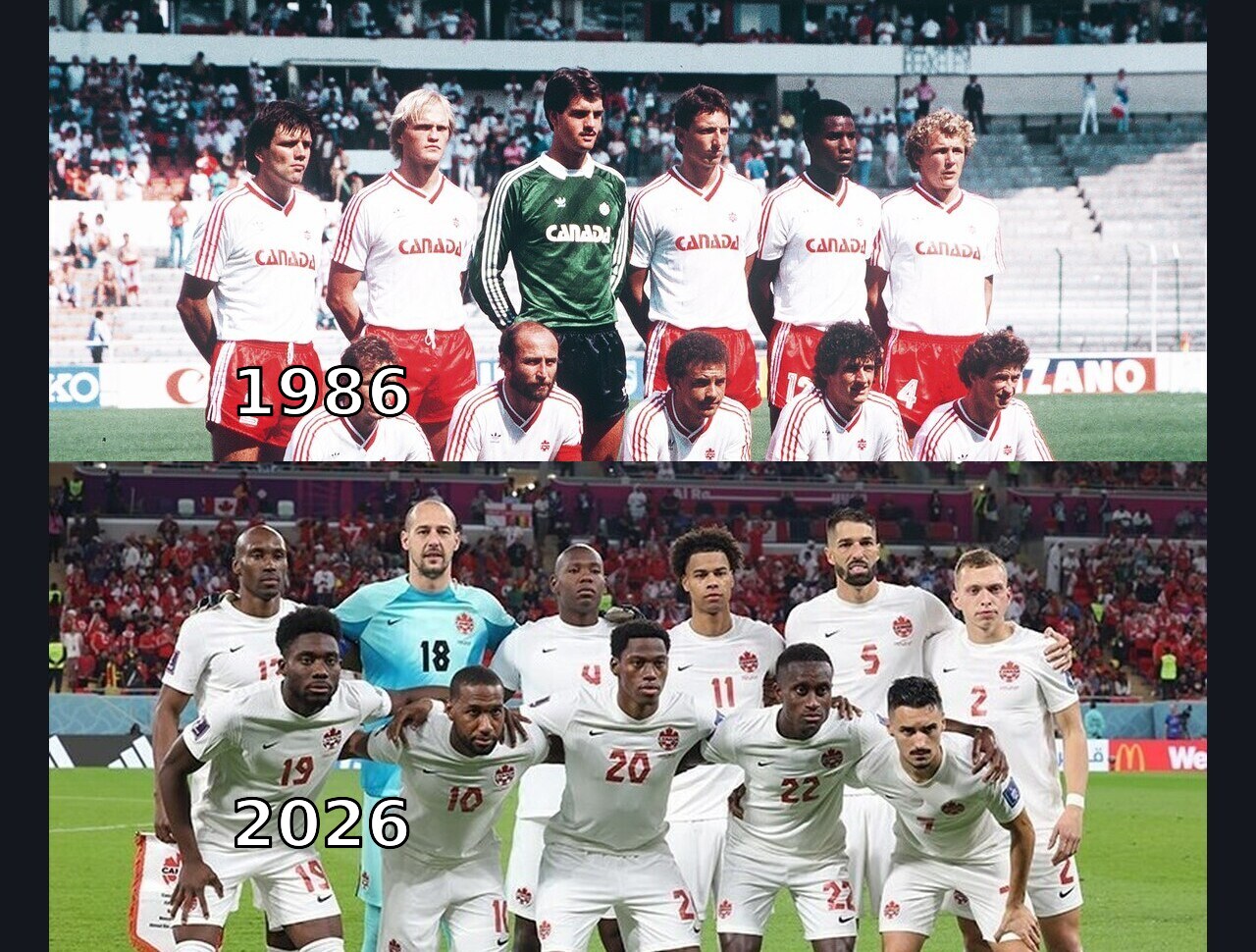
Canada was 90th in the world in 2013. It hosts the 2026 World Cup as its strongest team ever.
When Canada plays a home World Cup match for the first time this June, it does so as the strongest men's team in its history. A decade ago it sat 90th in the world. Measured in Elo, soccer's results-based strength rating, the climb since has carried Canada past the United States and into second place in North America, behind only Mexico.

As Dunkin' prepares for its Canadian relaunch via Foodtastic, public LMIA data shows the master franchisee hires foreign workers at nearly the same rate as Tim Hortons
Foodtastic, the Montreal company that just signed an exclusive deal to bring Dunkin' back to Canada with "hundreds of locations," has approved 109 Temporary Foreign Worker positions across its existing portfolio over the past two years. Normalized by workforce, that works out to roughly 5.7 per 1,000 employees — about 85 per cent of Tim Hortons' rate. Tim Hortons got every front page for promising to cut its TFW use. Foodtastic, with a similar per-worker rate, is opening hundreds of new stores under a "Dunkin' is back" headline.

Canada blamed Tim Hortons. McDonald's hired more foreign workers — and stayed quiet.
Tim Hortons said this morning it will cut Temporary Foreign Workers and hire 10,000 Canadians instead. The chain's full franchise network — every "12345 Ontario Inc o/a Tim Hortons" plus the two big franchisee groups whose corporate names don't carry the brand — has 747 LMIA-approved positions for 2024-2025. Roll up McDonald's the same way and you get 907. The chain making headlines about foreign-worker cuts isn't even Canada's biggest fast-food user of the program.

More cops, less crime? Not in Canadian cities.
Calgary spends roughly a third less per resident on policing than Montréal, and has less violent crime to show for it. Across 29 major Canadian metropolitan areas, the correlation between officers per 100,000 residents and the violent Crime Severity Index is essentially zero. Built from the 2025 Police Administration Survey, released Wednesday.
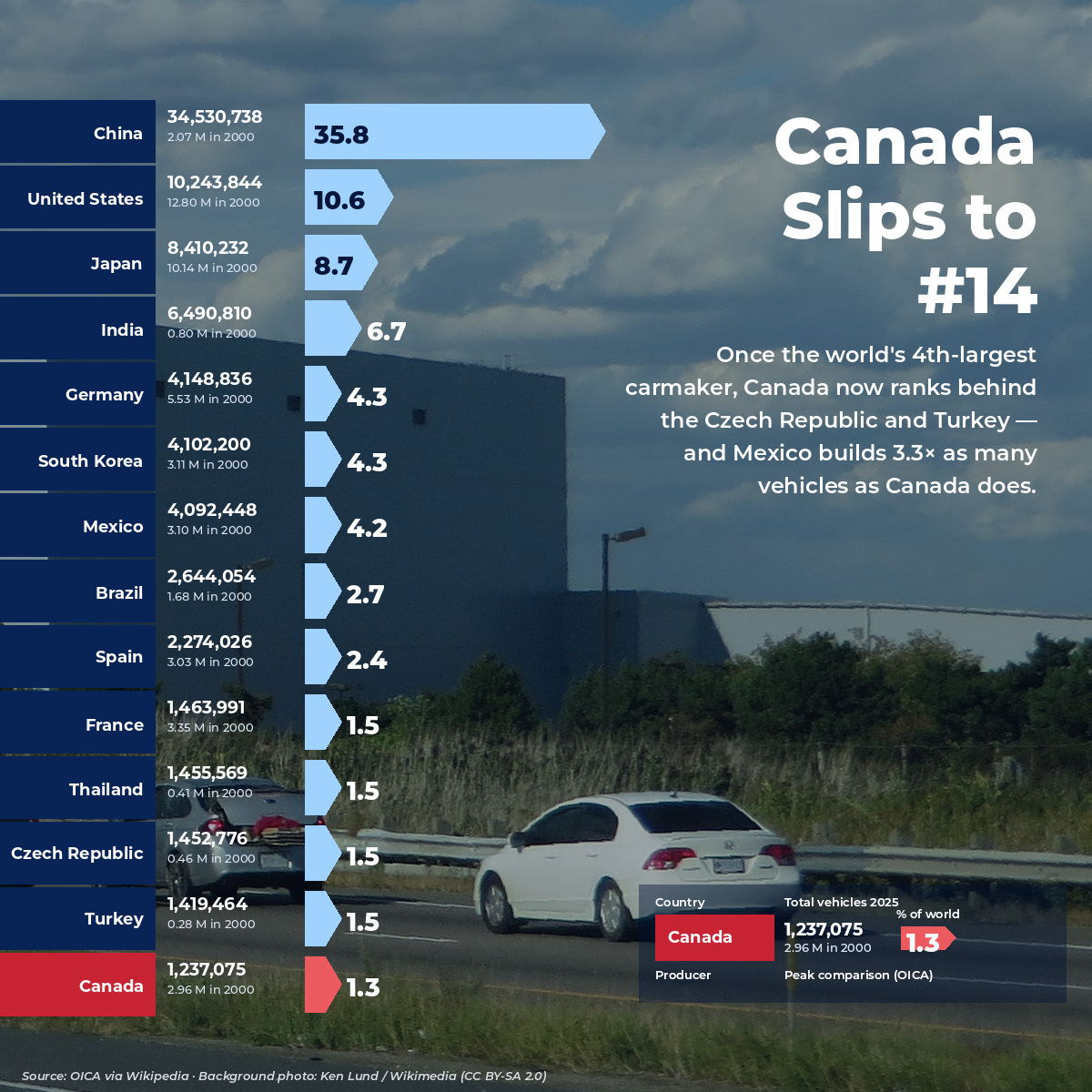
Canada was the world's 4th-largest carmaker in 2000. It now ranks 14th.
In 2000 Canada built 2.96 million vehicles and sat fourth in the world. In 2025 it built 1.24 million and slipped to 14th, behind the Czech Republic and Turkey. Mexico now builds 3.3 times as many vehicles as Canada does.

Canada's 2026 Census is being collected now — here's when each result lands, and what's worth watching
The fieldwork started in May. Statistics Canada hasn't published its 2026 release calendar yet, but the 2021 cycle gives a tight template — first headline counts about nine months after census day, full picture about eighteen. Ten things the new data is set up to settle.

Canada's military recruitment hit a 30-year high. Female officer intake nearly doubled.
466 women enrolled as Canadian Armed Forces officers in fiscal year 2025/26 — a 94 percent year-over-year jump and the largest single-year shift for any subgroup in 28 years of DND open data. The composition of the 2025 cohort doesn't match the working-class enlistment story most coverage told.

Canadian millennials are twice as likely to live with their parents as boomers were
16.3 percent of millennials aged 25 to 39 lived with at least one parent in 2021. Boomers at the same age in 1991 — 8.2 percent. The rate has roughly doubled, and the figure is from the last census, before mortgage rates and rents climbed further.
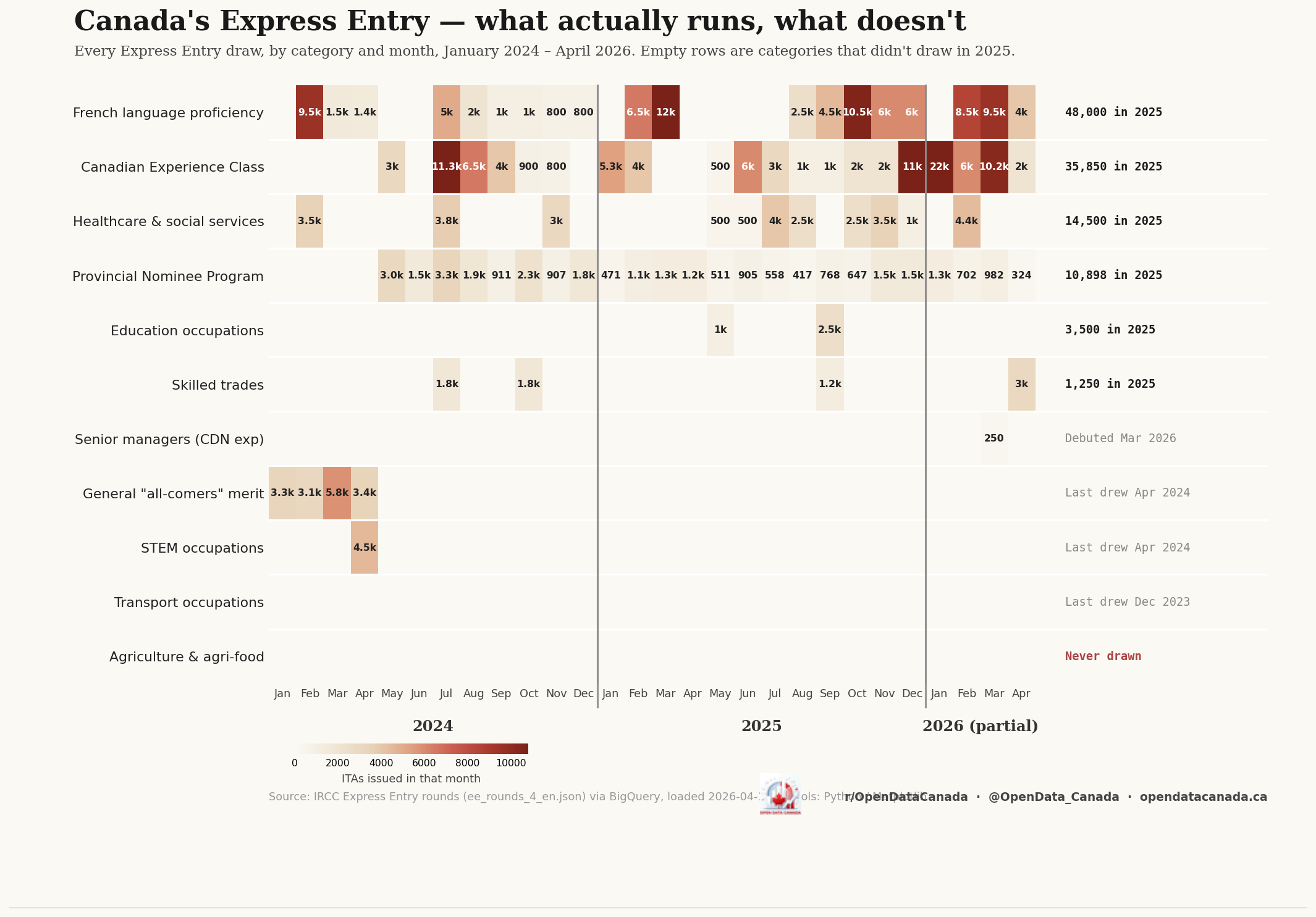
Three categories did 86% of Express Entry's 2025 invitations. Three more were dormant. One has never drawn.
Canada lists seven federal "priority" categories on its Express Entry page. In 2025, French, CEC, and Healthcare did 86,350 of the 113,998 invitations issued. STEM hasn't drawn since April 2024. Agriculture has never drawn at all.
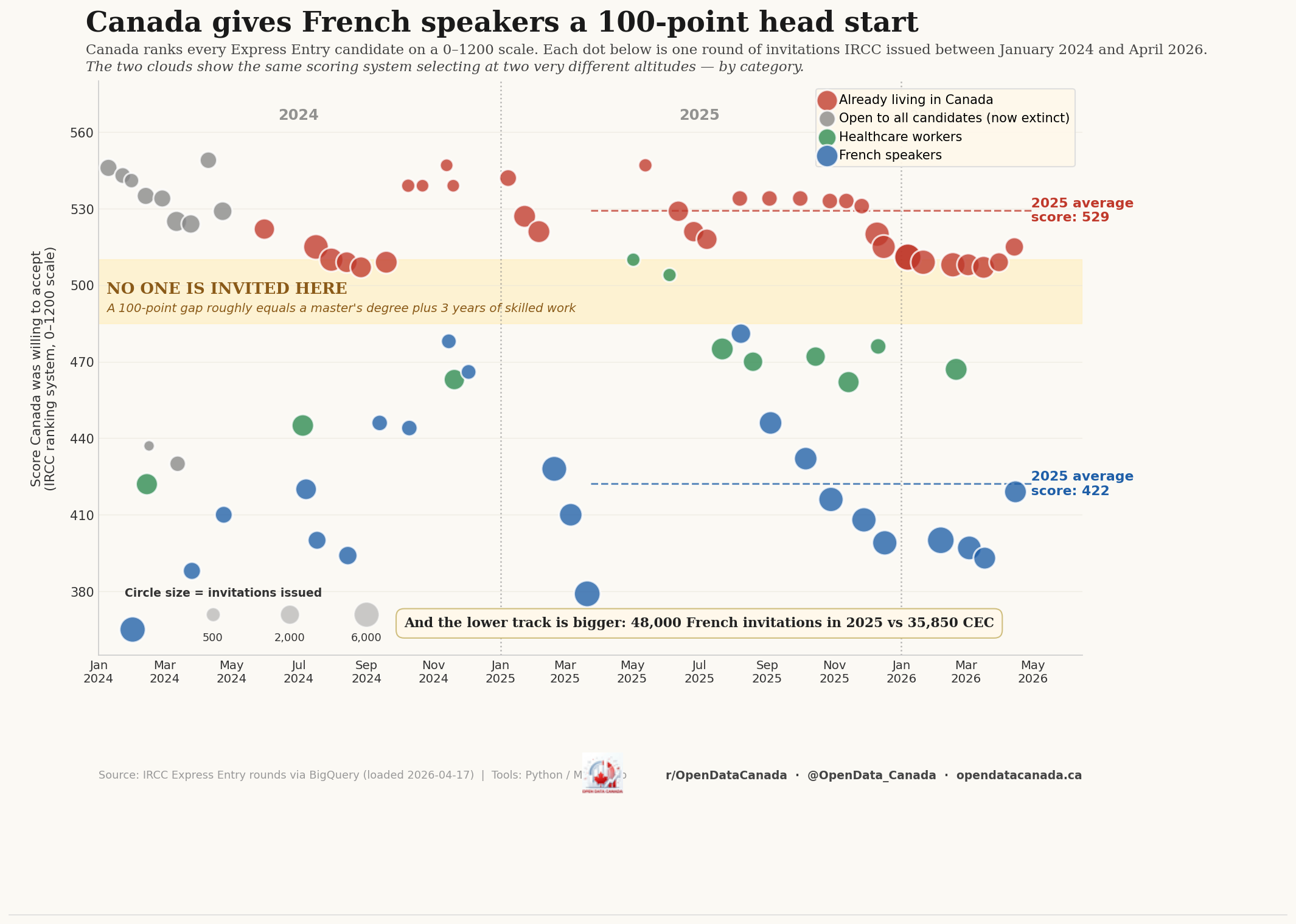
Canada will pay 107 CRS points for a French speaker
A French-speaking Express Entry candidate gets accepted at a score 107 points lower than an otherwise-equivalent candidate. The gap is the policy, and almost nobody is talking about it.
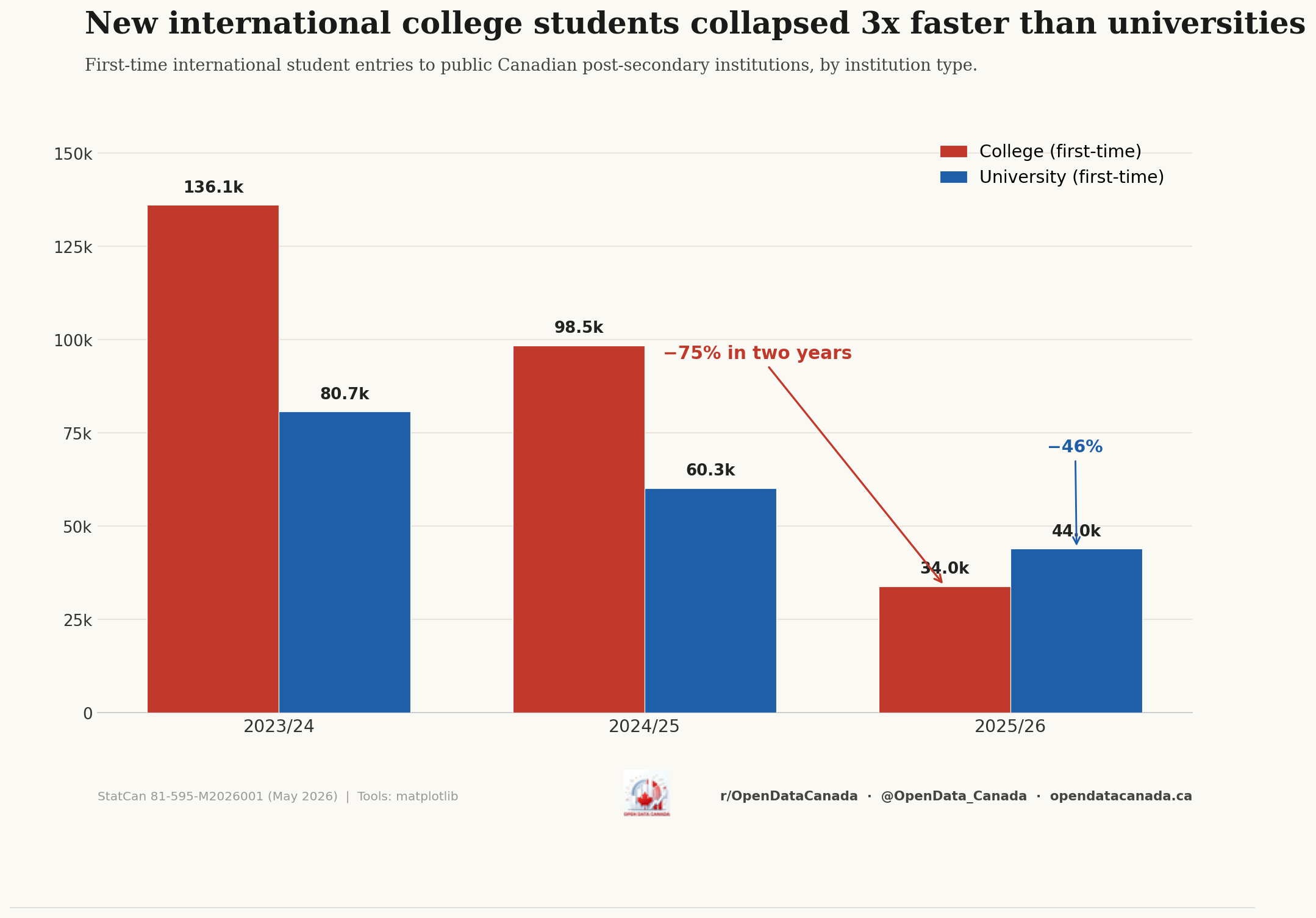
When Canada closed the side door to permanent residency, 100,000 'students' vanished
New first-time international college entries fell 75 percent in two years. Universities fell 46 percent. The gap is the story.
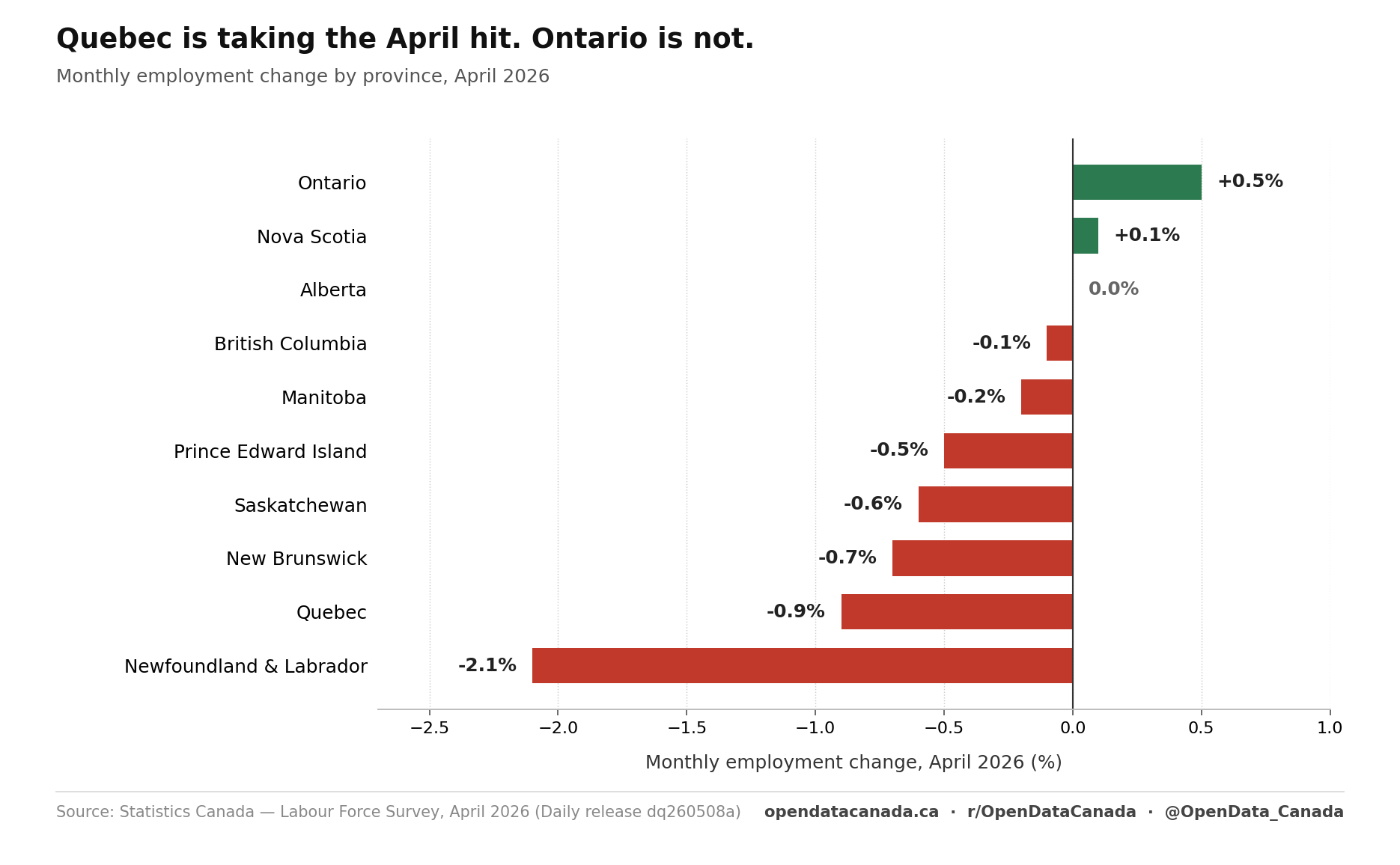
Canada has lost 111,000 full-time jobs since January. Quebec is taking the worst of it.
April was the fourth straight monthly decline in full-time employment. Unemployment hit a six-month high. Wages still grew 4.5 percent year-over-year. The headline number of minus 18,000 hides what is happening underneath it.
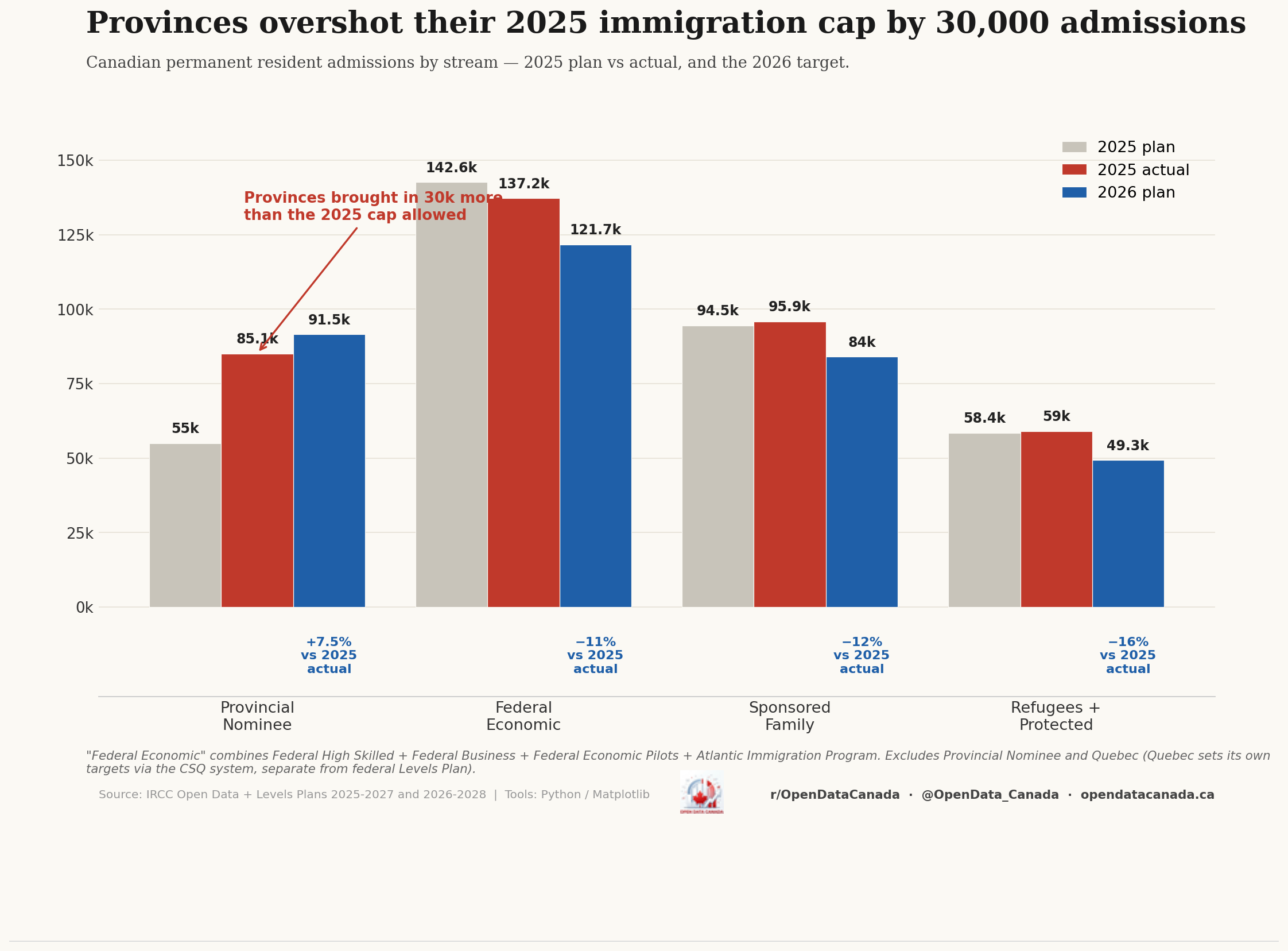
How Canadian provinces took control of immigration policy — and what got cut along the way
Ottawa called the 2026 Provincial Nominee expansion "historic." Provinces had already overshot their 2025 cap by 30,000 admissions. The 2026 plan formalizes it — and cuts family reunification, refugees, and federal merit selection to keep the total flat.
![[object Object]](/posts/thunder-bay-hero.jpg)
Ontario's opioid crisis is concentrated in the North — Thunder Bay's death rate is nearly 4× the provincial average
Ontario as a whole had 2,242 opioid toxicity deaths in 2024 — a rate of 13.9 per 100,000, well below Canada's 17.7 national rate. But the provincial average hides a sharp split: five northern Public Health Units sit between 35 and 54 per 100,000, while Toronto and Peel sit near or below the average.
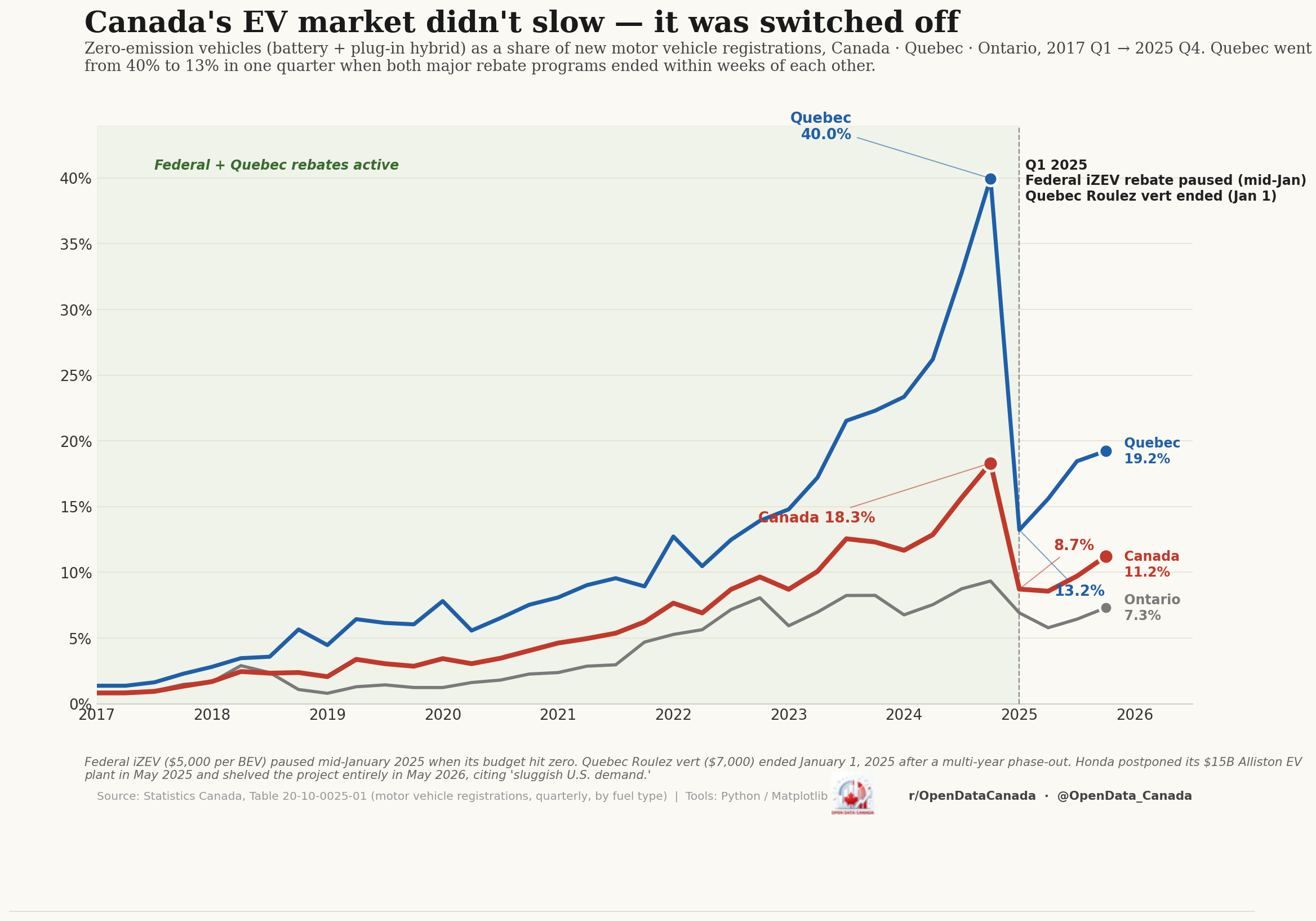
Canada's EV market didn't slow — it was switched off
Honda is shelving its largest-ever North American EV investment, citing 'sluggish U.S. demand.' The Canadian story is sharper — ZEV market share fell from 18% to 9% in one quarter when both major rebates ended within weeks of each other.
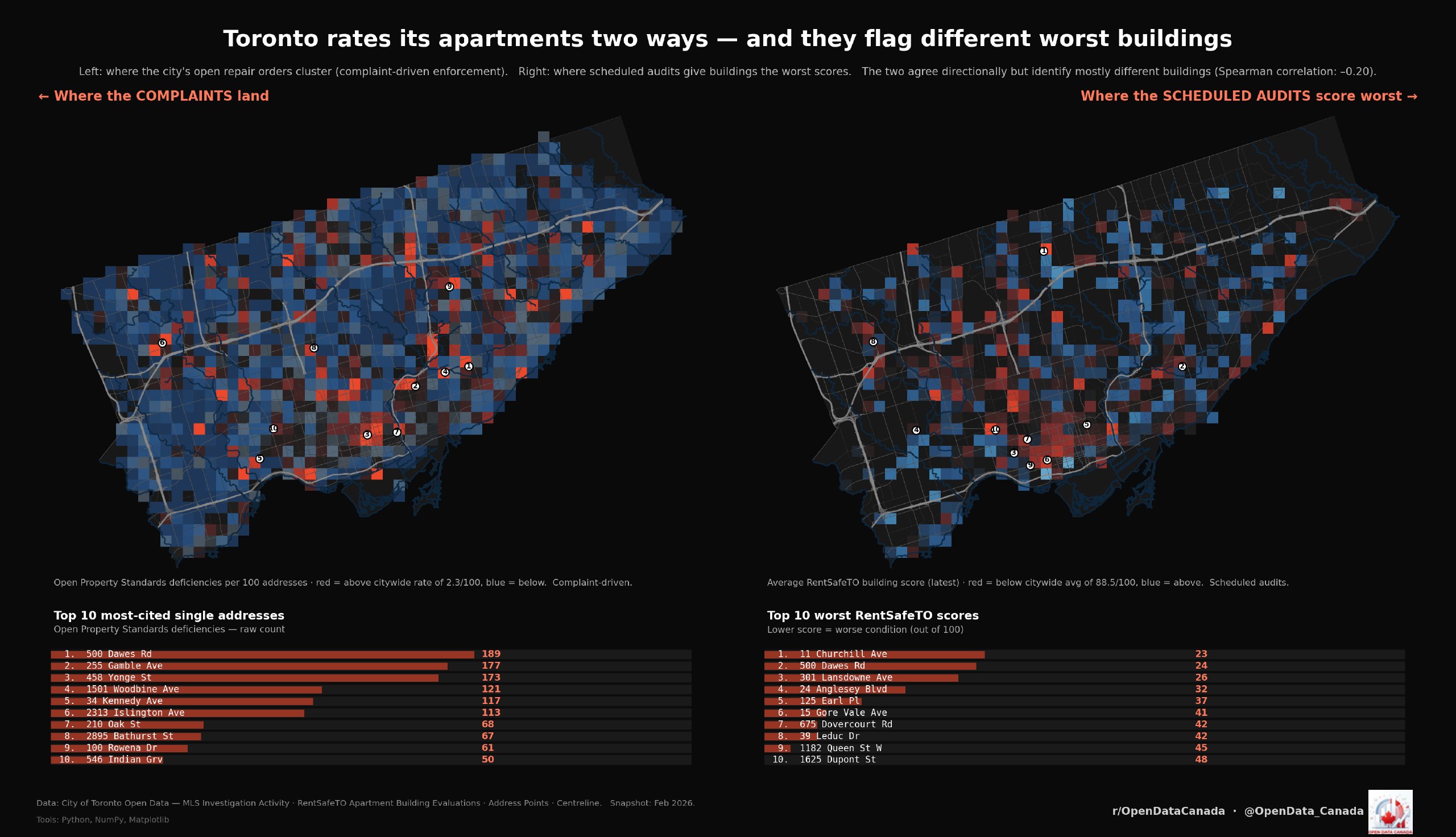
Toronto rates its apartments two ways — and they almost never agree
500 Dawes Road is the only building both of Toronto's parallel rating systems flag as one of the worst — and that agreement is unusual enough it might be why Mayor Chow went there.
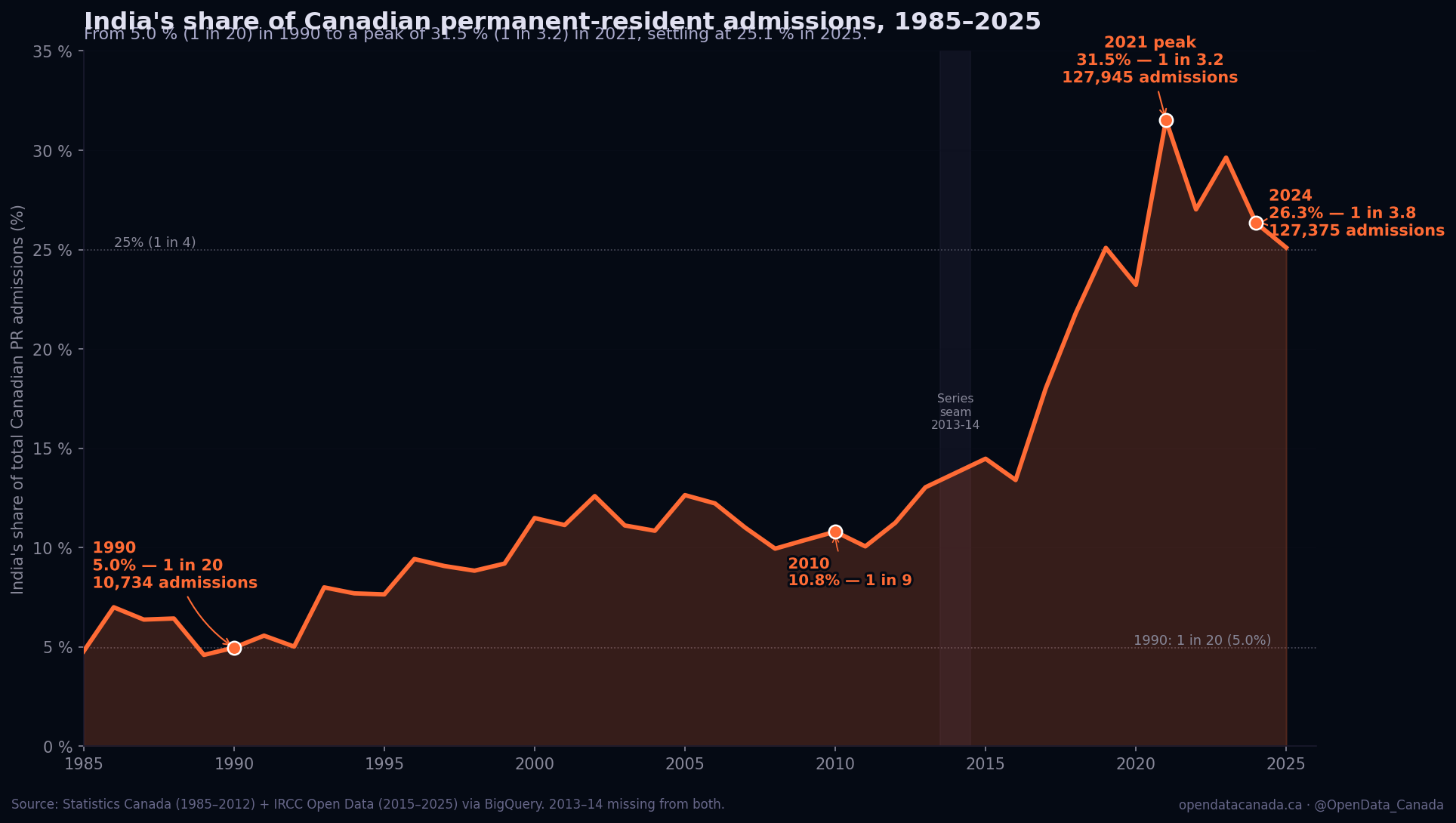
1 in 4 — how India became Canada's dominant immigration source
From 5 % of PR admissions in 1990 to a 31.5 % peak in 2021. Holding at 25 % even as the total falls. Four mechanisms explain the shift, including Express Entry's 2015 launch.
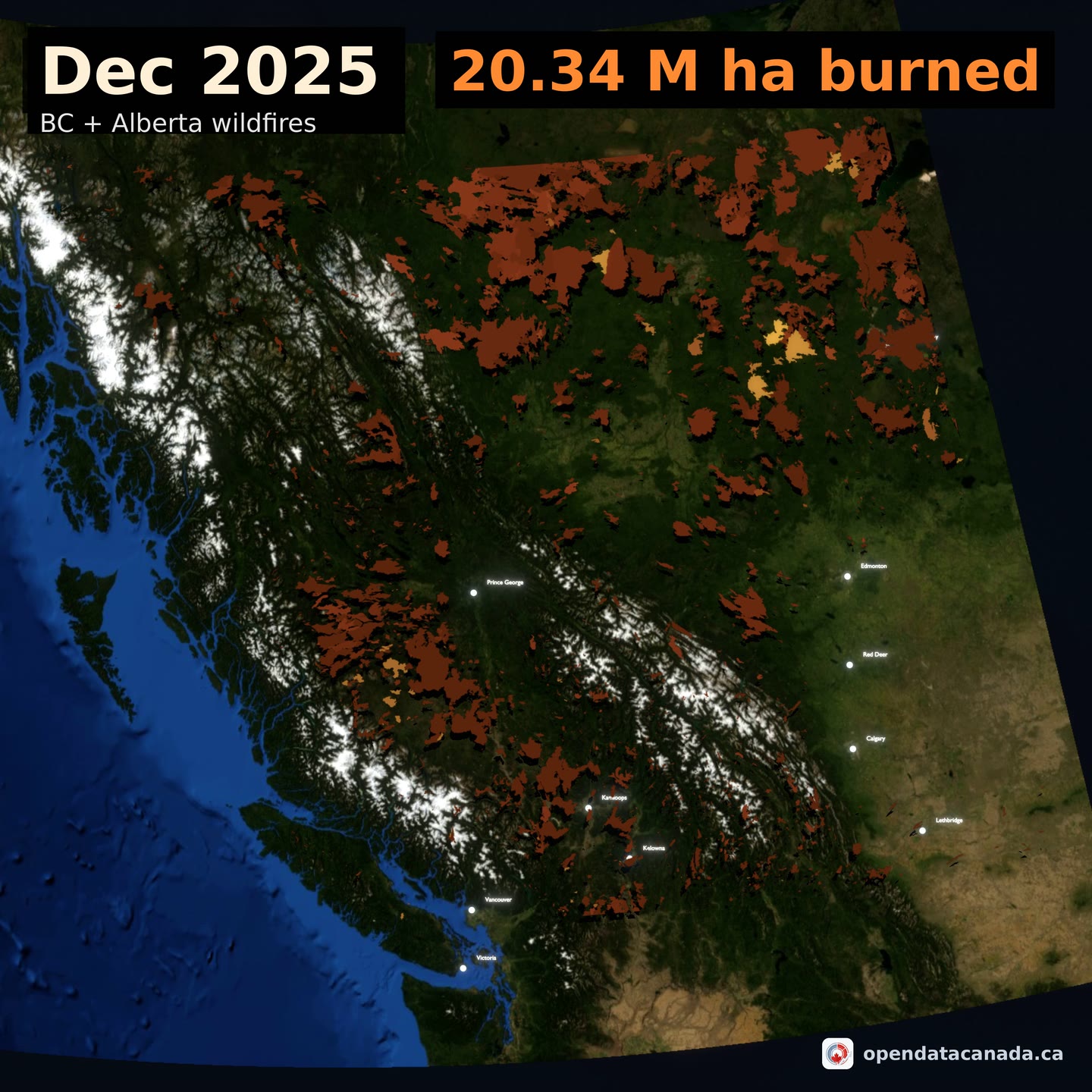
An area larger than England has burned in BC and Alberta since 2000
Every mapped fire perimeter in British Columbia and Alberta, animated month by month over 26 years. Most of the burning happened in the last six. What the acceleration means for carbon, water, communities and insurance.
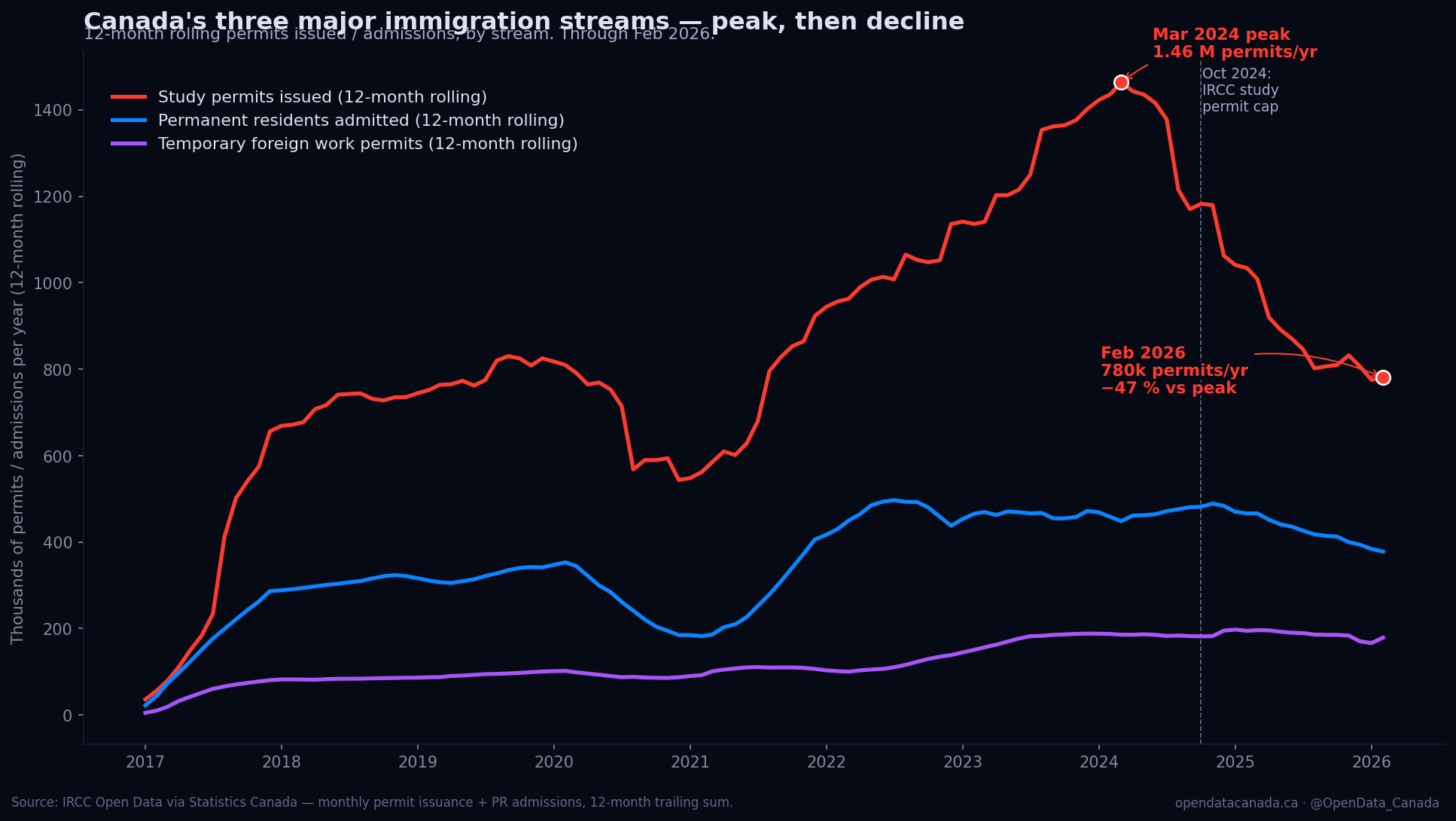
The boom is over — every immigration stream is now declining
Study permits −47 %. PR admissions −24 %. TFW work permits −9 %. The October 2024 cap is hitting its target faster than the announced trajectory required.
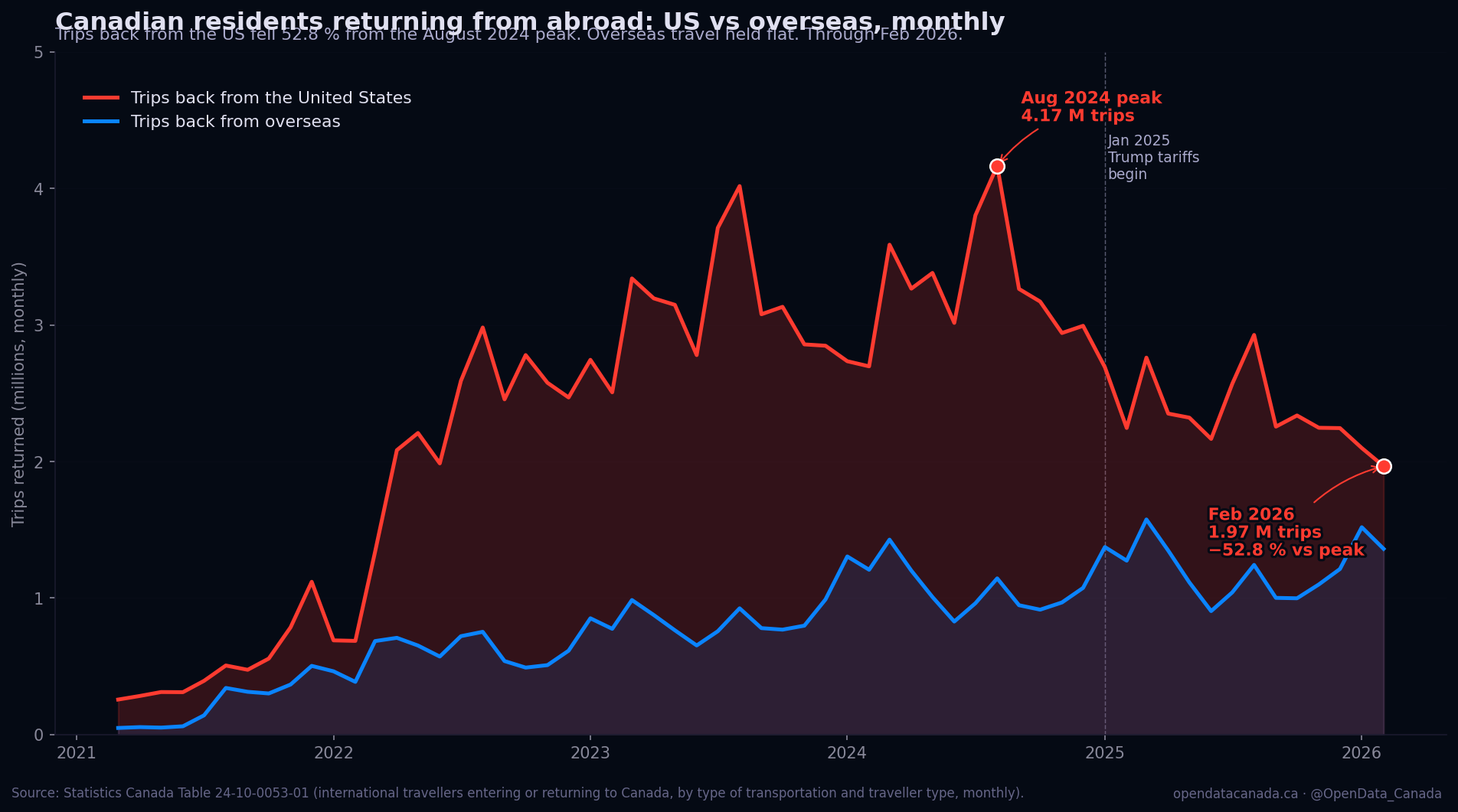
52.8 % — Canadian trips to the US have collapsed since August 2024
4.17 M monthly trips at the peak → 1.97 M by Feb 2026. Fourteenth consecutive month of YoY decline. Overseas travel didn't move. The mechanism: January 2025 tariffs.
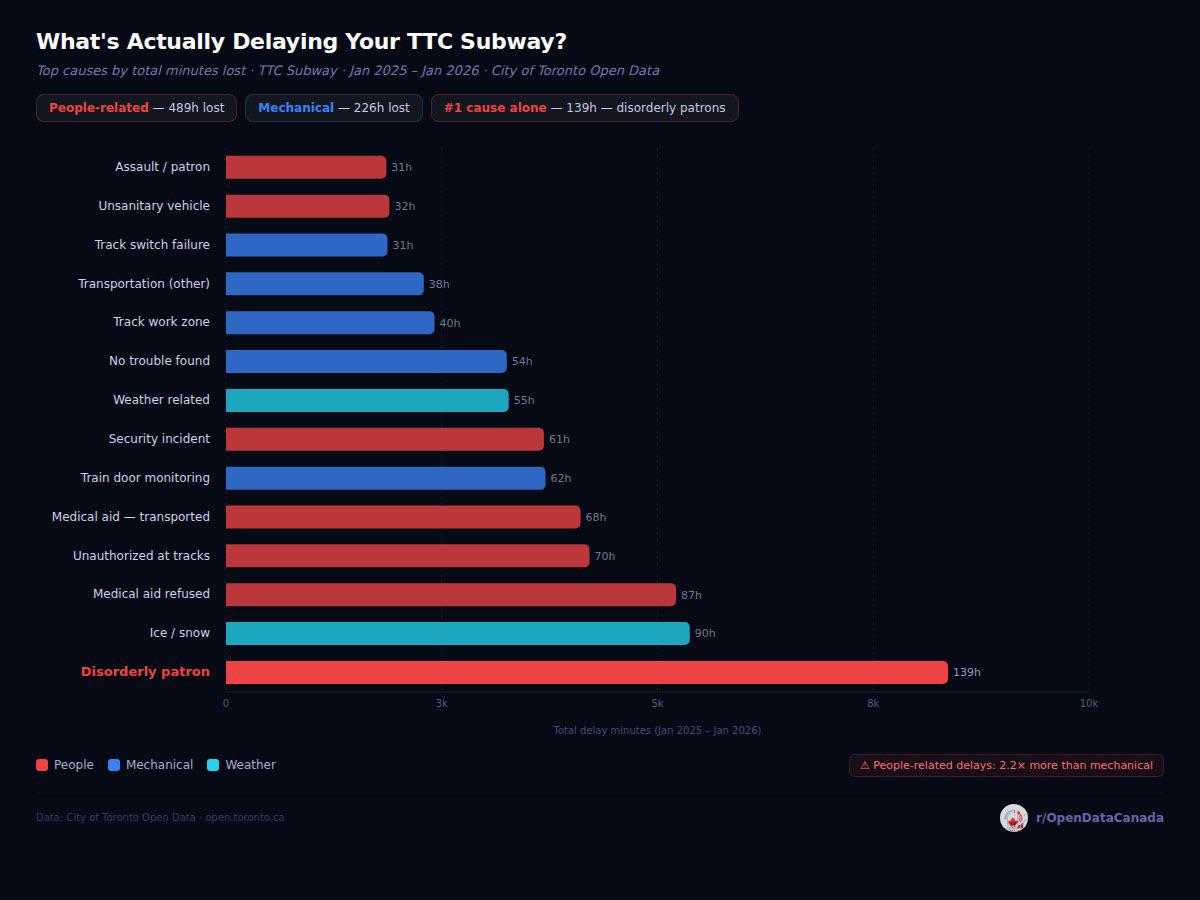
What's actually delaying the TTC subway
1,385 hours lost across 10,087 incidents. Disorderly patrons top the chart by total time but Line 1 carries 56 % of all delay. Built directly from the open-data file.
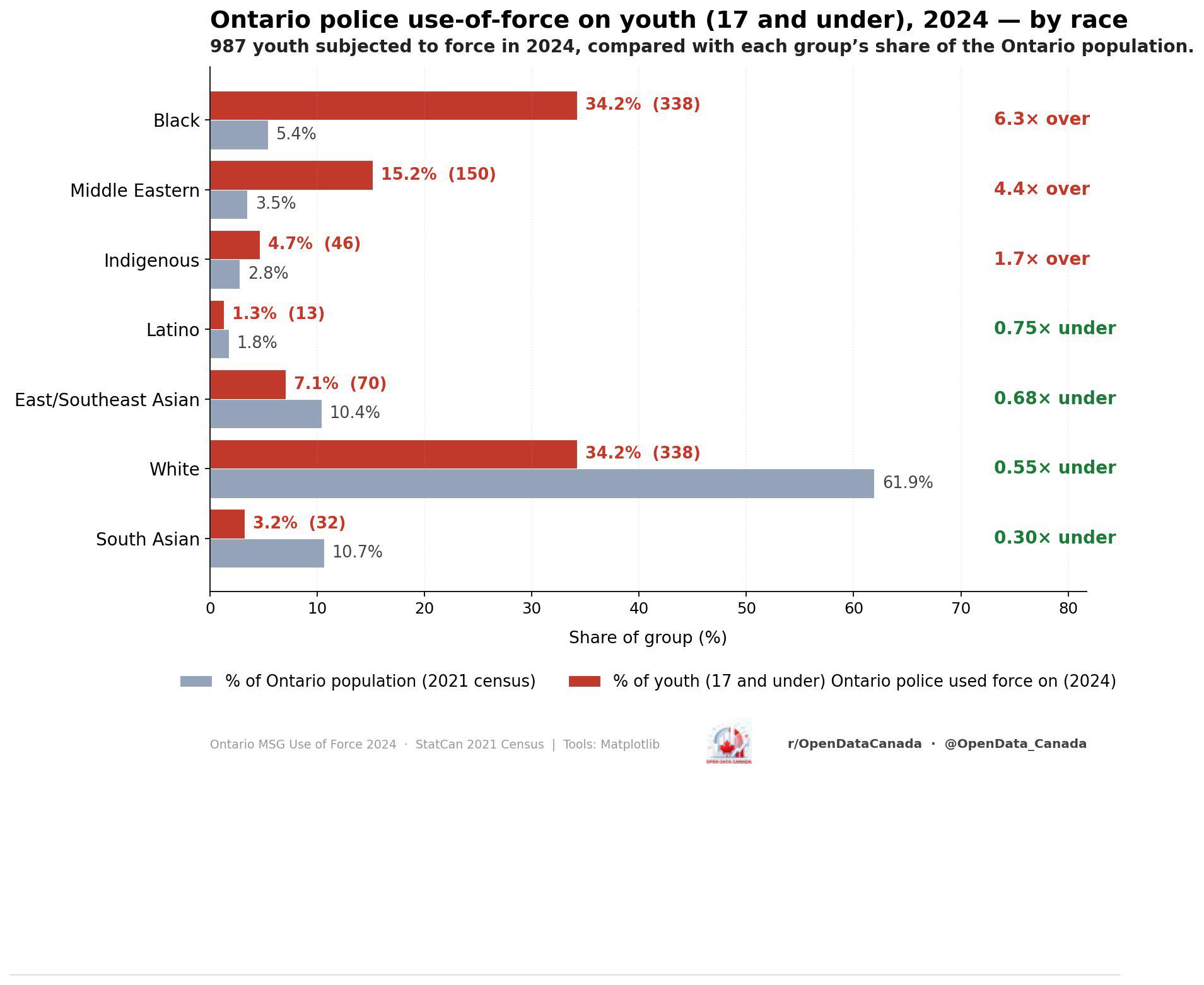
The 987 — what Ontario's 2024 police use-of-force data on youth says
Black youth 6.3× their population share. Middle Eastern 4.4×. Indigenous 1.7×. The four objections that survive scrutiny, and what the chart can and can't tell you.
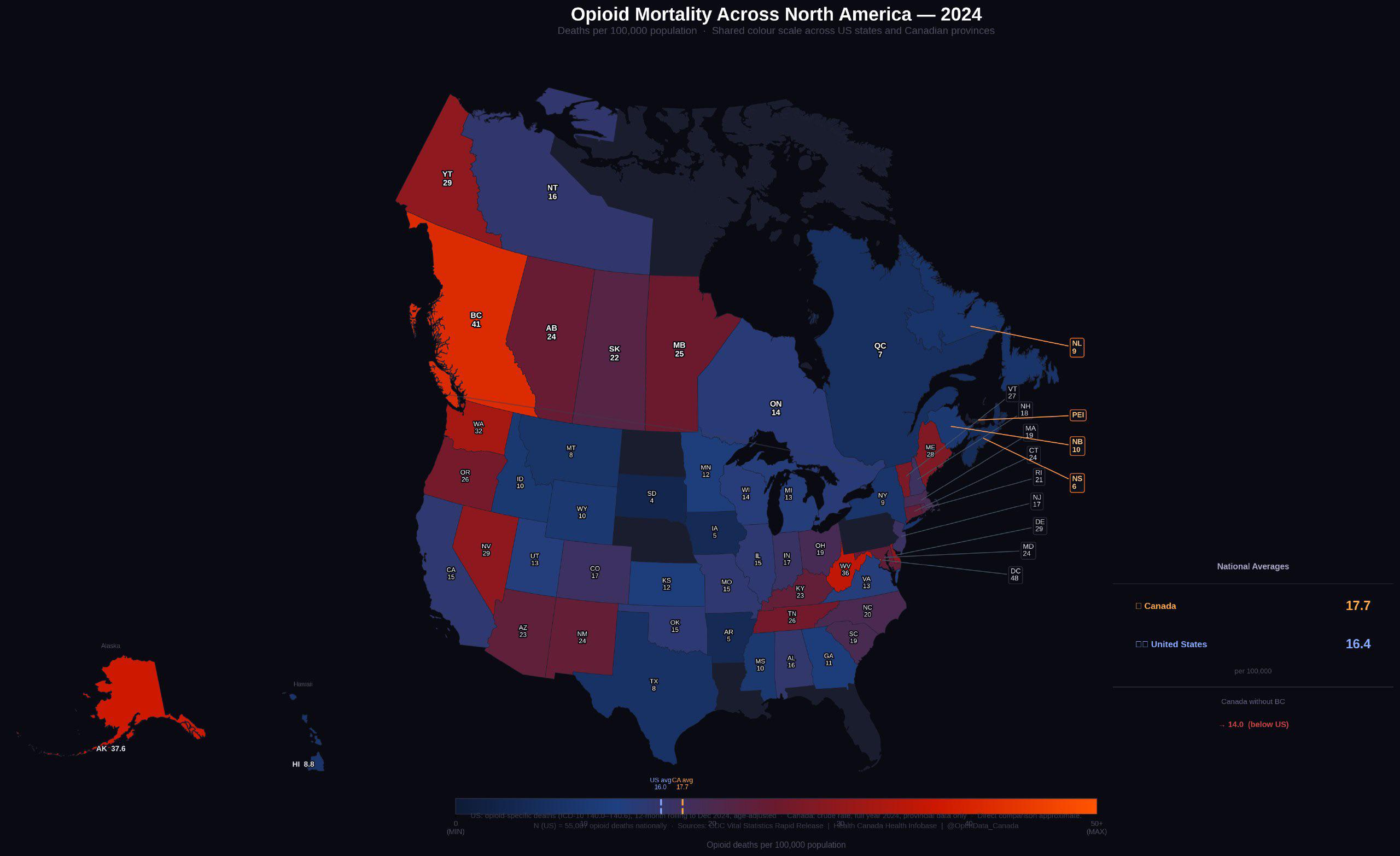
Why Canada's opioid death rate just passed the US
17.7 vs 16.4 per 100,000 in 2024 — but the headline depends on whether you count British Columbia. Strip BC out and Canada drops to 14.0, well below the US rate.
No articles in this topic yet — try another, or read everything.