Article · Population · 7 min read
Canada has seven Express Entry priority categories. Three of them did 86% of the work.
In 2025 the Canadian federal government invited 113,998 applicants through Express Entry. Three categories — French language, Canadian Experience Class, and Healthcare — accounted for 86,350 of those. The other categories on the federal "priority" list either ran small, ran dormant, or have never run a draw at all.
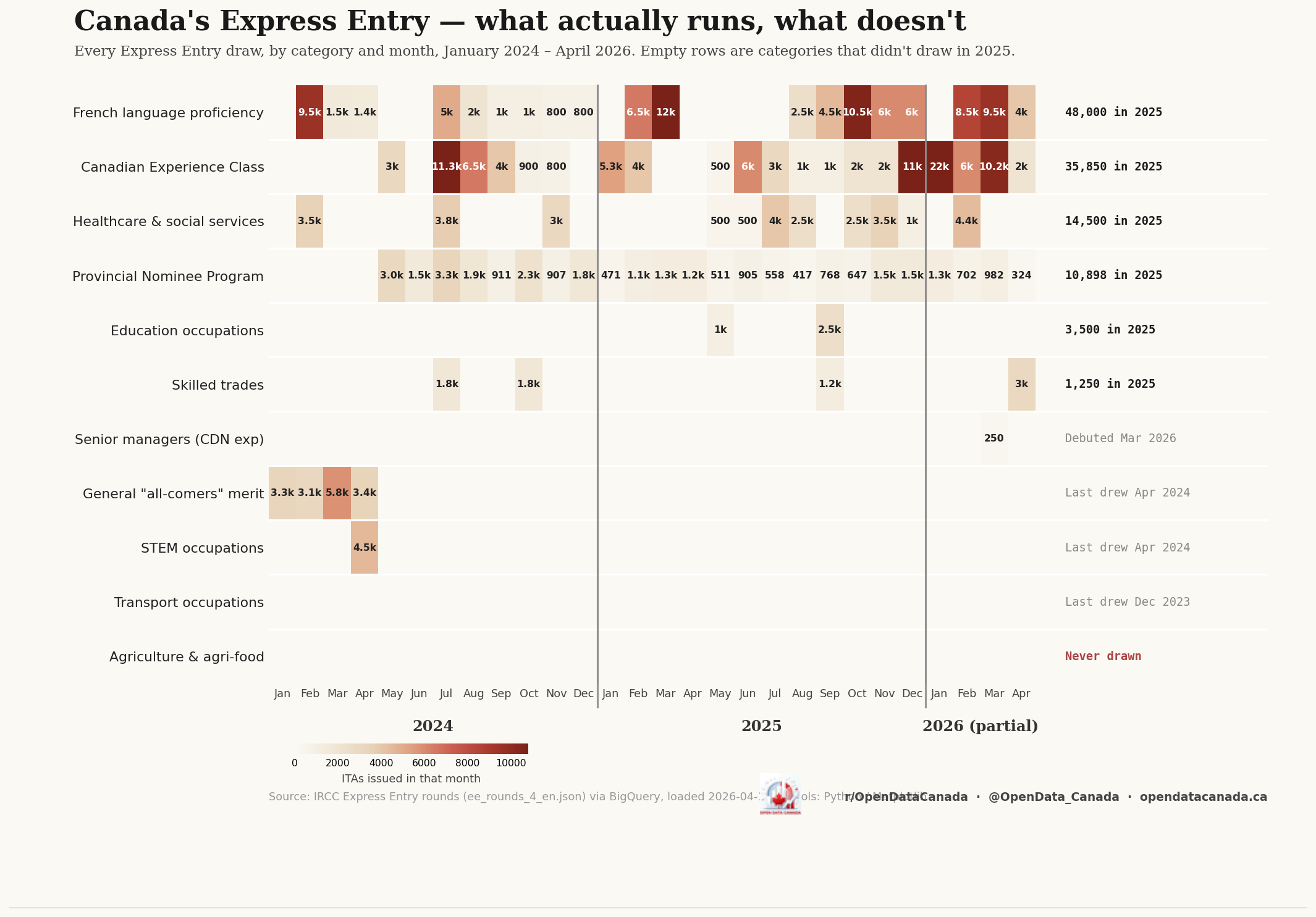
The chart above is every Canadian Express Entry draw IRCC has issued since January 2024 — 134 draws in total — organized as one row per category and one column per month. Cell colour intensity is the volume of invitations that month. Top six rows have data. Bottom five rows are almost entirely empty.
Almost every conversation about Canadian Express Entry assumes the seven federal "priority" categories — announced in May 2023 and built on the June 2023 Royal Assent of Bill C-19 — operate as parallel intake streams. The chart shows they don't.
What the data actually says
Verified totals from IRCC's open-data Express Entry rounds endpoint, pulled into BigQuery on 2026-04-17 with a calendar-year-2025 window:
| Category | 2025 ITAs | Draws | Avg CRS cutoff | Status |
|---|---|---|---|---|
| French language proficiency | 48,000 | 9 | 422 | Active |
| Canadian Experience Class | 35,850 | 15 | 529 | Active |
| Healthcare and social services | 14,500 | 7 | 481 | Active |
| Provincial Nominee Program | 10,898 | 24 | 730 (incl. +600 nomination bonus) | Active |
| Education occupations | 3,500 | 2 | 471 | Debuted 2025 |
| Skilled trades | 1,250 | 1 | 505 | Active but minimal |
| Senior managers | 0 | 0 | — | Debuted March 2026 only |
| General "all-comers" merit | 0 | 0 | — | Last drew April 2024 |
| STEM occupations | 0 | 0 | — | Last drew April 2024 |
| Transport occupations | 0 | 0 | — | Last drew December 2023 |
| Agriculture and agri-food | 0 | 0 | — | Has never drawn |
Three observations the policy framing hides:
- Three categories did most of the work. French (42% of all 2025 ITAs), CEC (31%), and Healthcare (13%) collectively account for 86,350 of the 113,998 Express Entry invitations issued in 2025 — 75.7%. Add Provincial Nominee Program (10%) and the four-category share rises to 96%. Everything else combined was less than 5%.
- Three official categories drew nothing in 2025. STEM occupations have not run a draw since 2024-04-11. Transport occupations ran exactly once, on 2023-12-20, issuing 670 invitations — and never since. Agriculture and agri-food, named as a priority category in May 2023, has not held a single draw in the three years since.
- The "general" merit draw — the original 2015 mechanism — went silent in 2025. Before category-based draws launched, Express Entry ran general draws open to everyone in the pool. Those draws issued 82,000 invitations in 2023 and 15,570 in 2024. In 2025 they issued zero. The system in 2025 is exclusively a category-based or program-specific (CEC/PNP) machine.
Why the dormant categories matter
This is not academic. Each of the four largely-or-completely dormant categories points to a labour-market commitment the federal government made and is not currently using Express Entry to deliver on:
Agriculture and agri-food, named as a priority in May 2023, is the labour-market gap that Canadian agricultural employer groups have testified to Parliament about for almost a decade. The Temporary Foreign Worker Program continues to deliver agricultural labour — about 70,000 positions per year through 2024 — but those are temporary visas, not permanent residency. The Express Entry agriculture stream was meant to be the PR conversion path for that workforce. Three years in, the path has not opened.
Transport occupations (truck drivers, aircraft mechanics, pilots, transit operators) was named in May 2023 against a backdrop of a documented Canadian truck-driver shortage that the Canadian Trucking Alliance estimated at roughly 25,000 unfilled positions. The single Express Entry transport draw issued 670 invitations in December 2023 — closer to a tenth of the documented gap than a meaningful response.
STEM occupations drew aggressively in 2023 and the first half of 2024 (12,800 invitations across three rounds) and then went silent. The labour-market case did not change between April 2024 and now — the Information and Communications Technology Council has continued to publish gap reports through 2025. The change is the policy-attention budget, not the underlying need.
Senior managers with Canadian work experience is the newest category, announced in early 2026 and run exactly once on March 5, 2026, issuing 250 invitations at a CRS cutoff of 429. Whether it scales is a 2026 question, but at one draw of 250 in three months, it is not on the trajectory of the active categories.
What the active three are doing
The 86,350 invitations the active three categories produced in 2025 break down with internal consistency:
| Active category | Volume | What it selects for | Effective CRS floor |
|---|---|---|---|
| French | 48,000 | French CLB 7+ proficiency, drawn from any program | ~380–485 |
| CEC | 35,850 | Canadian work-experience holders (work-permit-to-PR) | ~510–550 |
| Healthcare | 14,500 | Healthcare NOCs (nurses, PSWs, doctors, pharmacists, social workers) | ~460–510 |
Two of these — French and Healthcare — are category-based draws, so they invite candidates from across all underlying programs (CEC, FSW, FST) so long as the language or occupational criterion is met. The third, CEC, is a program-specific draw that only invites Canadian Experience Class candidates.
The combined effect is that Canada's Express Entry program in 2025 is, in practice, three things: a Francophone-immigration delivery vehicle (the largest single mechanism), a path-to-PR for people already in Canada on work permits (the second-largest), and a healthcare workforce builder (the third).
The other four official categories are administratively present and operationally absent.
The methodology criticisms worth taking seriously
Objection one: dormant doesn't mean dead — IRCC could fire up STEM or Transport at any time.
Correct. Category-based draws are at the Minister's discretion, and the framework remains in place. The factual statement is that they have not run in 2025, not that they cannot. The pattern is informative — the Minister chose not to use those categories during a year when the underlying labour-market gaps did not narrow — but it does not preclude future use.
Objection two: PNP issuing 24 small draws and dominating the count understates its actual share.
Partially correct. PNP issued 10,898 invitations across 24 separate draws in 2025 — small per-draw averages, but 9.6% of the year's total. Provincial allocation cuts in the 2025–2027 Levels Plan reduced PNP's volume from 25,090 ITAs in 2024 to 10,898 in 2025, a 59% drop. So PNP's quiet-but-frequent cadence in 2025 is the result of the cap, not its underlying scale.
Objection three: Education is a brand-new category, so calling it "small" misreads the trend.
Correct caveat. Education was added to the priority list only in early 2025 and issued its first draw in mid-2025. Two draws in its debut year totalling 3,500 invitations is roughly proportional to a category in its launch phase. Whether it grows in 2026 is the test. Through 2026-04-15 it has not yet held a 2026 draw.
Objection four: 2026 partial data could change the picture meaningfully.
Correct caveat. The dataset behind this article runs through April 15, 2026 — three and a half months of 2026. Through that window the pattern has held: French (22,000 ITAs), CEC (24,000), and Healthcare (4,400) are running heavily, with one-off STEM/Trades/Senior-manager draws in the low thousands. The active-three concentration appears to be intensifying, not diluting, in 2026.
What we still do not know
The question this dataset cannot answer is what the intended per-category trajectory was in 2024 when Bill C-19 received Royal Assent. IRCC has not published a per-category target curve. The May 2023 announcement listed seven priority categories without committing to a draw schedule or a per-category invitation volume — by design, since the Minister's discretionary authority depends on flexibility.
That makes it hard to call any specific category "behind schedule." But it also makes the dormant-category pattern hard to read as anything other than active deprioritization. Agriculture, Transport, and STEM each had a labour-market case as strong in 2025 as it was in 2023 — and each got, respectively, zero, zero, and zero draws.
The closest statement the data does support: the seven-category framing on the IRCC priority page is, in 2025, a list of three active categories, three dormant ones, and one that has never run. A program description that cannot be written without three asterisks is functionally a different program from the one its description names.
Read next