Article · Population · 6 min read
How Canadian provinces took control of immigration policy — and what got cut along the way
Ottawa called the 2026 Provincial Nominee expansion "historic." Provinces had already overshot their 2025 cap by 30,000 admissions. The 2026 plan formalizes it — and cuts family reunification, refugees, and federal merit selection to keep the total flat.
When Ottawa announced its 2026 Immigration Levels Plan in November, the headline was a 66 percent expansion of the Provincial Nominee Program. From 55,000 admissions a year to 91,500. The largest expansion in the program's history, the government called it.
That number is true. It just isn't the change it sounds like.
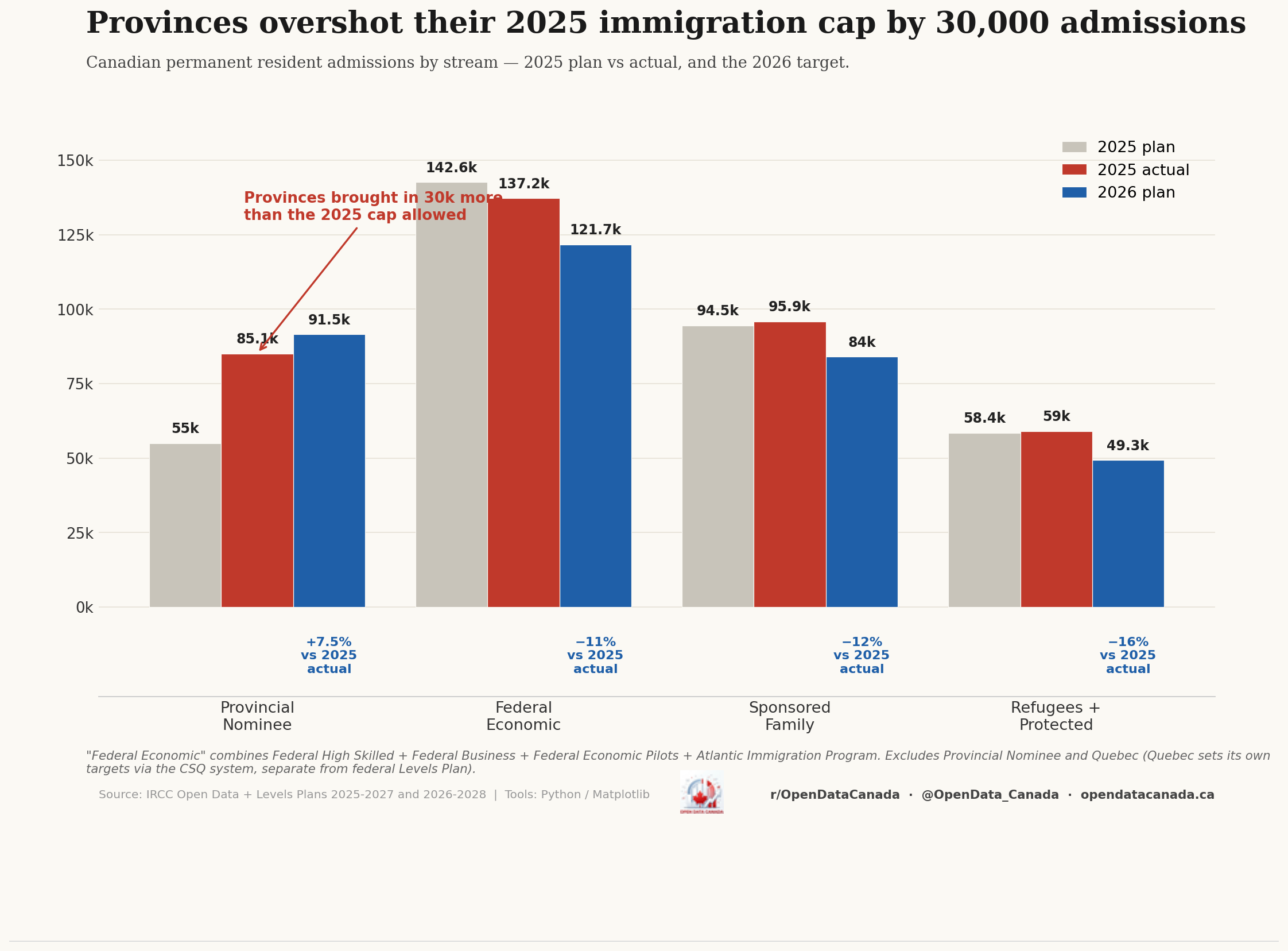
The 2025 plan also said 55,000 PNP admissions. The actual number for 2025 was 85,110. Provinces nominated 30,000 more permanent residents than the federal cap allowed and IRCC processed them anyway. The 2026 plan's "increase" mostly catches up to what was already happening.
What the data actually says
The 2025 plan, set in October 2024, was on paper a serious cut. Total PR admissions were supposed to fall from 483,000 in 2024 to 395,000 in 2025 — about 90,000 fewer permanent residents in a single year. The aggregate cap mostly held. Final 2025 actuals: 392,740.
The mix is where it gets interesting.
| Stream | 2024 actual | 2025 actual | 2024 → 2025 change |
|---|---|---|---|
| Provincial Nominee | 114,910 | 85,110 | −26% |
| Worker Program (Federal Economic) | 148,565 | 137,235 | −8% |
| Sponsored Family | 105,740 | 95,925 | −9% |
| Refugees + Protected | 76,505 | 59,005 | −23% |
| TOTAL | 482,570 | 392,740 | −19% |
PNP and refugees took the steepest cuts in 2025. But PNP's cut, on paper, was an artifact of a plan that was wildly under-set. Provinces ignored the 55,000 ceiling and nominated 85,110. The federal cuts that actually held were against refugees, family reunification, and federal economic streams.
What 2026 actually changes
Now the 2026 plan formalizes the PNP overflow. PNP gets bumped from 55,000 to 91,500 — about where 2025 actuals already landed. The other streams don't get a recovery.
| Stream | 2025 actual | 2026 plan | 2025 actual → 2026 plan |
|---|---|---|---|
| Provincial Nominee | 85,110 | 91,500 | +7.5% |
| Federal Economic | 137,235 | 121,675 | −11% |
| Sponsored Family | 95,925 | 84,000 | −12% |
| Refugees + Protected | 59,005 | 49,300 | −16% |
| TOTAL | 392,740 | 380,000 | −3% |
The 2026 plan asks for 380,000 PR admissions — basically where 2025 ended up. The total stays roughly flat. The composition shifts further toward streams provinces select for.
Less federal merit selection. Less family reunification. Fewer refugees. More provincial nomination.
What this means for who gets in
The Provincial Nominee Program is a different selection apparatus than the federal merit system. Express Entry — the federal system PNP is gradually replacing — uses a Comprehensive Ranking Score (CRS): points for age, education, English or French proficiency, Canadian work experience. The 2024-2025 cutoffs typically landed between 470 and 540, which usually means a master's degree, strong English, and Canadian work history.
PNP streams generally lower the bar on language and education in exchange for regional ties — having worked or studied in the province, or being in a designated occupation. Each province sets its own priorities. Saskatchewan and Manitoba target truck drivers, agriculture, and trades. Atlantic provinces prioritize population retention. Alberta wants energy and trades. Ontario and BC favour tech and healthcare workers. A PNP nomination also adds 600 CRS points if the candidate also has an Express Entry profile, which essentially guarantees PR.
The shift from federal merit to provincial nomination is therefore not a shift in headcount alone. It's a shift in who gets to decide what kind of immigrant Canada wants — from a single federal point system to thirteen provincial and territorial priority lists.
Plus a one-time exit ramp. A separate IRCC measure announced 17 November 2025 grants permanent residency to 33,000 existing work permit holders, processed automatically from existing inventories starting 17 March 2026. These admissions don't appear in any stream-specific target above. They're a discretionary public policy admission outside the Levels Plan structure.
What we don't know yet
Whether 2026 actuals track the plan. The first month of data, January 2026, shows 53,255 PR admissions — annualized that's well above the 380,000 plan, but January is historically a high-volume month and one data point is noise. Whether the family and refugee cuts hold. Whether provinces continue to nominate beyond their 91,500 cap. Whether the federal economic cuts hit the streams Ottawa controls or just the categories on paper.
The 2025 numbers establish the precedent: the headline plan and the actual processing diverged by 30,000 admissions in a single stream. The 2026 plan acknowledges that divergence. What it doesn't acknowledge is the redistribution of selection authority that produced it.