Article · Population · 8 min read
Canada will pay 107 CRS points for a French speaker
In 2025 a French-speaking Express Entry candidate got invited at a Comprehensive Ranking score 107 points lower than an otherwise-equivalent Canadian Experience Class candidate. The gap is the policy lever, the gap is structural, and the gap pulls Canadian immigration toward a set of source countries that Canada has not historically selected from at this scale.
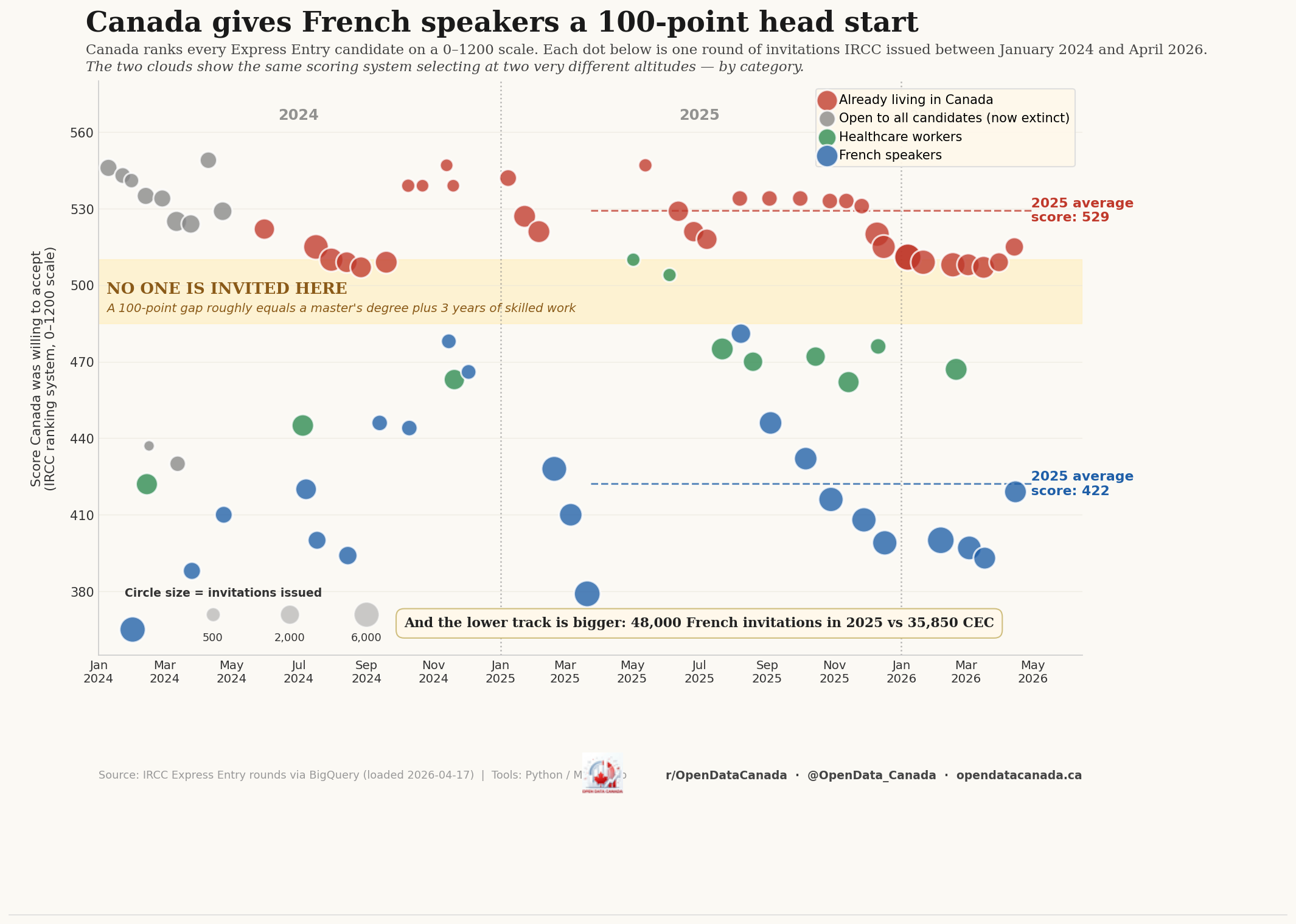
If you have not been following Canadian immigration mechanics this is going to read as strange, so let us start with what the chart is.
Canada runs Express Entry — its main economic-immigration program — by ranking every applicant on a single 0-to-1200 scale called the Comprehensive Ranking System. Roughly every two weeks, Immigration, Refugees and Citizenship Canada (IRCC) holds a "round of invitations" where they pick everyone above some cutoff score and send them invitations to apply for permanent residency. Higher score, better odds. The CRS itself is points-for-everything: education, work experience, English and French language scores, age, Canadian study or work history, a job offer, a provincial nomination. There is one number per candidate, and it is the number the system runs on.
What the chart shows is every IRCC round of invitations between January 2024 and April 2026 — 134 draws — plotted by the cutoff score the round drew at. Each circle is one round. The circle's height is the score Canada was willing to accept. The circle's size is the number of invitations issued. The colour is the round's category.
There are two clouds.
The red cloud sits between CRS 510 and 560. Those are the Canadian Experience Class draws — rounds that invite candidates already in Canada on a work permit, who tend to score high because Canadian work experience is heavily weighted in the CRS rubric. In 2025 the red cloud's average was 529.
The blue cloud sits between CRS 380 and 485. Those are the French-language-proficiency draws — rounds that only invite candidates who have demonstrated French at Canadian Language Benchmark 7 or above. In 2025 the blue cloud's average was 422.
The 107-point gap between the two averages is the entire story.
What 107 CRS points actually buys
Saying "107 CRS points" sounds like a lot if you know the system and like nothing if you don't. Here is what 107 points represents in the actual Express Entry rubric:
- Roughly the difference between a bachelor's degree and a PhD (about 25 points).
- Plus the difference between zero years of skilled work experience and five (about 50 points).
- Plus the difference between intermediate English and advanced English in all four CLB measures (about 30 points).
Add those up and you are most of the way to 107. A French-speaking applicant who is missing the PhD, missing five years of work experience, and only at intermediate English ends up at the same place in the Express Entry pool as someone who has all three but no French. That is how big a 107-point head-start is.
It also matters that 107 points is roughly the lower bound of the gap, not the upper bound. The largest single Express Entry draw of 2025 — held on March 21, 2025 — invited 7,500 French speakers at a CRS cutoff of 379. A non-French-speaking general applicant at 480 in 2025 received nothing. The same applicant with French CLB 7 received multiple invitations.
How the gap got there
This is not an accident or a quirk of the scoring system. It is a deliberate federal policy whose target is fixed in legislation.
In June 2023 the Minister of Immigration gained the authority to direct IRCC to hold "category-based" draws targeting specific federal economic priorities. Six categories were named: French-language proficiency, healthcare and social services, STEM occupations, skilled trades, transport, and agriculture and agri-food. A seventh — education — was added in early 2025. In each of these categories the Minister can direct IRCC to invite only candidates from the targeted profile, at whatever cutoff score the round produces.
The cutoff score in a category-based draw is whatever it is. If the targeted pool only has 5,000 candidates above CRS 480, then the cutoff lands at CRS 480 and 5,000 invitations go out. If you are not in the targeted pool, the round does not see you.
In parallel, the federal government's 2023 Francophone Immigration Policy committed to growing the Francophone share of permanent-resident admissions outside Quebec from roughly 4.4% to 8.0% by 2026, and the Bill C-13 modernization of the Official Languages Act in June 2023 made that target a statutory obligation rather than a political aspiration. By 2024 IRCC was visibly behind.
Category-based draws are how IRCC is catching up. The volume tells the story. French invitations went 8,700 in the second half of 2023, 23,000 in 2024, and 48,000 in 2025 — a 5.5× increase over two and a half years. By 2025 French was Canada's single largest category-based draw stream by a factor of three over Healthcare, the next largest.
The source-country implication few people are tracking
"French CLB 7+" is, mechanically, a filter that selects from a fairly specific pool of countries: France, Belgium, Switzerland, Quebec residents emigrating to other provinces, the Maghreb (Algeria, Morocco, Tunisia), Sub-Saharan Francophone Africa (Cameroon, Senegal, Côte d'Ivoire, Madagascar, the Democratic Republic of the Congo, Mali, Burkina Faso, Niger), Haiti, Mauritius, and a residual flow from Lebanon and Vietnam.
These are not the populations Canada was selecting through Express Entry in 2018. India, the Philippines, China, Nigeria, and Pakistan accounted for the majority of pre-2023 Express Entry admissions, and English-language scoring on the CRS is structured in a way that tends to pull from those countries even when no language category is being run.
Forty-eight thousand invitations a year toward a Francophone pool — and the pool is not theoretical, IRCC's own admissions data shows real flows from Cameroon, Algeria, France, Senegal, and Tunisia growing in lockstep with the category-based draw cadence — is the largest deliberate source-country reshape of Canadian economic immigration since Express Entry launched in January 2015.
The conversation about who Canada immigrates from in 2026 is happening, but mostly in the context of the post-2024 international-student cap and its effect on study-permit issuance. The shift inside Express Entry is bigger and is happening with much less public attention.
The methodology criticisms worth taking seriously
Objection one: the 107-point gap doesn't account for the Francophone-bonus points already in the CRS rubric.
Partially correct. The CRS rubric awards an additional 25 points for French CLB 7+ on top of whatever language base score a candidate has. So a French-speaking applicant's CRS score is, all else equal, already 25 points higher than the same applicant without French. The gap between the actual cutoffs (107 points) and the bonus already baked into scoring (25 points) leaves an effective discount of about 80 points — still the largest standing language-based score advantage in any G7 country's economic-immigration system, but smaller than the headline figure suggests.
Objection two: French-stream draws produce smaller numbers of high-quality candidates because the pool is small, so direct cutoff comparisons are misleading.
Partially correct, and not a defense of the gap. The Francophone Express Entry pool is smaller than the general pool, which is why category-based draws clear so deeply into the score distribution. But the policy choice is to invite the entire targeted pool down to whatever cutoff produces the targeted volume — not to compete the targeted pool against the rest of the system. The gap is not an artifact; it is the mechanism.
Objection three: this is just Quebec-driven preference and Quebec runs its own immigration system anyway.
Incorrect framing. Quebec selects its own immigrants through the Programme régulier des travailleurs qualifiés and is largely separate from federal Express Entry. The Francophone target Bill C-13 codifies is specifically for Francophone immigration outside Quebec — Ontario's North, Manitoba's Saint-Boniface, Acadia in New Brunswick, Sudbury, Ottawa, Alberta's Bonnyville. The 48,000 French Express Entry ITAs in 2025 are intended for those receiving communities, not Quebec.
Objection four: 2026 data is partial and might change the picture.
Correct caveat. The dataset behind this article was loaded on 2026-04-17 and contains all 134 IRCC draws through April 15, 2026. Any draws between that date and publication are not reflected. Through April 15, 2026 the trend has continued — French has issued 22,000 invitations in just over three months, on track to exceed 2025's 48,000.
What we still do not know
Three things this dataset does not answer that the next year of data will:
Acceptance rates. We have invitations issued, not the share that result in submitted PR applications, nor the share that get approved, nor the share that actually arrive in Canada. International-student-cap tightening in 2024–2025 has plausibly reduced the acceptance rate for category-based ITAs from countries that historically rely on study-permit-to-PR pathways, but IRCC's open-data publishing schedule does not yet let us see this cleanly.
Province of settlement. A French speaker invited in a federal Express Entry round can settle anywhere in Canada (except Quebec, which has its own selection). The 8% target is for Francophone admissions outside Quebec. Whether the 48,000 invitations are translating into Francophone settlement in Acadia, Sudbury, Saint-Boniface, and other receiving communities — or whether arrivals are concentrating in Ontario and BC's English-language anglophone metros and assimilating linguistically within a generation — is not yet visible in the data.
The 2026 ceiling. The federal government's own published 2026 target ratio for Francophone admissions outside Quebec is 8.5%, rising to 9.5% by 2027 and 10% by 2028. The CRS gap will probably need to widen, not narrow, to hit those numbers — unless the Francophone applicant pool grows faster than we have seen, which would itself be a function of the diaspora networks the program is starting to build.
The one thing the data does say cleanly is the headline. In 2025 Canada's Express Entry program invited a French-speaking applicant at a score 107 points below an otherwise-equivalent applicant who did not speak French. That is the largest standing language-based selection differential in the G7. It is the largest single mechanism reshaping who Canada selects through its main economic-immigration channel. And it is happening without much of a conversation.
Read next