Article · Population · 6 min read
Canadian millennials are twice as likely to live with their parents as boomers were
In 2021, 16.3 percent of Canadian millennials aged 25 to 39 still lived in a census family with at least one parent. The same age group, measured in 1991 when it was filled with baby boomers, sat at 8.2 percent. The 30-year doubling is the headline. The harder fact is that the 16.3 percent figure is already four years old, and every condition that produced it has worsened since.
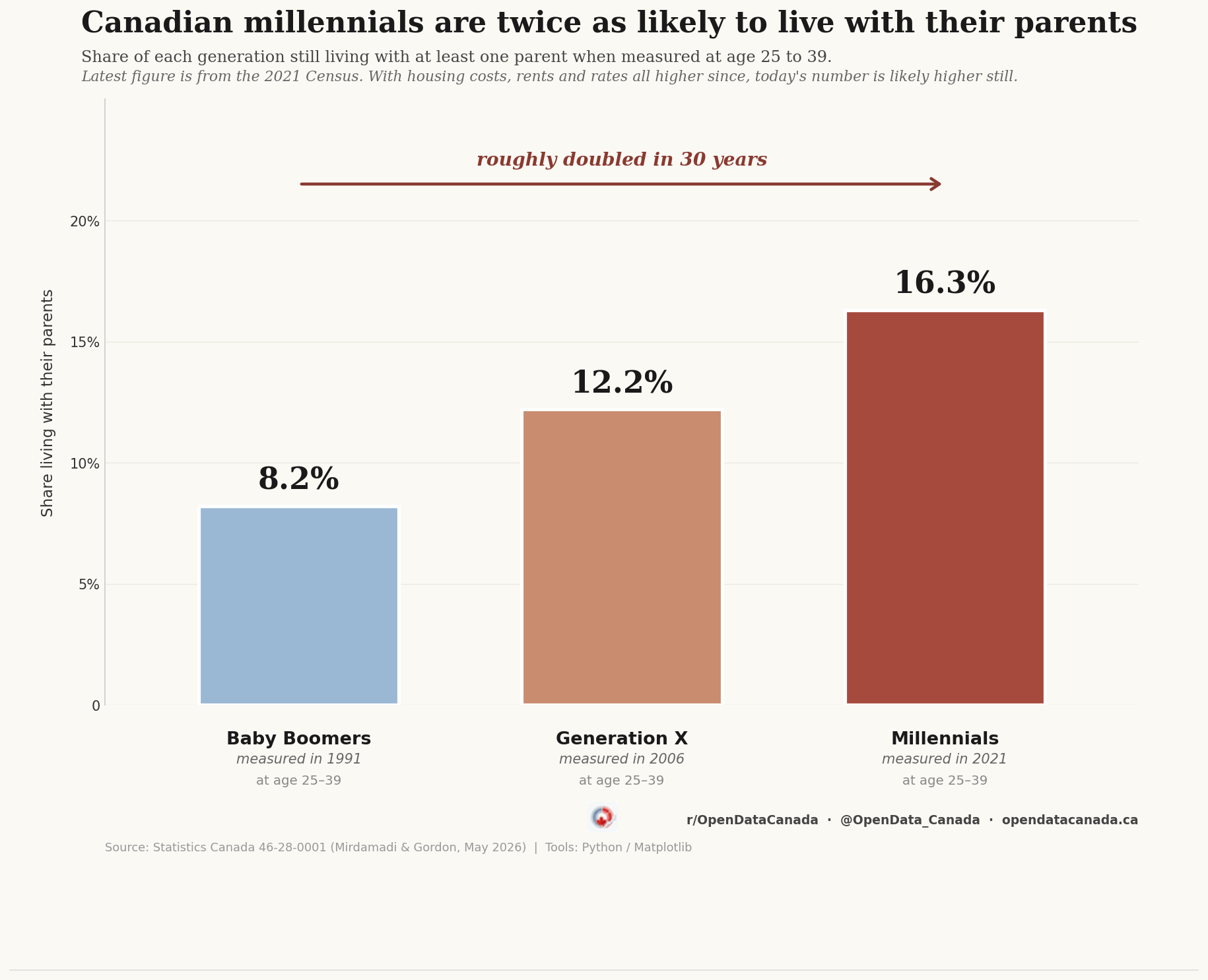
The chart is built on a deliberately strict comparison. Each bar shows the share of one Canadian generation that was still living with at least one parent when that generation was aged 25 to 39 — a life stage by which most adults have historically left the parental home, partnered up, and started running a household of their own. Boomers were 25 to 39 in 1991. Gen X was 25 to 39 in 2006. Millennials were 25 to 39 in 2021. Three different generations, the same age window, the same census definition of household.
What the comparison does is strip away the obvious objection. If you point at any single census and notice that lots of young people live with their parents, the natural reply is "that's just because they're young — they'll move out." Holding age constant kills that reply. At the same point in life, the cohort born in the early 1990s is twice as likely to be at home as the cohort born in the late 1950s.
The 25-to-29 group is where the doubling actually happened
The 16.3 percent headline averages across a 15-year age span, and the doubling is not evenly distributed across it. Statistics Canada's underlying tables break the same series out by five-year age band:
- Ages 25 to 29. 15.7 percent of boomers (1991) → 23.8 percent of Gen X (2006) → 31.1 percent of millennials (2021). Roughly doubled.
- Ages 30 to 34. 5.8 percent → 8.8 percent → 12.6 percent. Roughly doubled.
- Ages 35 to 39. 3.0 percent → 5.1 percent → 6.5 percent. Roughly doubled, but on a much smaller base.
The takeaway is that "millennials in their late twenties" is where the picture has changed most dramatically — almost one in three. By a millennial's mid-thirties the rate is back down near 6 percent, which is to say most do eventually leave. The shift is not that millennials never leave home. It is that they leave later, and a larger fraction of the late-twenties window now happens under a parental roof than at any point in the post-war period for which we have comparable data.
Toronto is the staying-home capital. Halifax is the leaving-home capital.
Within the 2021 millennial cohort the regional spread is enormous. Statistics Canada's tables for the eight largest Census Metropolitan Areas show:
- Toronto — 26.1 percent of millennials still at home
- Vancouver — 19.3 percent
- Winnipeg — 16.1 percent
- Montréal — 14.9 percent
- Ottawa–Gatineau — 14.7 percent
- Calgary — 12.8 percent
- Edmonton — 12.5 percent
- Halifax — 10.8 percent
The pattern follows the housing-cost gradient almost perfectly: the cities where staying with parents is most common are the same cities where independent rent or a starter mortgage is most expensive relative to typical millennial income. Toronto's 26.1 percent is more than double Halifax's 10.8 percent, and the eight CMAs sort cleanly from west-coast and Greater-Toronto pressure cookers down to the prairie and Atlantic markets where leaving home at 27 is still the modal outcome.
And homeownership at the same age is going the other way
The other half of the StatCan paper — the one that takes some sting out of the staying-home story — is that even with the implicit subsidy of free or cheap parental housing, millennials are still buying less than the previous two generations did at the same age. Statistics Canada's adjusted homeownership series for the 25-to-39 window:
- Boomers (1991) — 55.9 percent owned
- Gen X (2006) — 56.2 percent owned
- Millennials (2021) — 49.9 percent owned
Six percentage points lower than Gen X. The gap is not closed by living with parents longer; in StatCan's tables, living with parents and not yet owning are not substitutes — they are the same shape of constraint, observed in two different parts of the same balance sheet. Millennials who are still at home at 30 are usually also not yet on title for a home of their own. The two trends move together.
That matters because "millennials live at home longer" is sometimes argued to be a pure preference shift — extended adolescence, more travel, delayed marriage. The homeownership data makes the preference reading harder to defend. If the preference were for delayed adulthood per se, you would expect millennials at 35 to 39 — the cohort that has already left home — to own homes at roughly the boomer rate when they finally do start. They do not. At 35 to 39 the millennial homeownership rate is 64.2 percent versus 69.5 percent for boomers. The gap survives even when you condition on the leaving-home decision having already happened.
The 2021 caveat: numbers are almost certainly higher now
The 16.3 percent figure is from the long-form 2021 Census. The next census is in the field right now — May 2026 is the reference month — but the family-and-dwelling release is, based on the 2021 publication cadence, not expected before mid-to-late 2027. Until that lands, 16.3 percent is the most recent verified figure.
It is also almost certainly an undercount of where the 2026 number will land, because every condition the StatCan authors identify as a driver has worsened since 2021:
- The Bank of Canada's overnight rate moved from 0.25 percent in 2021 to a 5.00 percent peak in 2023 and remains in the 2.75-to-3.25 range through early 2026. Five-year fixed mortgage rates moved from a sub-2 percent floor in 2021 to a 5-to-7 percent range during 2022 through 2024. The monthly carrying cost of a starter home has, in much of urban Canada, roughly doubled.
- CMHC's national rental market reports show average two-bedroom rent up by roughly 25 percent between October 2021 and October 2024 in the major Census Metropolitan Areas, with Toronto, Vancouver, and Calgary above the national average.
- House prices, despite the rate hikes, did not collapse. The price-to-income ratio in Toronto and Vancouver remains near record highs.
- The age of first marriage and first cohabitation has continued drifting later, removing one of the historical triggers for leaving the parental home.
What this article does not do is put a number on the 2026 figure. There is no annual-frequency public series tracking "share of 25-to-39-year-olds living with parents" in between censuses, and an estimate constructed from the Labour Force Survey or the Canadian Income Survey would not be directly comparable to the census measure StatCan uses. The honest version of the story is the one the chart tells: 8.2 → 12.2 → 16.3 across three census points, and a strong prior — supported by every conditioning variable — that the 2027 release will produce a fourth point higher still. A different Statistics Canada survey, covering a younger age band, recorded a similar rise in the meantime.
What this is not
A few framings that are reasonable to consider and reject:
It is not a story about choice. Some millennials live with parents because it is the right family arrangement for them — multigenerational caregiving, immigrant household structures where extended family co-residence is the cultural baseline, mutual support through illness or job loss. Statistics Canada's separate work on multigenerational households estimates that roughly 6.5 percent of all Canadians live in a three-generation home. That share has grown too, but more slowly than the staying-with-parents share has. The two trends are related but not identical, and the 16.3 percent figure includes both circumstantial and chosen arrangements.
It is not an immigrant-driven story. Statistics Canada cross-tabulates the rate by immigration status. Millennials born in Canada and millennials who immigrated to Canada both show the same upward trend across generations. The pattern is not concentrated in any single subgroup.
It is not a story about Quebec. Quebec's at-home rate (14.9 percent for Montréal millennials) is below the Canadian average. The shift is most visible in Ontario and British Columbia, where house prices have moved most relative to local incomes. The pattern that drives the headline is the housing cost pattern.
It is not a story about adolescence extending into the late thirties. By age 35 to 39, only 6.5 percent of millennials are still at home — most do leave. The late-twenties bulge is the real change.
What the next census will tell us
Three things the 2027 release will settle:
Whether the doubling continued or plateaued. Linear extrapolation of the three census points would put the 2026 number near 19 percent. The 2021-to-2026 housing-cost trajectory makes a number above 19 percent the central case, but the post-pandemic family-formation rebound and immigration-driven household formation are both pushing the other direction. The mid-2027 release will be the first clean read.
Whether the regional spread widened. Toronto-versus-Halifax was already a 2.4× ratio in 2021. The 2022-to-2024 rent and price moves were much larger in Toronto than in Halifax. If the regional gradient tracks housing costs as cleanly going forward as it has historically, the 2026 Toronto number will sit somewhere in the low thirties.
Whether the homeownership gap closed or widened. The boomer-versus-millennial homeownership gap at age 25-to-39 was 6 percentage points in 2021. Whether the gap stays at six, widens to ten, or closes back as boomer-aged millennials finally get into the market in their late thirties is the most policy-load-bearing question in the dataset.
What the 2026 Census cannot tell us is the counterfactual — what Canadian household formation would have looked like over the past five years under a different rate environment, a different housing-supply trajectory, or a different ratio of population growth to dwelling completion. For that, the right framework is the one the StatCan authors gestured at in their final paragraph: this is not a millennial story or even a housing story. It is a story about how a country's housing system converts price signals into living arrangements.
When prices rise faster than incomes, more young adults stay home longer. When the doubling has held across thirty years, three census points, eight metros, two genders, and both immigration statuses — the simplest read is that the price signal is the binding constraint, and that the 2026 number will reflect five more years of the same constraint applied harder.
Read next