Government · Pew Research Center
Americans rate Canada and Australia warmest among G20 countries
Asked to rate 18 G20 countries from 0 to 100, Americans gave Canada 67, tied with Australia for warmest. That is down from 71 in 2018. Pew finds the decline is concentrated among Republicans, especially those 50 and older.
So how do Americans feel about Canada? Mostly warmly. In September, Pew Research Center asked U.S. adults to rate the 18 other members of the Group of 20 (G20) major economies on a "feeling thermometer", where 0 means as cold and negative as possible and 100 means as warm and positive as possible. Canada averaged 67. That ties it with Australia for the top spot, just ahead of Japan (65) and Italy (64). Russia came last at 27.
Pew released the survey on October 16, ahead of the G20 summit the U.S. hosts in December.
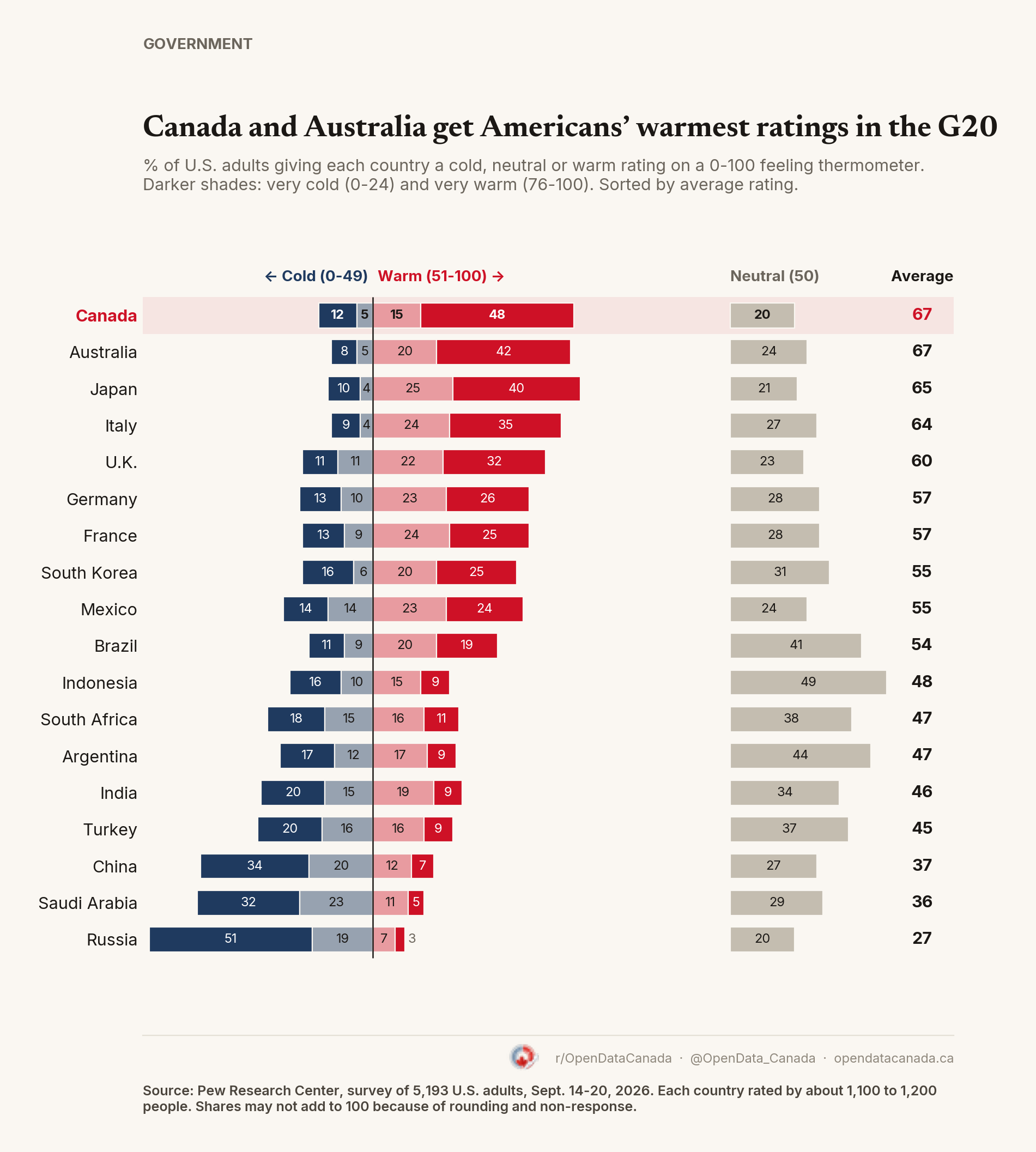
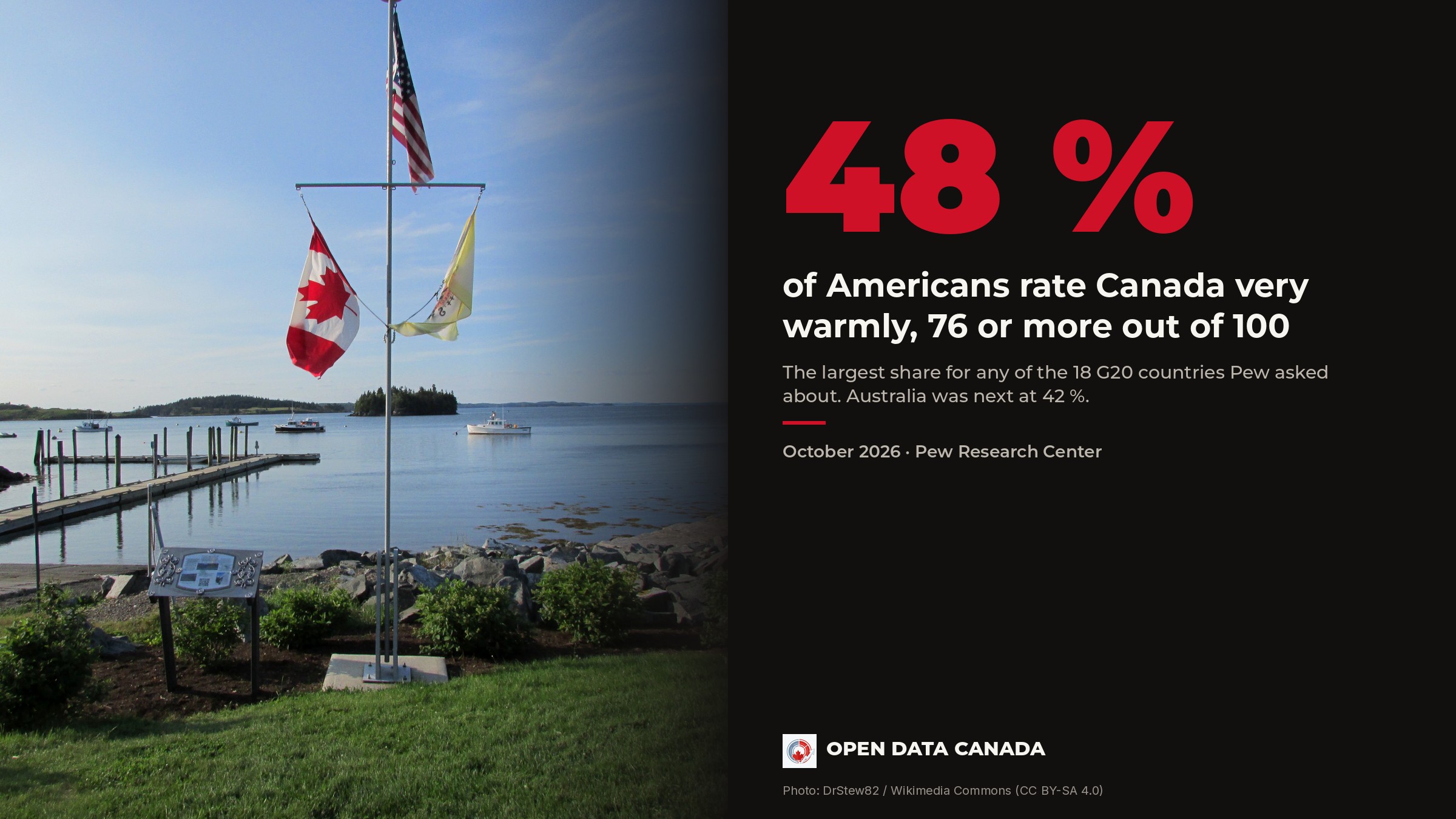
Nearly half of Americans (48%) put Canada between 76 and 100, which Pew counts as "very warm". That is the largest share for any country in the survey. Australia was next at 42%. Another 15% gave Canada a somewhat warm rating, 20% put it at exactly 50, and 17% rated it cold.
How Republicans and Democrats rate Canada
Democrats and independents who lean Democratic gave Canada 77, their highest rating for any country and eight points above their next choice, Australia (69). Republicans and Republican-leaning independents gave Canada 58, behind Australia (65), Japan (65) and Italy (64).
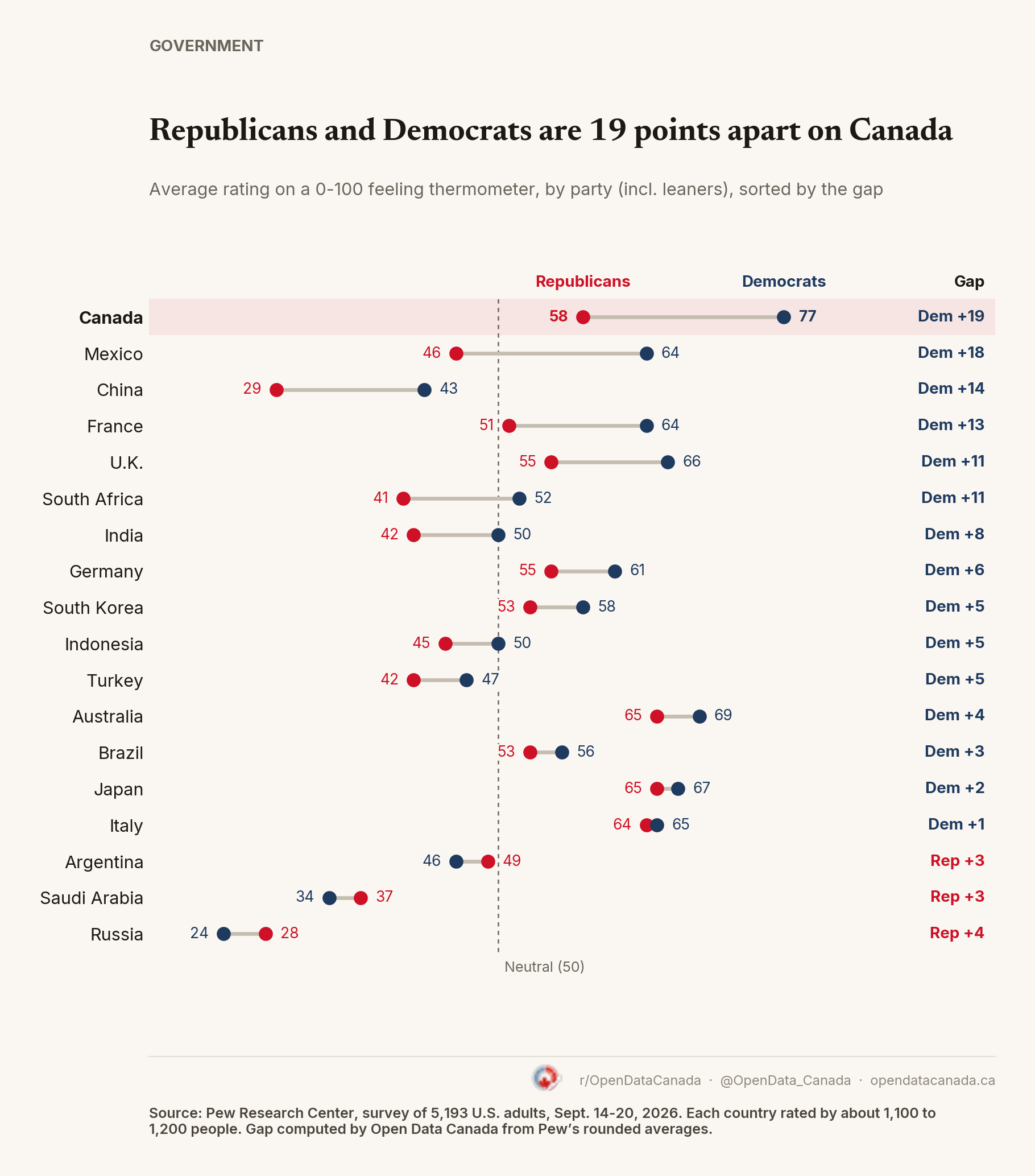
The 19-point gap on Canada and the 18-point gap on Mexico are among the widest partisan gaps in the survey, Pew says. For most countries the two parties are within about five points of each other. Pew identifies Russia as the only country Republicans feel more warmly toward than Democrats do, 28 to 24.
What has changed since 2018
Pew has earlier readings for eight of the 18 countries, from surveys in 2016, 2018 or 2021. It last asked about Canada in the summer of 2018, when the average was 71. Now it's 67. Over the same period the share giving Canada a warm rating (51 to 100) went from 67% to 63%, and the share giving it a cold rating (0 to 49) went from 12% to 17%. Pew describes this as a slight cooling.
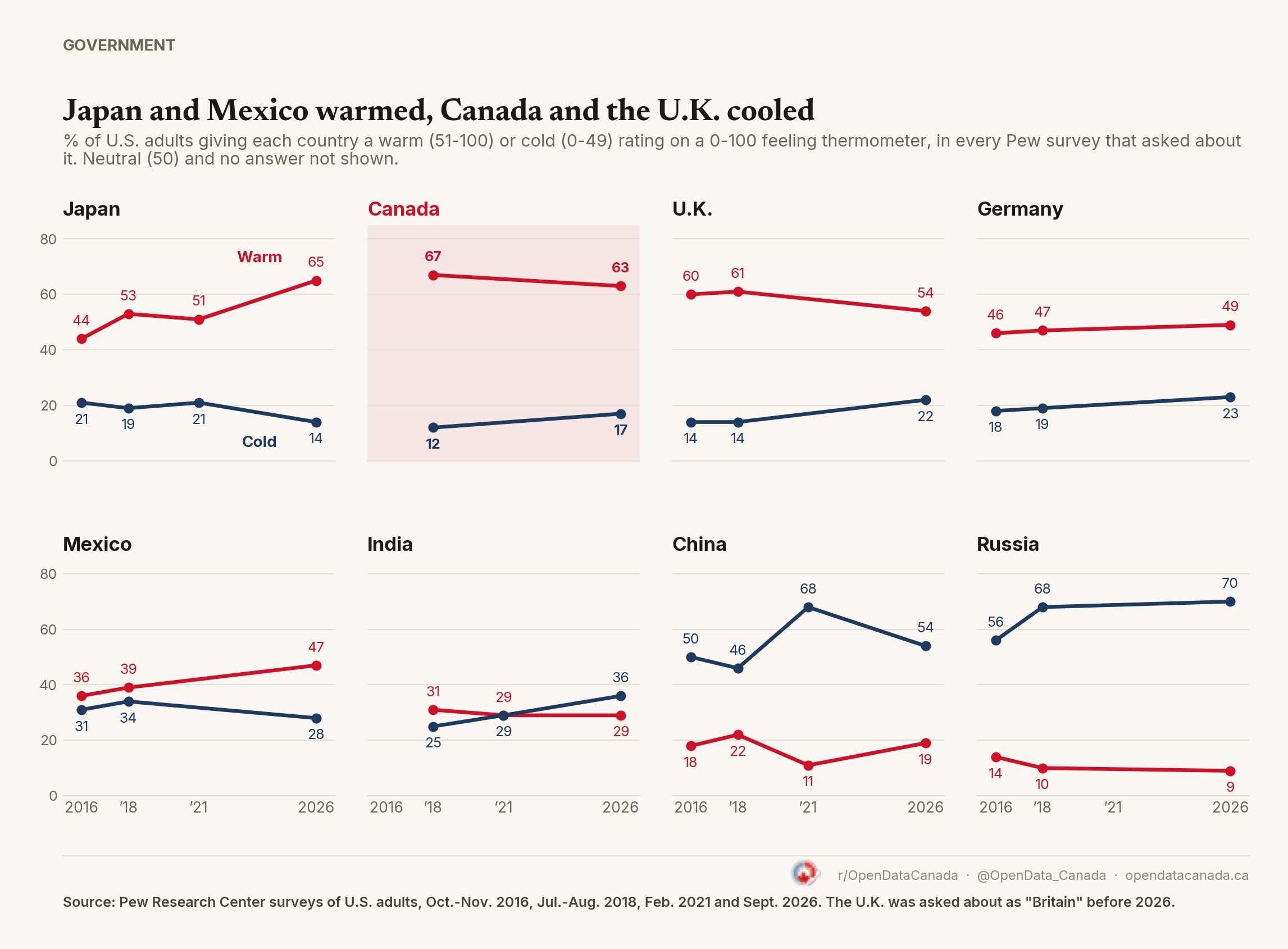
Other countries moved more. Japan's warm share rose from 44% in 2016 to 65%, and Mexico's from 36% to 47%. China's warm share is up from 11% in 2021 to 19%, and its cold share is down from 68% to 54%. The U.K. went the other way: its warm share fell from 61% in 2018 to 54%, which Pew calls a significant cooling "driven primarily by shifting views among Republicans". India's cold share rose from 25% in 2018 to 36% as fewer people gave it a neutral rating. Russia's cold share is 70%, close to 2018's 68% and up from 56% in 2016. Germany has held steady, with a warm share between 46% and 49% in all three surveys.
Which Americans changed their view of Canada
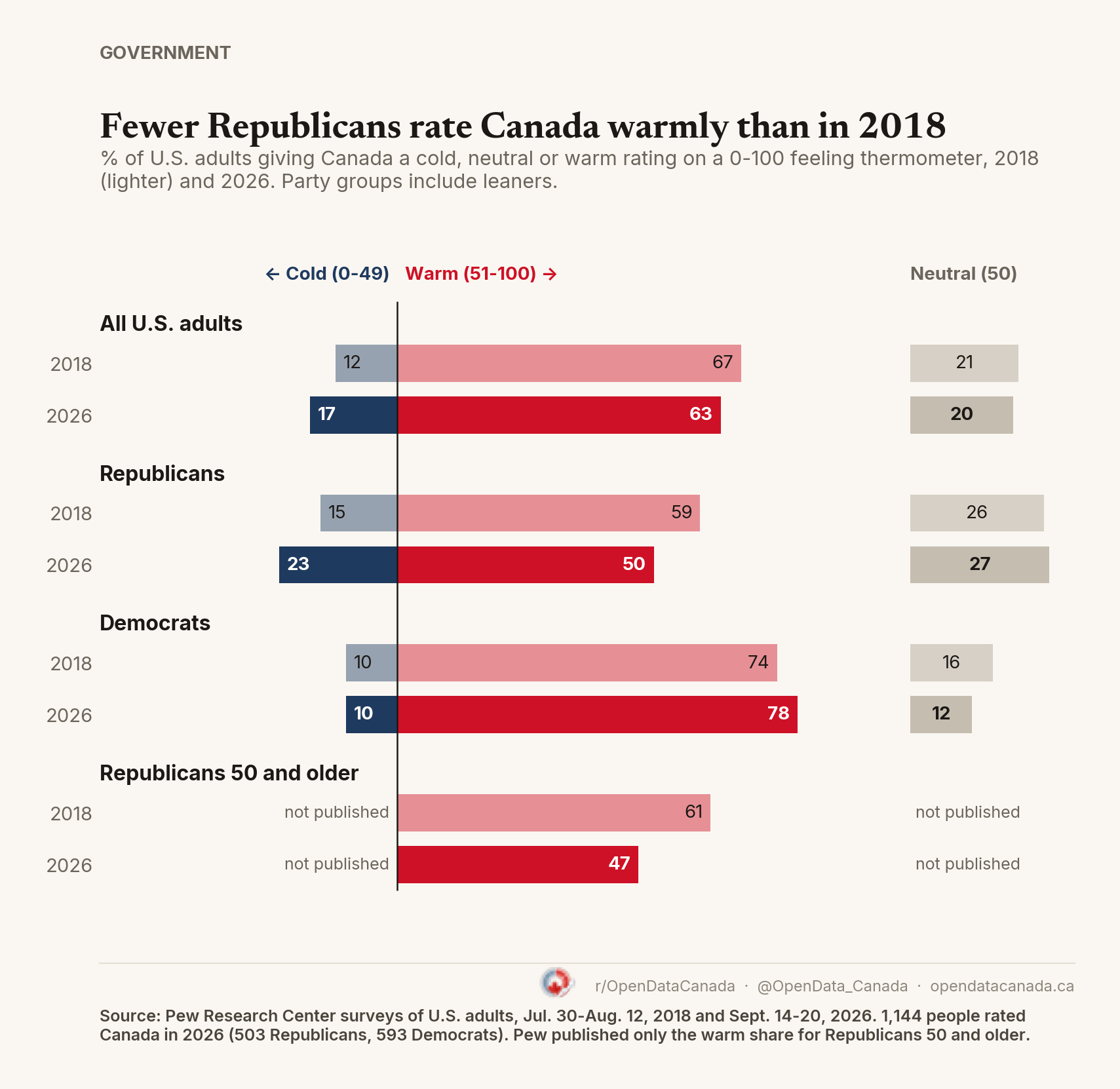
Among Republicans, the share with a warm view of Canada fell from 59% in 2018 to 50%, and the share with a cold view rose from 15% to 23%. The change is largest among Republicans 50 and older: 61% rated Canada warmly in 2018, 47% do now. Pew finds no significant change among younger Republicans. Among Democrats, 74% rated Canada warmly in 2018 and 78% do now, a change Pew does not count as meaningful.
Age on its own makes almost no difference. Americans under 50 gave Canada 67 and those 50 and older gave it 68. The change Pew finds is among older Republicans specifically.
Pew doesn't give a reason for the shift, and the survey didn't ask for one. Both surveys were taken while Donald Trump was president.
How Canadians rate the U.S.
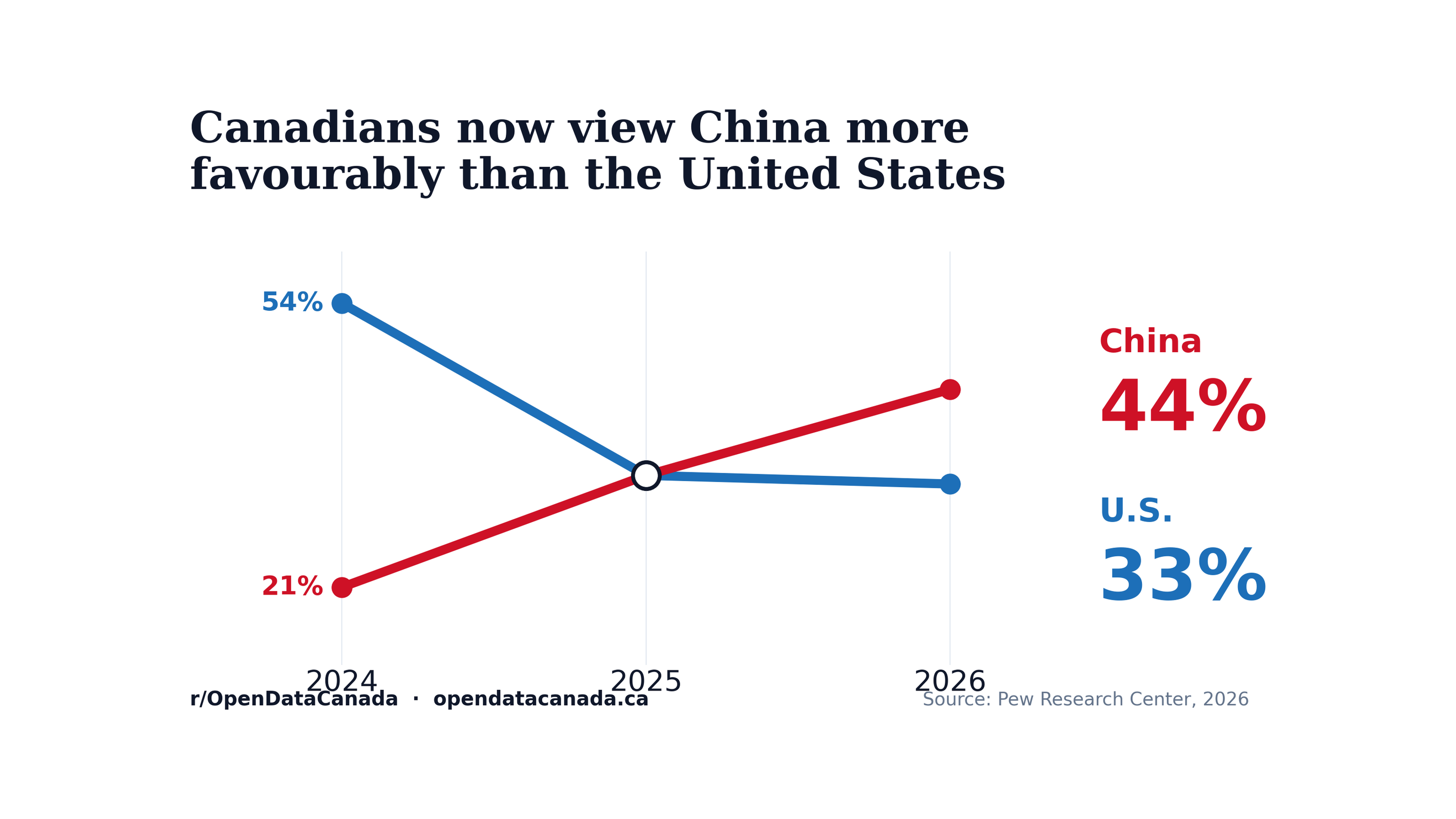
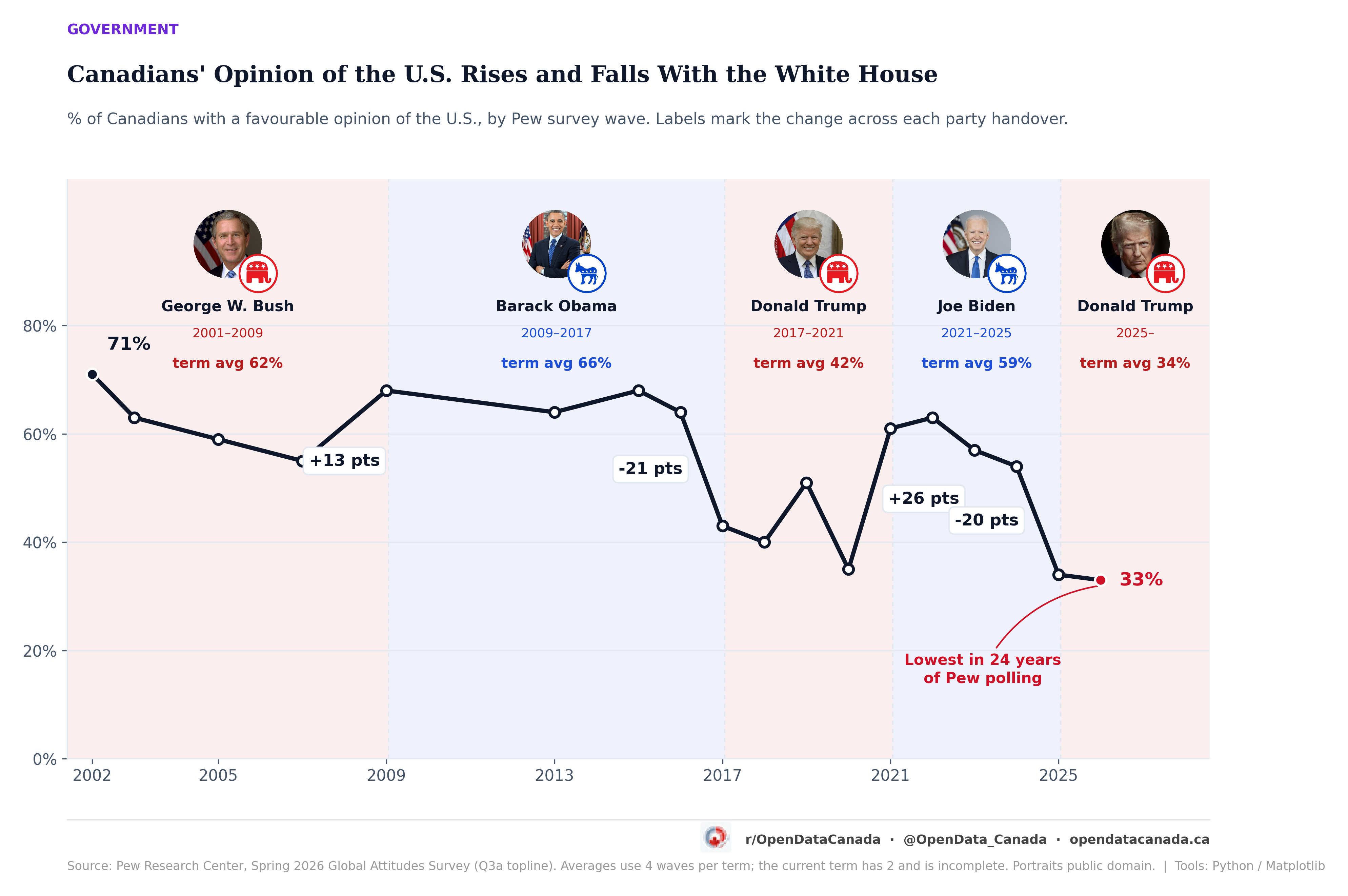
Canadian views of the United States have dropped sharply. In Pew's spring 2026 survey, 33% of Canadians had a favourable view of the U.S. and 38% had a very unfavourable one, the lowest U.S. reading in Canada since Pew began asking in 2002 (our July analysis). Canadian return trips from the U.S. were down 52.8% from their August 2024 peak by February 2026 (Statistics Canada travel data).
The two surveys ask different questions, a 0-to-100 thermometer in the U.S. and a four-point favourable-or-not scale in Canada, so their numbers can't be compared directly. Each on its own terms: 63% of Americans rate Canada warmly, and 66% of Canadians view the U.S. unfavourably.
For how Canadian opinion of the U.S. has tracked each change of president since 2002, see Canadians reprice America every time the White House changes hands.
Overall, Canada's standing with Americans has moved little: 67 out of 100, tied for first. The distance between the parties has grown. In 2018, 74% of Democrats and 59% of Republicans rated Canada warmly, 15 points apart. In 2026 it is 78% and 50%, 28 points apart.