Article · Government · 6 min read
Canadians rate China above the U.S. again, and by the widest margin yet
Pew's 2026 survey finds 44 percent of Canadians view China favourably against 33 percent for the United States, the lowest U.S. reading in Canada since Pew began asking in 2002. It is the second time Canadians have rated China the higher of the two, after a narrower crossover during Donald Trump's first term. Both times, a collapse in views of the U.S. did the work.
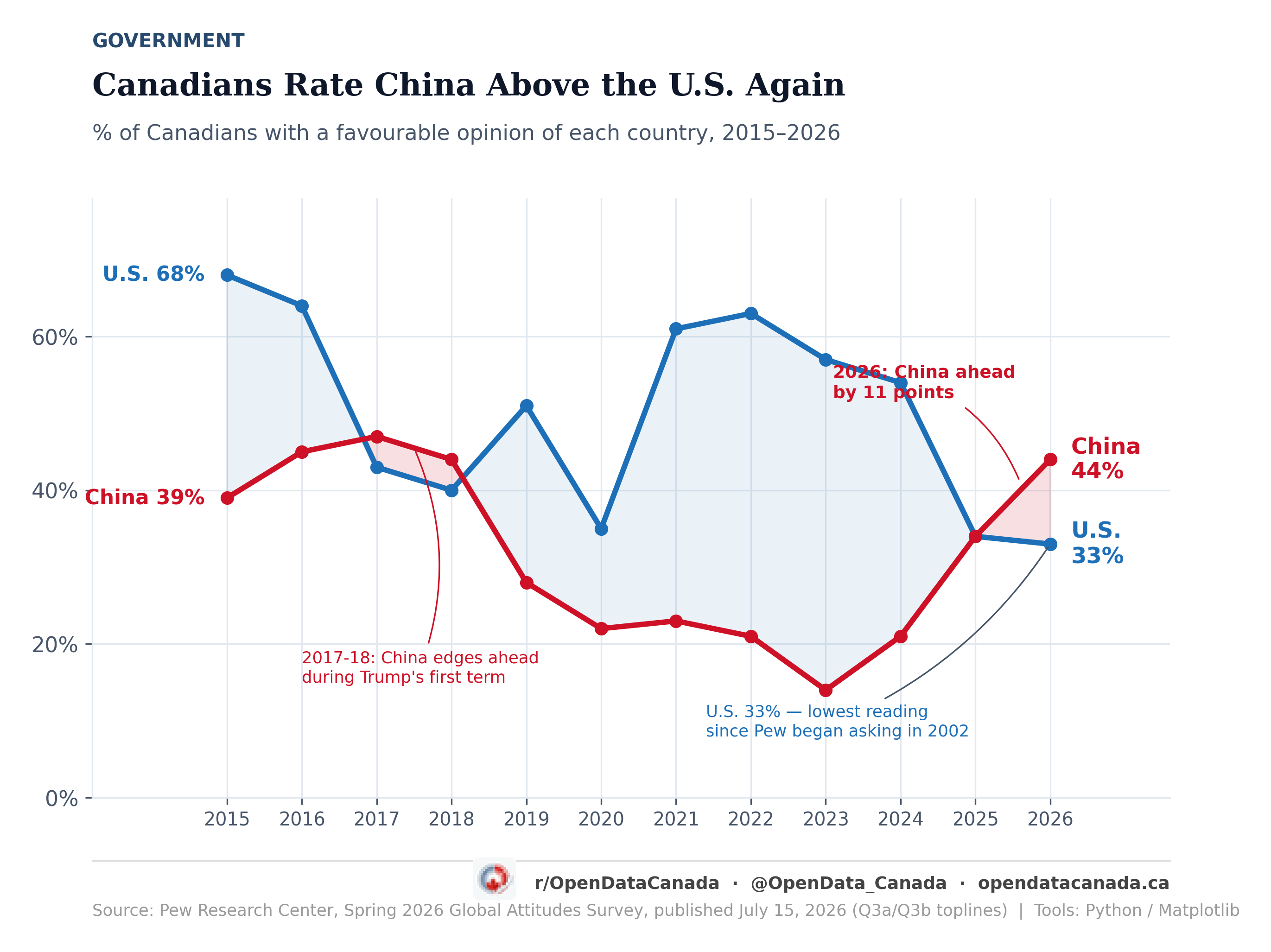
In July 2026, 44 percent of Canadians reported a favourable opinion of China against 33 percent for the United States, an 11-point edge for Beijing. The U.S. figure is the lowest Pew has recorded in Canada since it began asking the question in 2002.
This is not the first time the two lines have crossed. In 2017 and 2018, during Donald Trump's first term, Canadian favourability of the U.S. fell to 43 and then 40 percent while views of China held in the mid-40s, putting China narrowly ahead. What is new in 2026 is the size of the gap. At 11 points it is the widest margin by which Canadians have preferred China to the United States in the history of the series.
What the data says
Two things moved, and they moved in opposite directions. Canadian favourability of the United States fell from 57 percent in 2023 to 33 percent in 2026, a 24-point slide to its lowest reading since 2002. Over the same window, favourability of China climbed from a floor of 14 percent to 44 percent. The lines met in 2025, when Canadians rated the two countries about equally at roughly 34 percent each, and separated in China's favour in 2026.
| Year | Favourable: U.S. | Favourable: China | Lead |
|---|---|---|---|
| 2016 | 64% | 45% | U.S. +19 |
| 2017 | 43% | 47% | China +4 |
| 2018 | 40% | 44% | China +4 |
| 2019 | 51% | 28% | U.S. +23 |
| 2023 | 57% | 14% | U.S. +43 |
| 2024 | 54% | 21% | U.S. +33 |
| 2025 | ~34% | ~34% | roughly tied |
| 2026 | 33% | 44% | China +11 |
The pattern in the table is the story: Canadians do not so much admire China as sour on the United States, and when they sour on it hard enough, China ends up on top by default. It happened once under Trump before, in a narrower form. It has happened again, wider.
A global shift, not just a Canadian one
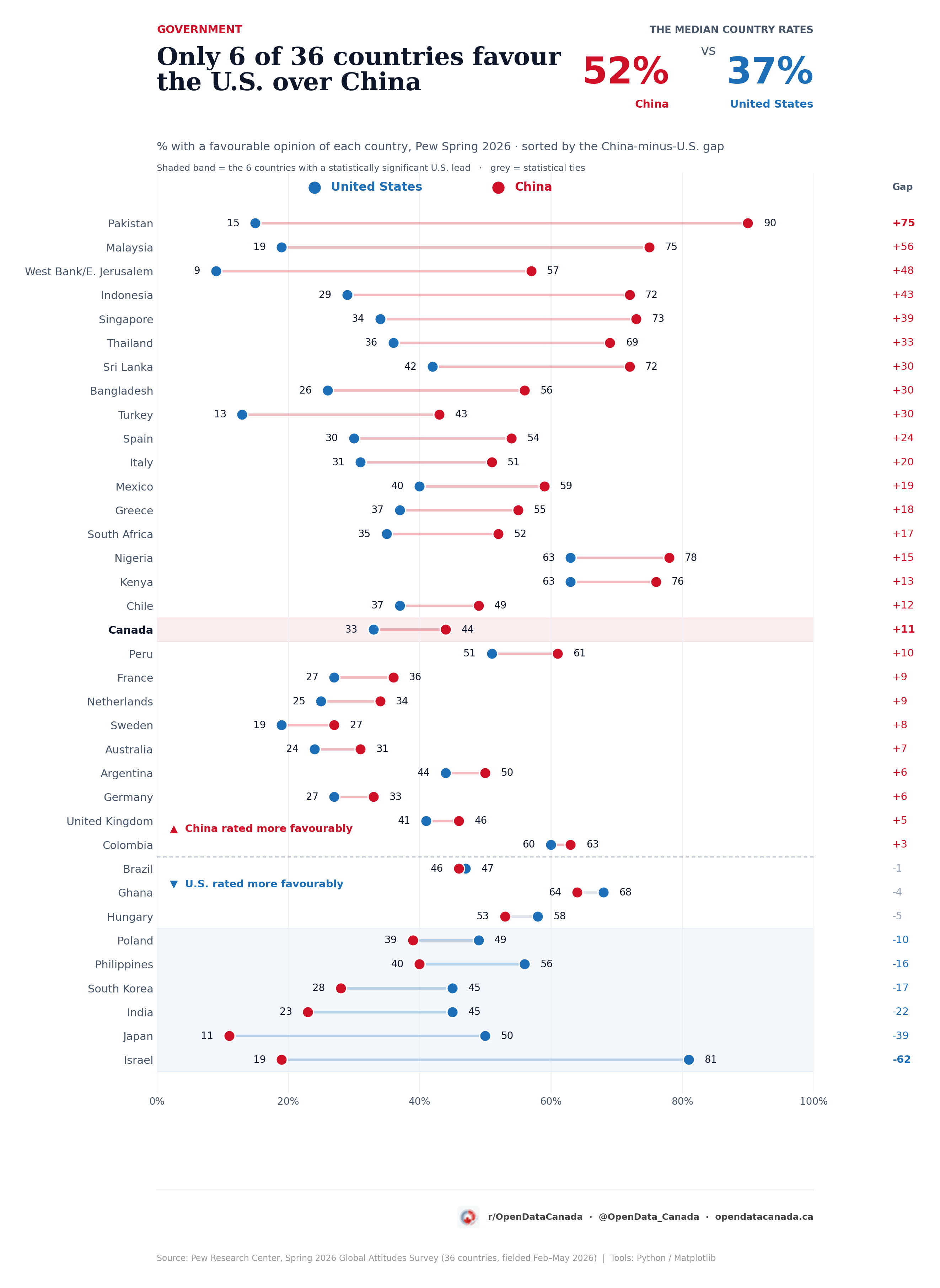
Canada's crossover is one instance of a worldwide pattern. Across all 36 countries Pew surveyed in 2026, China was rated at least as favourably as the United States in 30 of them; the United States came out clearly ahead in only six — Israel, Japan, India, South Korea, the Philippines and Poland. The median surveyed public gave China 52 percent favourability against 37 percent for the United States. Canada, at an 11-point China lead, sits almost exactly at that global midpoint.
The geography is not random. China's biggest leads cluster in Asia, Africa and Latin America: 90 percent favourability in Pakistan, and readings in the 70s across Malaysia, Indonesia, Singapore and Sri Lanka. The handful of countries that still prefer the United States are mostly its Asia-Pacific treaty allies, along with Israel, where the U.S. leads by 62 points. Canada belongs to the large China-leaning majority, its margin narrower than Mexico's or Spain's but on the same side of the ledger as most of the world.
Why the U.S. line fell
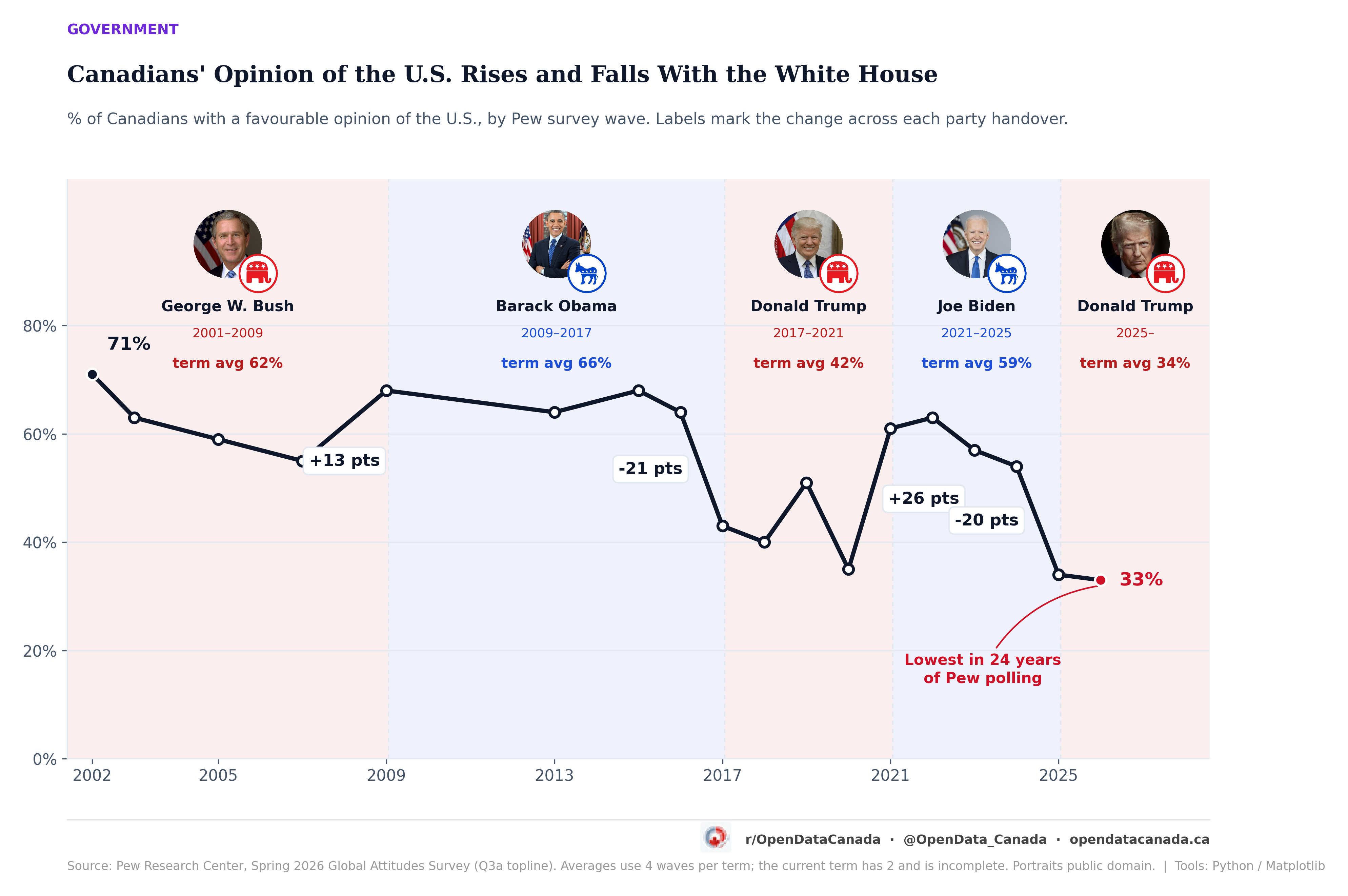
The collapse in Canadian regard for the United States tracks a specific and unusually public rupture. Through 2025 and into 2026 Washington placed tariffs on Canadian goods and the U.S. president repeatedly referred to Canada as a future 51st state. A neighbour that Canadians had rated favourably by wide margins for most of two decades became, briefly, an economic antagonist, and public opinion followed. That both of Canada's China-over-U.S. crossovers, 2017-18 and 2026, fall inside Trump presidencies is the clearest signal in the series: the swing is being driven by what Canadians think of Washington, not by any warmth toward Beijing.
Why the China line rose
The China half of the story is a recovery, not a conversion. Canadian views of China had cratered after 2018, when the arrest of Huawei executive Meng Wanzhou in Vancouver and Beijing's retaliatory detention of two Canadians, Michael Kovrig and Michael Spavor, sent favourability from 44 percent to a low of 14 percent by 2023. With both Canadians home since 2021 and the acute crisis behind it, the number has simply climbed back to where it sat before the rupture.
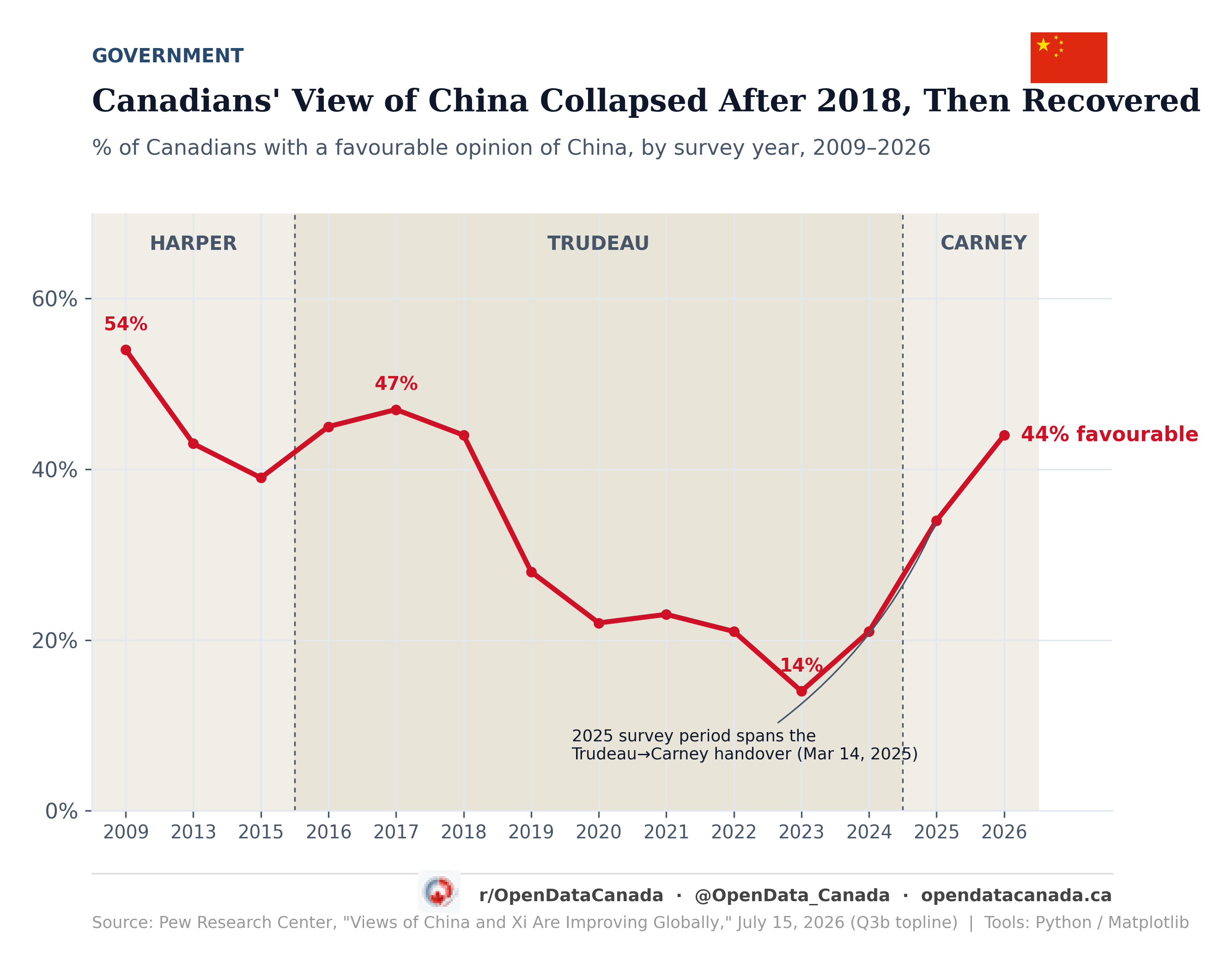
Notably, the swing does not line up with who was in power in Ottawa. Favourability held steady across the 2015 Harper-to-Trudeau handover, collapsed and recovered entirely within Trudeau's own tenure, and the 2026 high arrives under Mark Carney. The number moves with events between capitals, not with elections at home. We measured that pattern precisely across every U.S. presidential handover since 2002.
What the crossover does not mean
Favourable is not the same as trusted. Pew's wider results are a useful check: even as China out-scores the United States on general favourability, the U.S. still leads on whether a country is seen to respect the personal freedoms of its people. A Canadian can hold a dimmer view of Washington today than of Beijing without concluding that China is the better-governed or more reliable partner. The favourability question captures mood, and in 2026 the mood toward the United States is sour.
Two caveats sit on the numbers themselves. The 2025 reading is where the two lines meet, and small differences there should not be over-read. And favourability figures of this kind carry sampling margins of a few points, so the 2026 gap of 11 points is real but not enormous.
What is not in doubt is the direction. A plurality of Canadians now looks more warmly on China than on its closest ally, and by the widest margin Pew has ever recorded here. The last time it happened the gap closed as soon as the first Trump term ended. Whether it closes again when the tariff fight cools is the question the 2027 survey will answer.