Article · Economy · 6 min read
One shipment on the record in six years: Canada's forced-labour import ban now carries a US tariff
The United States has stopped 42,807 shipment lines under its forced-labour import ban. Canada, bound by the same CUSMA obligation, has one shipment on its public record, later released. Washington has been charging a 10 per cent tariff over it since July 24. Ottawa's fix has been consulted on but is not law.
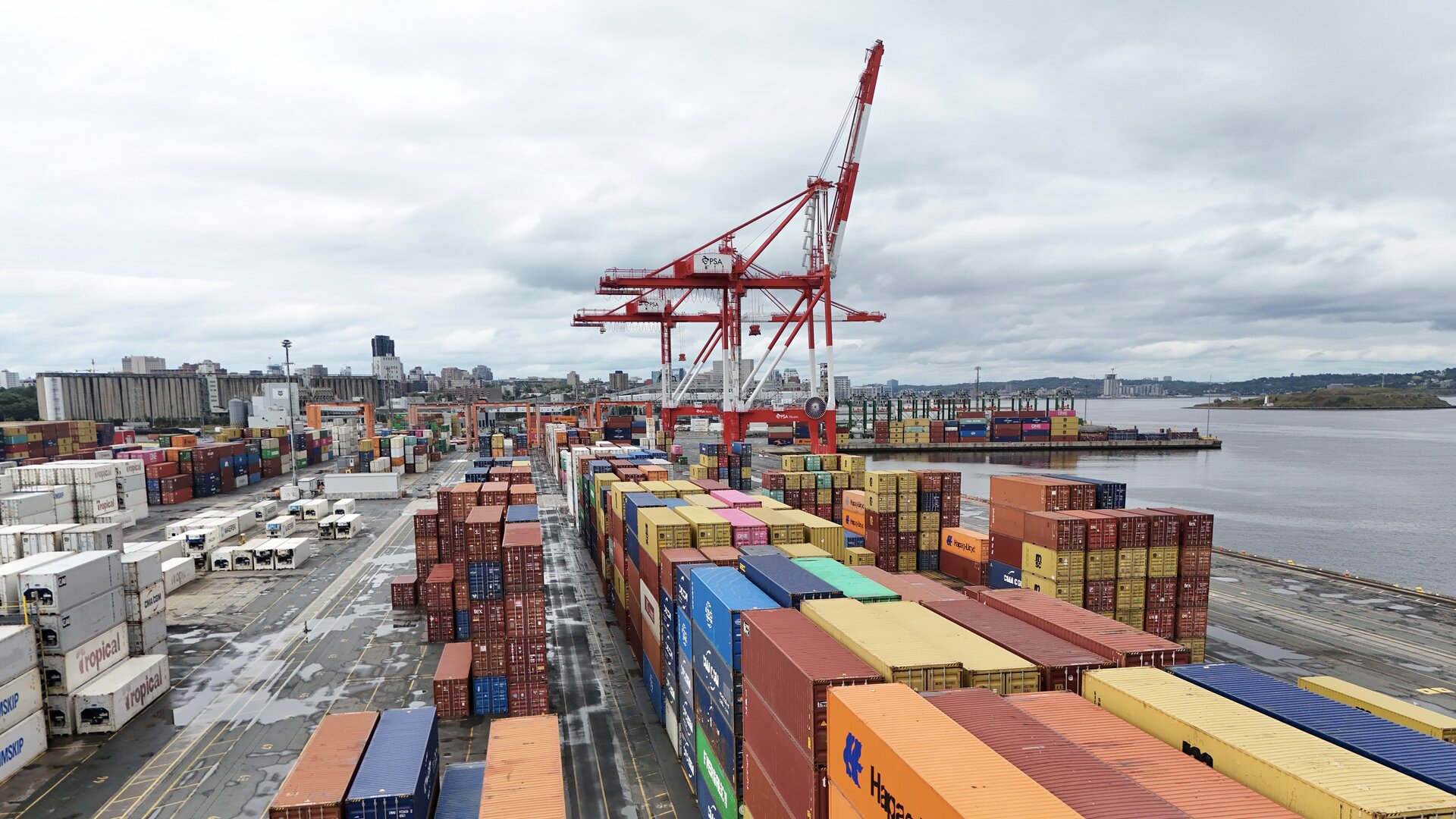
On June 18, a Canada Border Services Agency (CBSA) official sat in front of the House of Commons international trade committee and confirmed, on the record, what critics had alleged for years: Canada does not publish a single statistic about its forced-labour import ban.
"With respect to forced labour import bans, that is true," said Graeme Hamilton, CBSA's director general for trade and anti-dumping programs. "We have not published statistics in terms of how many goods have been intercepted and whether they're successful, abandoned or re-exported." The reason, he added, is "the limited number of cases." CBSA publishes detailed statistics on drug seizures, gun seizures and inadmissibility. For forced labour, there is so little enforcement that there is nothing worth counting.
The public record backs him up. Since Canada's ban took effect in July 2020, only one shipment has appeared on that record as classified under the prohibition: a batch of clothing from China seized in the fall of 2021. CBSA later released it. Correspondence obtained by the NGO Above Ground confirmed no further shipments had been classified as of mid-2022. CBSA has published no count since, and officials cited no newer figure when MPs asked in June 2026. The true total may be higher than one. Nobody outside the agency can say.
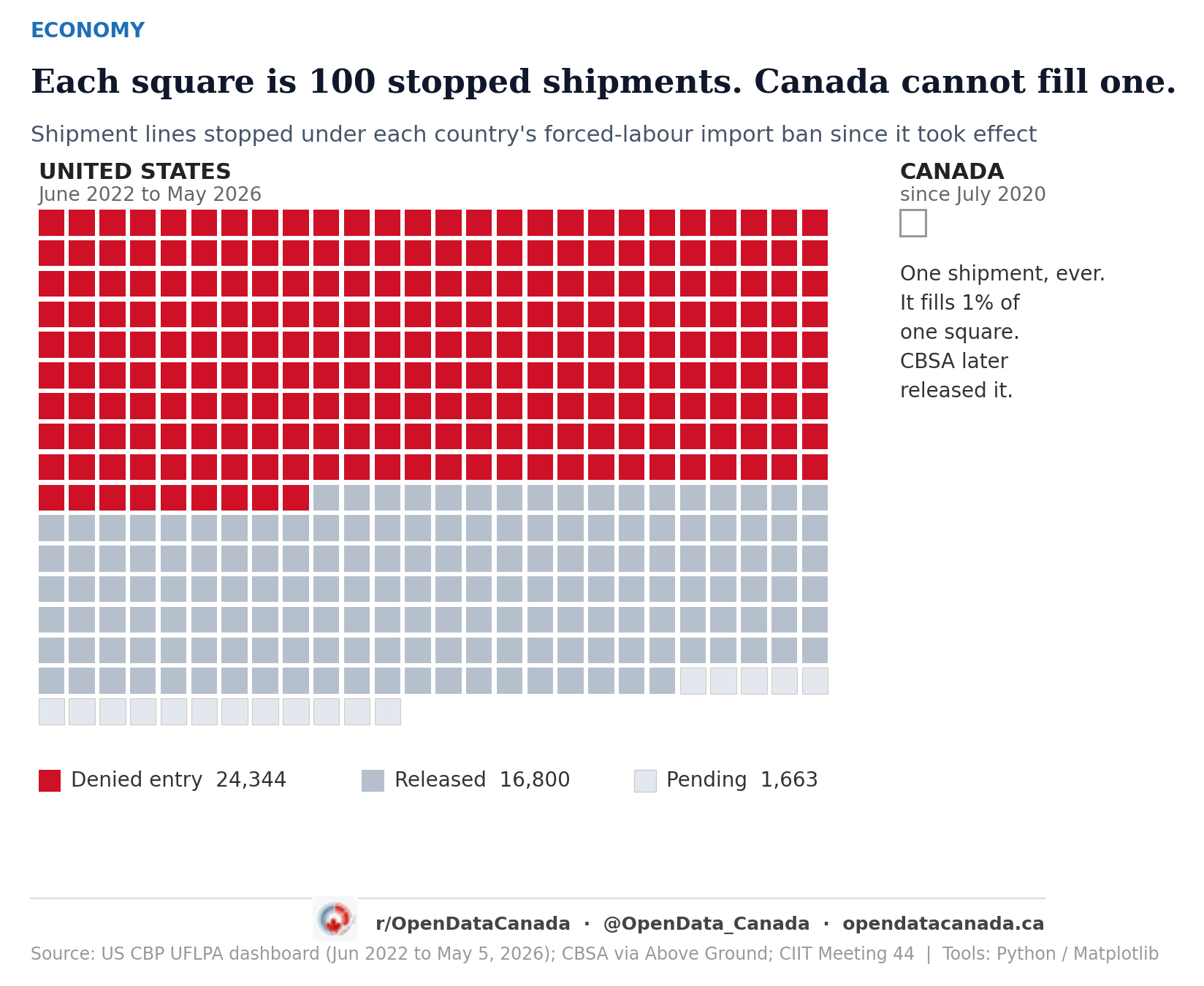
Both countries are bound by the Canada-United States-Mexico Agreement (CUSMA) to prohibit imports of goods made with forced labour. They have built very different enforcement systems around that obligation. The United States, which has banned such goods since 1930, enforces its ban through the Uyghur Forced Labor Prevention Act (UFLPA). Since that law took effect in June 2022, US Customs and Border Protection (CBP) has stopped 42,807 shipment lines worth 3.96 billion US dollars and denied entry to 24,344 of them.
Two bans, opposite machines
The gap is not about willpower at the border. It is baked into the legal design, and CBSA said so itself.
The American ban works on a presumption. Goods made wholly or in part in China's Xinjiang region, or by a company on a published entity list, are presumed to be made with forced labour and are barred. The importer must prove otherwise, with documentation CBP has warned must be extensive: affidavits, redacted records and incomplete supplier information will not cut it.
Canada's ban, tariff item 9897.00.00 in the Customs Tariff, flips that burden. CBSA must prove that the specific goods in the specific container in front of it were made with forced labour, shipment by shipment. Hamilton walked the committee through what that means in practice.
"The burden of proof is that the particular car that is in front of you has a particular chassis which was made from aluminum that was produced using forced labour," he testified. "Then, for the next shipment of cars, we'd have to re-prove that the exact same supply chain is in place." That standard, he said, "becomes inherently difficult."
The difference is not that Canada has no ban. It is where the burden of proof sits.
Canada also has no public list of suspect companies, goods or regions, five years into the ban. Sara Wilshaw, Global Affairs Canada's chief trade commissioner, confirmed it: "We have not produced a list or published a list at this stage." CBSA works from an internal target list Hamilton described as "fewer than 1,000 but more than a dozen" entities. Importers cannot see it, and neither can the public.
The US approach produces enforcement with teeth. Of everything CBP has stopped under the UFLPA, more than half, 24,344 shipment lines, never entered the American market.
Washington noticed
For years the only pressure on Ottawa came from NGOs and Senate committees. In March 2026 it started coming from Washington, with tariffs attached.
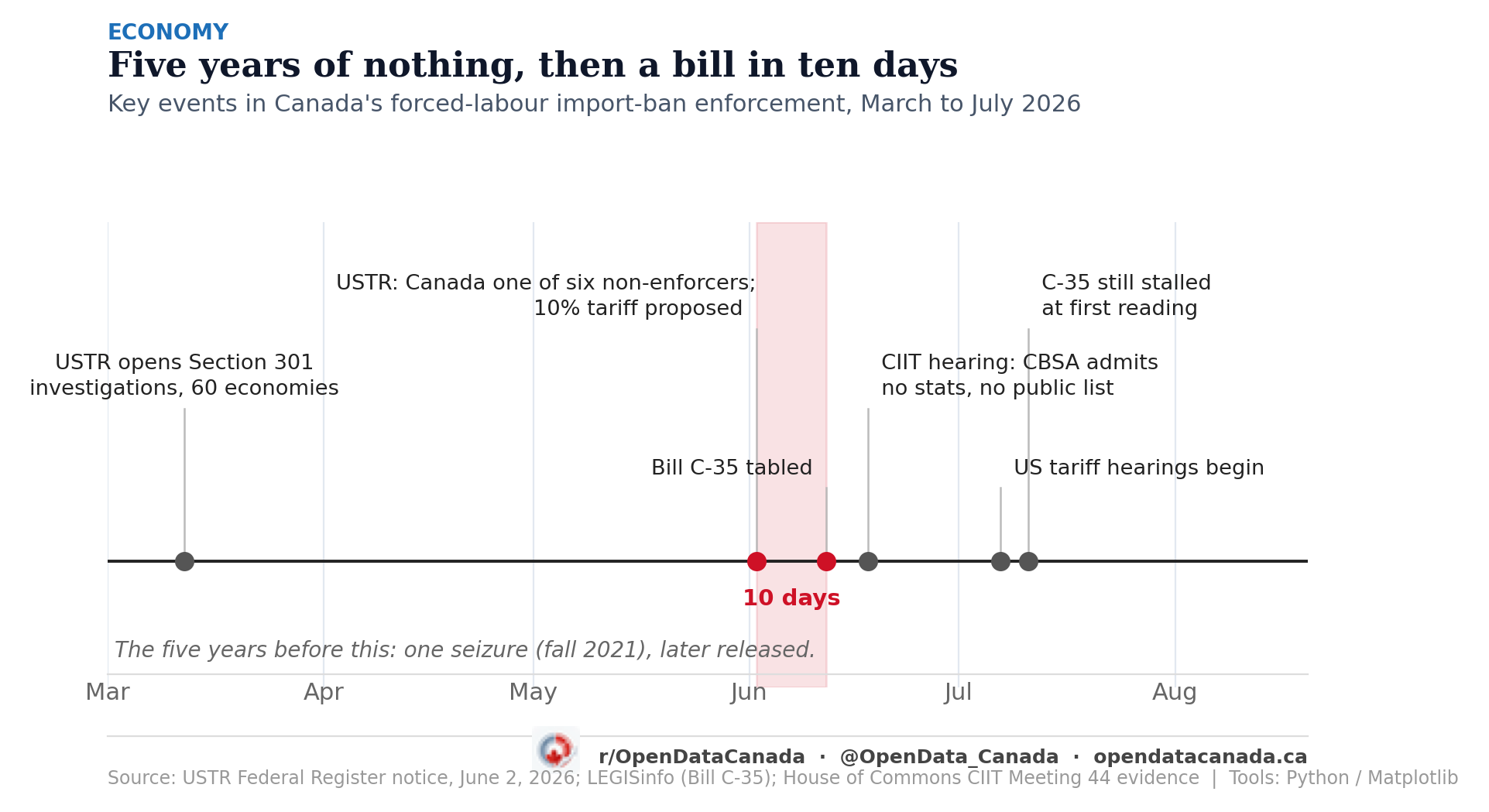
The Office of the United States Trade Representative (USTR) opened investigations into 60 economies' forced-labour import rules on March 12. On June 2 it published its determination: Canada is one of just six economies, alongside the European Union and Mexico, that have a ban on the books but "have failed to effectively enforce" it. USTR proposed an additional 10 per cent tariff on Canadian products as a consequence. Economies with no ban at all face a proposed 12.5 per cent.
There is a significant carve-out: CUSMA-qualifying goods are excluded, so the duty touches only Canadian exports that do not meet the agreement's rules of origin. That carve-out survived: on July 23, 2026, President Trump directed USTR to take final action, and the tariffs took effect at 12:01 a.m. EDT on July 24, a 10 per cent duty on Canadian goods that fall outside CUSMA, stacked on top of any other applicable tariffs. Canada-US Trade Minister Dominic LeBlanc said in a statement that the measure was part of "a broader series of unilateral U.S. trade actions" but "is not unexpected." The finding behind it, that Canada does not enforce its own forced-labour import law, is no longer a proposal. It is now in effect.
Ottawa's response arrived with conspicuous timing. Ten days after the USTR determination, the government tabled Bill C-35, the Ban on Importing Goods Made with Forced Labour Act. Bloc Québécois MP Patrick Bonin put the sequence bluntly at the June 18 hearing: "We had been asking for this for years, but the government wasn't doing anything. Now, Mr. Trump just made an announcement. As if by magic, the bill quickly materializes."
Bill C-35 is the fix. It is not law.
Bill C-35 would rebuild Canada's ban along American lines. Officials described its two core mechanisms to the committee: a ministerial public list of suspect goods, regions and companies, and regulations imposing a reverse onus, requiring importers of listed goods to hand CBSA documentation proving their supply chains are clean, or be turned away.
That is the UFLPA playbook, adapted. It is also, for now, just a bill. C-35 received first reading on June 12. LEGISinfo now lists it "at second reading," but records no activity at that stage: no debate, no committee referral, no recorded votes. Its last recorded event is still the day it was tabled. The House does not sit again until September 21. And the bill is sponsored by the Minister of Foreign Affairs, Anita Anand, which places the new regime under Global Affairs Canada rather than under Public Safety, the department responsible for CBSA and the border it is supposed to police.
The regulatory machinery is being drafted ahead of the statute. From July 27 to August 21, Global Affairs Canada and CBSA ran a public consultation on how the new regime would work: the "approach, evidence, criteria, and methods" for deciding which goods go on the list, and what importers of listed goods would have to hand over to CBSA on request. The government's own framing was that the approach must be "well designed before any goods are listed." Until the bill passes, none of it applies, and the shipment-by-shipment regime Hamilton described is still the law at the border.
Canada's other forced-labour law offers a preview of what happens when obligations exist without enforcement. The supply-chain transparency act known as S-211 requires companies to file annual reports on forced-labour risks. In 2025, Public Safety Canada received thousands of them, analyzed 4,313, and took zero enforcement actions: no ministerial orders, no charges. Ninety-one per cent of reporting organizations said remediation questions did not apply to them because they had found no forced labour in their supply chains at all.
The government now says the right things. Officials told the committee the current regime is inherently difficult, that a public list would help, that a reverse onus is the intent. Every one of those statements is an admission about the six years that came before, in which Canada carried a trade obligation, a G7 reputation and a functioning import ban on paper, and stopped one shipment.
That admission now has a price tag. Canada's forced-labour import ban has been on the books since 2020. Its public enforcement record is one shipment, later released, and CBSA says the case-by-case burden of proof makes enforcement "inherently difficult." Bill C-35 would change the model: a public list of suspect goods, regions and producers, and importers who must prove their supply chains are clean. It has been consulted on but not debated, and the House does not sit until September 21. Until that framework becomes law, Canada's ban remains far less enforceable, and far less visible to the public, than the US system. Since July 24, it also costs a tariff.
Import enforcement gaps aren't limited to labour. See what CFIA's pesticide tests on imported berries show.