Federal by-elections · Dec. 7, 2026
Six by-elections, but Carney's majority isn't at stake
Six House of Commons seats are empty and vote on Dec. 7. The Liberals hold 173 of 343 seats, one more than a majority, so they keep it even if they lose all six. Three of the races would have flipped in 2025 if fewer than 3,800 voters had switched.
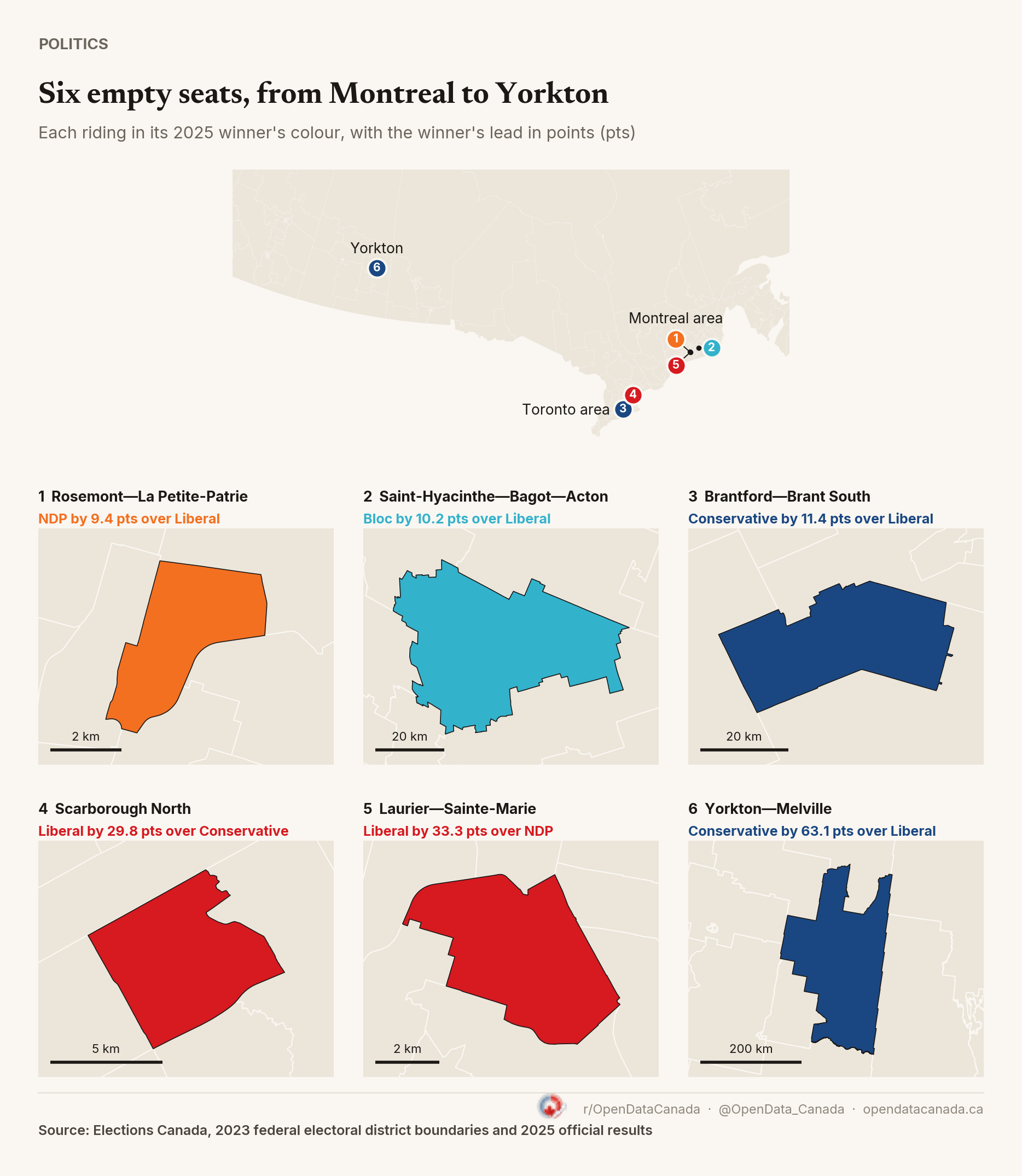
Prime Minister Mark Carney called six federal by-elections on Nov. 1, all for Monday, Dec. 7. Three of the seats are in Quebec, two in Ontario and one in Saskatchewan. Two were held by Liberals, two by Conservatives, one by the Bloc Québécois and one by an MP first elected for the NDP.
Every one of these by-elections is a local race. None of them decides who governs.
Can the Liberals lose their majority on Dec. 7?
No. A majority in the 343-seat House is 172. The Liberals have 173 members today, with the six seats empty. If they lose all six races they stay at 173. If they win all six they reach 179.
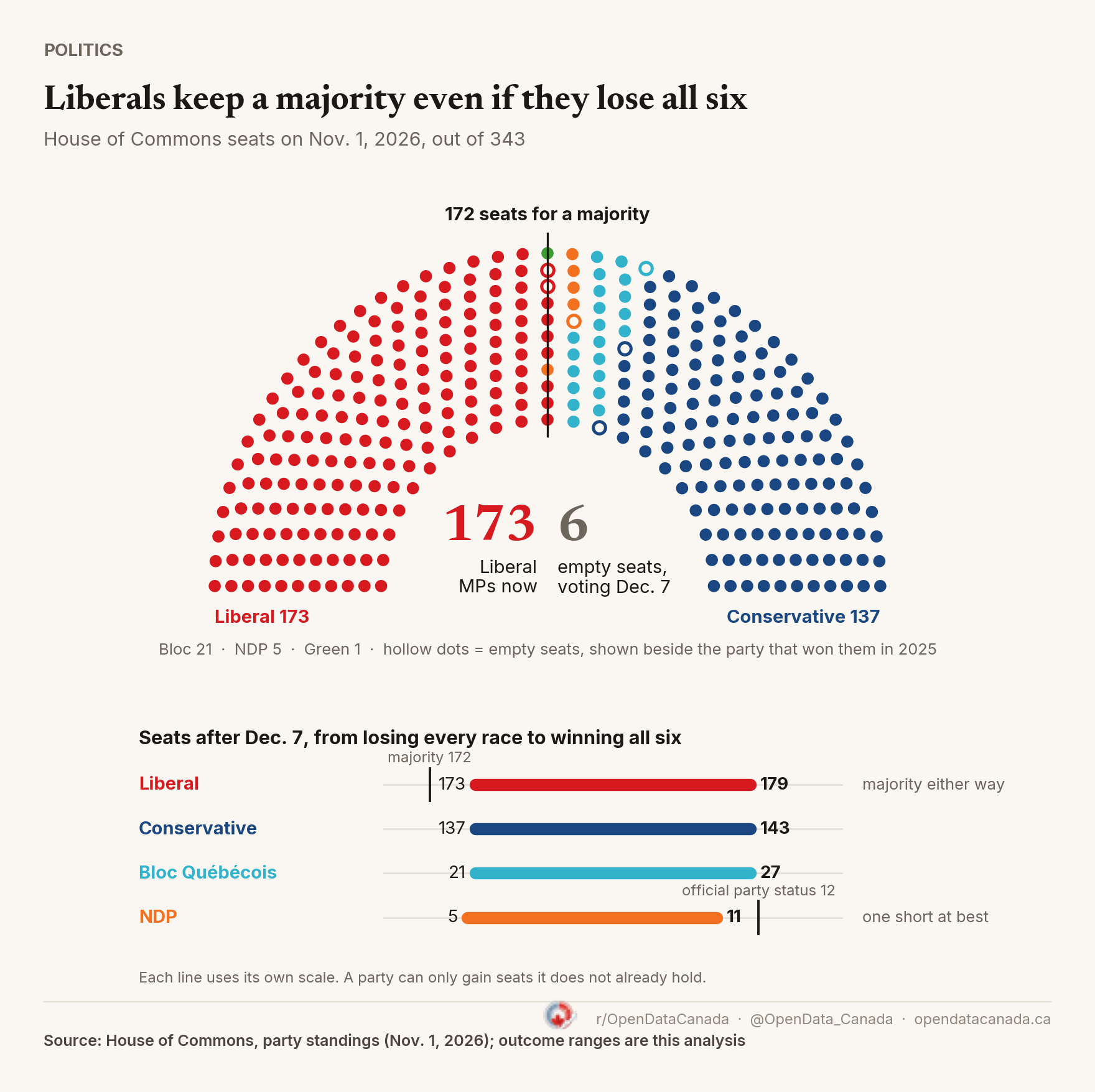
The other parties can't change the picture much either. The Conservatives would reach 143 by sweeping all six. The NDP's best case is 11 seats, one short of the 12 a party needs for official status in the House. That would take wins in five ridings the NDP lost in 2025, including Yorkton-Melville, where it was not in the top two.
Which ridings could change hands?
The simplest way to measure a race is to ask how many people would have had to change their vote in 2025 to produce a different winner. Each voter who moves from the winner to the second-place candidate takes one vote off the leader and adds one to the challenger, so the gap closes by two. Half the gap, plus one, flips the seat.
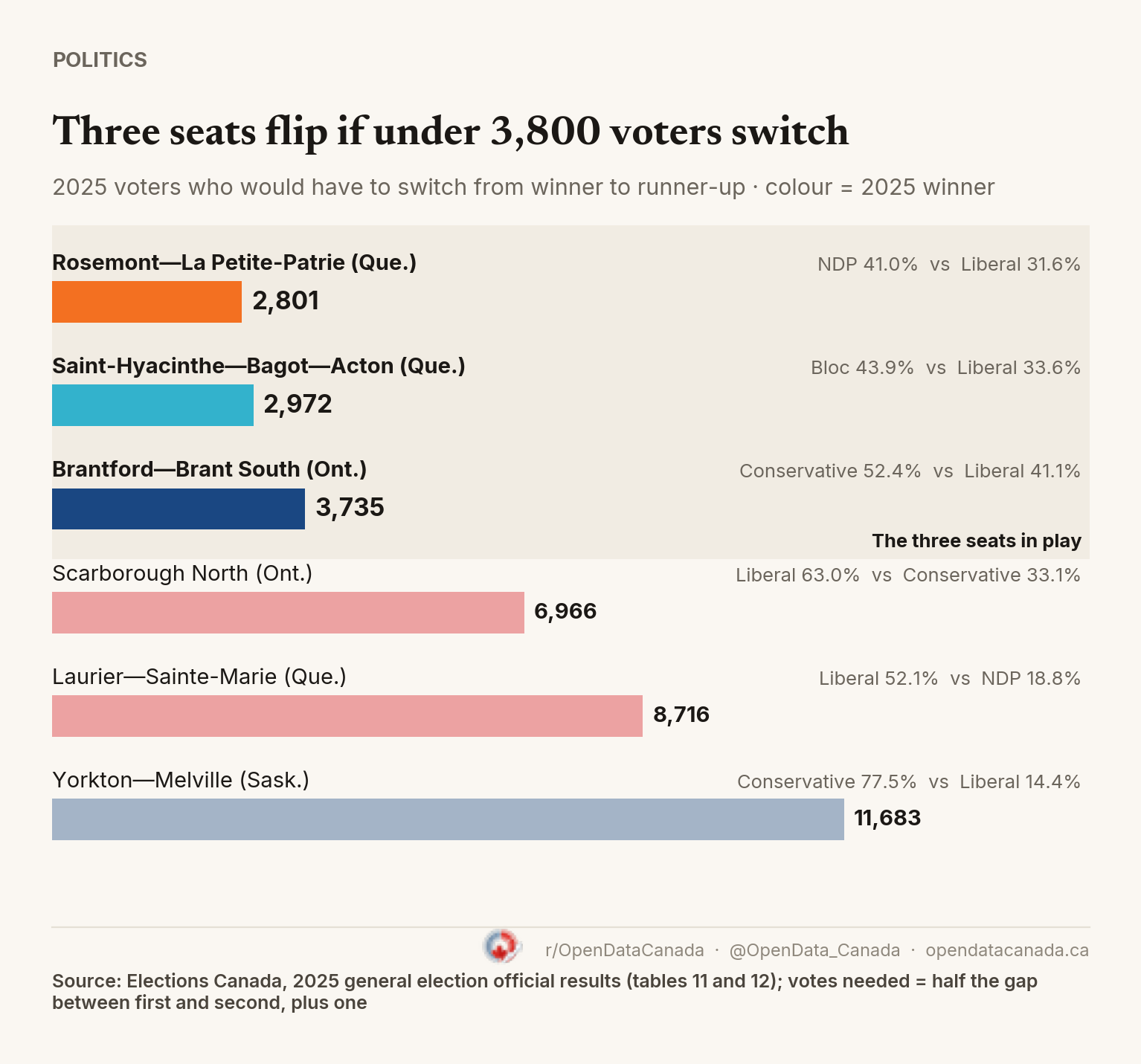
Three seats stand out, and in each the Liberals finished second.
- Rosemont-La Petite-Patrie (Montreal): the NDP won with 41.0% to the Liberals' 31.6%, a gap of 5,601 votes. About 2,800 voters switching would have flipped it. Put another way, a move of 4.7% of the vote from one party to the other.
- Saint-Hyacinthe-Bagot-Acton (Quebec): the Bloc won 43.9% to 33.6%, a gap of 5,943 votes, or 2,972 voters.
- Brantford-Brant South (Ontario): the Conservatives won 52.4% to 41.1%, a gap of 7,469 votes, or 3,735 voters. In 2025 the riding was called Brantford-Brant South-Six Nations. Parliament renamed it in 2026.
The other three were not close. The Liberals took Scarborough North by 29.8 points and Laurier-Sainte-Marie by 33.3. The Conservatives won Yorkton-Melville with 77.5% of the vote, 63.1 points ahead of the Liberals. Flipping Yorkton-Melville would take a move of about 32% of the vote from one party to the other.
The Liberals are about 16 to 17 points ahead nationally in the federal poll tracker, against the 2.5-point margin they won by in 2025. No polls of these six ridings have been published, and a national lead does not spread evenly across ridings.
How many people vote in a by-election?
Far fewer than in a general election. Seven by-elections have been held since the April 2025 vote. In every one, turnout fell by at least 15 points from the riding's 2025 level.
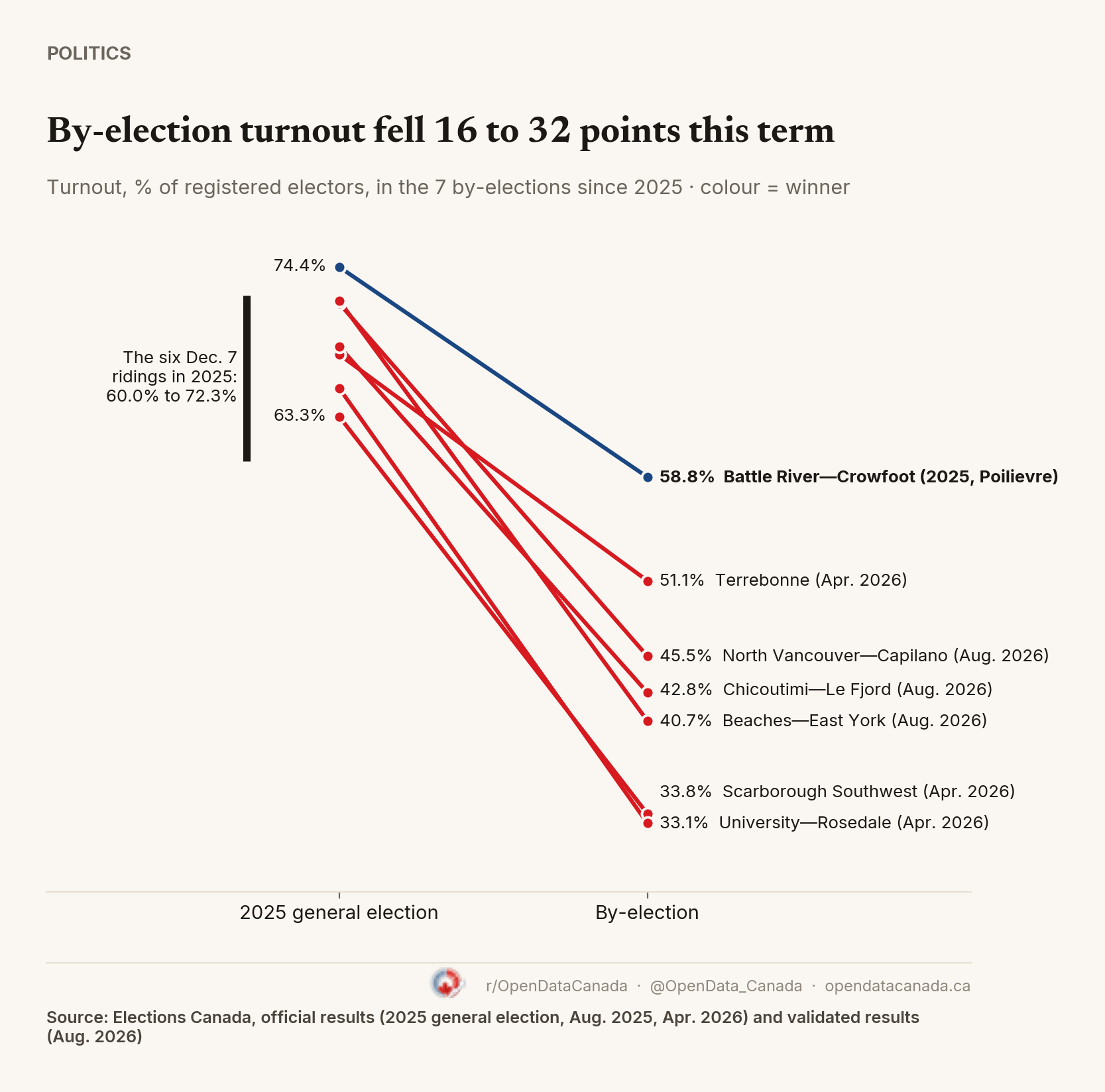
The highest by-election turnout this term, 58.8%, came when Conservative Leader Pierre Poilievre won Battle River-Crowfoot in August 2025. The lowest, 33.1%, was in University-Rosedale in April 2026. The Liberals won six of the seven, including Chicoutimi-Le Fjord, which they took from the Conservatives.
Turnout in the six Dec. 7 ridings ranged from 60.0% in Scarborough North to 72.3% in Rosemont-La Petite-Patrie in 2025. If they follow this term's pattern, far fewer people will vote, so the counts in the bar chart above overstate how many votes it will take to change a result.
Key dates
- Nov. 16, 2 p.m.: nominations close.
- Nov. 18: Elections Canada publishes the confirmed list of candidates.
- Nov. 27 to 30: advance polls.
- Dec. 7: polls open 9:30 a.m. to 9:30 p.m. local time (8:30 a.m. to 8:30 p.m. in Yorkton-Melville), so all six close at 9:30 p.m. Eastern.
To vote, a person must live in the riding from Nov. 1 to election day. This page will be updated with the confirmed candidates after Nov. 18.
A by-election cannot topple this government. What Dec. 7 will show is whether a national lead of about 16 points is enough to take Rosemont, Saint-Hyacinthe and Brantford.