Quebec election 2026 · Chart note
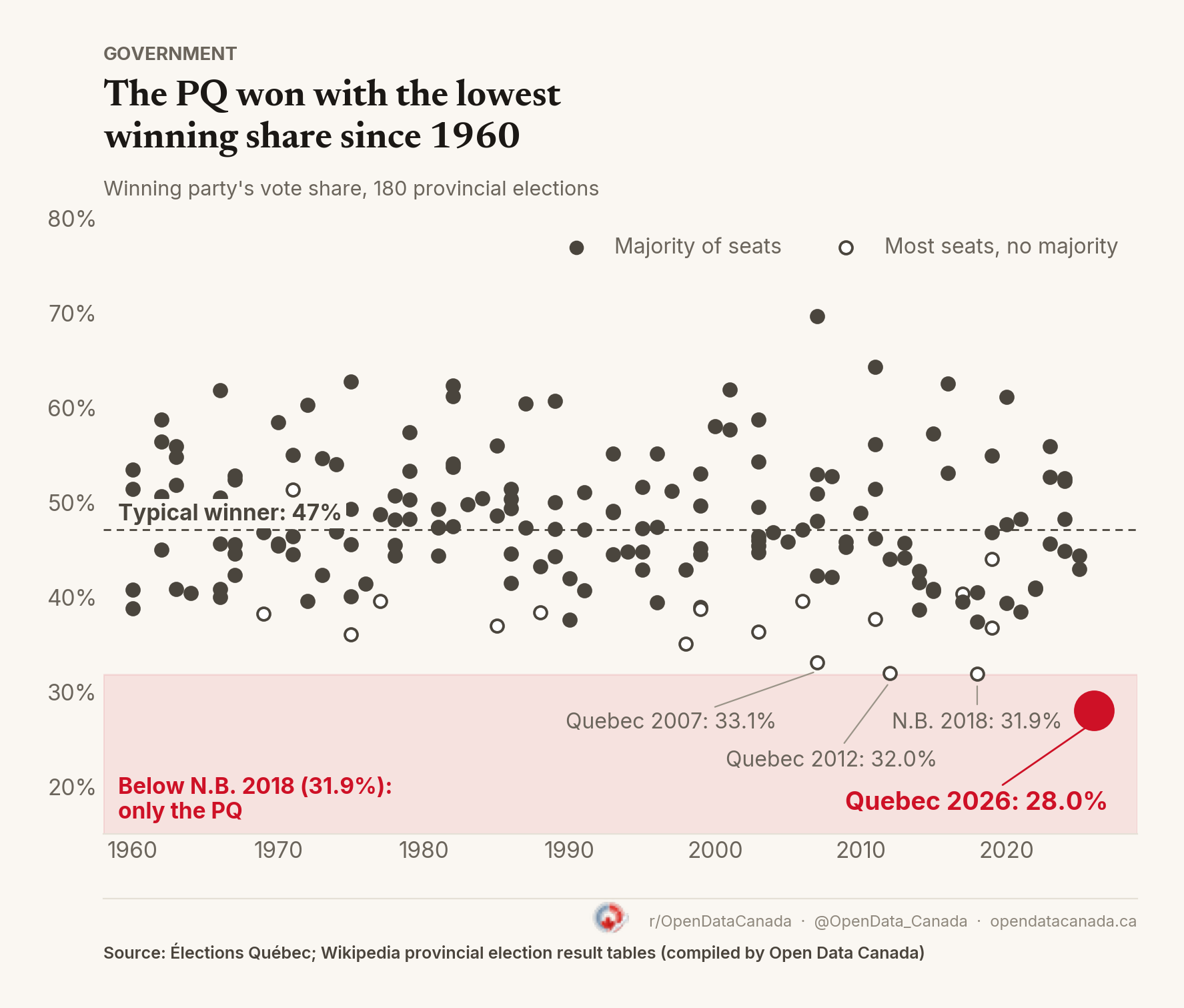
The PQ won Quebec with 28 per cent of the vote, the smallest winning share in any province since 1960.
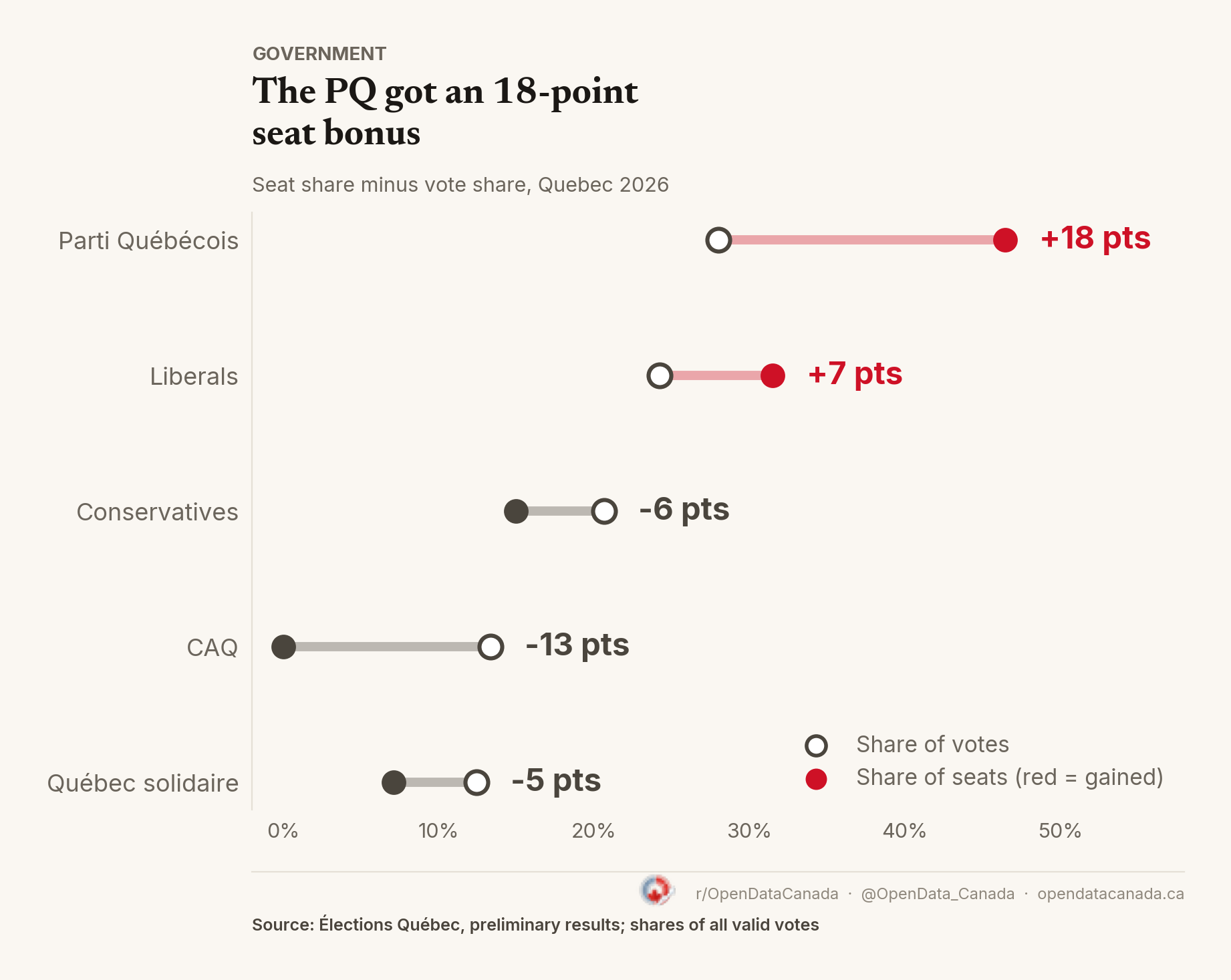
The Parti Québécois took 59 of 127 seats on 28.02 per cent of the vote, five seats short of a majority. Of 180 provincial elections since 1960, no winning party has had a smaller share.
The Parti Québécois (PQ), the party that wants Quebec to become its own country, won the October 2026 election with 1,200,394 votes. That is 28.02 per cent of valid votes, and it turned into 59 of the 127 seats in the preliminary count. A majority takes 64.
No province has produced a winner with a smaller share since at least 1960. We compared the winning party in 180 provincial elections with a recorded vote share. The next weakest win is New Brunswick in 2018, when the Progressive Conservatives took 31.89 per cent. The PQ sits 3.9 points below that.
Five parties split the vote, and the seats did not follow it
The Liberals finished second with 24.23 per cent and 40 seats. The Conservative Party of Quebec took 20.66 per cent and only 19 seats. Québec solidaire won 9 seats on 12.42 per cent.
The Coalition Avenir Québec (CAQ), the governing party since 2018, got 572,037 votes and no seats at all. Québec solidaire got 532,093 votes, 39,944 fewer, and elected nine. Four years ago the CAQ won 90 seats on 40.98 per cent. The PQ went from 3 seats on 14.61 per cent in 2022 to the largest bloc in the National Assembly.
A split field is how a party wins on 28 per cent. The PQ led the Liberals by 3.8 points. That was enough.
Why the chart starts in 1960
The chart starts in 1960 because that is the point from which every province has a recorded vote share and plain first-past-the-post ballots. Go back further and two earlier wins fall below the PQ, with caveats. In 1919 the United Farmers of Ontario won the most seats on 21.0 per cent, but only governed by teaming up with Labour, a bloc that had about 33.9 per cent. In 1952 British Columbia's Social Credit won the most seats on 27.20 per cent of first-choice votes under a ranked ballot, while the Co-operative Commonwealth Federation (CCF) led first choices at 30.78 per cent.
Neither is a plain one-vote, one-party win. Since 1960 the PQ's is.
What one post-election poll says (not official results)
Everything above is counted election results. This section is a single poll. Research Co. surveyed 500 Quebecers who voted, online, on October 4 and 5 (margin of error 4.4 points; it is not a random sample). It asked how people would vote in a referendum on independence held today. Overall, 27 per cent would vote for sovereignty, 58 per cent against, and 15 per cent were unsure. In the 1980 referendum the yes side got 40.44 per cent. In 1995 it got 49.42 per cent.
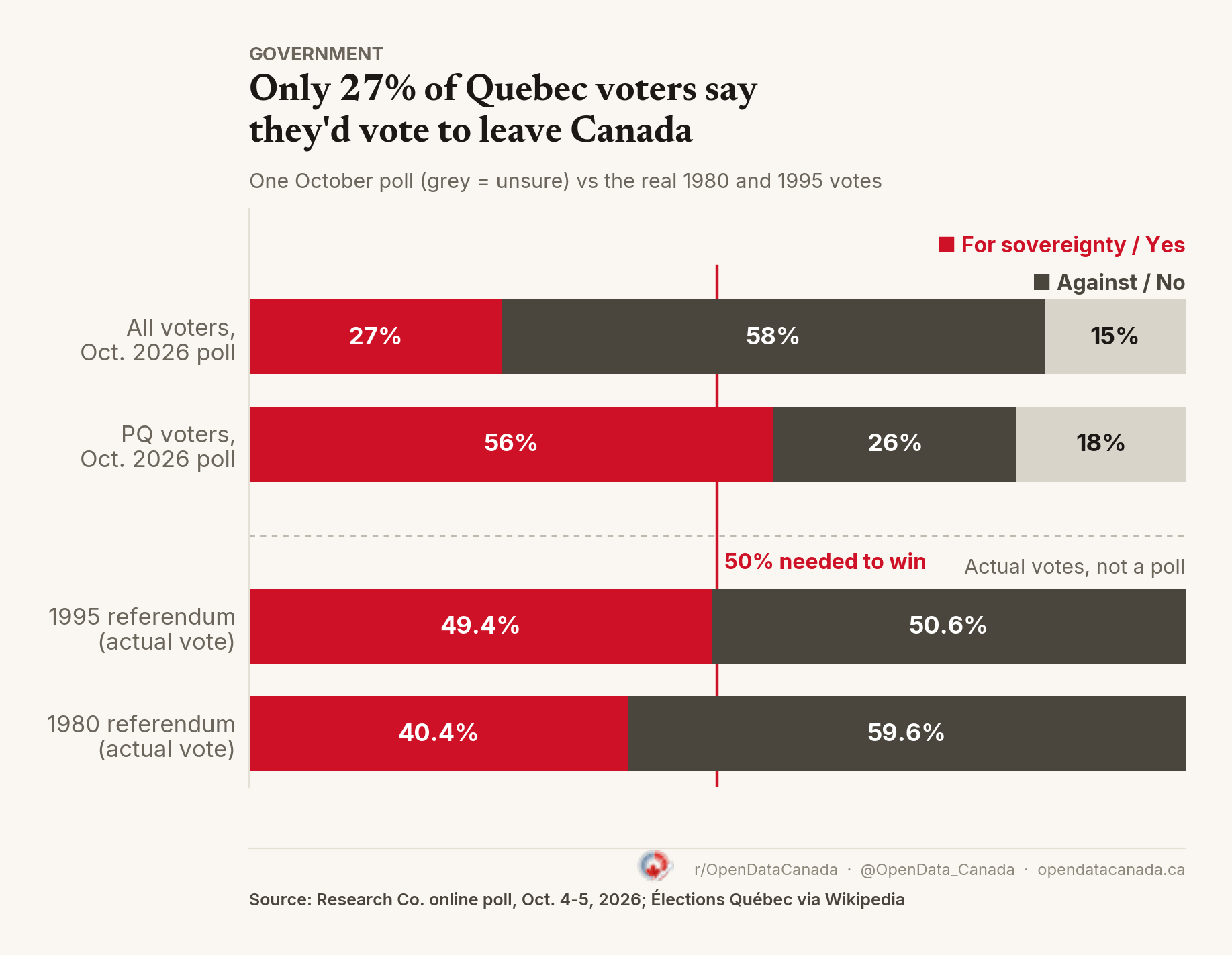
Among people who voted PQ, 56 per cent said they would vote for sovereignty, 26 per cent against and 18 per cent were unsure. That group is only about 140 people if the sample mirrors the result, so its margin of error is closer to 8 points.
Asked about priorities for the new government, 36 per cent of all voters called setting a timeframe for a new referendum very or moderately important. Among PQ voters it was 63 per cent. Only 26 per cent of PQ voters called it very important.
The PQ won the seats on a thin plurality. In this poll, most of the people who voted still say no to independence.
Common questions
Did the PQ win a majority in 2026? No. It won 59 of 127 seats, 5 short of the 64 needed.
Is 28 per cent the lowest winning vote share in Canadian history? No. Two earlier wins on record were lower, in Ontario in 1919 and British Columbia in 1952, both explained above. Since 1960, it is the lowest.
Would Quebec vote to leave Canada today? In the Research Co. poll, 27 per cent said they would vote for sovereignty and 58 per cent against. The 1995 referendum was lost with 49.42 per cent yes.
How did the CAQ win no seats with 13 per cent? Its 572,037 votes did not put it first in a single one of the 127 ridings. It elected 90 members in 2022.
For another referendum vote this month, see Alberta's ten referendum questions and how each one is polling.