Alberta referendum · Explainer
Alberta's 10 referendum questions, and how each one is polling
Albertans vote on ten questions on October 19. Premier Danielle Smith has named a winning bar for only one, the question on leaving Canada. On two others that poll under 50 per cent, yes is still ahead of no.
Google searches in Canada for "Alberta referendum" peaked the week of October 4, at about eight times their May high. Searches for "Alberta separation" have barely moved since May, and "Alberta voter ID" and "Alberta Senate" sit near zero. People are looking up the vote, not the nine other questions on the same ballot.
When and how do I vote?
- Advance voting: Tuesday October 13 to Saturday October 17, at any advance location in your riding. Most open 9 a.m. to 8 p.m.
- Election day: Monday October 19, 9 a.m. to 8 p.m.
- Mail-in: applications closed September 25. If you already have your package, it must reach Elections Alberta by 5 p.m. on October 16.
- ID: every voter must prove their name and home address. Elections Alberta accepts more than 50 kinds of ID. Mail-in voters send photocopies.
Each question is on its own colour-coded ballot, so you get ten ballots. You can leave any of them blank.
What are the ten questions?
The government announced nine questions on February 19 and added the tenth, on separation, on May 21. In plain words:
- Q1 Immigration. Should Alberta take more control of immigration, to bring numbers down, favour people who come to work, and give Albertans first pick of new jobs?
- Q2 Who gets services. Should a new law limit provincially funded health care, schools and social services to citizens, permanent residents and people with a status Alberta approves?
- Q3 A 12-month wait. Should people on temporary status have to live in Alberta 12 months before getting provincial social supports?
- Q4 A fee. Should Alberta charge people on temporary status a reasonable fee for health care and schools?
- Q5 Voter ID. Should voters have to prove they are citizens, with a passport, birth certificate or citizenship card?
- Q6 Judges. Should Alberta work with other provinces to change the Constitution so provinces, not Ottawa, choose provincial court judges?
- Q7 Senate. Should Alberta work with other provinces to abolish the Senate?
- Q8 Opting out. Should provinces be able to leave federal programs in areas they run, such as health care and schools, and keep the federal money?
- Q9 Whose law wins. Should a province's laws on provincial or shared matters win over federal laws when the two conflict?
- Q10 Separation. Should Alberta stay a province of Canada, or start the legal steps toward a binding vote on leaving?
What counts as a yes?
For Q10, Smith says the bar is 50 per cent plus one, and that the October result is not binding, meaning the government does not have to act on it. CBC reported she was unclear about what bar applies to Q1 to Q9.
Q6 to Q9 all ask to change the Constitution, which Alberta cannot do alone. A yes starts talks with Ottawa and other provinces.
How are they polling?
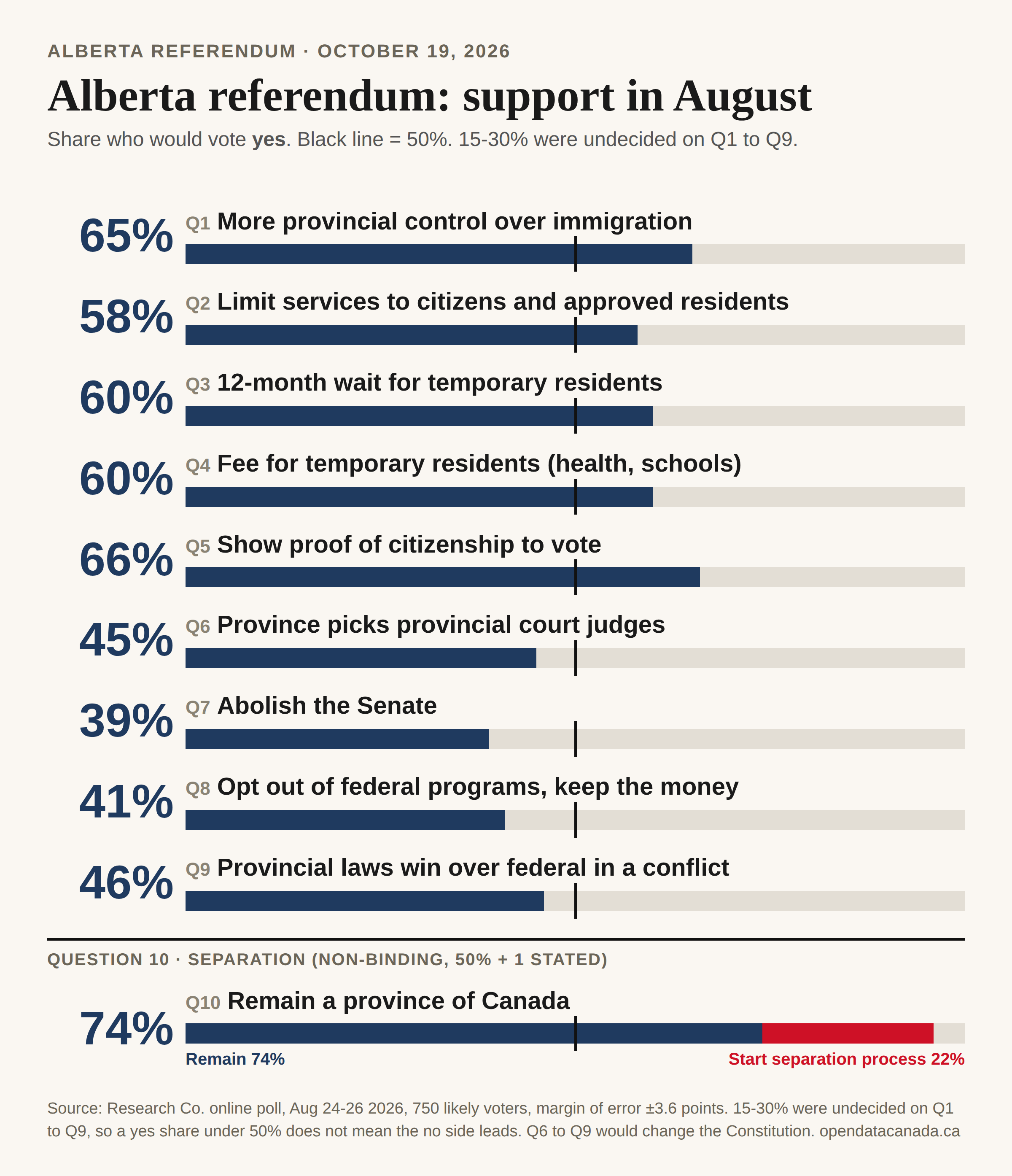
Research Co. surveyed 750 likely voters online from August 24 to 26. Results could be off by about 3.6 points either way. Five questions have majority support: voter ID at 66 per cent, immigration control at 65, the 12-month wait and the fee at 60 each, and limiting services at 58.
Judges, the Senate, opting out and law priority poll between 39 and 46 per cent. That does not mean they are losing. Research Co. published only the yes share, and 15 to 30 per cent were undecided on Q1 to Q9. With 45 per cent yes and at least 15 per cent undecided on judges, no can be at most 40. On law priority it is 46 yes against at most 39 no. Yes leads on both, and if the undecided split or stay home, both can pass 50 per cent of the votes cast. Only the Senate (39) and opting out (41) are real toss-ups.
Almost nobody is undecided on Q10, about 4 per cent. Research Co. has 74 per cent for staying and 22 for starting the separation process. Leger's October 2 to 4 poll of 1,001 Albertans, from an online panel rather than a random sample, has 70 stay, 22 separate and 7 undecided. Stay voters are surer of their choice: 91 per cent call themselves certain, against 71 per cent of separation voters. Sixty-one per cent worry about American influence on the vote. Voters of Smith's own party, the United Conservative Party, lean the other way: 48 per cent for separation, 43 for staying.
What happens if Q10 says leave?
Nothing changes on October 20. Smith has said a binding vote could follow in spring 2027, after Alberta consults First Nations and the House of Commons approves the question. An advisor quoted by the Globe and Mail estimates the consultation alone would take 18 months to two years.
Spring 2027 is six months away. The step Smith says must come first could take three to four times as long.