Politics · Data centres
U.S. voters rejected data centres 40 times out of 41. Is Canada next?
American voters sided against data centres in nearly every local ballot on Nov. 3. Most Canadians want limits too, whichever party they back. But the question rarely reaches a ballot here, so the fight runs through city halls, regulators and courts.
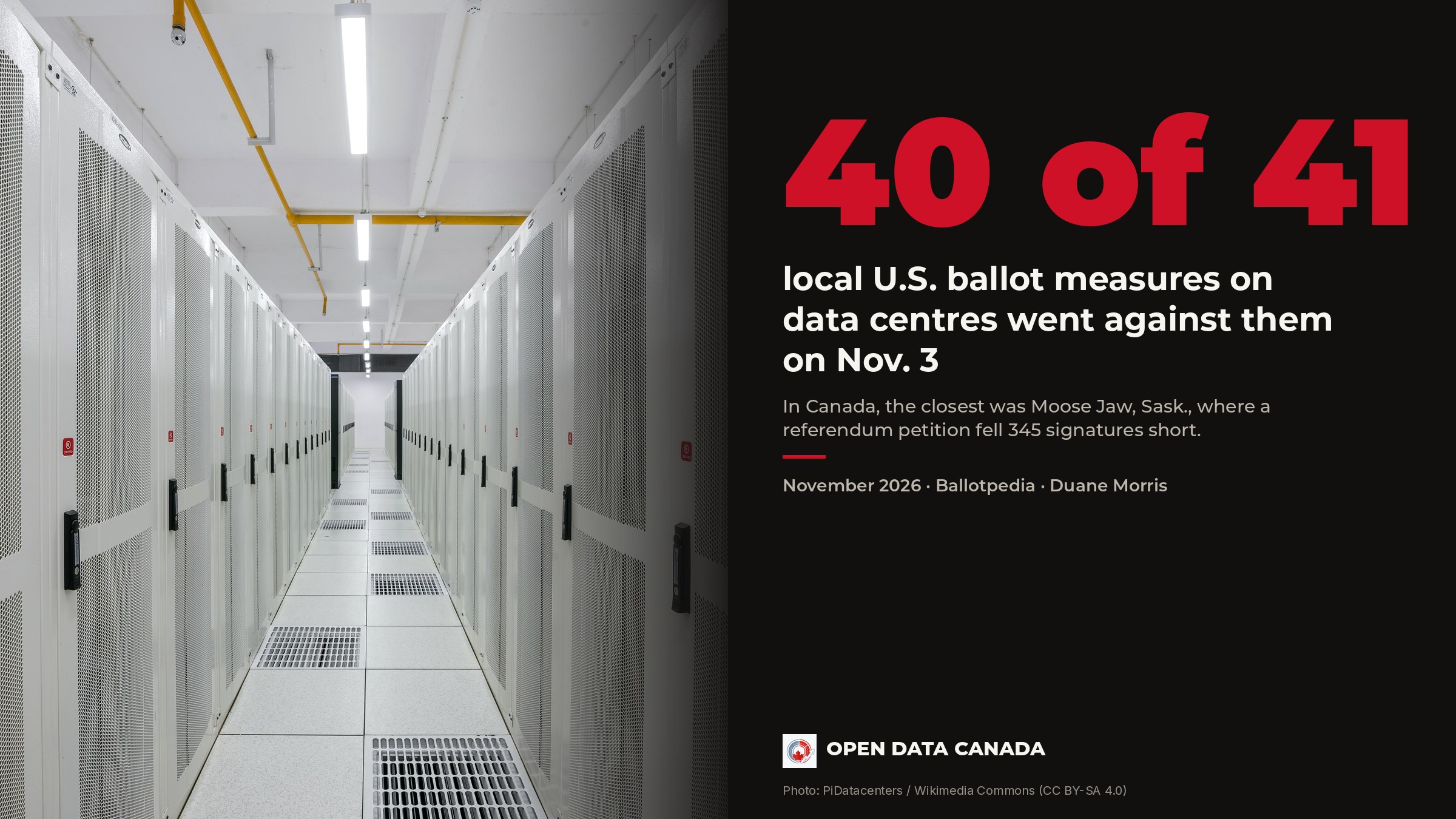
Moose Jaw, Sask., came closest. Residents petitioned for a referendum on a data centre moratorium and came up 345 valid signatures short of the 3,367 required, the city clerk found. No vote on data centres was found anywhere in Canada, held or scheduled.
In the United States, voters in 10 states decided 41 local ballot measures on data centres on Nov. 3. By the count of Duane Morris Government Strategies, the side trying to limit them won 40. The exception was Harwood, N.D., where voters rejected an added review of industrial projects, 76 to 24. Six earlier votes this year had all gone against data centres too. Early counts differ: a Redbud Consulting tally cited by The Verge had 33 of 45 restricting them.
Not all of these were outright bans. Of the 50 measures tracked on ballots this year, 24 were bans or moratoriums, 10 were non-binding advisory questions, nine were votes on specific projects and seven were approval or zoning rules. The direction was the same across all four types.
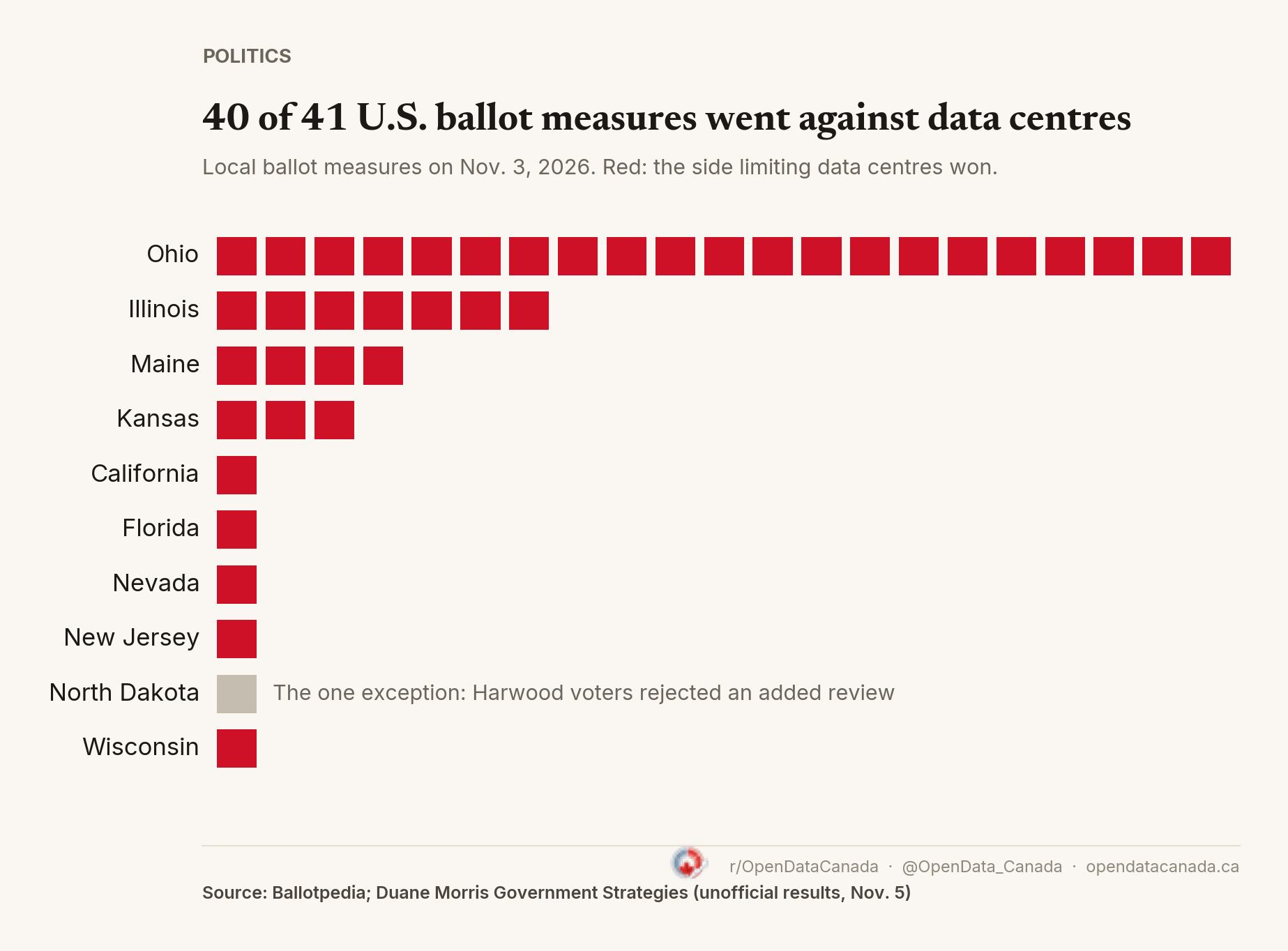
These were small places, many of which already had a fight on their hands, and Ohio alone held 21 of the votes. They don't show how the whole country feels. But they do show something about the coalition. Alex Brown, who covers the issue for the news site Stateline, told the Columbia Journalism Review what he kept hearing from people behind these measures: "I'm a Trump voter, and one of my strongest allies in this is a liberal Democrat."
Canada's opposition crosses party lines too
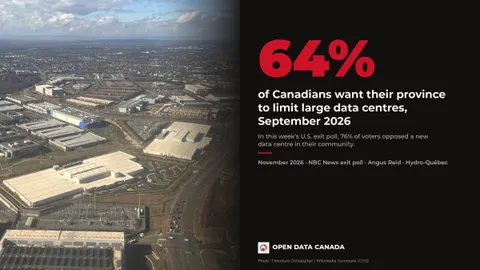
Canada has its own version of that coalition. In an Angus Reid survey in September, 64% said their province should limit large data centres and 18% said it should encourage more. A majority of every major federal party's voters chose limits. So did most people in every region but Quebec, where support for limits was 50%: 64% in Alberta, 69% in Ontario, 70% in Saskatchewan and 72% in Manitoba.
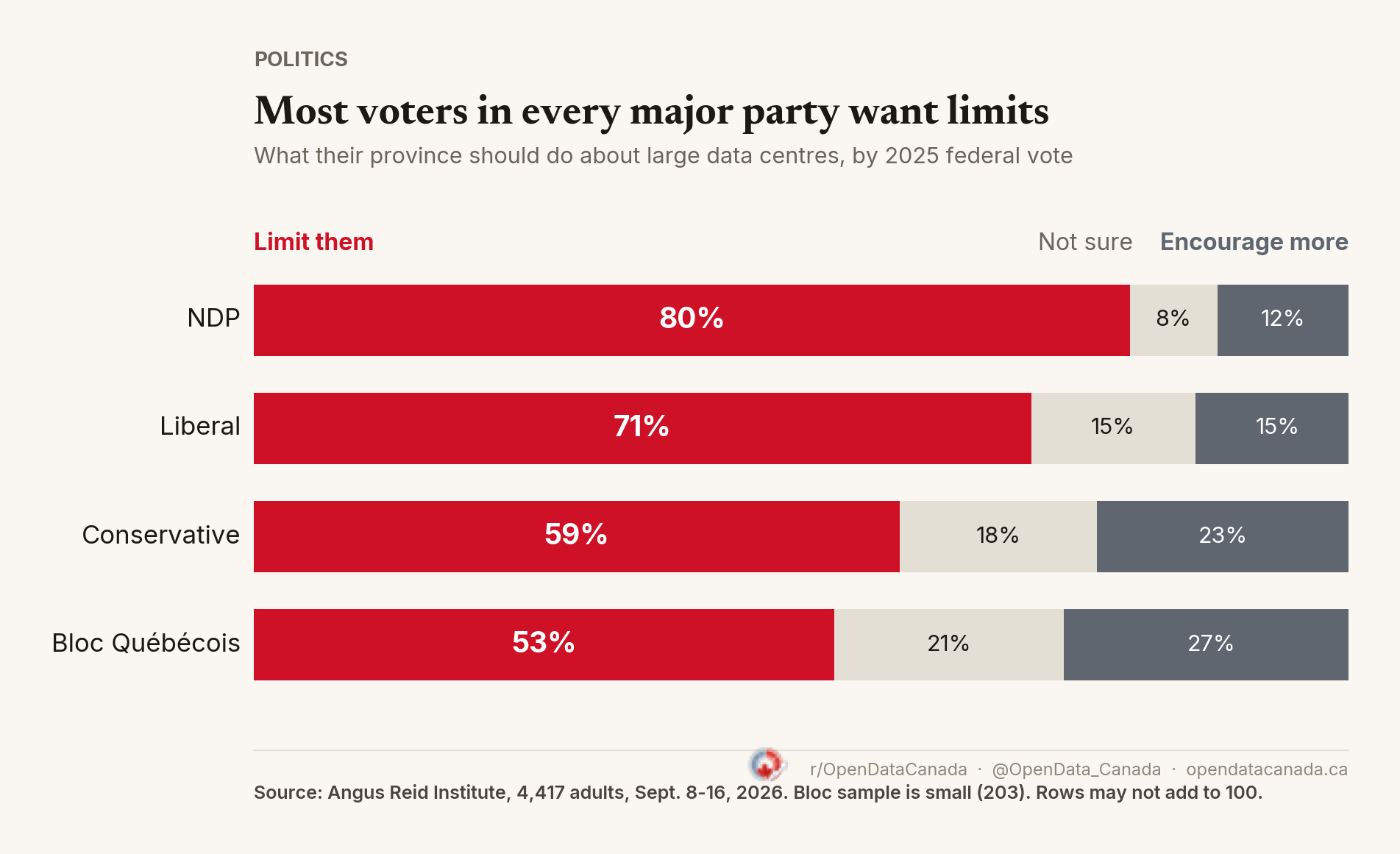
Liberal and Conservative voters are 12 points apart. That order isn't stable. When Abacus Data asked in March about a large AI data centre in people's own community, NDP voters were again the most opposed, at 48%, but Liberal voters were the least likely to object. Overall, 34% were opposed, and half said it depended on the details or weren't sure. When Angus Reid asked in May about one within a few blocks of home, as a plain support-or-oppose question, 68% were opposed.
The sharpest warning for a conservative government is in Alberta. A Janet Brown poll for CBC reported in September found 7% strongly support AI data centres and 31% strongly oppose them, with another 26% mostly opposed but open to a few. "I think this could be a real sleeper issue for Danielle Smith," Brown said.
Canada has fewer routes to a direct vote
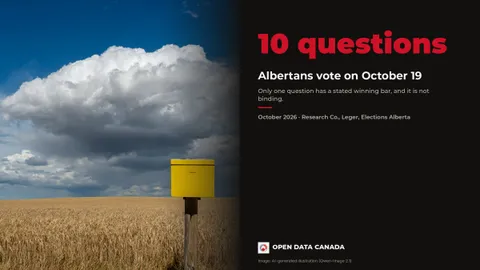
The missing ballot question isn't special to data centres. Most U.S. measures came from residents: by Ballotpedia's September count, 31 of 38 qualified through citizen petitions. Ohio, which held 21 of the U.S. votes, lets township residents petition to send a zoning change to voters. In Canada, Saskatchewan's petition route got Moose Jaw residents part of the way. Elsewhere the door is narrower. In Alberta, a resident petition asking for a new planning bylaw "has no effect" under the Municipal Government Act. A council can choose to ask voters a question, but the result "does not bind council." In Ontario, the Municipal Elections Act lets a council or the minister put a question on the ballot, and a council's bylaw has to pass by March 1 of the election year. For this year's Oct. 26 vote, that date had passed by the time Oakville, the first Ontario town to act, voted in August. The Act gives residents no general way to force a question onto the ballot, and even then a result binds council only if more than 50% of eligible voters vote on it. The next regular municipal election is in 2030.
So Canadian opponents work through the channels they have.
| Where it went | Place | What happened |
|---|---|---|
| Council | Oakville, Mississauga | Unanimous one-year pauses. Sault Ste. Marie followed |
| Council | Hamilton, Burlington | Pauses voted down, 10-6 in Hamilton |
| Regulator | Olds, Alta. | Power plant for a data centre rejected as "too close to the surrounding community," after about 1,500 applied to take part in hearings |
| Petition | Sherbrooke, Que. | More than 12,000 signatures. Mayor delayed a moratorium decision |
| Petition | Ritchot, Man. | More than 13,500 signatures. Premier Wab Kinew said the project won't go ahead |
| Court | Saint John, N.B. | Residents await a ruling on an industrial park expansion |
| Court | Near Regina | Standing Buffalo Dakota First Nation threatens legal action over Bell's project |
Voters can still punish a mayor or councillor, but an election bundles data centres with every other issue. Ontario's Oct. 26 municipal elections were the nearest thing to a test, and they don't prove much. Hamilton's Andrea Horwath, who voted against the pause, finished third, but nine of 20 sitting mayors lost that night, including those in Oakville and Mississauga, whose councils had passed pauses. No result can be pinned on data centres.
Most proposed data centres are in Alberta
The mismatch is geographic. The Ontario pauses sit far from where most projects are proposed. A York University study, based on commercial data and not peer reviewed, found Alberta would hold about 90% of the country's data centres if every proposal went ahead. Not all of them will. Still, the Alberta government's own figures show companies asking to connect about 19,565 megawatts of new data centre load, roughly one and a half times the most power the province has ever used in an hour. The grid operator allowed 1,200 megawatts in its first stage.
Alberta is also where a petition can't force a planning change. Ontario's government isn't offering residents much more: Doug Ford says the province needs to move "full steam ahead," though he says he'd rather go to a "willing host."
That leaves party politics. U.S. voters said the issue mattered when they picked candidates. In Canada the federal NDP has called for a moratorium. Its voters are already the most opposed. The bigger opening is on the right and centre, where 59% of Conservative voters and 71% of Liberals want limits. No call for a pause from either federal party turned up in this review.
The opposition Americans took to the ballot box is already here. In Canada it has to win over a council, a regulator, a judge or a premier, one project at a time.