Cost of living · Electricity
Big Tech wants more power and data centres. Will Canadians pay the price?
A new U.S. exit poll found 76% of voters oppose a data centre in their community. In Canada, 64% want their province to limit them. Ottawa says developers must pay the added electricity costs. But in Quebec, data centres pay about 5 cents per kilowatt hour less than Hydro-Québec says new energy costs.
Data centres were on the ballot in the United States this week, and they mostly lost.
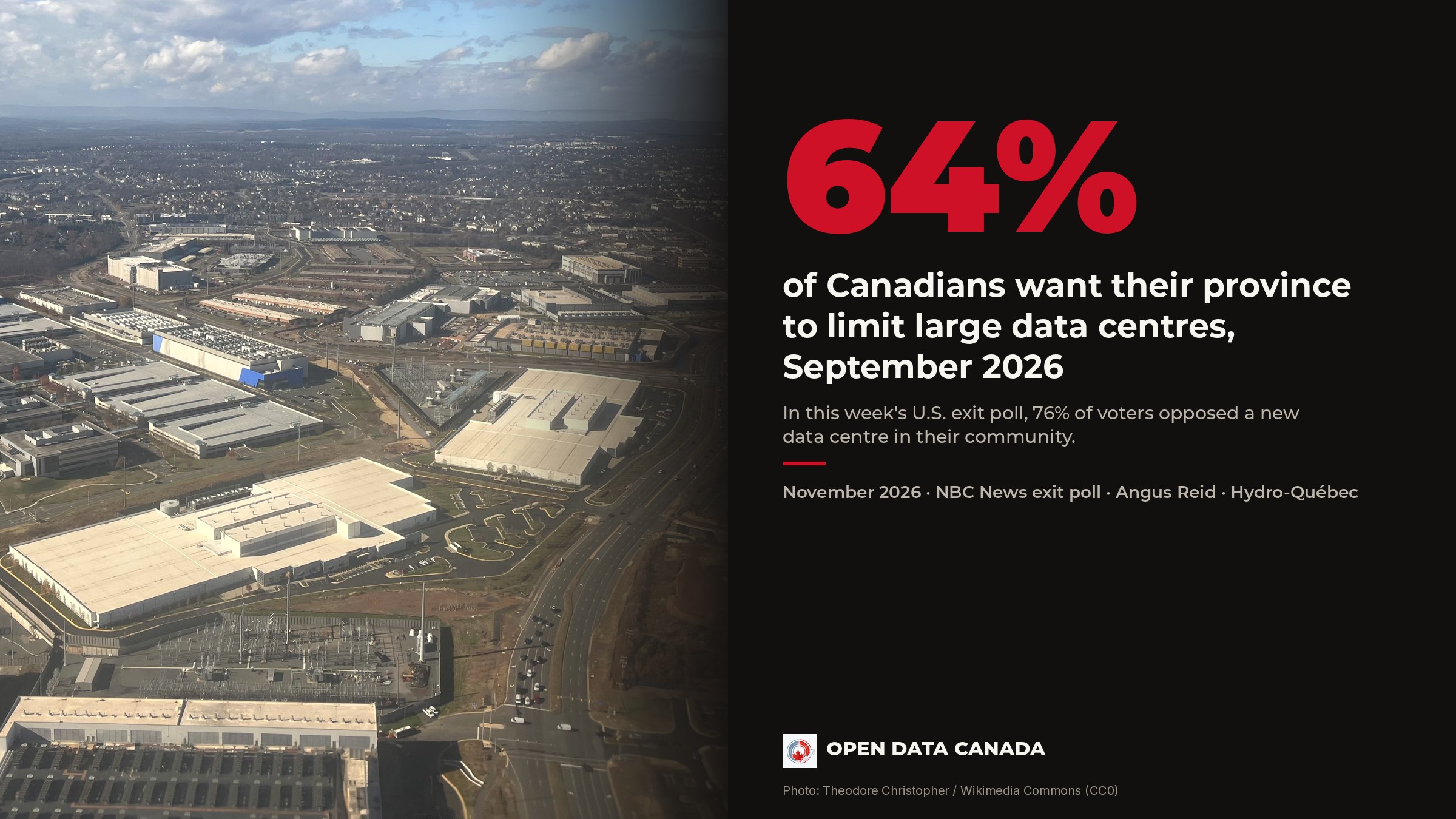
NBC's exit poll found 76% of voters would oppose a new data centre in their community and 24% would favour one. Opponents were the majority in all 45 states polled, from 57% in Wyoming to 84% in Hawaii. Opposition crossed party lines: working from the poll's rounded figures, about 88% of Democratic voters and about 60% of Republican voters were opposed.
Money may be part of it. In the same poll, 86% of voters said they were concerned about what they pay for utilities such as electricity, natural gas and water, though the poll doesn't link that worry to data centres. AI and data centres were a crucial or major factor for 56% of voters, well behind the cost of living at 89%.
Local ballots pointed the same way, though early counts differ. Duane Morris Government Strategies found 37 of the 38 measures called by Wednesday went against data centres, while a Redbud Consulting tally cited by The Verge had 33 of 45 restricting them. Those are places where a fight had already started, and an exit poll can't show how many votes the issue moved. These numbers are also preliminary.
Canadians are already there
Canada is trying to build at scale. The federal AI strategy says the country will need 5.5 gigawatts of AI computing for its commercial players by 2030. One gigawatt is 1,000 megawatts, and a York University study cited by CBC puts a typical 100-megawatt data centre at the yearly electricity use of 40,000 to 64,000 households.
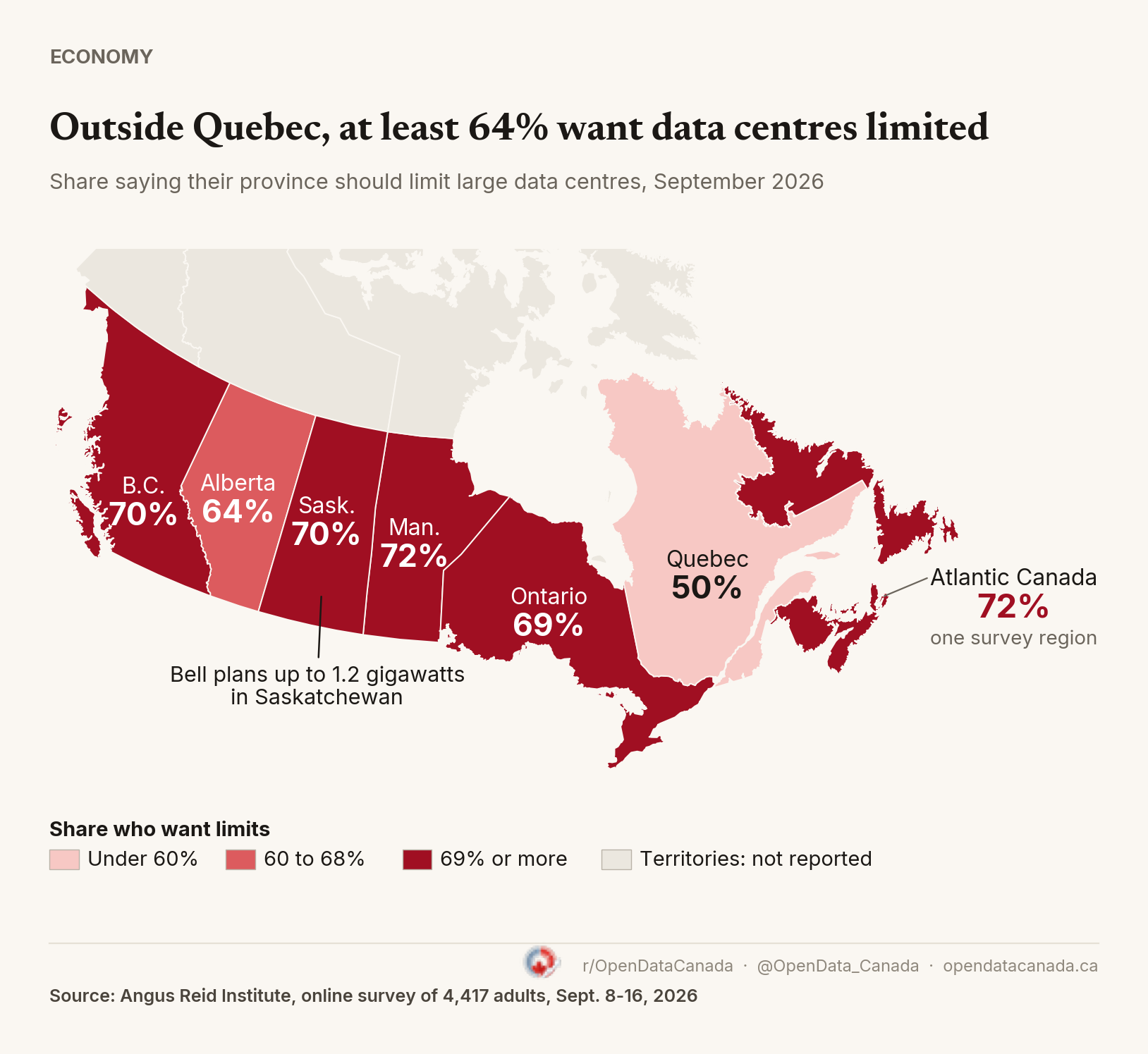
In September, Angus Reid asked Canadians what their province should do. Sixty-four per cent said limit development and 18% said encourage it. Among those who want limits, water use (51%) was the top reason and power costs (38%) came second.
The wording of the question matters. A Leger poll in July asked about support for data centres in the respondent's province and got a near tie, 44% to 42%. It also found 81% concerned about their power bills. People can accept data centres in principle and still fear paying for them. A separate Nanos poll found most Canadians oppose subsidies for them.
The promise
Ottawa's answer came on Sept. 3 in a set of principles for responsible data centre development: "Data centre growth must not shift project-driven electricity system costs onto households and existing businesses." Companies, it says, must pay for connecting and serving their projects, "including new generation, transmission, substations and grid upgrades directly attributable to their development."
That is a clear sentence, and Bell, Google and Meta are among the companies that signed on. But saying developers must pay is not the same as showing that they do. The text names no penalty, covers only costs "directly attributable" to a project, and describes itself as complementing provincial and other regulatory processes. Provinces and their utilities set electricity rates, so that is where the promise gets kept or broken. They are at very different stages.
| Province | Where things stand |
|---|---|
| Quebec | Before the regulator. Hydro-Québec wants a higher rate for data centres; no final ruling found. |
| Ontario | Proposed. A new rate class for large new data centres "to ensure growth in the sector does not increase electricity bills for existing customers." No final regulation found. |
| Alberta | In force. A 1,200-megawatt connection limit is fully allocated, and later projects that bring their own power go first. The province says data centres pay their own way. |
| British Columbia | In force. A cap of up to 400 megawatts over two years, handed out by competition. No specific rule on who pays for grid upgrades was found. |
| Saskatchewan | Policy. New projects must supply their own power. Bell is the last allowed to use SaskPower. |
| Manitoba | Statement only. The premier says hyperscale data centres "don't appear to be in the best interests of Manitobans." |
| Atlantic Canada | No data centre rate found. New Brunswick says it is developing a policy. |
Quebec shows the size of the gap
Quebec has put the clearest number on the table. Data centres using 5 megawatts or more pay an average of 6.82 cents per kilowatt hour, by Hydro-Québec's estimate. Its filing puts the cost of new energy at 12 cents, plus about 2 cents for the capacity to deliver it at peak.
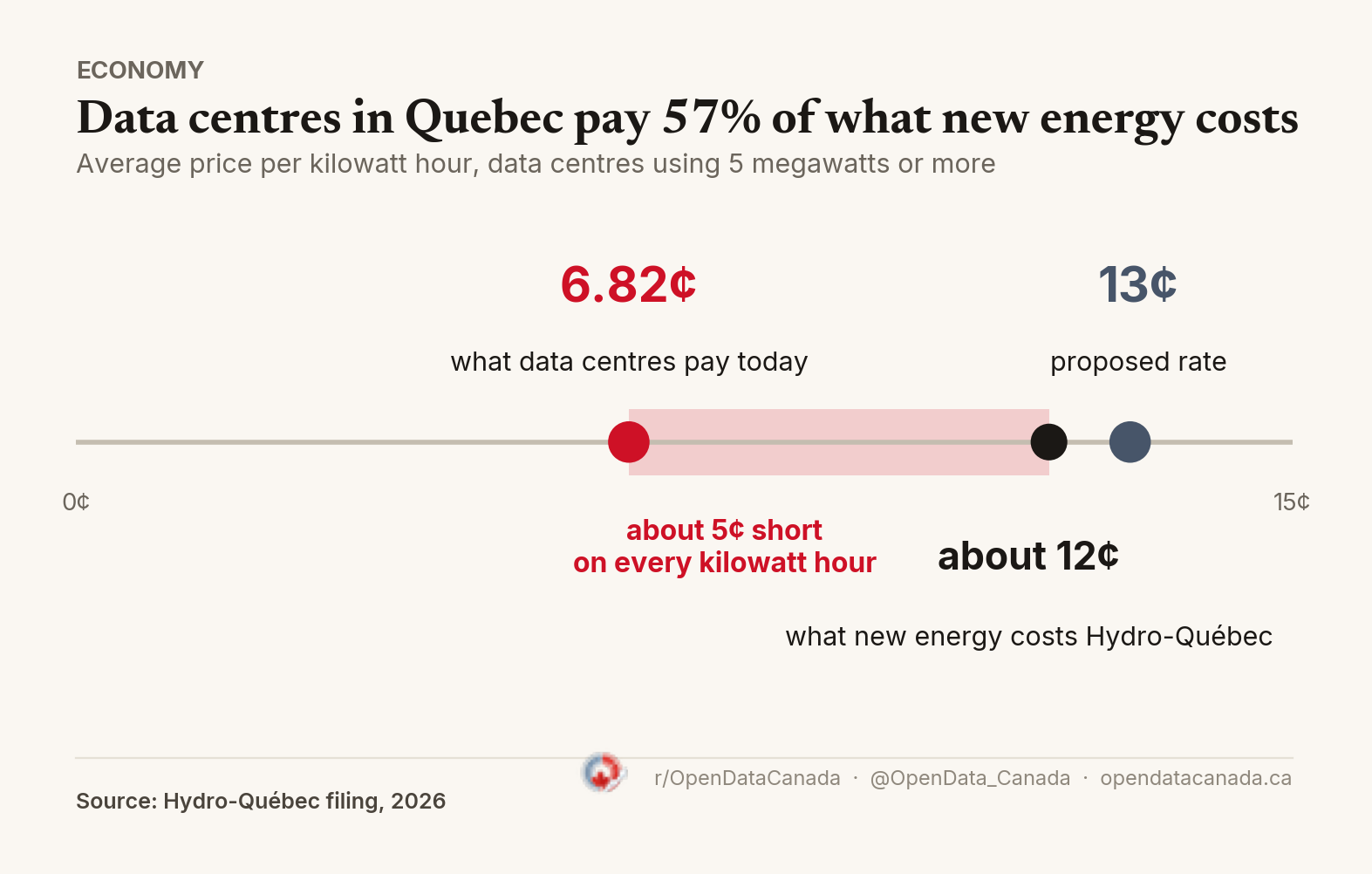
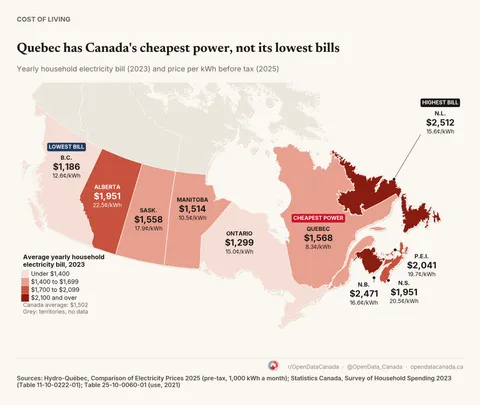
Hydro-Québec is asking the energy regulator, the Régie de l'énergie, for an average of 13 cents, arguing that a discount leaves other customers footing the bill. That rate has not been approved. Existing data centres would phase in over five years, starting at 8.06 cents. The utility says these customers use about 190 megawatts at peak today, which could reach 1,000 megawatts by 2035. Quebec households have the cheapest power in the country, so the price of serving new demand matters to them directly.
The hearings resume in December. Google, one of the companies that signed Ottawa's principles, is among those opposing the increase. A Superior Court judge struck down two government decrees backing the increase on Oct. 26, but the utility's request is still before the regulator.
Saskatchewan shows the scale
Bell's project near Regina is the biggest test of who pays, and its two parts raise different questions. Saskatchewan announced a pathway to 1.2 gigawatts in September: 300 megawatts from the provincial grid, and up to 900 megawatts more that Bell would supply itself, using natural gas generation off the grid. The larger part rests on a memorandum of understanding, and Bell says no site has been chosen.
For scale, 1.2 gigawatts is about 31% of SaskPower's record peak demand. Using the York study's numbers, it would use as much electricity in a year as 480,000 to 770,000 households. Saskatchewan has about 450,000.
But the full 1.2 gigawatts would not come from SaskPower. Bell says the extra 900 megawatts will put "no burden on the grid or ratepayers," and it may not, since that power would be off the grid. The harder question is the 300 megawatts that is on it. That is where the rate Bell pays matters, and no contract or rate terms for that supply were found in public documents.
What the evidence says so far
No observed rise in Canadian household bills has been tied to data centres in the sources reviewed here. What exists is a fight over forecasts. The Pembina Institute estimates that Meta's Alberta project could add $267 to $462 a year to the average household's bill between 2027 and 2031. That is a projection, not a measured increase. The Alberta government says Meta's transmission fees will cut the transmission portion of household bills by up to 6%, which is one line on the bill, not the whole bill.
The U.S. offers a warning. The independent monitor of PJM, the grid covering Pennsylvania, Virginia and Ohio, put the cost of data centre demand to customers at $6.3 billion in its latest power capacity auction and $29.4 billion over the last four. That is a cost from forecast demand in one market, not a measure of retail bills. American voters don't need the distinction to be worried, and neither will Canadians.
Ottawa's promise fits in one sentence. Quebec's regulator now has to put a price on it.