Cost of living · Electricity
Quebec has Canada's cheapest electricity, not its lowest bills
A kilowatt-hour costs less in Montréal than in any other big Canadian city. Quebec households still pay more for electricity in a year than households in British Columbia or Ontario, and about the same as Manitoba and Saskatchewan, because they use far more of it.
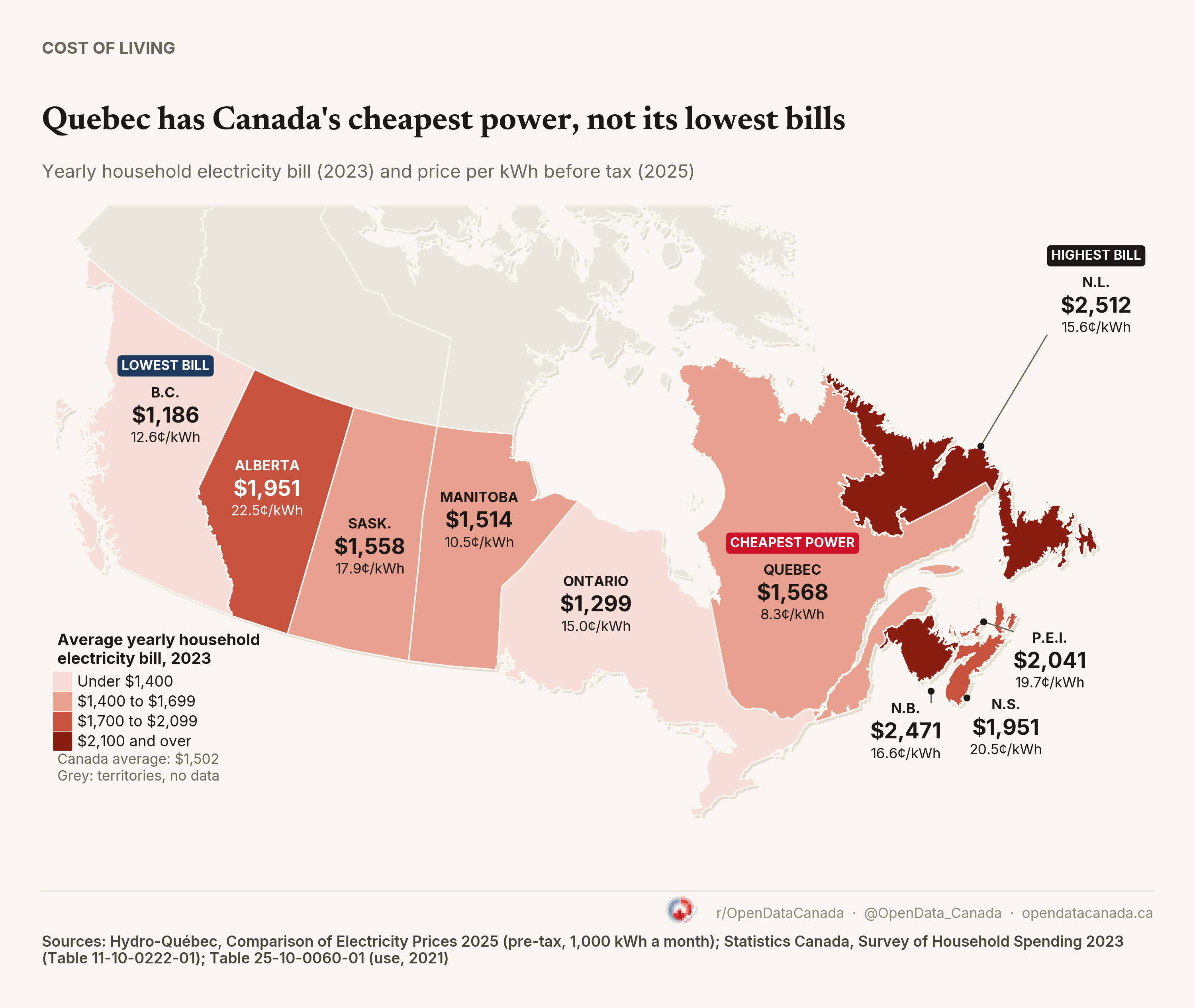
Hydro-Québec publishes a yearly comparison of power prices across North American cities, and Montréal was the cheapest Canadian city in each year from 2021 to 2025. In April 2025, a home using 1,000 kilowatt-hours a month in Montréal paid 8.3 cents per kilowatt-hour before tax. That is cheaper than the 21 other North American cities in the report, Canadian and American, and less than half what Calgary and Edmonton paid (22.5 cents on average).
A cheap rate is not the same thing as a cheap bill. Statistics Canada's Survey of Household Spending puts the average Quebec household's 2023 electricity bill at 1,568 dollars, slightly above the national average of 1,502. British Columbia households paid 1,186, the lowest in the country. Ontario households paid 1,299 and Manitobans 1,514.
 Download chart · Download data (CSV)
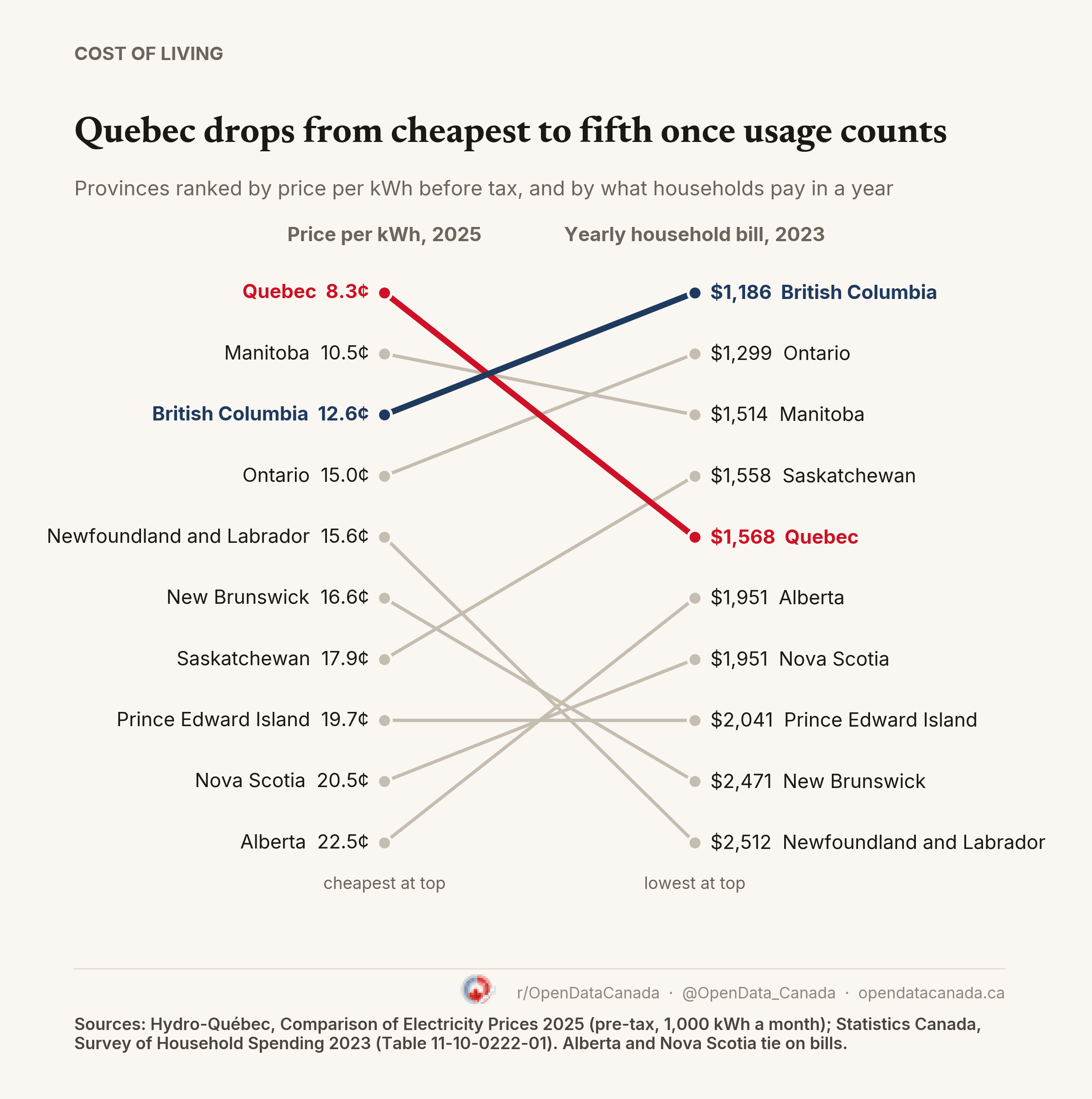
Rank the provinces both ways and the order shuffles. Quebec goes from first on price to fifth on bills. British Columbia, third on price, has the smallest bills. Ontario moves from fourth to second. Alberta, the most expensive place to buy a kilowatt-hour, ties Nova Scotia for the fourth-highest bill. Quebec, Saskatchewan and Manitoba sit within 54 dollars of each other, so their order is a near tie.
 Download chart
Why Quebec households use more electricity
The difference isn't colder weather. Alberta's winters are cold too, but its homes run mostly on natural gas, so much of the energy that keeps them warm lands on a gas bill. Quebec's homes run on electricity, so that energy lands on the power bill. In 2021, the average Quebec household used 17.1 megawatt-hours (17,100 kilowatt-hours) of electricity, according to Statistics Canada's household energy survey. That is the most of any province and 2.6 times the 6.5 used by an Alberta household. The national average was 10.9.
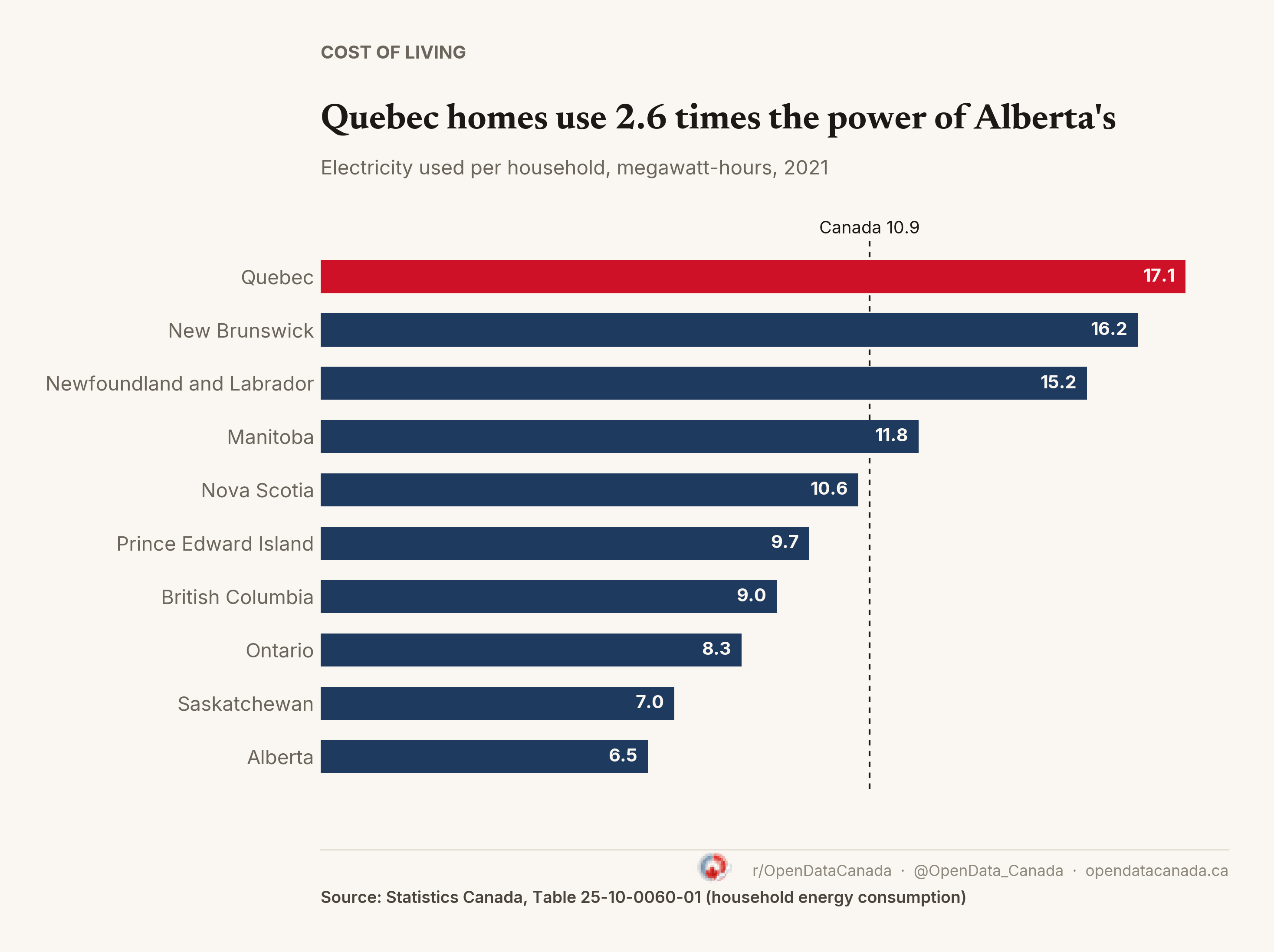 Download chart · Download data (CSV)
What fuels homes use shows the split. Electricity supplied 90 per cent of the energy Quebec households used at home in 2021, the latest year of the same survey. In Alberta it was 19 per cent; natural gas covered the other 81. Saskatchewan (25 per cent electric) and Ontario (34) also lean on gas. New Brunswick (88) and Newfoundland and Labrador (79) look like Quebec, and they have the two highest electricity bills in the country.
That also means the Prairie and Ontario bills on the map understate what those households spend to keep warm. An Alberta electricity bill leaves out the gas bill that heats the house. A Quebec electricity bill usually includes the heat.
What the cheap rate does buy
The low rate still matters. At Alberta's price, Quebec's 2021 use would cost about 3,850 dollars a year before tax (17,100 kilowatt-hours at 22.5 cents), far above anything on the map. The cheap rate is what lets an all-electric home land near the national average.
The Atlantic provinces show the other side. New Brunswick and Newfoundland and Labrador heat much like Quebec, but at 16.6 and 15.6 cents a kilowatt-hour, about double Montréal's rate. Their households paid 2,471 and 2,512 dollars in 2023, the highest bills in Canada and 900 to 950 dollars more than Quebec.
The numbers come from different years, because the three sources don't line up: prices are April 2025, bills are 2023, and use is 2021. Prices are for one city per province (two in Ontario and Alberta) and exclude taxes. Quebec's ranking still holds: the cheapest rate in Canada buys the country's fifth-lowest bill.