Explainer · Population & Migration · 5 min read
Alberta added more people than Ontario this year. That hasn't happened since 1981.
Canada had 41,798,407 people on July 1, 2026. The country grew by 0.46% over the year, its slowest growth since Statistics Canada's quarterly series began in 1946, and Alberta added 76,419 people while Ontario added 45,160.
How many people live in Canada in 2026?
41,798,407. That's Statistics Canada's estimate for July 1, 2026, the most recent date it covers. It's the highest the population has ever been, up 189,425 people from 41,608,982 a year earlier.
Ontario is home to 16.3 million of those people, or 38.9% of the country. Quebec has 9.1 million, British Columbia 5.7 million and Alberta 5.1 million. The three territories together hold about 139,000.
| Province or territory | Population, July 1, 2026 | Change from July 1, 2025 | Growth | Share of Canada |
|---|---|---|---|---|
| Ontario | 16,262,121 | +45,160 | 0.28% | 38.9% |
| Quebec | 9,067,114 | +16,092 | 0.18% | 21.7% |
| British Columbia | 5,710,598 | +8,054 | 0.14% | 13.7% |
| Alberta | 5,101,050 | +76,419 | 1.52% | 12.2% |
| Manitoba | 1,517,379 | +8,797 | 0.58% | 3.6% |
| Saskatchewan | 1,278,402 | +12,113 | 0.96% | 3.1% |
| Nova Scotia | 1,103,419 | +8,262 | 0.75% | 2.6% |
| New Brunswick | 883,522 | +8,811 | 1.01% | 2.1% |
| Newfoundland and Labrador | 552,462 | +2,260 | 0.41% | 1.3% |
| Prince Edward Island | 182,989 | +1,395 | 0.77% | 0.4% |
| Yukon | 50,356 | +1,206 | 2.45% | 0.1% |
| Northwest Territories | 45,904 | −127 | −0.28% | 0.1% |
| Nunavut | 43,091 | +983 | 2.33% | 0.1% |
| Canada | 41,798,407 | +189,425 | 0.46% | 100% |
These are estimates, not a head count. StatCan starts from the 2021 Census, adds births and newcomers, and subtracts deaths and departures. It revises them as better data comes in, and the September release raised its April 1, 2026 estimate by 301,008 people.
Which provinces are growing fastest?
Alberta, by a distance. It grew 1.52% in the year to July 1, faster than any other province, and it added more people than Ontario did in absolute terms. Alberta supplied 40.3% of Canada's entire population gain despite holding 12.2% of its people.
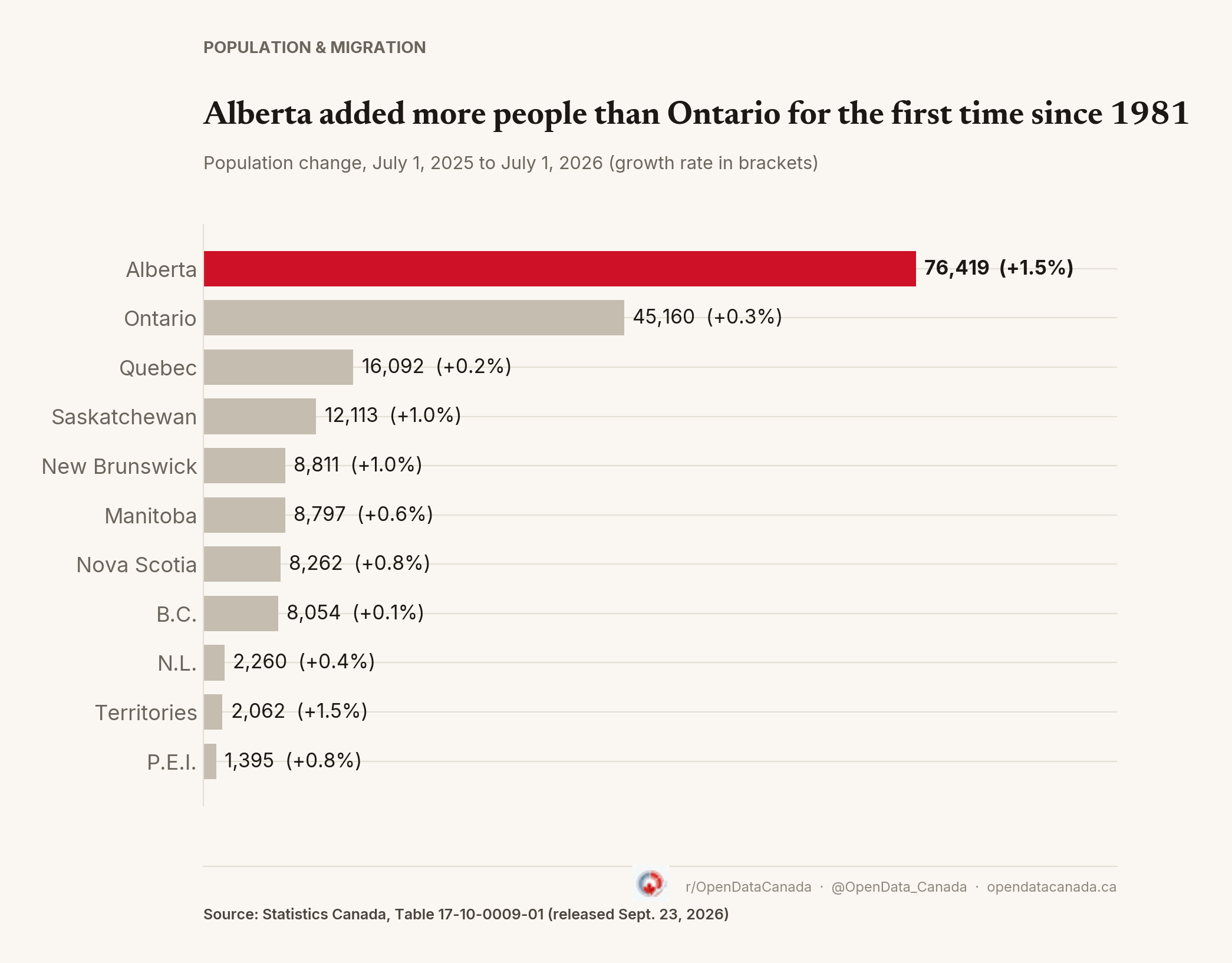
The last time Alberta's yearly gain beat Ontario's was 1981, during the oil boom that also pulled people west in 1979 and 1980. StatCan's quarterly series for Alberta starts in 1951, and those three years are the only other times it's happened.
This year's flip isn't because Alberta sped up. Its gain shrank too, from 213,763 in 2024 to 122,836 in 2025 to 76,419 this year. Ontario's collapsed much further, from 472,089 in 2024 to 126,603 in 2025 to 45,160. That's a 90% drop in two years.
The rest of the ranking by growth rate is mostly small provinces. New Brunswick grew 1.01% and Saskatchewan 0.96%. Prince Edward Island and Nova Scotia were both near 0.75%. Yukon (2.45%) and Nunavut (2.33%) grew fastest of all, though on small bases, and the Northwest Territories was the only jurisdiction to shrink.
The three slowest-growing provinces were the three biggest: Ontario at 0.28%, Quebec at 0.18% and British Columbia at 0.14%. Together they're home to three in four Canadians, and they added fewer people combined (69,306) than Alberta did alone.
Over five years the picture is less lopsided. Since July 2021 Alberta has grown 15.1%, against 9.6% for Ontario, 9.3% for British Columbia and 5.8% for Quebec. Canada as a whole grew 9.3%.
Is Canada's population shrinking?
No, but it's barely growing. The 0.46% gain in the year to July 1 is the smallest July-to-July increase in StatCan's series, which starts in 1946. The previous low was 0.56% in 2021, when pandemic border closures cut immigration sharply. Before that, the slowest year was 2015 at 0.76%.
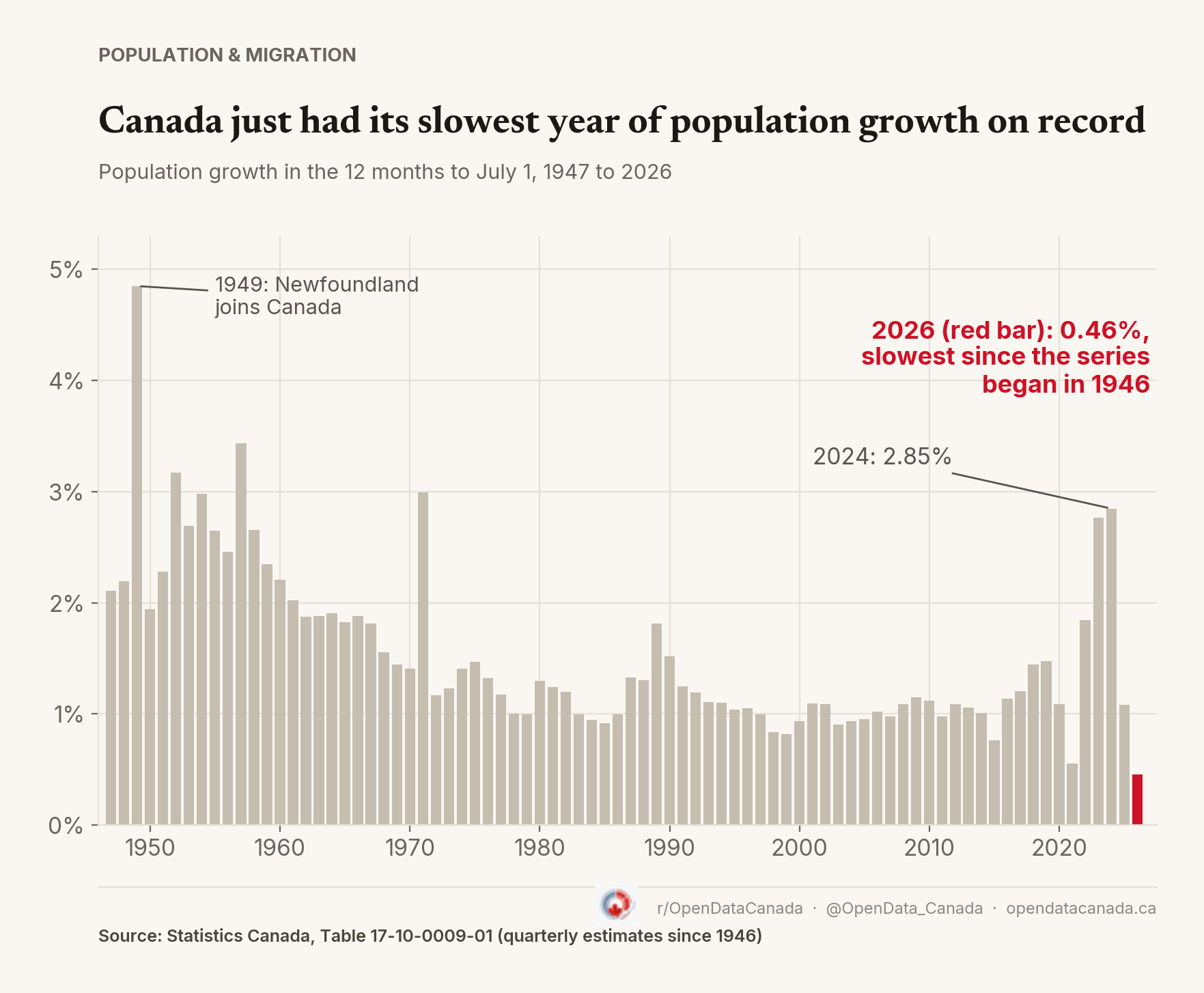
Two years ago the country was growing at 2.85%, its fastest pace since 1971. It added 1,139,889 people in the year to July 2024. This year it added 189,425, about a sixth as many.
There was one quarter of actual decline. Between October 1, 2025 and January 1, 2026, the population fell by 7,225 people. It was almost flat in the next quarter (+1,366) and then rose by 80,343 between April and July. Before the September revision, StatCan's estimates showed three straight quarters of decline; the revised series has only one.
The slowdown is policy, not biology. Ottawa has been cutting both permanent-resident targets and the number of temporary residents, who drove most of the surge. We've covered that side in how Canada's immigration boom ended.
What happens next?
The next quarterly estimate, for October 1, comes out in December. The bigger reset comes when the first 2026 Census counts are published, likely in early 2027. If the census finds more or fewer people than the estimates assume, StatCan will revise the whole series, provinces included.
A revision can move the levels, but it is unlikely to reverse the direction. From 2022 to 2024, Ontario and British Columbia together added between 440,000 and 620,000 people a year. This year they added 53,214 between them, while Alberta accounted for two of every five people Canada gained. The boom is over, and what growth is left has moved to Alberta.