Population · Chart note
Men outnumber women until 48
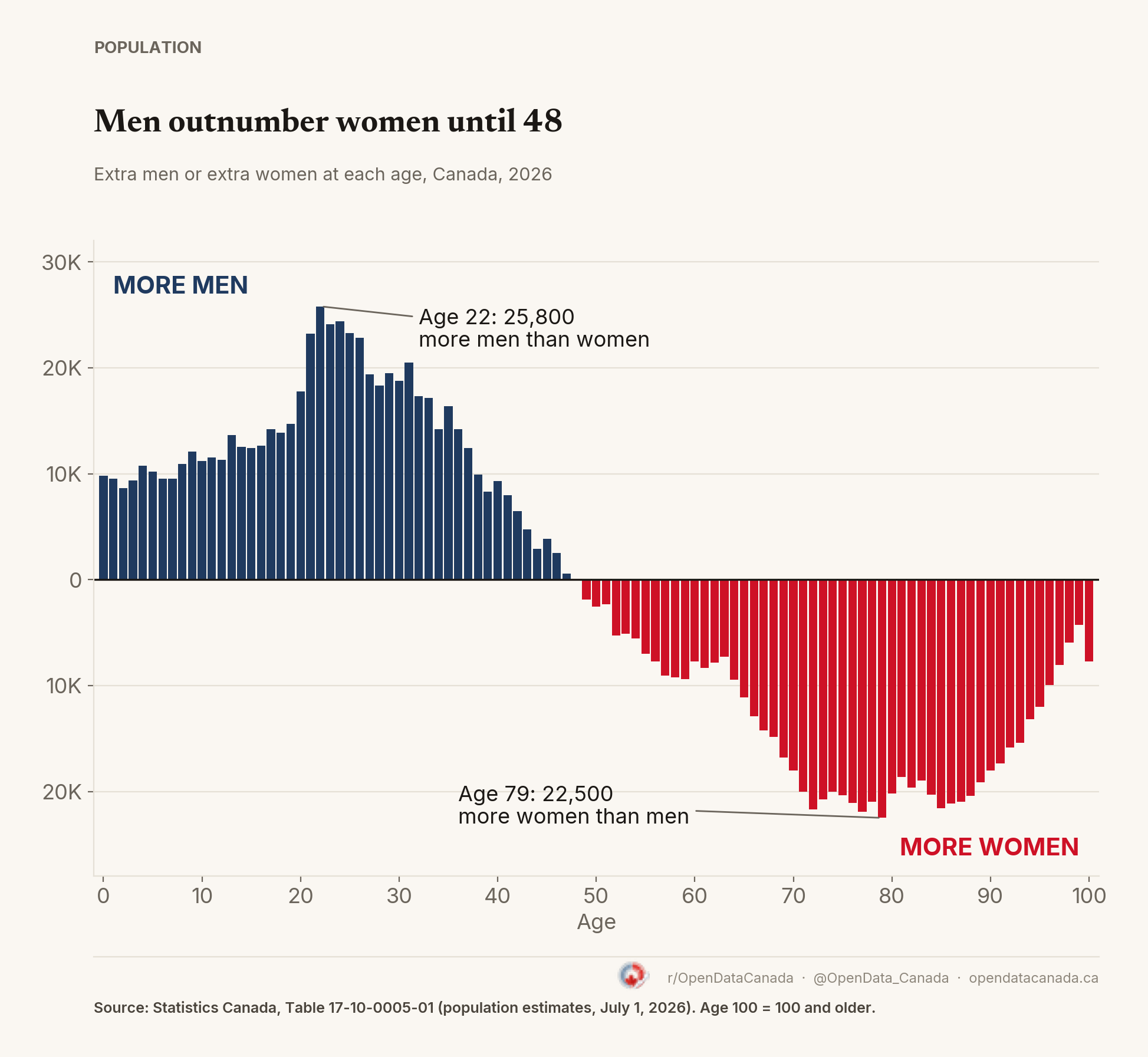
At 22, there are 110 men for every 100 women in Canada. The two are even at 48. From 49 on, women outnumber men, and by 90 there are 63 men for every 100 women.
Are there more men than women in Canada? It depends on which age you look at. Statistics Canada's newest population estimates, for July 1, 2026, count more men than women at every age from birth to 48. From 49 on, women outnumber men, and the gap widens with every decade.
Across all ages the two nearly cancel out: 20.94 million women and 20.86 million men, about 77,000 more women. That near-tie hides two large surpluses at opposite ends of life.
The surplus of men peaks at 22
The tilt is there from the start. Among babies under one, there are 105 boys for every 100 girls. The ratio holds at about 105 or 106 through childhood and the teens, then jumps in the early twenties and peaks at 22, when Statistics Canada counts 284,227 men and 258,469 women: 110 men for every 100 women, or 25,758 extra men at that single age.
It stays wide through the twenties. Among everyone aged 20 to 29 there are 108 men for every 100 women, about 219,000 more men. At 30 the ratio is still 106, and at 40 it is 103. Add up every age under 49 and men outnumber women by about 634,000.
The gap among people in their twenties is wider than it used to be. In 2011 the estimates put 102 men for every 100 women aged 20 to 29. That climbed to 110 in 2024, the highest in a series that goes back to 1971, before easing to 108 this year.
From 49 on, women outnumber men
At 48 the two counts are 18 people apart: 255,982 men and 255,964 women. A year later women are ahead, and they stay ahead at every older age.
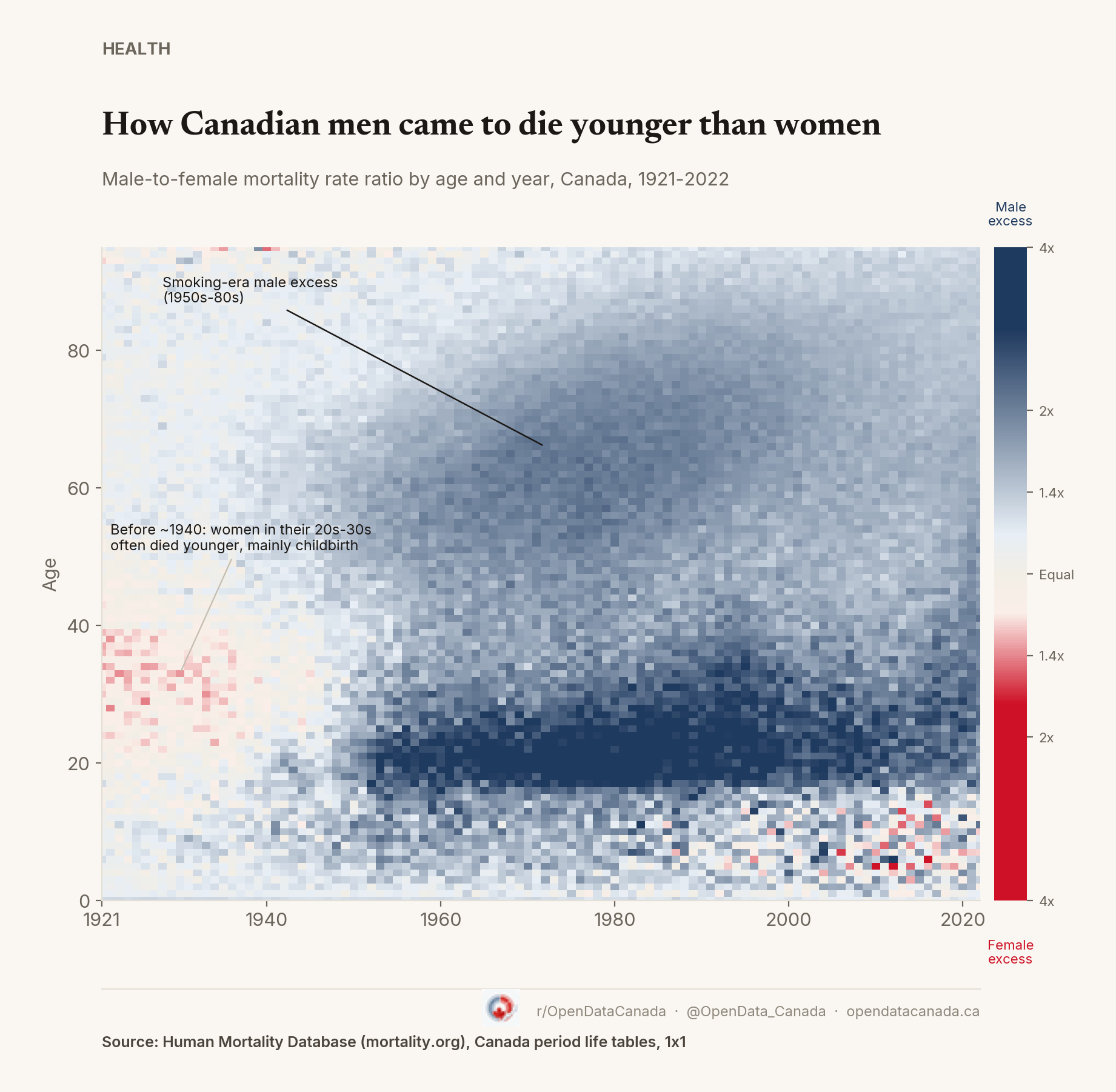
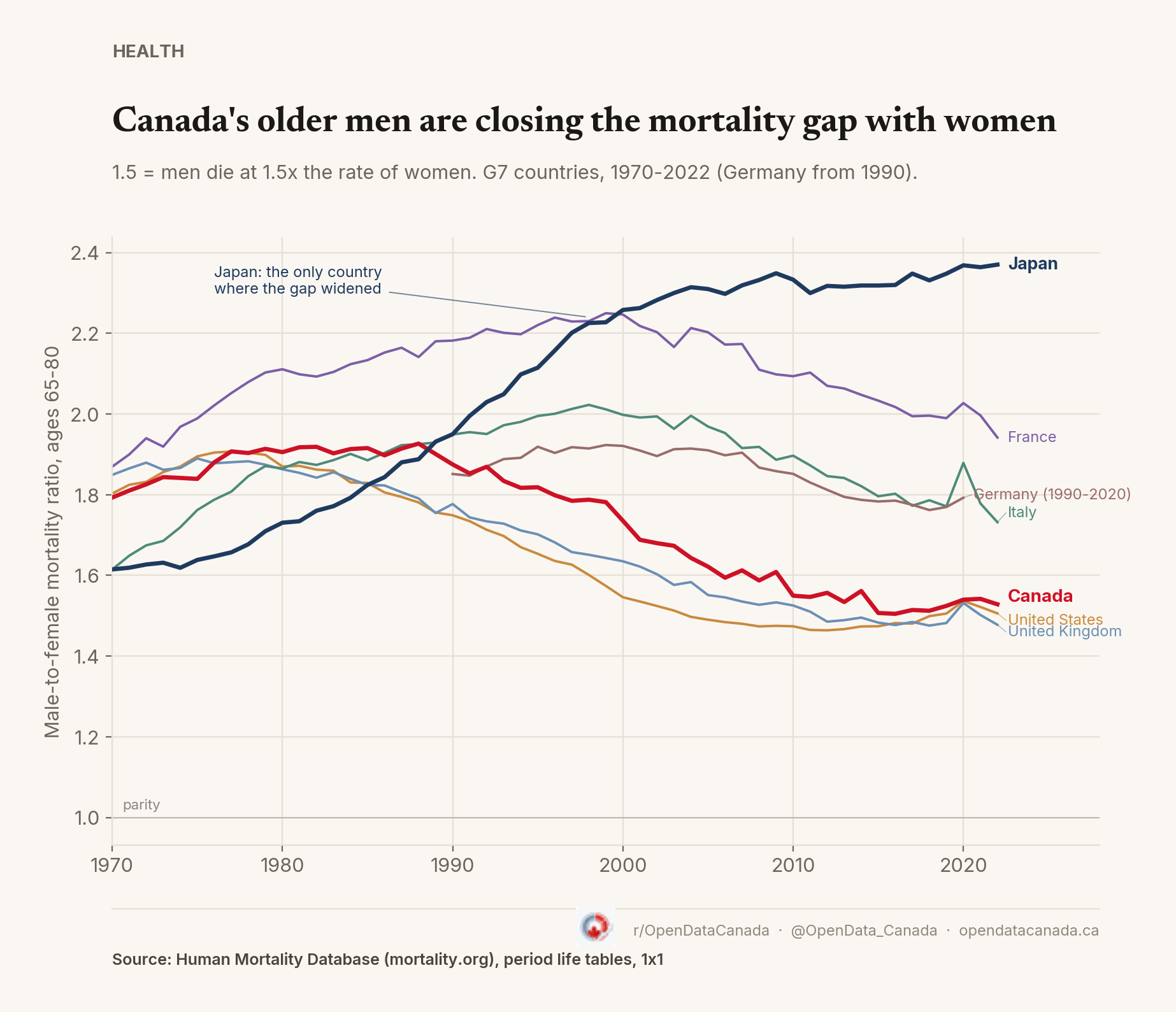
The reason is that men die younger. Every year since the 1940s, Canadian men have died younger than women. In 1982, a 22-year-old man was 4.4 times as likely to die as a woman the same age (our look at a century of mortality records). Those differences pile up over a lifetime.
By 65 there are 96 men for every 100 women. By 79 the count of extra women reaches its high point, 22,495 at that single age. After that the ratio falls at almost every age, but there are fewer people left at each age, so the surplus shrinks in numbers even as it grows in proportion. At 90 there are 63 men for every 100 women. Among people 100 and older, Statistics Canada counts 2,400 men and 10,105 women, about one man for every four women. From 49 up, women outnumber men by about 712,000 in total.
So the old line that Canada has more women than men is true for the country as a whole, and true for everyone past 48. For people in their twenties, it runs the other way.