Population · Chart note
Young men outnumber young women in 40 of Canada's 41 big cities
In Windsor, there are 127 men for every 100 women aged 18 to 34. Only one big city has more young women than young men. Here's how your city compares.
Canada's male to female ratio among young adults is 108 men for every 100 women aged 18 to 34, about 377,000 more young men than young women. That tilt shows up almost everywhere. Of Canada's 41 big cities, 40 have more young men than young women. Victoria is the exception.
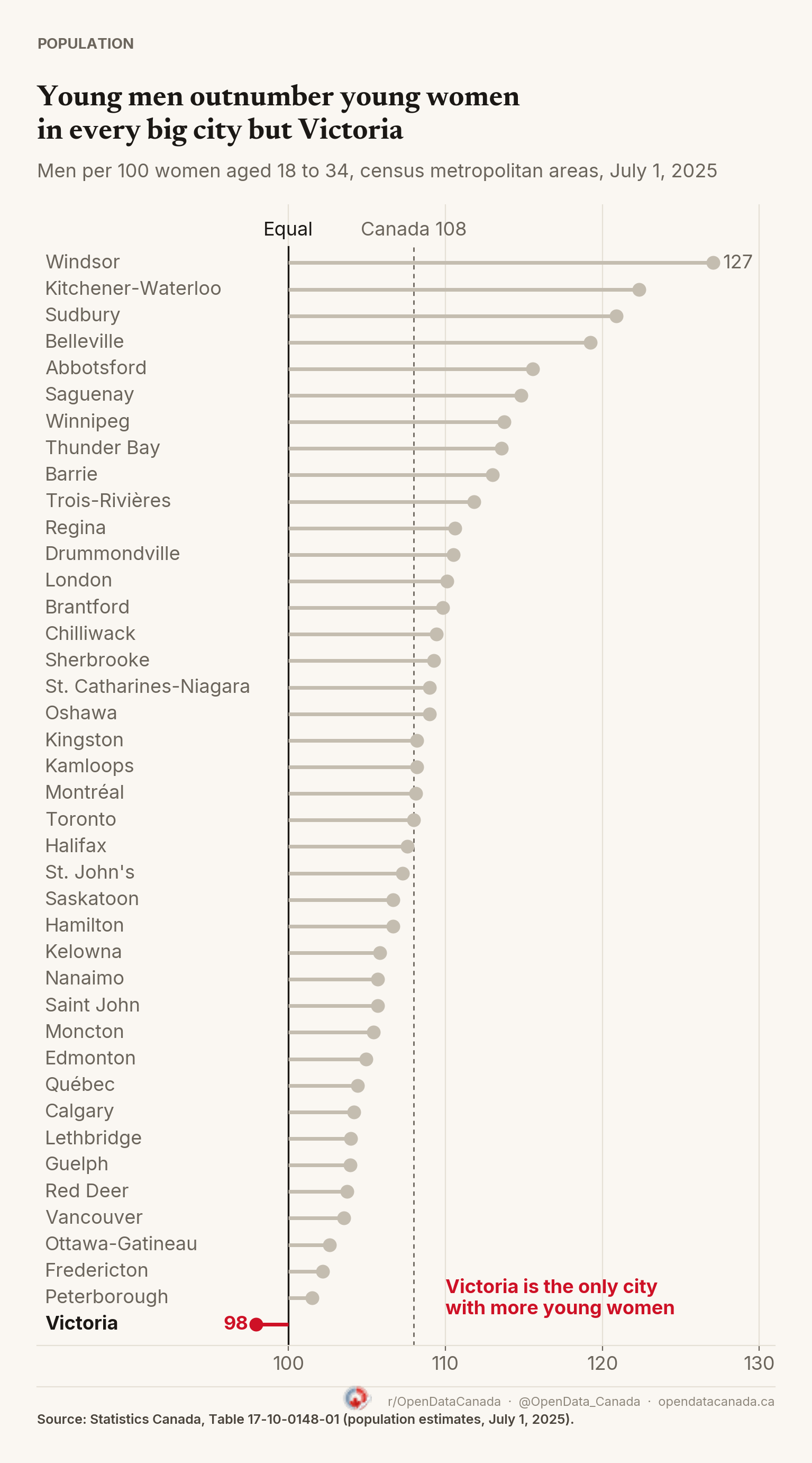
Victoria is the only big city with more young women
On July 1, 2025, Statistics Canada counted 50,872 women and 49,831 men aged 18 to 34 in Victoria: 98 men for every 100 women, or about 1,000 more young women than young men.
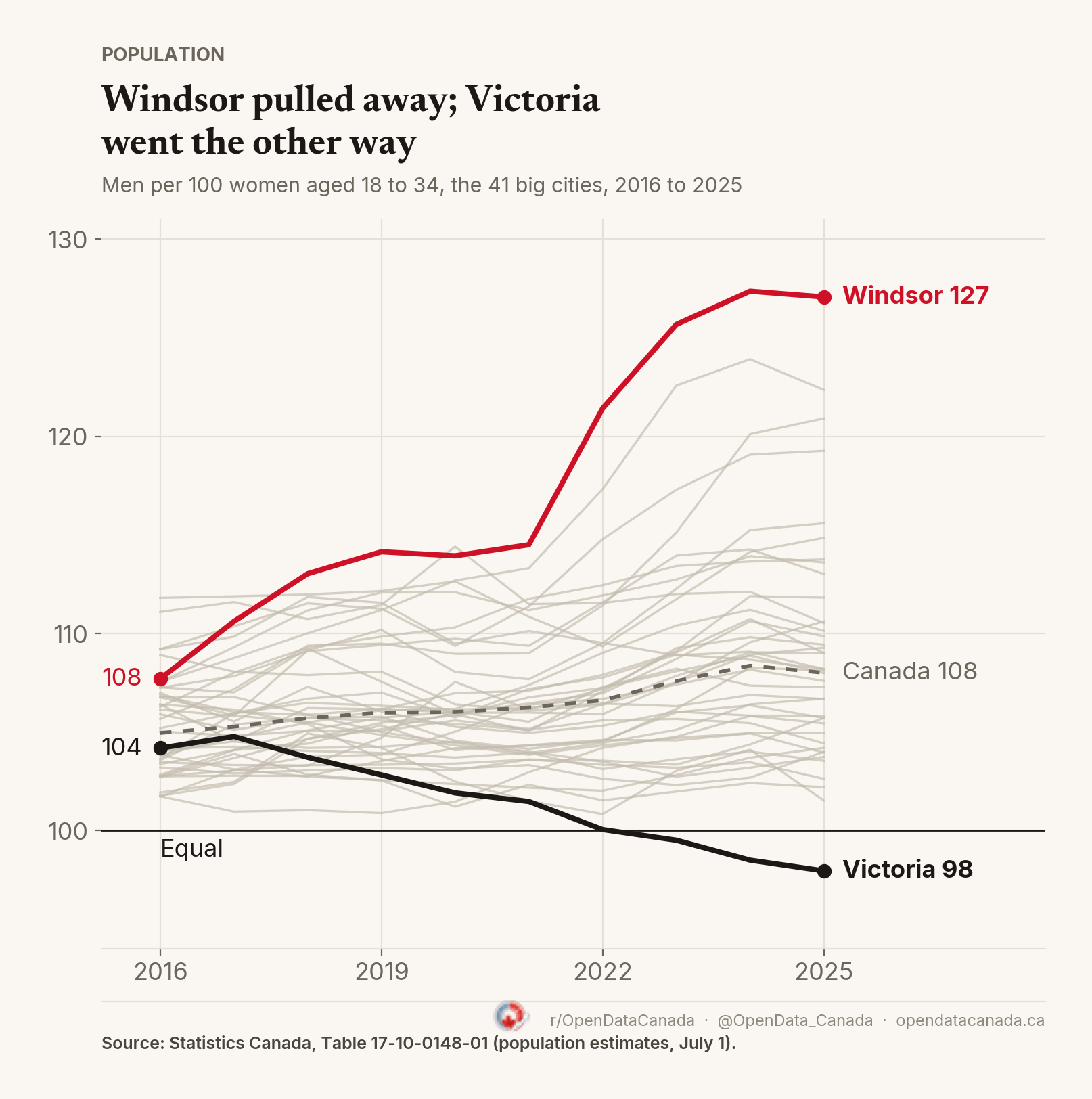
That is new. In 2016, Victoria had 104 young men for every 100 young women. The two were level in 2022, and women have been ahead since 2023. Both groups grew over those nine years, but women grew faster: up about 7,400 people, against 4,500 for men.
The cities closest to Victoria are only just above even: Peterborough at 101.5, Fredericton at 102.2 and Ottawa-Gatineau at 102.6. Among the six biggest cities, Ottawa-Gatineau and Vancouver (103.5) are closest to even.
Windsor has 127 young men for every 100 young women
At the other end, Windsor has 73,971 men and 58,217 women aged 18 to 34: 127 men for every 100 women, or about 15,800 extra young men. Kitchener-Waterloo (122), Sudbury (121) and Belleville (119) come next. Kitchener-Waterloo has about 21,900 extra young men, the third-largest number after Toronto and Montréal.
Toronto and Montréal sit right at the national ratio, at 108. Because they are so large, they hold the most extra young men in absolute terms: about 73,400 in Toronto and 41,000 in Montréal.
Is this normal?
More boys are born than girls, about 105 for every 100, so a small lean toward young men is expected. Moves for study and work shift the balance from there, and Canada's cities lean further than most.
To compare like with like, this section uses ages 20 to 34 and metro areas of 100,000 people or more everywhere. The median big Canadian city has 108 men for every 100 women in that age group. The median U.S. metro area has 103, and the median European metro area has 105. No U.S. metro area of a million or more people is above San Jose's 113. Among Europe's largest, Turin (110) and Milan (109) are near the top, while Paris, Warsaw, Madrid and Amsterdam have more young women than young men.
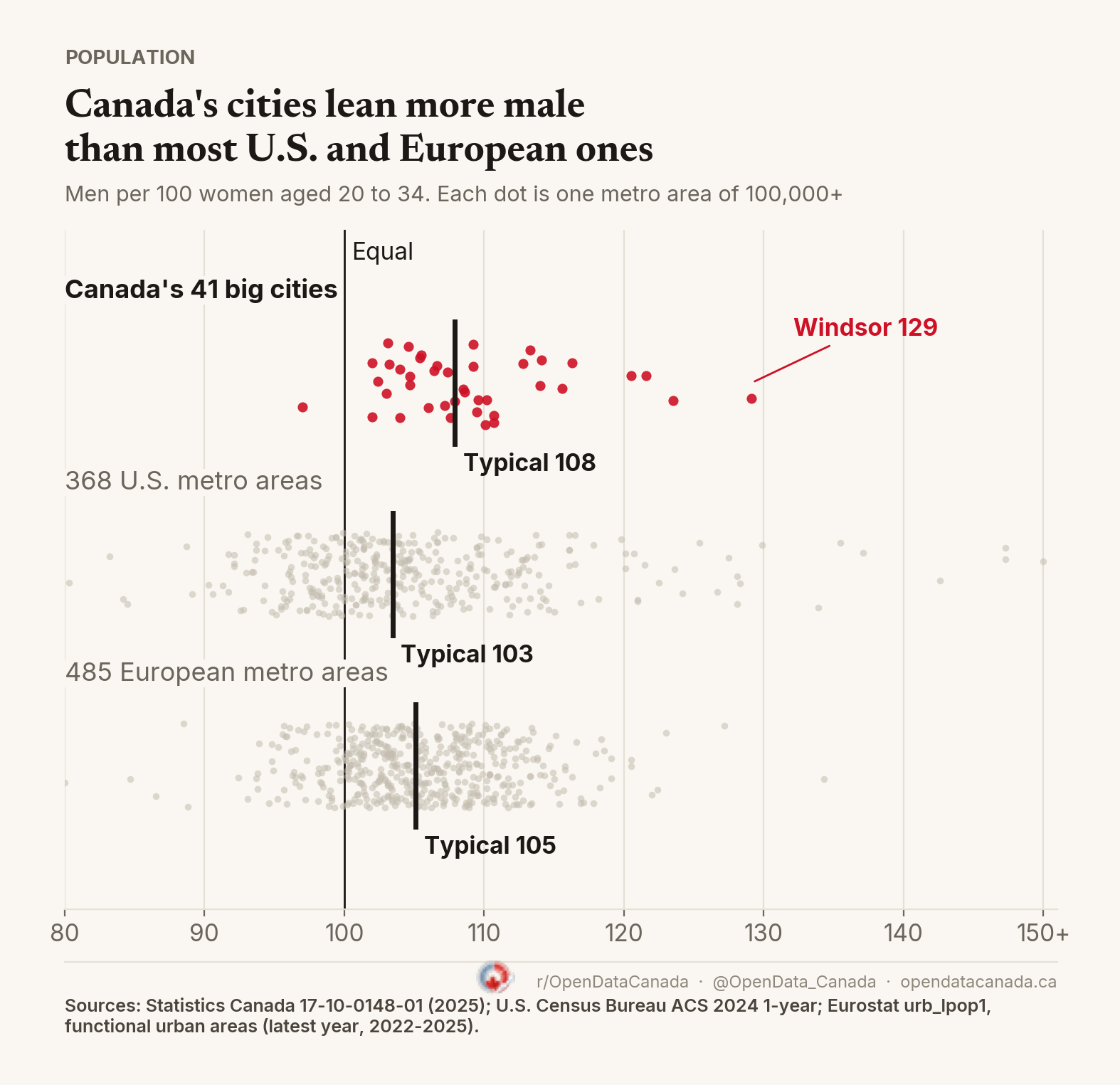
At 129 on this measure, Windsor is rare. Only 8 of 368 U.S. metro areas and 1 of 485 European ones are higher. Several of the U.S. ones are home to major military bases or large universities, such as Jacksonville, North Carolina (Camp Lejeune), Watertown, New York (Fort Drum) and State College, Pennsylvania (Penn State). Europe's highest are Valletta, Malta (134), and the German university city of Aachen (127).
The national picture matches. For ages 20 to 34, Canada has 108 men for every 100 women, 9th highest of 38 OECD countries, against 103 in the United States and 105 in the median OECD country.
Most of the gap opened after 2016
Windsor's gap is recent. In 2016 it had 108 young men for every 100 young women, close to the national figure of 105. It reached 114 by 2019 and then climbed fastest from 2021, to a peak of 127 in 2024. Since 2016, Windsor has added about 27,900 men aged 18 to 34 and 15,500 women.
Kitchener-Waterloo, Sudbury and Belleville followed the same path, each rising by 10 points or more since 2016. Across all 41 cities, 28 have a higher ratio now than in 2016. Victoria had the largest drop, 6 points.
Most of the extra young men arrived as temporary residents
Statistics Canada's migration estimates show where the gap came from. From 2016 to 2025, temporary residents aged 18 to 34 added about 27,500 men and 12,700 women to Windsor's population, a gap of about 14,800. In Kitchener-Waterloo, temporary residents added about 15,600 more young men than young women. Permanent immigrants and moves from elsewhere in Canada added far less, and in Windsor, people leaving for other parts of Ontario took about 3,000 men off the gap.
The timing matches a surge in international students at local colleges. Study permits taking effect at St. Clair College in Windsor rose from about 1,300 in 2016 to 8,700 in 2023. At Conestoga College in Kitchener, they rose from about 2,000 to 32,500. The federal government capped new study permits in January 2024. By 2025, permits at both colleges were down by three-quarters or more. The permit data aren't split by gender for each college, so they can't show how many of the extra young men came to study and how many came to work.
The climb has stalled for now. Windsor (127.1, down from 127.4) and Kitchener-Waterloo (122.4, down from 123.9) were both slightly lower in 2025 than in 2024. The July 1, 2026 city figures, expected in early 2027, will show whether Windsor's gap starts to close.