Population & Migration
Kids outnumber seniors in only 9 of Canada's 66 biggest cities
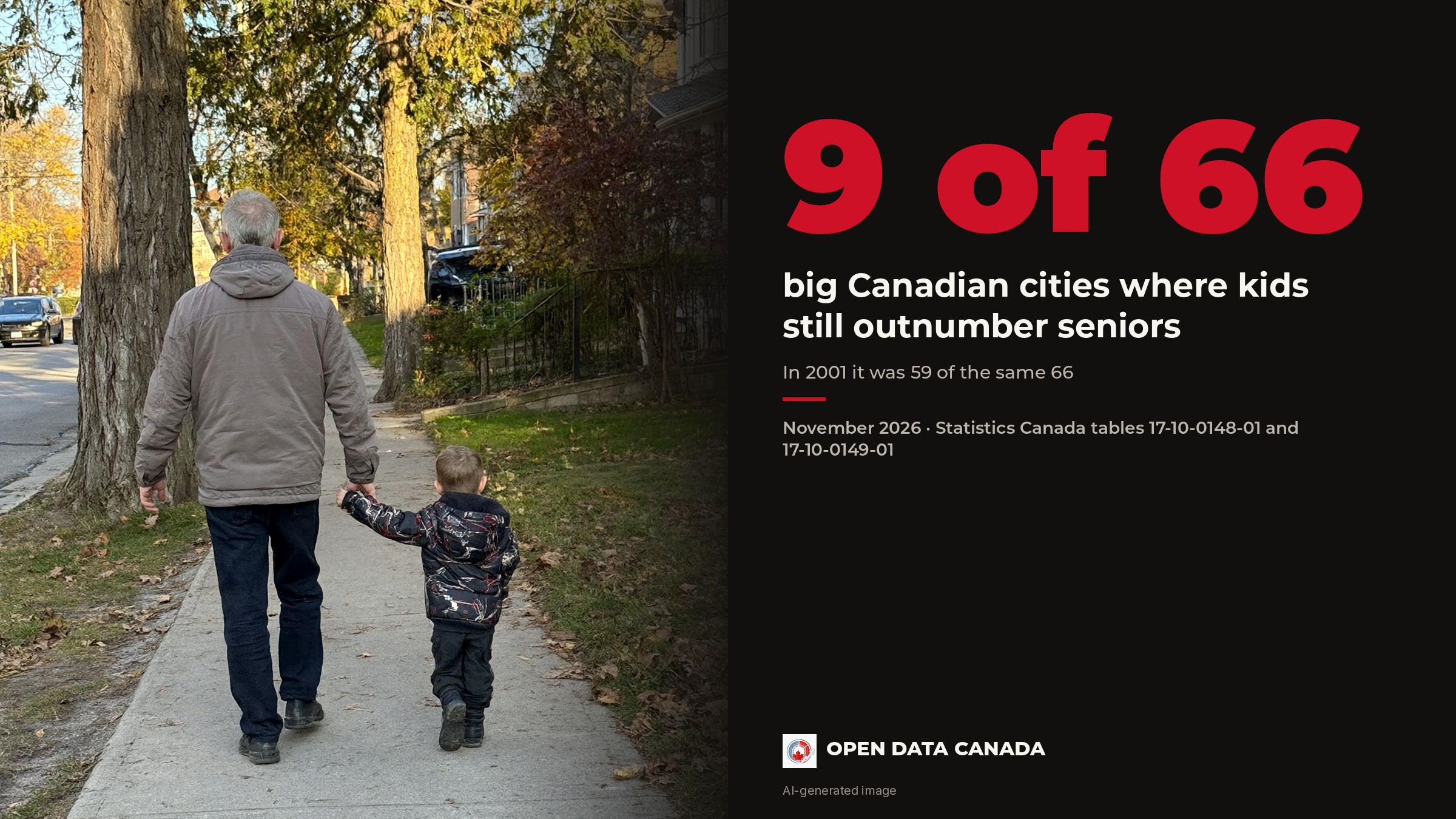
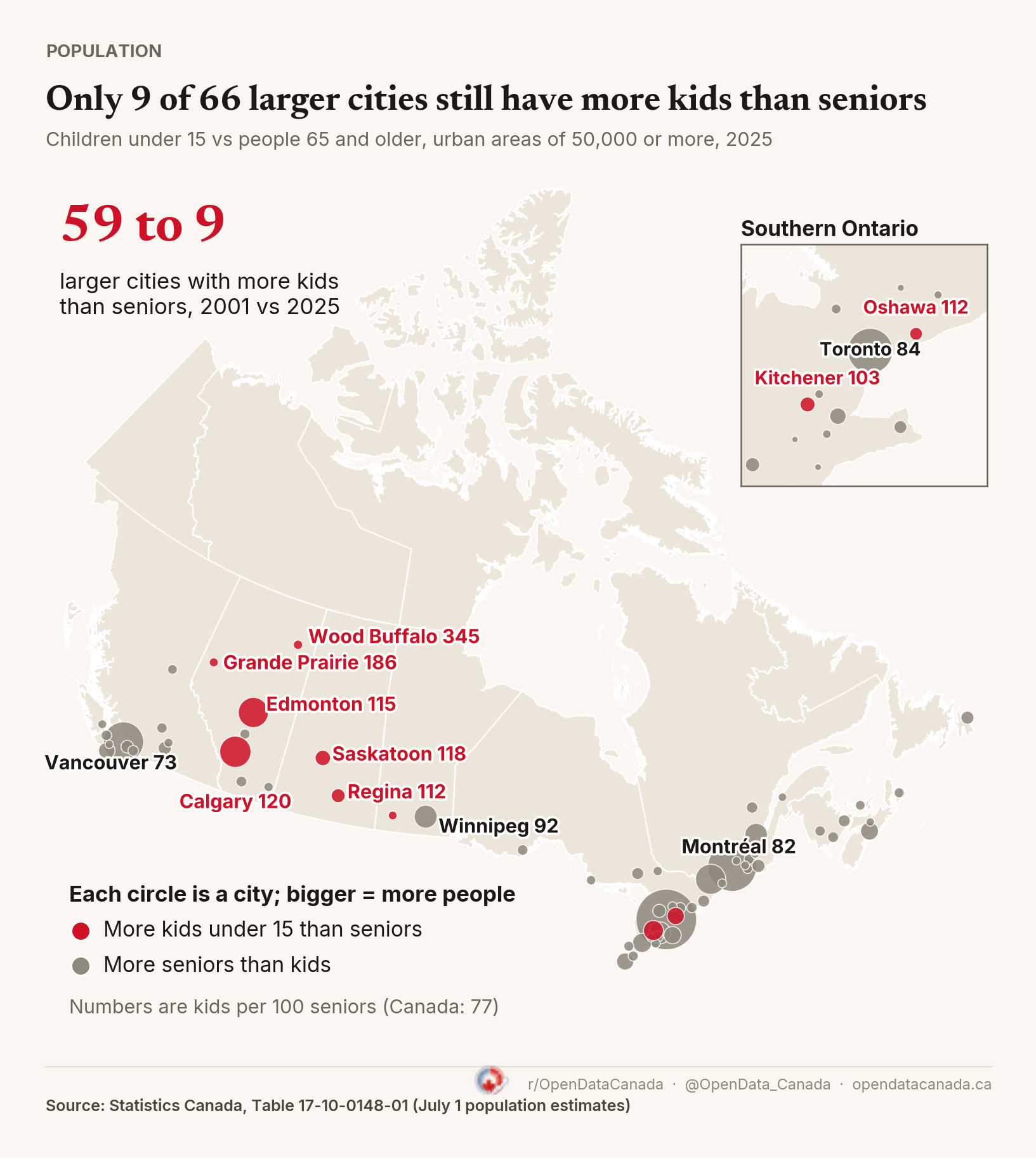
In 2001, kids under 15 outnumbered seniors in 59 of Canada's 66 biggest urban areas. By 2025, only nine were left, seven of them on the Prairies. At the pace of the past five years, those nine run out by 2033.
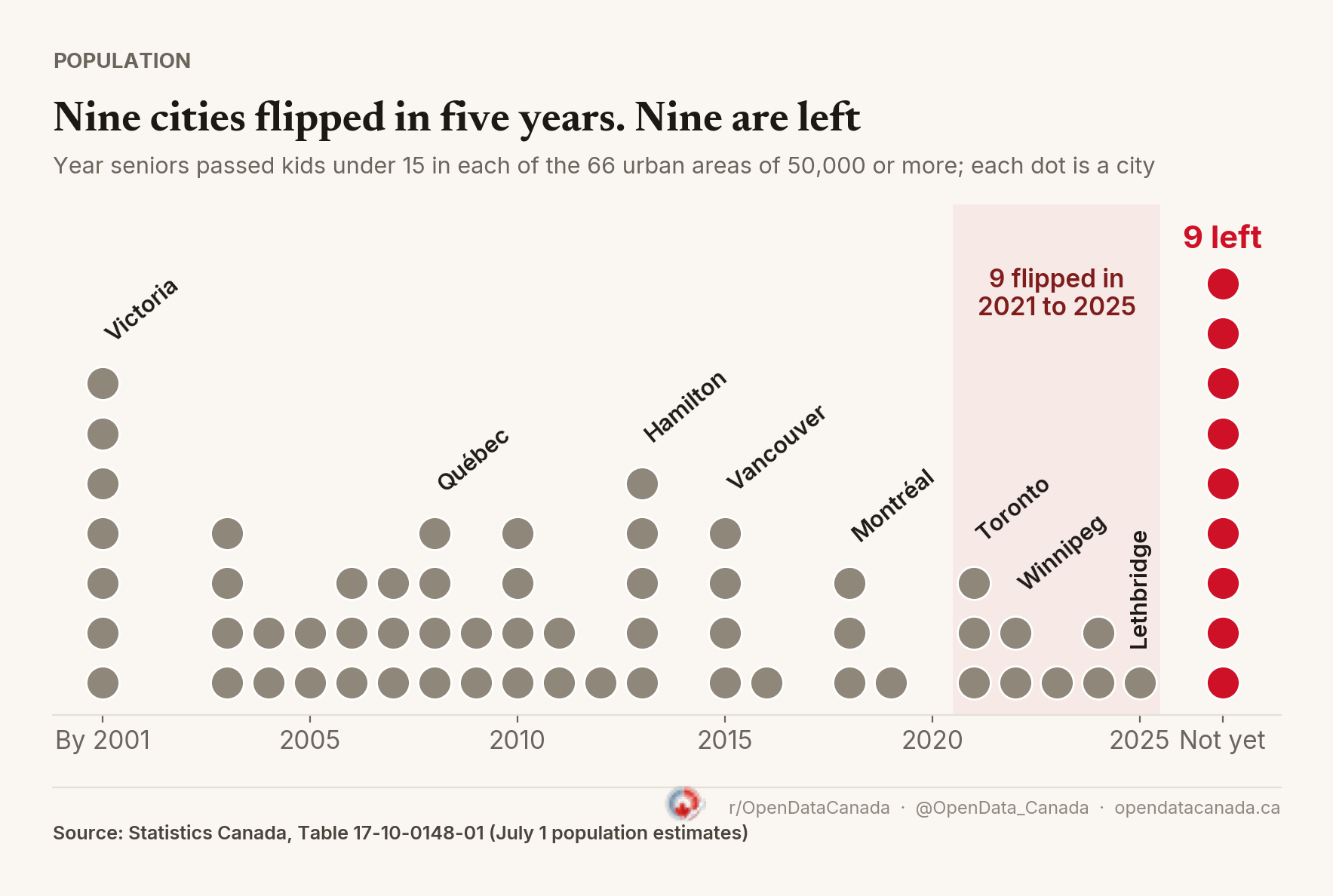
Toronto went in 2021, the same year as Ottawa-Gatineau and Guelph. Winnipeg and Abbotsford-Mission followed in 2022, Prince George in 2023, Barrie and Red Deer in 2024. Lethbridge crossed the line in 2025, with 99 kids under 15 for every 100 people 65 and older.
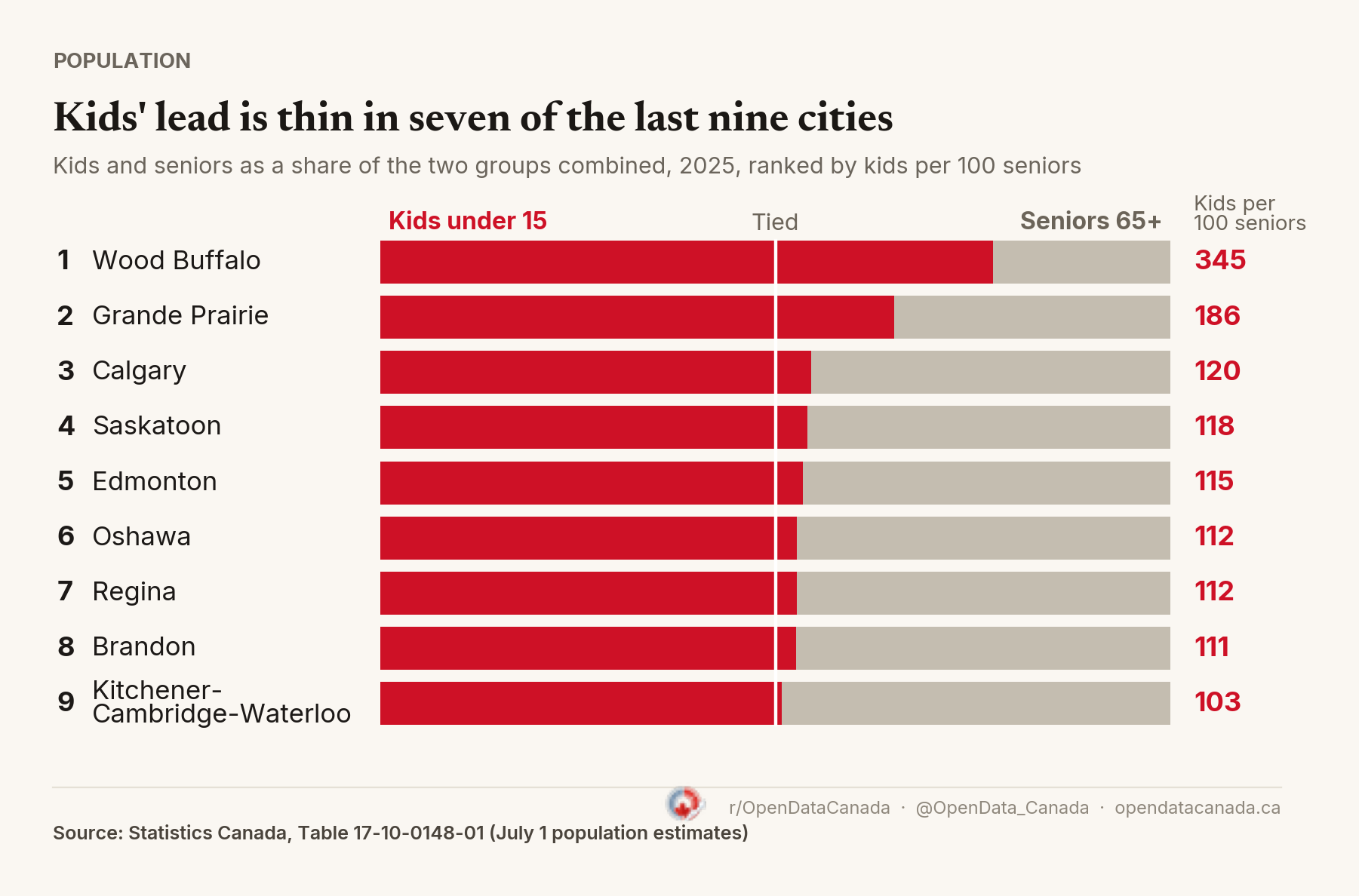
That makes nine big cities in five years, and it leaves nine. Canada's youngest big cities are now Wood Buffalo, Grande Prairie, Calgary, Saskatoon, Edmonton, Regina, Brandon, Oshawa and Kitchener-Cambridge-Waterloo. None is in British Columbia, Quebec or Atlantic Canada.
"City" here means a whole urban region, the core plus its commuter suburbs, so Toronto includes places like Mississauga and Brampton. All 66 had at least 50,000 people in 2025.
Every city got older, including the nine
The number of kids per 100 seniors fell in all 66 cities between 2001 and 2025. Across Canada it went from 149 to 77, passing below 100 in 2016. The country now has 6.26 million kids under 15 and 8.11 million seniors.
Seniors increased in every one of the 66 cities and at least doubled in 40 of them. Even the smallest rise, in Brandon, was 48 per cent. Kids are a different story: their numbers fell in 22 cities, including Windsor, Sudbury, Thunder Bay and Cape Breton.
Why these nine are still on the list
The obvious guess is that people in these cities have more children. They do, but only slightly: a typical city among the nine holdouts had 42 births per 1,000 women aged 15 to 49 in 2024-25, against 38 in the other 57 cities. Woodstock, Ontario, had the highest rate of all 66, at 51, and seniors passed kids there in 2012.
The second guess is that families are moving in. Over the past decade, the typical holdout gained 193 kids through migration for every 1,000 kids it started with. The other cities gained 181. Moncton gained the most, at 463, and seniors passed kids there in 2013.
The bigger difference is who already lived there. In 2001, the typical holdout had 188 kids for every 100 seniors, against 133 elsewhere. Today about 33 per cent of its residents are aged 25 to 44, the years when most parents have young children. In the other cities it's 28 per cent. The typical holdout's median age is 37, five years younger than the rest, and kids there are up 40 per cent since 2001, against 4 per cent elsewhere.
The extreme case is Wood Buffalo, the oil sands region around Fort McMurray. It had 1,205 kids for every 100 seniors in 2001 and has 345 now. Its senior population went from 827 to 5,051, even though more seniors left the region than arrived over the past decade.
Which city is next
If each city keeps losing ground at its 2020 to 2025 pace, Kitchener-Cambridge-Waterloo goes first and Oshawa last.
| City | Kids per 100 seniors, 2001 | 2025 | Seniors pass kids around |
|---|---|---|---|
| Kitchener-Cambridge-Waterloo | 184 | 103 | 2027 |
| Regina | 160 | 112 | 2029 |
| Edmonton | 188 | 115 | 2029 |
| Calgary | 219 | 120 | 2029 |
| Saskatoon | 176 | 118 | 2030 |
| Wood Buffalo | 1,205 | 345 | 2031 |
| Grande Prairie | 356 | 186 | 2032 |
| Brandon | 122 | 111 | 2032 |
| Oshawa | 218 | 112 | 2033 |
Those dates are a straight line drawn from five years of data, and a shift in who moves where would change them.
Fewer classrooms, more care
Schools will feel the turn first. In all 66 cities, the nine included, there are fewer children under 5 than children aged 10 to 14. In Toronto and Calgary there are about 85 of the younger group for every 100 of the older one. Unless more families arrive, the classes starting school will be smaller than the ones leaving elementary.
At the other end, people aged 85 and older across these 66 cities went from 302,542 in 2001 to 737,637 in 2025, and only about 1 in 5 Canadians have a plan to care for aging family. In 37 of the 66 cities, deaths outnumbered births in 2024-25. None of the nine is among them, for now.
Calgary, the largest city still on the list, has 1.8 million people and 120 kids for every 100 seniors. At its recent pace, it has until 2029.