Population · 4 min read
Only 1 in 5 Canadians have a plan to care for aging family
A Sunlife survey found 19% of Canadians have a full plan for caring for an aging or sick relative. By 2045, Canada will have about half as many people aged 45 to 64 per person aged 85 and older.
In 2018, the last time Statistics Canada counted, about 7.8 million people, one in four Canadians aged 15 and older, looked after a relative or friend with a long-term health condition, a disability or problems related to aging. Almost half of them (47%) were mainly caring for a parent or parent-in-law. Among caregivers aged 45 to 64, it was 61%.
That's the backdrop for the number in a new survey from Sunlife, the insurer that rebranded from Sun Life this week. Asked whether they had a full plan to care for an aging or sick family member, 19% of Canadians said yes. That figure isn't in Sunlife's public release; it comes from country results Sunlife gave the Globe and Mail. Americans came in at 18%. Respondents in the six Asian markets surveyed averaged about 30%.
Canada's aging population: half as many 45-to-64s per person over 85
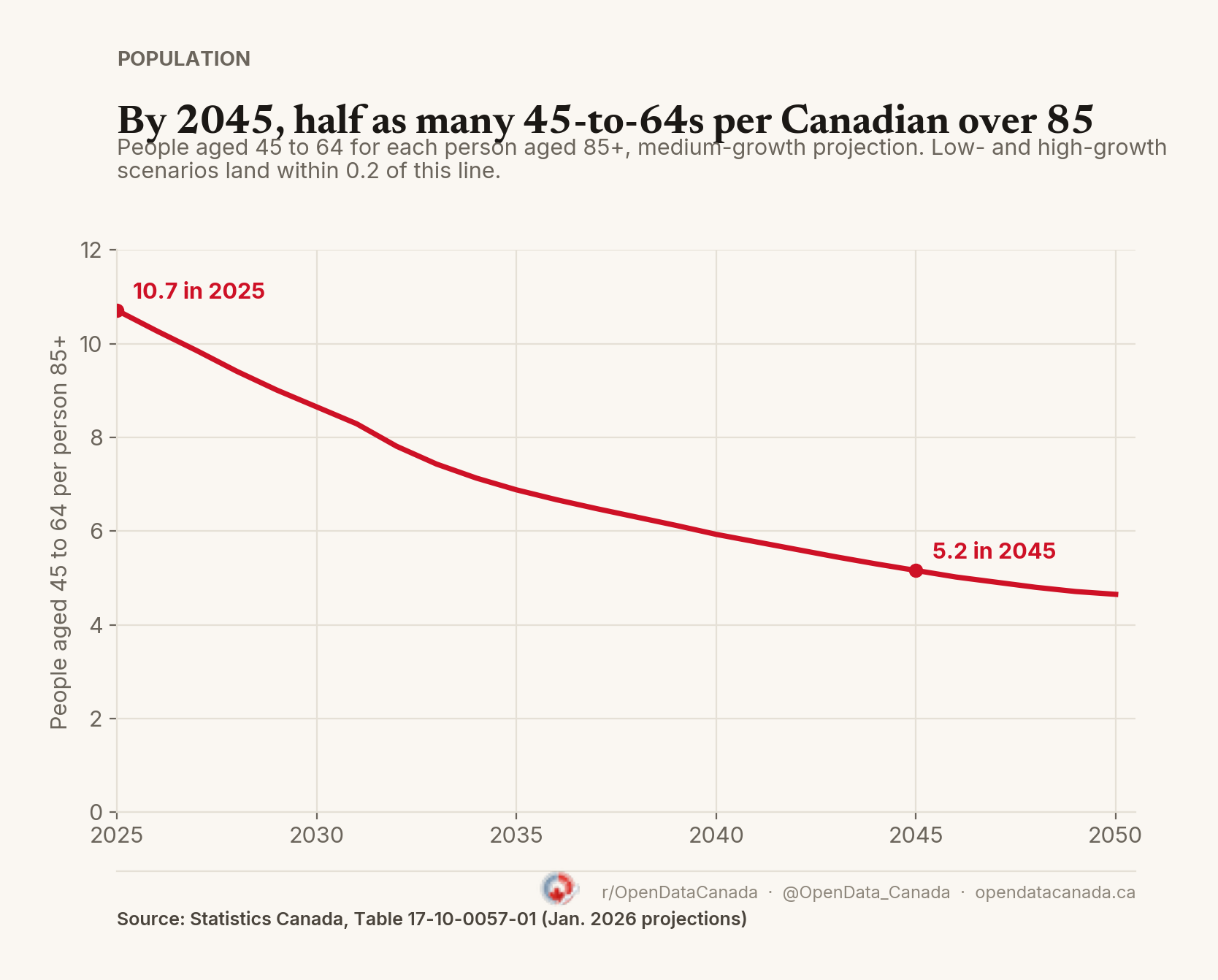
Statistics Canada's January 2026 projections put the population aged 85 and older at 951,833 in 2025. In its middle-of-the-road scenario, that reaches about 2.34 million by 2045, roughly two and a half times as many. The wider population aged 65 and older grows from 8.1 million to about 11 million. Over the same 20 years, the 45-to-64 age group, where most caregivers are looking after a parent, grows only from 10.2 million to about 12 million.
That works out to 10.7 people aged 45 to 64 for every Canadian over 85 today, and 5.2 in 2045. Canada's overall population grew more slowly in the year to July 1, 2026 than in any year since Statistics Canada's series began in 1946, as we covered in our explainer on Canada's population. The oldest group is different: anyone who will be over 85 in 2045 is already at least 65 today.
This ratio compares age groups. It is not a count of caregivers: many 45-to-64-year-olds will never care for anyone, and many people over 85 need little help.
The projections also correct a claim in this week's coverage. The Globe and Mail, citing Statistics Canada, and the Philippine Canadian Inquirer, citing the Canadian Institute for Health Information, both reported that the 85-plus population could triple over the next two decades. Statistics Canada's projections put it at 2.17 million to 2.52 million by 2045, or 2.3 to 2.65 times today's level. Even the high-growth scenario doesn't pass triple until 2049.
What Sunlife actually asked, and who answered
Sunlife released the research on Oct. 15, the same day it unveiled its new brand, and its own release calls closing the planning gap "central to how we will grow our business." The pollster Earnscliffe ran a 15-minute online survey from Sept. 10 to 25 in Canada, the United States, Hong Kong, the Philippines, Vietnam, Indonesia, Malaysia and Singapore, using Leger and Prodege panels.
Canada's sample of 1,599 included 570 extra people picked for their wealth: 152 aged 25 to 44 with household assets over 100,000 dollars and 418 aged 45 to 74 with assets over 500,000 dollars. Earnscliffe weighted them back to their real share of the population, and weighted each country by age, gender and region. Online panels are not random samples, so the release itself says its margin of error (2.45 points for Canada) is "for comparison purposes only."
The 19% is people's own judgment of whether they have a "full plan." It is not a count of savings, wills or care arrangements, and it doesn't mean the other 81% have nothing in place.
The public release reports only the eight-market average: 57% said having the money and ability to care for an aging or sick relative was very important, and 27% had a full plan. That 30-point gap was the widest of any topic Sunlife asked about, wider than retirement (56% versus 31%) or protecting against an unexpected illness (61% versus 33%).
The caregivers already doing it say they didn't plan either
Edward Jones Canada published its own research a day earlier. The Harris Poll surveyed 2,152 Canadians online from May 13 to June 9 who already support an adult over 65 or a disabled adult financially. 71% said they took on the role with little or no planning.
On average, they spent 7,025 dollars a year of their own money that wasn't paid back and gave about 89 hours a month, roughly three hours a day, for an average of seven years. 54% were also supporting at least one child. Edward Jones estimates more than 3.6 million Canadians are in this role for someone over 65.
Two firms that sell financial planning, two different questions, one answer: most people don't plan for this, and the ones living it say they didn't either. Sunlife's survey asked whether families have a plan. Statistics Canada's projections say that in 20 years, whoever carries out that plan will come from a pool half as large: about five people aged 45 to 64 for each Canadian over 85.