Article · Housing · 4 min read
In 1981, 27% of young adults lived with their parents. The latest survey puts it at 55%.
The Census shows a rise from 27% in 1981 to 42% in 2011 for ages 20 to 29. The 2024 Canadian Housing Survey puts ages 18 to 29 at 55%, up from 51.3% in 2022.
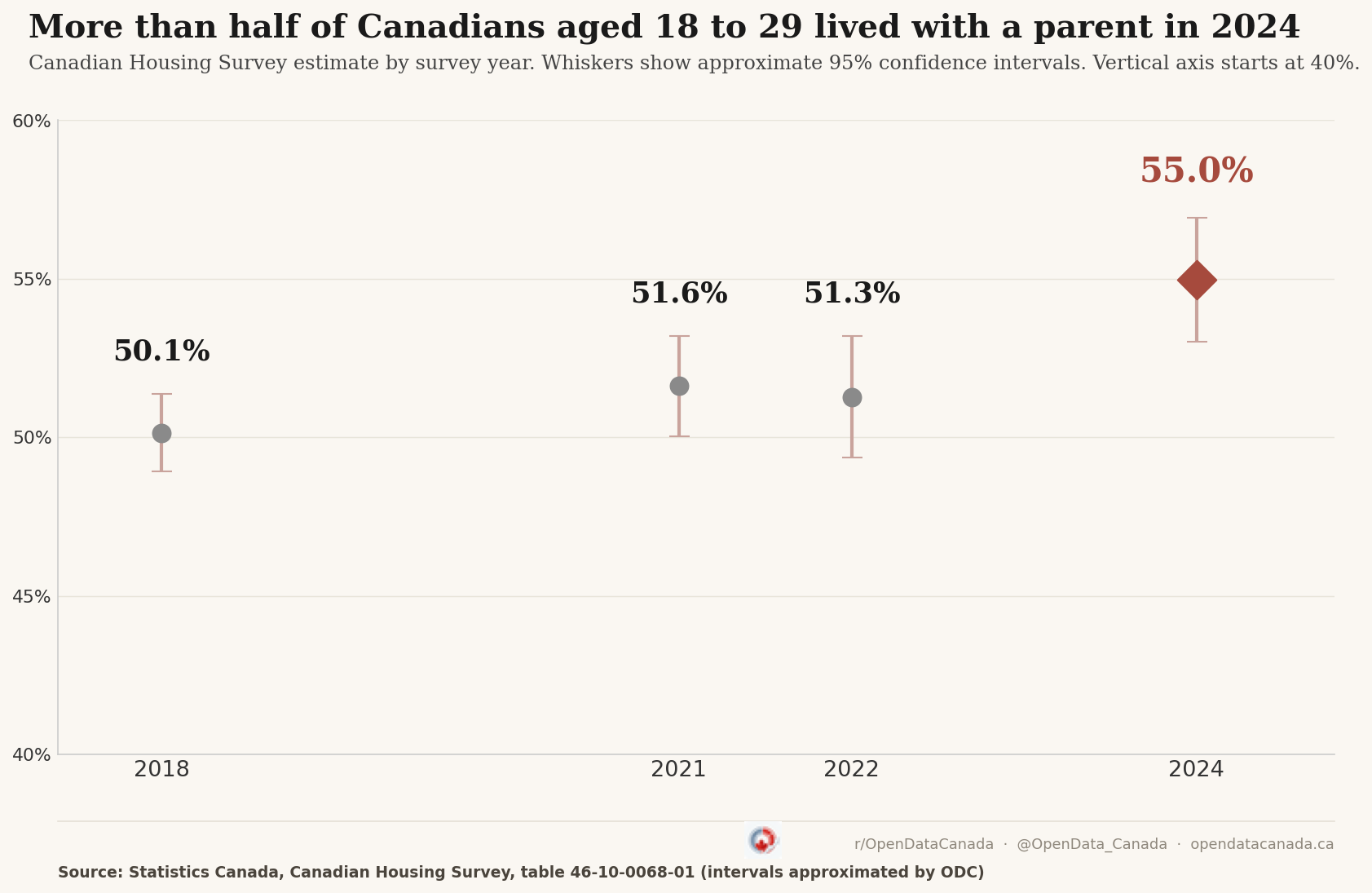
More than half of young adults in Canada lived with a parent in 2024. Statistics Canada's Canadian Housing Survey, released on 21 September, estimates that 55.0 percent of people aged 18 to 29 were living in a home with a parent. That is about 3.5 million people, out of an age group of 6.3 million.
The survey has asked the question four times. The estimate was 50.1 percent in 2018, 51.6 percent in 2021 and 51.3 percent in 2022. The 2024 figure is the first to move clearly outside that range.
Two things stand out in the 2024 numbers. The age group grew: the survey counts 6.30 million 18-to-29-year-olds, up from 5.88 million in 2022. And the number living apart from parents barely moved, from 2.86 million to 2.84 million. The count living with a parent went from 3.01 million to 3.47 million.
That pattern is not new. The estimated number of young adults living apart from parents has sat between 2.75 and 2.86 million in every survey cycle since 2018, while the age group has grown by about 700,000.
These are snapshots, not a tracked group. The survey does not follow the same people over time, so it cannot show anyone moving back home or leaving. It shows that in 2024, more of a larger group of young adults were counted in a parent's household.
The longer view
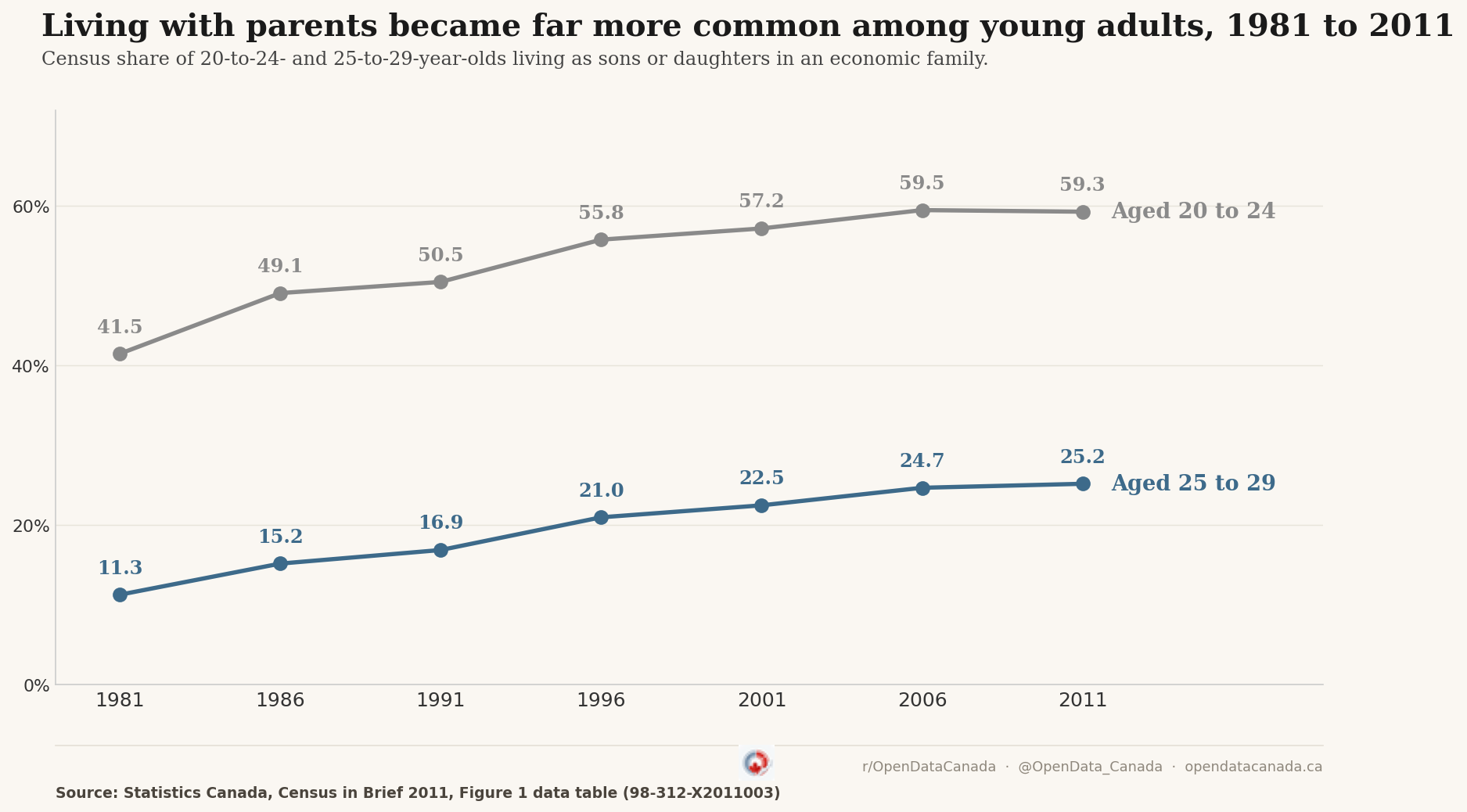
The Census tells the earlier part of the story. Statistics Canada's own analysis of the 2011 Census found that the share of 20-to-29-year-olds living with parents rose from 27 percent in 1981 to 42 percent in 2011.
The rise was steepest among people in their late twenties. Among 25-to-29-year-olds, the share living at home more than doubled, from 11 percent to 25 percent. Among 20-to-24-year-olds it went from 42 percent to 59 percent.
After 2011 the Census trend flattened. A later Census tabulation, on a somewhat broader definition, puts the 20-to-29 share at 44 percent in 2011, 46 percent in 2016 and 46 percent in 2021. Statistics Canada reported no change for ages 20 to 34 between the 2016 and 2021 censuses.
So the shape of the story is a long rise to 2011, a decade of little change to 2021, and a 2024 survey reading higher than anything the same survey had found before.
What the numbers can and cannot tell us
The Census and the Housing Survey are different measures. The Census figures cover ages 20 to 29 and count sons and daughters in an economic family. The Housing Survey covers ages 18 to 29 and counts people identified as a child of the household's reference person. That alone makes the two shares different. The charts sit side by side for context; they cannot be joined into one line, and the gap between 42 percent in 2011 and 55 percent in 2024 is not a measured increase.
The 2022-to-2024 change should be read with care. The survey estimate rose from 51.3 percent to 55.0 percent. The published data cannot say how much of that difference is a real change in living arrangements and how much comes from sampling and other survey factors. The 2024 survey got responses from 32 percent of sampled households, against 47 percent in 2022, and its weighting is described differently. By our approximate calculation the difference is larger than sampling error alone would explain, but sampling error is only one of the possible survey effects. Statistics Canada's release does not comment on the measure.
The measure does not capture every way of living with a parent. It counts a young adult only if they are a child, by birth, step or adoption, of the household's reference person. A young adult who is the reference person, or who lives with a parent who is not the reference person, is not counted.
The published table cannot show who is behind the change. It is Canada-wide only, with no split by age band, province, city or sex. Whether the increase sits among 18- and 19-year-olds, people in their early twenties or their late twenties would need a custom tabulation from Statistics Canada.