Article · Population & Migration · Data Revision · 4 min read
StatCan Revisions Erase Canada's Reported Population Decline
Three months ago, Statistics Canada's preliminary estimates showed Canada's population falling for three straight quarters. Today's revision adds 301,008 people to the April estimate, turning that apparent decline into a brief pause. Canada's population reached a record 41.8 million on July 1.
Statistics Canada put Canada's population at 41,798,407 on July 1, 2026, the highest it has ever been. The population grew by 80,343 people in the second quarter.
That number isn't the story. The story is what happened to the three quarters before it.
Until this morning, StatCan's preliminary estimates said Canada was shrinking. The estimates published on June 17 showed the population peaking at 41,651,653 on July 1, 2025. It then fell in each of the next three quarters, to 41,417,056 by April 1, 2026, a drop of 234,597 people.
Today's release substantially revises that period. In the revised numbers, the population grew by 114,941 in the third quarter of 2025. It dipped by 7,225 in the fourth quarter and then rose by 1,366 in the first quarter of 2026. The three-quarter decline has become a brief pause.
What StatCan revised
Every September, StatCan revises its population estimates as fuller data comes in. This year it updated every quarter from the third quarter of 2021 to the first quarter of 2026.
The revision ran in two directions:
- 2023 to mid-2025 were revised down. The biggest cut was 138,629 people at January 1, 2025. The population boom was a bit smaller than first reported.
- Late 2025 and early 2026 were revised up, by 148,338 at October 1, 2025, 244,617 at January 1, 2026, and 301,008 at April 1, 2026.
Put together, the revised numbers show slower growth during the boom and only a brief dip afterwards.
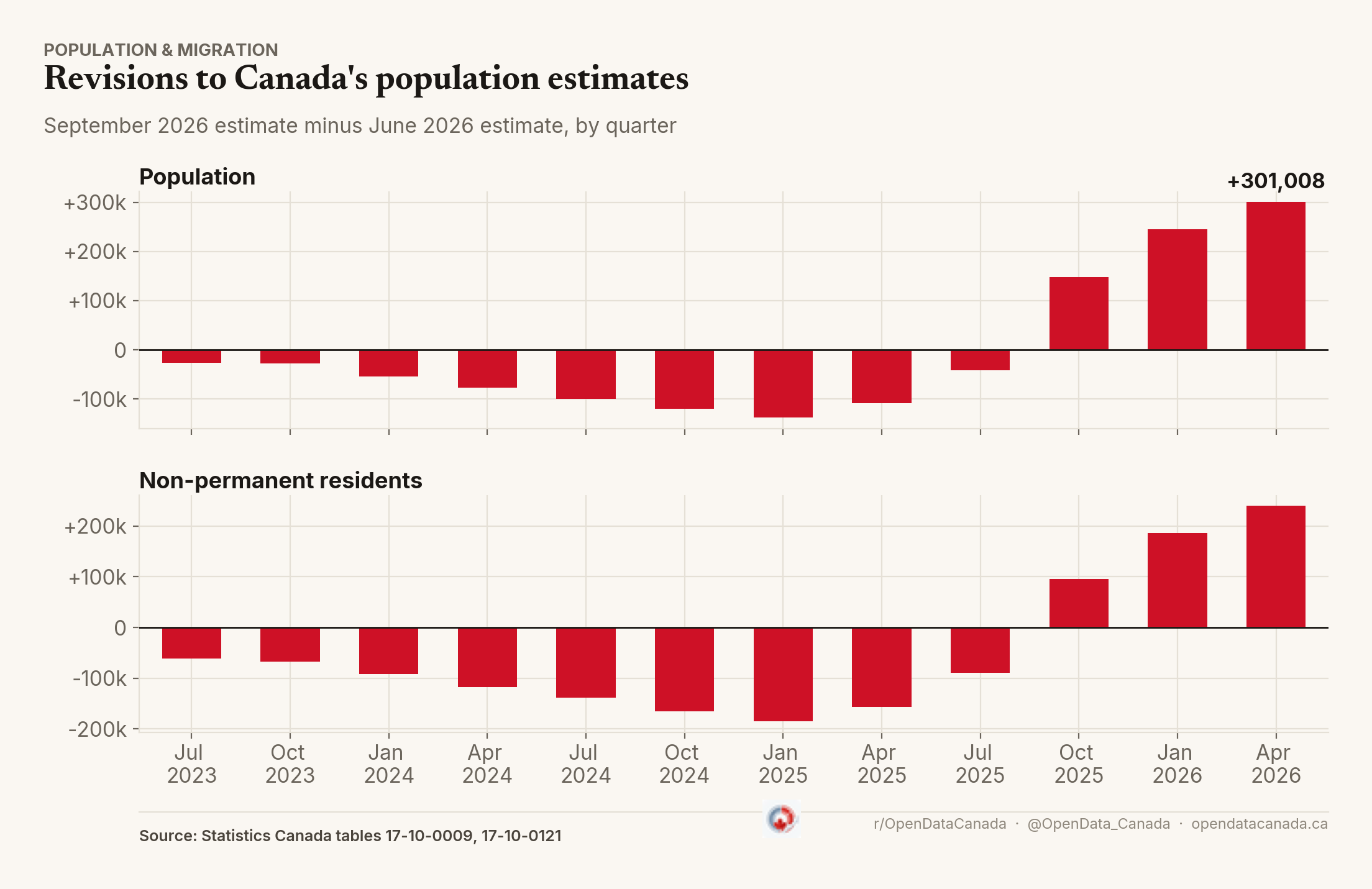
Most of the change comes from non-permanent residents: temporary workers, international students, asylum claimants and their families. Their April 2026 count was revised up by 240,087, which is about four-fifths of the total population revision.
That changes the story of the temporary-resident drawdown. The June estimates showed the number of non-permanent residents falling by 590,569 from its October 2024 peak. The revised figures show a fall of 185,636 over the same period, less than a third as large. There are now 2,779,774 non-permanent residents, or 6.7% of the population.
StatCan flagged this possibility in June. Its first-quarter release noted that Immigration, Refugees and Citizenship Canada was granting more permit extensions and taking longer to process them. It warned that this could lead to "more pronounced upward changes to population estimates."
Today's note to readers explains one way preliminary estimates undercount. If a temporary resident's permit expires and the next one is issued after a long gap, that person can drop out of the preliminary count. They are added back once fuller immigration records arrive. StatCan also credits Immigration, Refugees and Citizenship Canada as a data partner for its immigrant and non-permanent resident estimates.
Ontario accounts for almost half of the April 2026 revision, at +140,304 people. British Columbia follows at +57,263 and Quebec at +37,592. Every province and territory was revised up.
What's driving growth now: migration, not births and deaths
The revision doesn't change what drives Canada's population. In the second quarter of 2026:
- Net international migration added 67,384 people. That's 99,148 immigrants, minus 12,889 in net emigration, minus a net outflow of 18,875 non-permanent residents.
- Natural increase added 12,959 people, from 94,381 births and 81,422 deaths.
More non-permanent residents left than arrived. The count is still falling, just much more slowly than the June numbers showed. Permanent immigration is what's keeping growth positive.
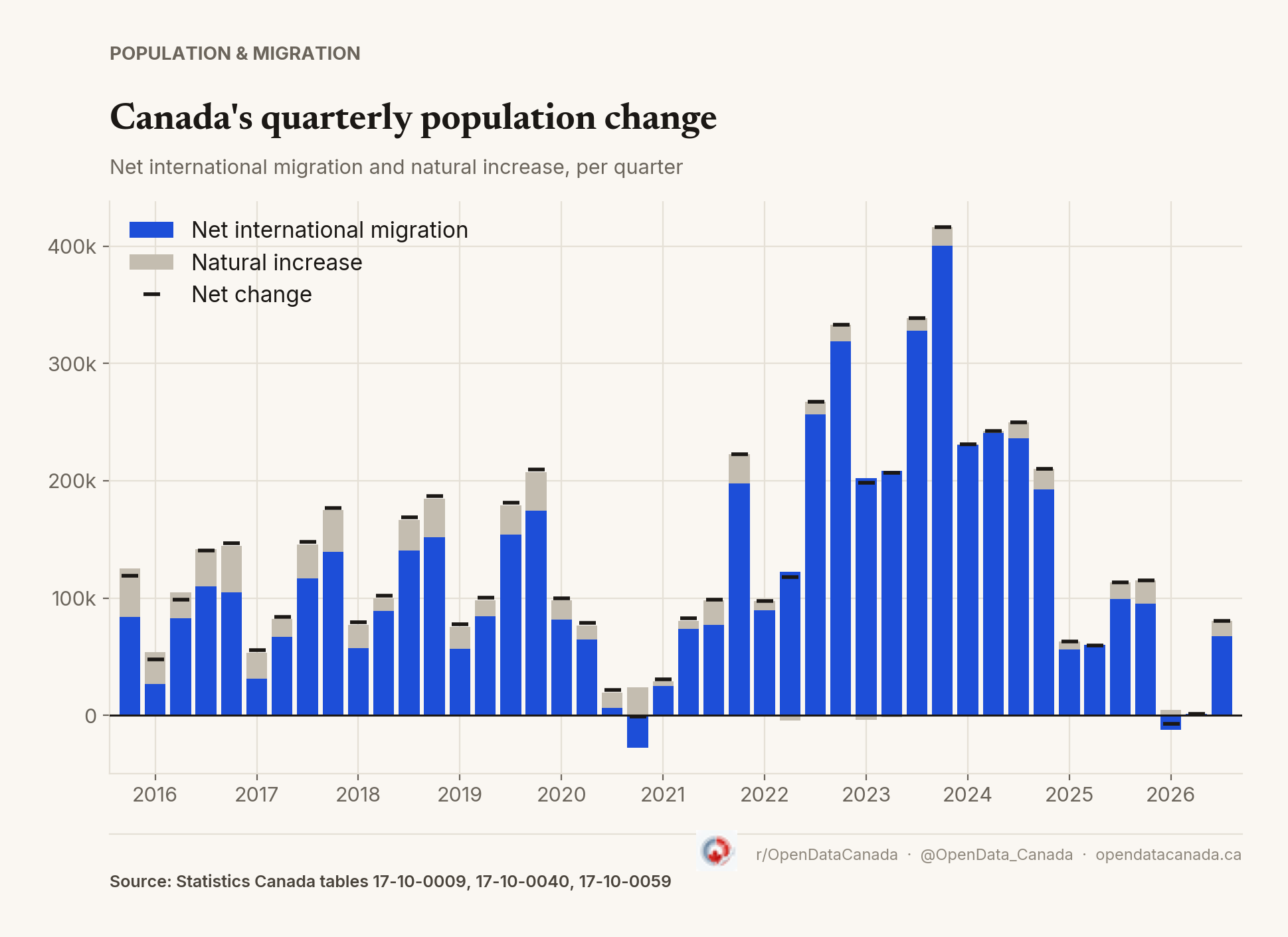
Over the full year to July 1, 2026, the population grew by 189,425, or 0.46%.
Where the June figures come from
Figures come directly from Statistics Canada tables 17-10-0009 (quarterly population estimates), 17-10-0040 (components of international migration), 17-10-0059 (births and deaths) and 17-10-0121 (non-permanent residents), all released 23 September 2026. In the latest quarter, the components add up exactly to the change in population.
Because Statistics Canada's current tables overwrite earlier preliminary estimates, the June figures used for this comparison were preserved by Open Data Canada on 21 September 2026, two days before the September revision. Those June figures match StatCan's June 17 release, which reported 41,417,056 people and 2,558,562 non-permanent residents on April 1, 2026.
The estimates for the second quarter of 2026 are preliminary and will be revised again. StatCan now treats estimates up to and including the second quarter of 2023 as final. All figures are still based on the 2021 Census. The 2026 Census counts come out on February 10, 2027 and may shift the whole series.