Article · Population · 6 min read
Canadians aren't leaving in record numbers — the math behind a viral headline
A headline doing the rounds this week says 120,640 people emigrated from Canada in 2025, a new record, "up significantly" from 2024. The count is real. But per capita the rate barely budged, and the framing buries the departure that actually matters: temporary residents leaving as the permit caps bite.
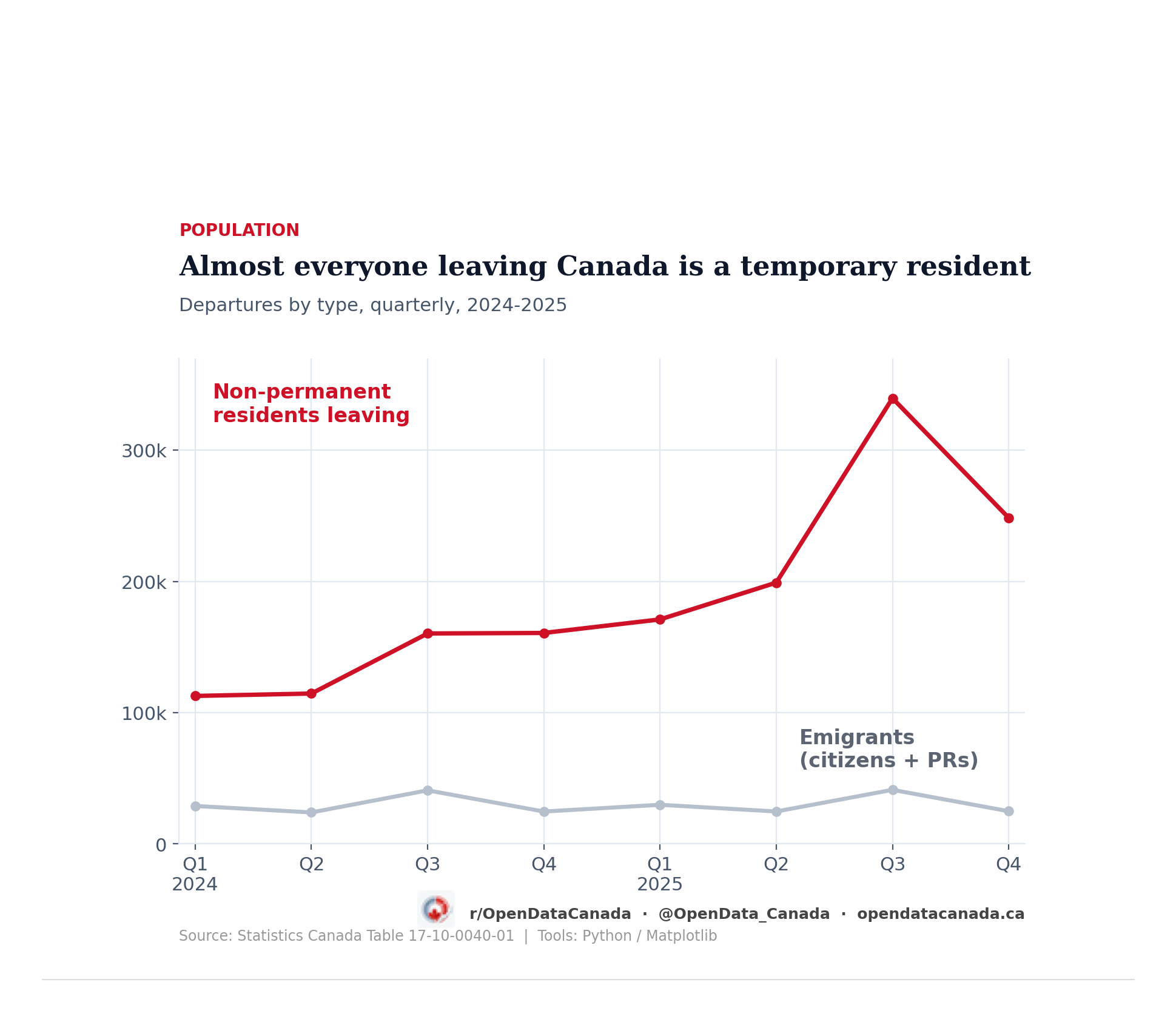
The viral version goes like this: "According to Statistics Canada, 120,640 people emigrated from Canada in 2025, up significantly from the record-setting 118,409 departures in 2024." Both figures check out. Sum the four quarterly emigrant counts in StatCan's migration table and you get exactly 120,640 for 2025 and 118,409 for 2024.
The problem is the word significantly. The increase is 2,231 people — a 1.9 percent rise year over year. Over the same stretch Canada's population grew 0.9 percent, from 41.26 million to 41.65 million. So the emigration rate went from 0.287 percent of the population to 0.290 percent: a change of three one-thousandths of a percentage point.
When the denominator keeps climbing, the raw count hits records almost automatically. That is all a "record" emigration headline is measuring. The propensity of any given resident to pack up and leave was essentially unchanged from 2024 to 2025.
The real story is the people the headline ignores
If you actually want to know how many people left Canada in 2025, emigrants are the wrong line to read. They are the smallest outbound flow in the table.
The largest by far is non-permanent residents — people here on study permits, work permits, and asylum claims — going home. StatCan counts roughly 958,000 NPR departures across 2025, up from about 548,000 in 2024. That is nearly eight times the emigrant figure, and it is the line that actually moved: NPR outflows rose every quarter through mid-2025, peaking near 340,000 in a single quarter.
On a net basis — arrivals minus departures — the non-permanent-resident population fell by roughly 462,000 in 2025. The quarterly net figure flipped negative in the final quarter of 2024 (−11,002) and stayed negative all year, reaching −176,479 in the third quarter of 2025. The country's temporary population is contracting, by design.
Why this is happening, and why it isn't a panic
This is the other side of a story we covered in The boom is over: the federal government's October 2024 decision to cap study and work permits. That article tracked the inflow collapsing. The NPR outflow is the same policy viewed from the exit door — permits issued during the 2022–2024 surge are now expiring, and the people who held them are leaving roughly on schedule.
It is worth keeping two groups distinct, because the headline blurs them:
- Emigrants (120,640) are mostly citizens and permanent residents choosing to build a life abroad.
- NPR departures (~958,000) are foreign nationals whose temporary status ended.
Both are "people leaving Canada," but only the first group is what most readers picture when they see "Canadians are fleeing." That smaller group's behaviour barely changed. The dramatic number — the one closer to a million — is a planned wind-down of a temporary population, not a vote of no confidence by citizens.
None of this means emigration doesn't matter, or that who is leaving (and from which province — Ontario accounts for close to half of emigrants) isn't worth watching. But the "record exodus" framing measures the wrong thing. The count is a record. The rate is flat. And the real large-scale departure isn't citizens at all — it is a temporary-resident drawdown Ottawa set in motion two years ago.