Government · Local elections
Which Canadian city votes most in local elections? 27 cities ranked
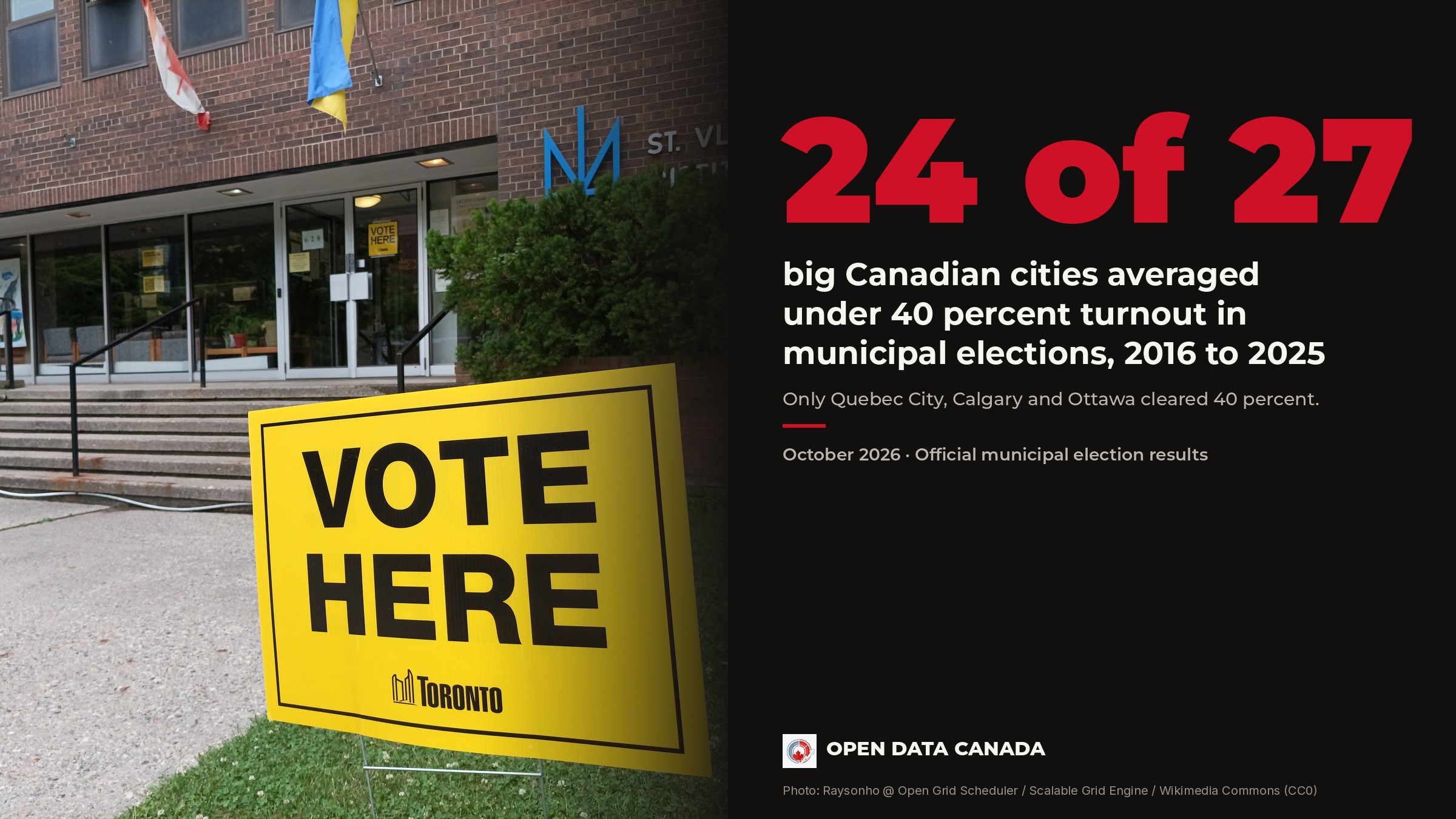
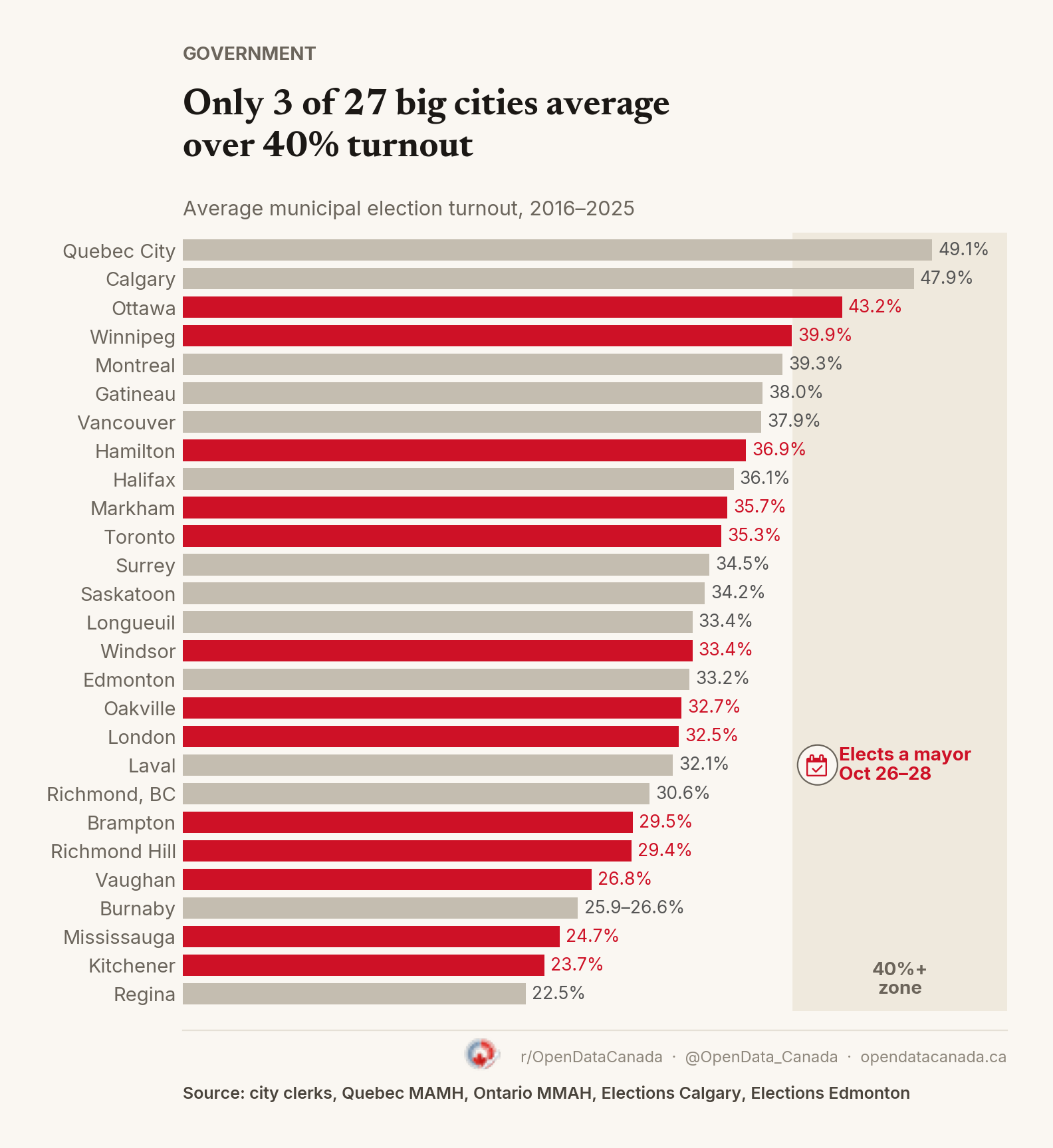
Across 27 Canadian cities over 200,000 people, only three averaged more than 40 percent turnout in municipal elections since 2016. Thirteen of them pick a mayor this week, starting with Toronto and Ottawa on October 26.
Municipal elections take place across Ontario on Monday, October 26, in a province of 444 municipalities. Twelve of the 27 cities in this ranking are in Ontario, including Toronto and Ottawa, and all twelve elect a mayor that day. Winnipeg follows on Wednesday, October 28. That makes 13 of the 27 biggest cities choosing a mayor this week.
Official results from every general municipal election between 2016 and 2025 were collected for the 27 Canadian cities with more than 200,000 residents. Averaged over that decade, Quebec City had the highest turnout at 49.1 percent. Regina had the lowest at 22.5 percent. In the city that votes most, about half of eligible voters still skip it.
Federal elections draw far more voters. Elections Canada puts federal turnout at 67.0 percent in 2019, 62.6 percent in 2021 and 69.0 percent in 2025, an average of 66.2 percent. Quebec City, the top city in this ranking, sits about 17 points below that. Regina's local turnout is about a third of it. Federal turnout counts registered electors nationwide, so the gap is approximate, but no city comes close.
Toronto fell sharply in 2022, but 2026 starts differently
Toronto ranks 11th at 35.3 percent, but that average hides a steep fall. Turnout went from 40.9 percent in 2018 to 29.66 percent in 2022, a drop of more than 11 points.
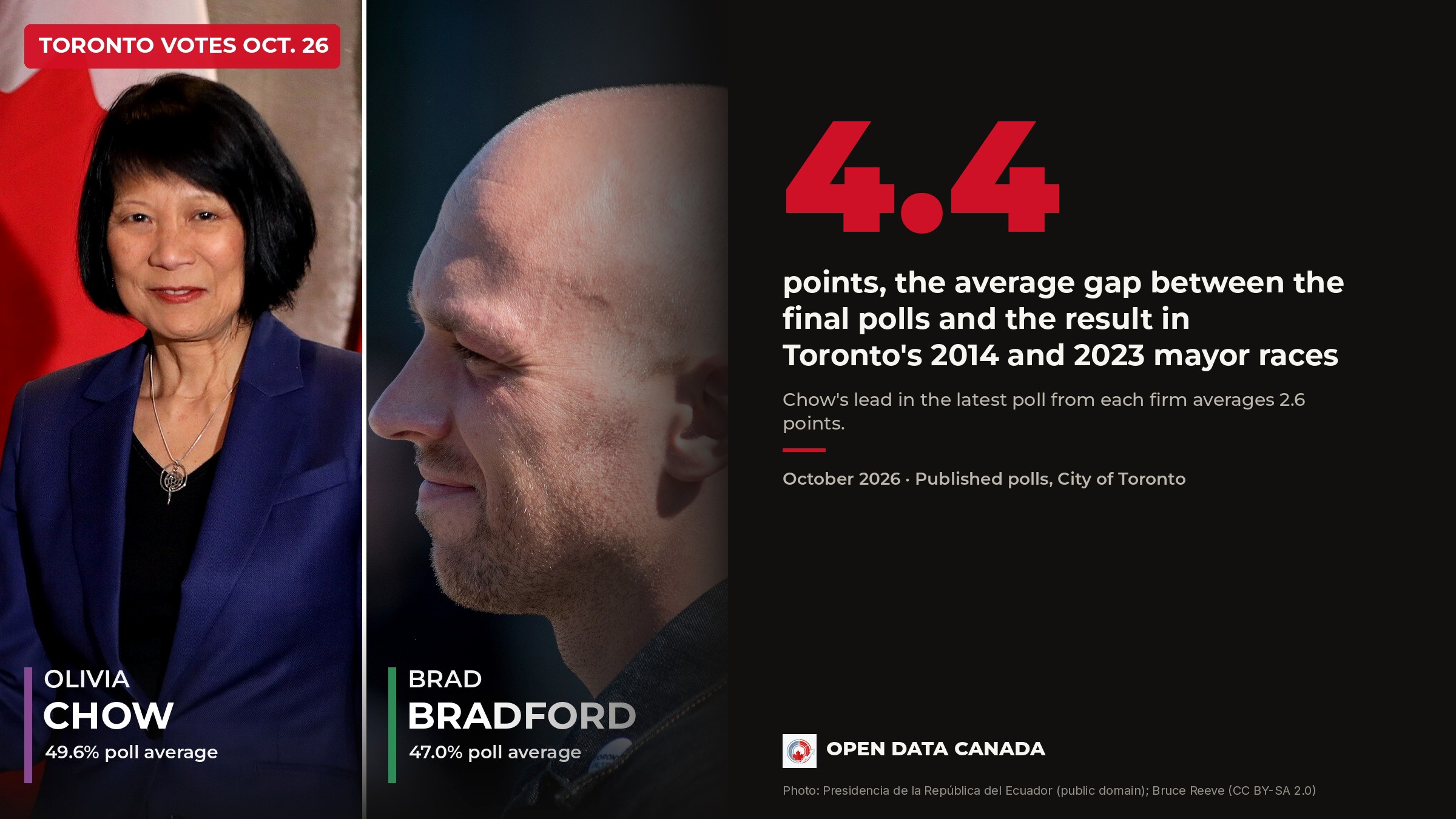
The 2026 campaign looks different so far. The City of Toronto says 222,550 people voted during six days of advance voting, October 6 to 11. That is about 92 percent more than the 115,911 advance votes in 2022, and more than the 124,299 in 2018, the 161,147 in 2014 or the 129,745 in the 2023 mayoral by-election. Advance votes don't predict final turnout on their own, since some voters may simply be casting ballots earlier, but this year's advance count is the highest of any Toronto election since at least 2010. For the race itself, see the Toronto mayor polls and ward map.
Ottawa, by contrast, ranks third at 43.2 percent, and its turnout held steady: 42.55 percent in 2018 and 43.79 percent in 2022. It was one of only two Ontario cities in the ranking where turnout rose; Richmond Hill was the other. The other ten, Toronto included, fell. London went from 39.46 percent to 25.50 percent.
Four Toronto suburbs sit near the bottom
The bottom of the table is crowded with Toronto's neighbours. Brampton (29.5 percent), Richmond Hill (29.4), Vaughan (26.8) and Mississauga (24.7) all rank in the bottom seven. Burnaby (25.9 to 26.6), Kitchener (23.7) and Regina (22.5) make up the rest of the bottom seven.
Burnaby's 19.71 percent in 2022 is the lowest single result in the data. British Columbia's cities, including Vancouver, Surrey, Burnaby and Richmond, voted on October 17; those 2026 results are not included here.
Quebec does better. Three of the top six are Quebec cities: Quebec City, Montreal (39.3 percent) and Gatineau (38.0). Laval and Longueuil, the two big suburbs of Montreal, sit at 32.1 and 33.4 percent, ahead of Brampton, Richmond Hill, Vaughan and Mississauga.
Calgary's number is partly a change in counting
Calgary ranks second at 47.9 percent, but its turnout fell from 58.14 percent in 2017 to 39.04 percent in 2025. Part of that drop comes from a change in who counts as an eligible voter. Calgary and Edmonton switched to new permanent voter lists for 2025, and Calgary's 2021 count used a different estimate of eligible voters ("enumerated electors"). Turnout depends on the count of eligible voters, and cities don't define it the same way. Small gaps between cities in the middle of the table, such as Longueuil and Windsor tied at 33.4 percent, should not be read as real differences.
Monday tests Toronto's comeback
Even so, the spread is wide: average turnout in Quebec City was more than twice Regina's. Toronto's advance vote, the highest since at least 2010, is an early sign of stronger participation this year. Monday's count will show whether the city climbs back from its 2022 low.