BC election 2026 · Explainer
Could a 3-Point Conservative Lead Win a Majority in BC?
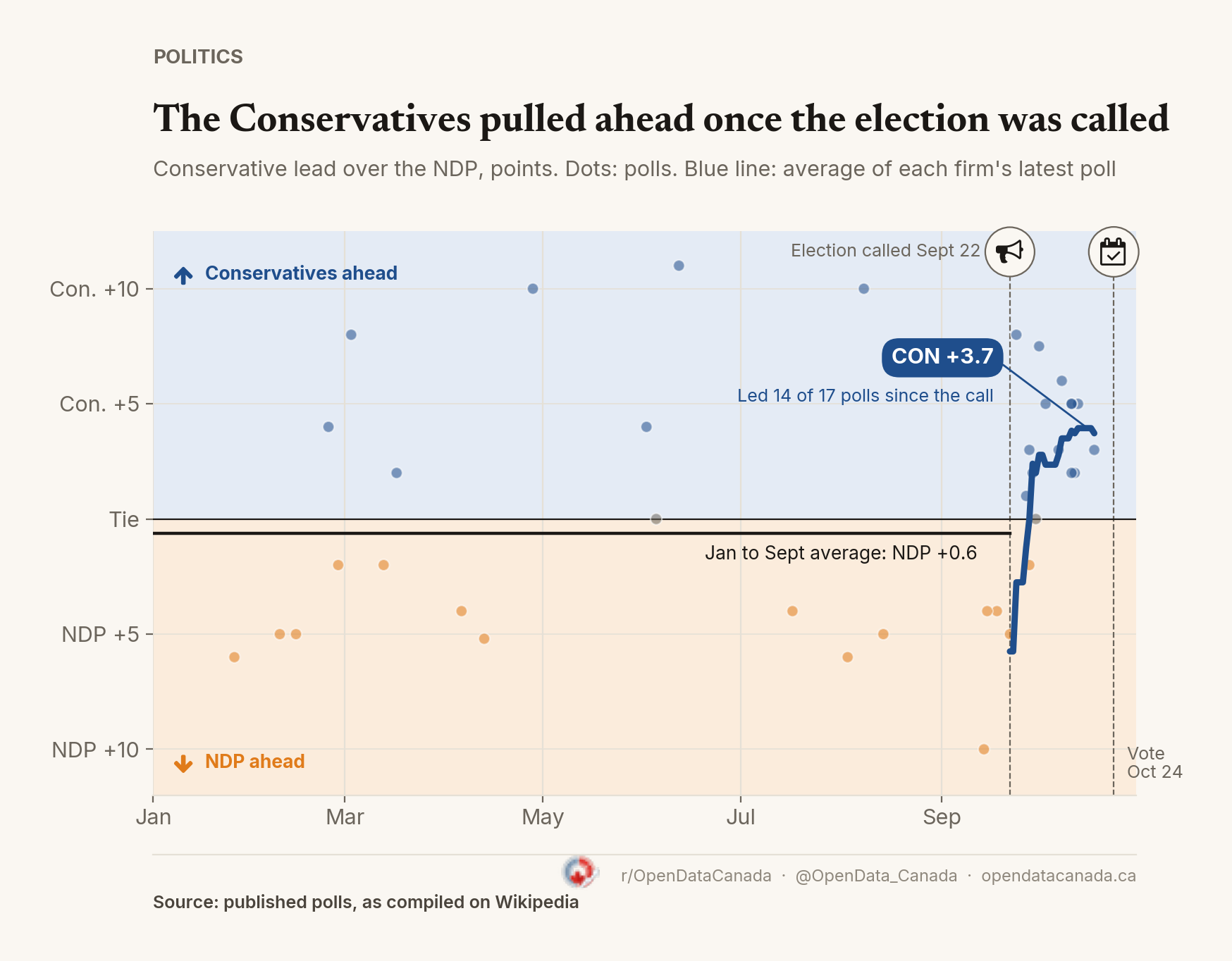
The Conservatives have led 14 of 17 polls since the Sept. 22 snap call. Move every riding by the same amount from its 2024 result and that lead becomes 53 of 93 seats. A tied vote would still leave them first.
British Columbia votes on Saturday, Oct. 24. Premier David Eby called the election on Sept. 22, two years before the fixed election date in October 2028. He called the U.S. trade war an "existential moment" for the province and argued that his majority was too shaky to rely on.
The polls shifted after the call. Across 21 polls from January to Sept. 21, the NDP led the Conservatives by 0.6 points on average, which is close to a tie. Since the call, the Conservatives have led 14 of 17.
BC has 93 seats, so a party needs 47 for a majority. Whether a lead of about 4 points gets there depends on how close the ridings were last time. In 2024, many of them were close.
Who is leading the BC election polls?
Nine firms have published 17 polls since the call. Taking the latest poll from each firm and averaging them gives the Conservatives 42.9 per cent, the NDP 39.1 and the Greens 10.2. The two new parties, OneBC and Centre BC, have about 6 per cent between them. The Conservative lead is 3.7 points, or 4.1 if larger polls count for more.
The firms disagree on the size of that lead. Mainstreet Research had the Conservatives 7.5 points ahead, 44.7 per cent to 37.2 (Sept. 30 to Oct. 1). Research Co. and Leger each had them 2 points ahead in polls taken Oct. 9 to 12. Innovative Research, in late September, had the NDP ahead by 2.
The lead peaked in early October. Polls taken Oct. 1 to 8 put it at 5.4 points on average; polls since Oct. 9 put it at 3.7. The newest, from Angus Reid (Oct. 15 to 18, 793 people), has the Conservatives at 46 and the NDP at 43. The same firm had the gap at 8 points on Sept. 24 and 5 points on Oct. 5.
How close was the 2024 BC election by riding?
In 2024 the NDP won 47 seats with 44.9 per cent of the vote. The Conservatives won 44 with 43.3 per cent and the Greens won 2 with 8.2 per cent. The NDP's majority was one seat.
Twenty-two ridings were won by less than 5 points, and five by less than 1. Surrey-Guildford went NDP by 22 votes out of 19,066. Kelowna Centre went Conservative by 40.
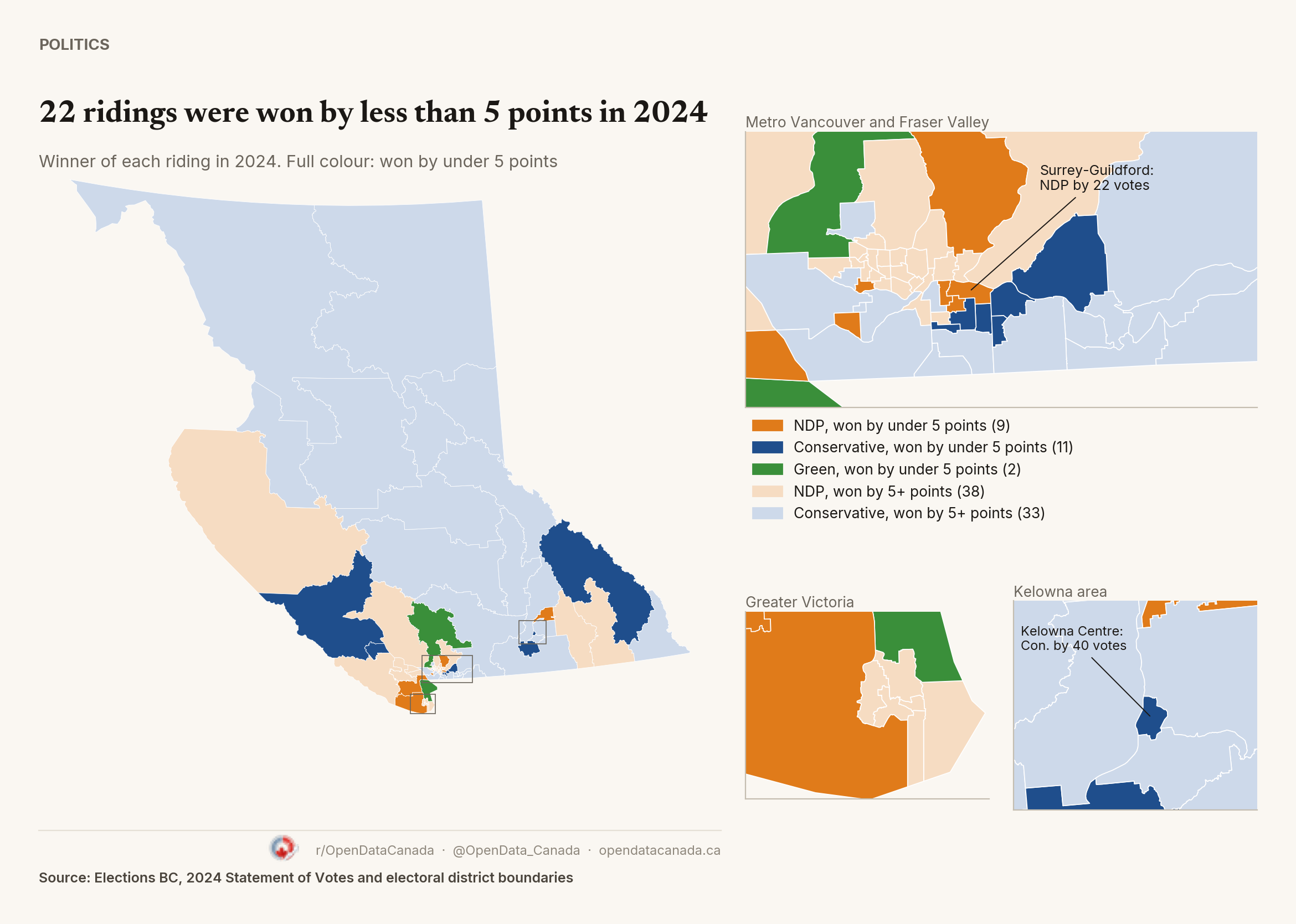
Six of the 22 are in Surrey. Three went NDP (Surrey-Guildford, Surrey City Centre and Surrey-Fleetwood) and three went Conservative (Surrey-Panorama, Surrey-Serpentine River and Surrey-Cloverdale).
The map also leans slightly Conservative. Line up all 93 ridings from most NDP to most Conservative and the one in the middle was 0.6 points more NDP than Conservative in 2024. The province as a whole was 1.6 points more NDP.
What would a 3.7-point lead mean in seats?
The simplest way to turn a poll into seats is to assume every riding moves by the same amount. The NDP's average is 5.8 points below its 2024 result, so take 5.8 points off its share in every riding, and do the same for each other party. This is called uniform swing. It is an estimate, not a forecast.
At the current average, it gives the Conservatives 53 seats, the NDP 38 and the Greens 2. Nine NDP ridings change hands: Surrey-Guildford, Juan de Fuca-Malahat, Surrey City Centre, Coquitlam-Burke Mountain, Vernon-Lumby, Richmond-Steveston, Vancouver-Langara, Cowichan Valley and Surrey-Fleetwood. The NDP won every one of them by under 4 points in 2024.
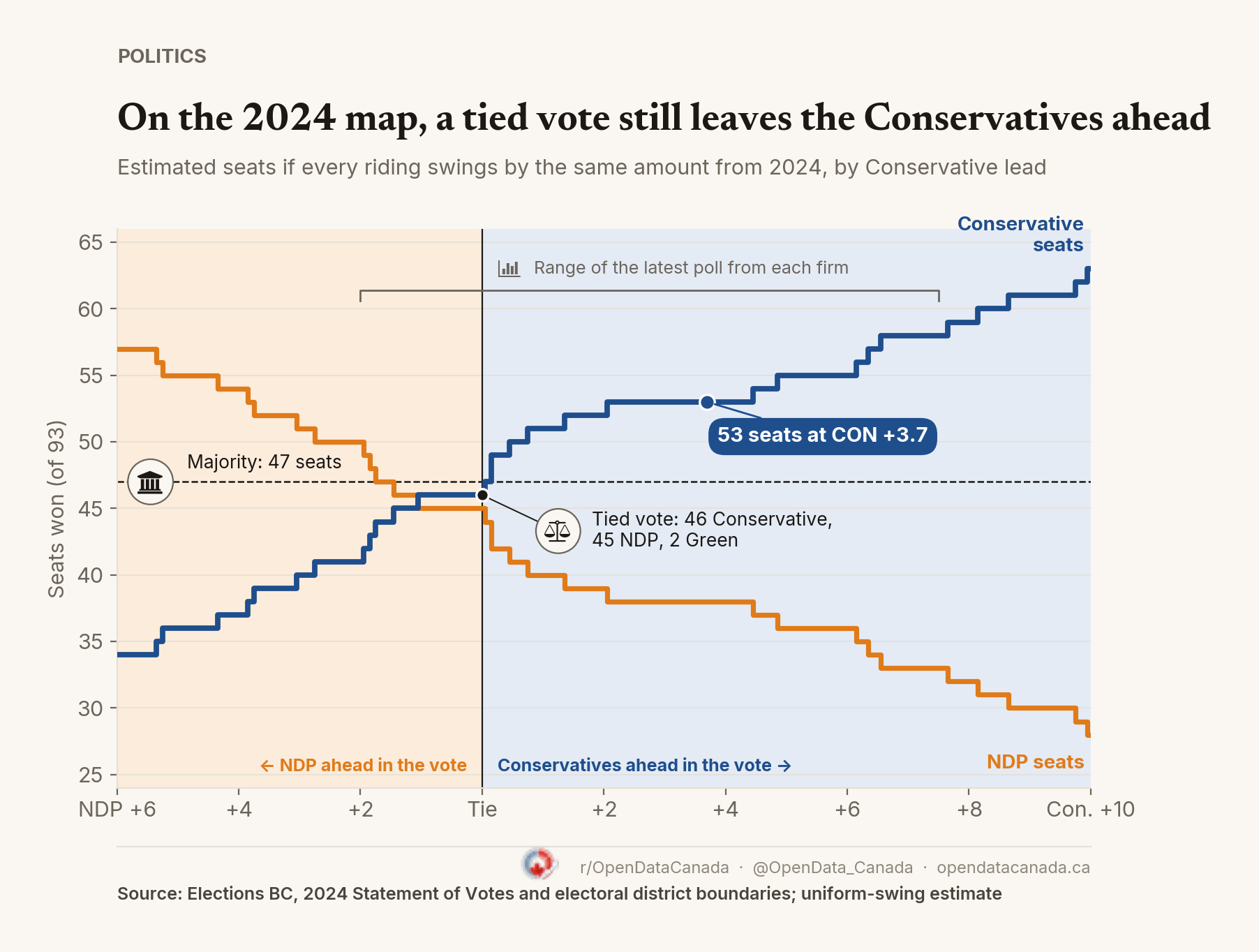
The chart shows where the seat count turns.
- Even a tied vote favours the Conservatives. It gives them 46 seats to the NDP's 45. Neither has a majority, and the 2 Greens would decide which party governs.
- Any Conservative lead is a majority. At a lead of 0.1 points they reach exactly 47.
- The NDP needs to win by about 1.5 points to reach 47. In 2024 it won by 1.6 and got exactly 47.
Across the full range of the firms' latest polls, the estimate runs from an NDP majority of 50 seats to a Conservative majority of 58.
Other seat projections land in the same place. 338Canada, which builds its projection from polls and other data, had the Conservatives at 51 seats and the NDP at 40 on Oct. 19. Its range for the Conservatives runs from 35 to 68.
In practice, the swing is never the same everywhere. Research Co.'s poll from Oct. 9 to 11 had the NDP ahead on Vancouver Island by 52 to 34, and the Conservatives ahead in Metro Vancouver by only 45 to 43. Regional numbers from one poll are rough, but a Conservative gain that piles up where the party already wins adds votes without adding seats. The method also spreads OneBC and Centre BC evenly, although they run candidates in only 33 and 35 of the 93 ridings.
Which BC ridings will decide the election?
These are the 22 ridings won by under 5 points in 2024, closest first, with what the uniform-swing estimate does to each at the current poll average.
| Riding | Won in 2024 | Runner-up | Won by (votes) | Won by (points) | If Conservatives lead by 3.7 |
|---|---|---|---|---|---|
| Surrey-Guildford | NDP | Conservative | 22 | 0.1 | Conservative gain |
| Kelowna Centre | Conservative | NDP | 40 | 0.2 | Holds |
| Courtenay-Comox | Conservative | NDP | 93 | 0.3 | Holds |
| Maple Ridge East | Conservative | NDP | 97 | 0.4 | Holds |
| Juan de Fuca-Malahat | NDP | Conservative | 141 | 0.6 | Conservative gain |
| Penticton-Summerland | Conservative | NDP | 317 | 1.1 | Holds |
| Surrey-Panorama | Conservative | NDP | 263 | 1.5 | Holds |
| Surrey City Centre | NDP | Conservative | 232 | 1.6 | Conservative gain |
| Coquitlam-Burke Mountain | NDP | Conservative | 368 | 1.7 | Conservative gain |
| Vernon-Lumby | NDP | Conservative | 476 | 1.7 | Conservative gain |
| Richmond-Steveston | NDP | Conservative | 484 | 2.1 | Conservative gain |
| North Island | Conservative | NDP | 639 | 2.1 | Holds |
| Surrey-Serpentine River | Conservative | NDP | 435 | 2.2 | Holds |
| Vancouver-Langara | NDP | Conservative | 419 | 2.4 | Conservative gain |
| West Vancouver-Sea to Sky | Green | Conservative | 676 | 2.5 | Holds |
| Surrey-Cloverdale | Conservative | NDP | 586 | 2.8 | Holds |
| Cowichan Valley | NDP | Conservative | 849 | 2.9 | Conservative gain |
| Columbia River-Revelstoke | Conservative | NDP | 670 | 3.7 | Holds |
| Surrey-Fleetwood | NDP | Conservative | 753 | 3.7 | Conservative gain |
| Langley-Willowbrook | Conservative | NDP | 867 | 3.8 | Holds |
| Saanich North and the Islands | Green | NDP | 1,350 | 4.0 | Holds |
| Langley-Walnut Grove | Conservative | NDP | 1,172 | 4.8 | Holds |
Source: Elections BC, 2024 Statement of Votes. Points are the winner's lead over the runner-up as a share of valid votes in the riding.
The NDP-held seats in this list are the ones the Conservatives need. The NDP's way back runs through the three Conservative seats won by under 100 votes: Kelowna Centre, Courtenay-Comox and Maple Ridge East.
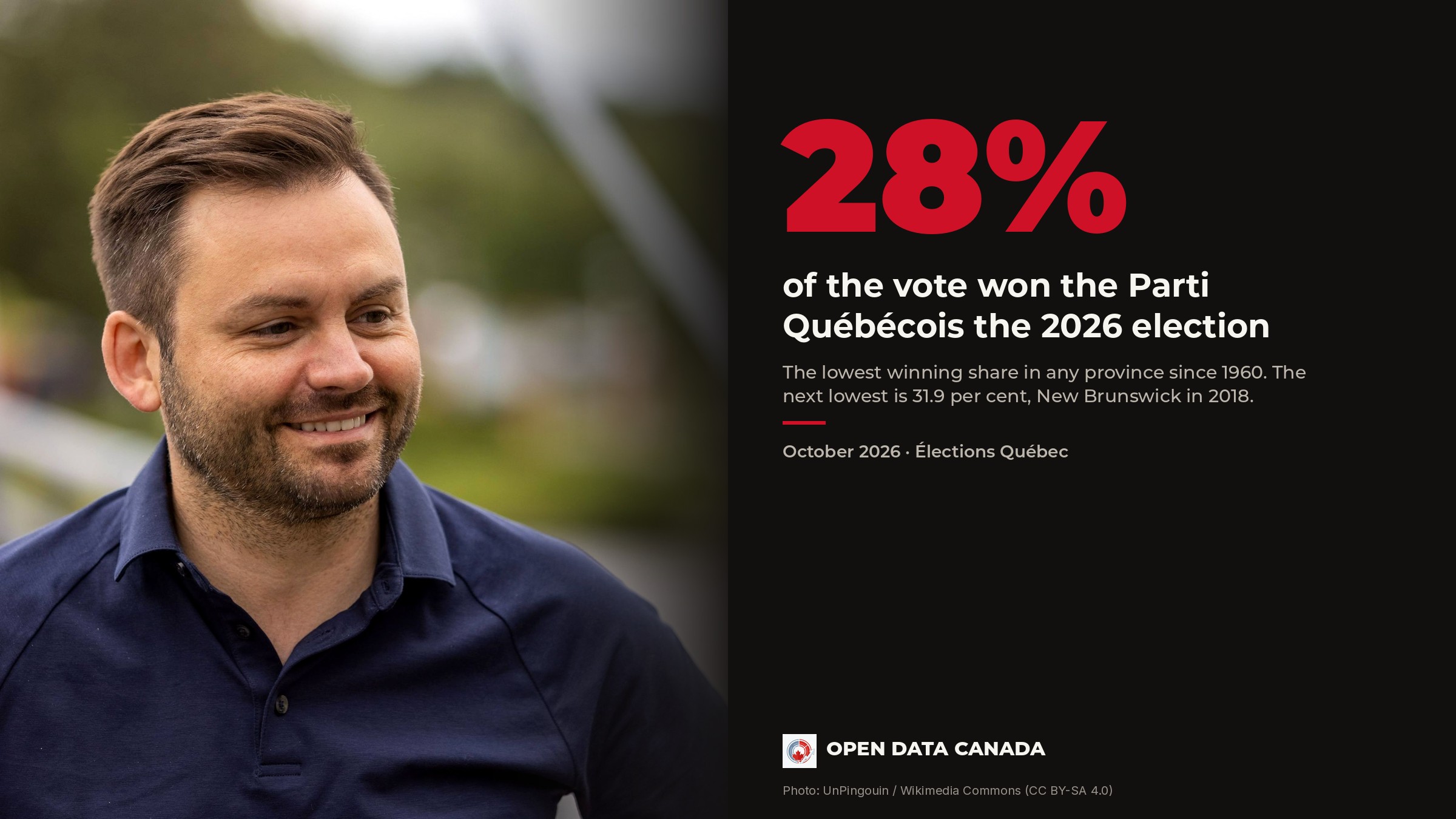
Seats can drift a long way from votes. Earlier this month the Parti Québécois won 59 of 127 Quebec seats on 28 per cent.
When will the BC election results be known?
Advance voting runs until Oct. 21. In its first three days, Oct. 16 to 18, 440,318 people voted, 11.8 per cent of the 3,738,182 registered voters as of Oct. 14. Elections BC lists 355 candidates. The Conservatives are running in all 93 ridings, the NDP in 92 and the Greens in 73.
Voting places close at 8 p.m. Pacific time on Oct. 24, and preliminary results start after that.
On the 2024 map, the NDP has to win the popular vote by about as much as it did last time just to keep a one-seat majority, and right now it is behind.