Population · Express Entry explainer
Express Entry will award up to 100 points for a high-wage job offer from Nov. 3
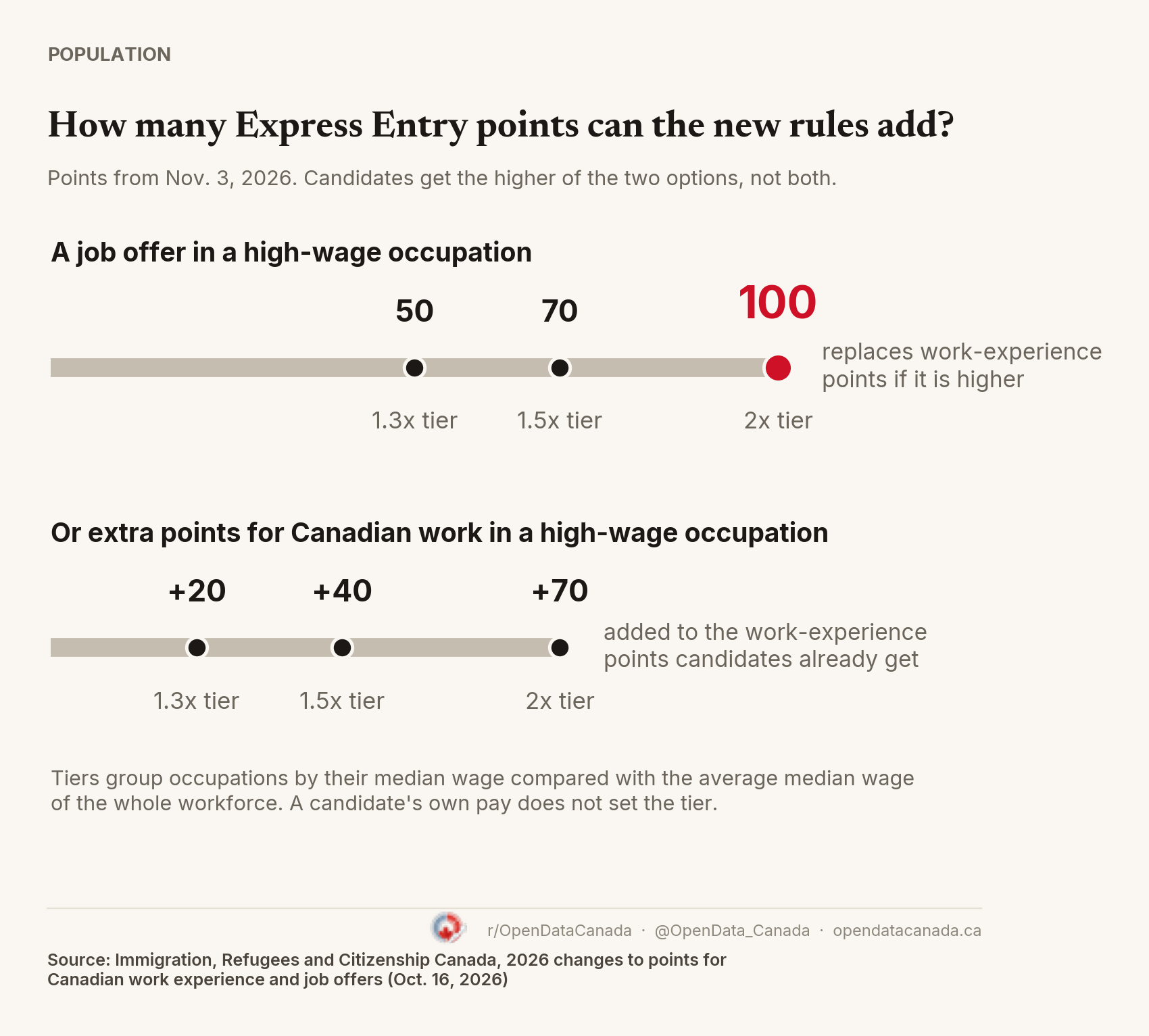
Starting November 3, 2026, Canada will award up to 100 Express Entry points for a qualifying high-wage job offer. Eligible Canadian work experience in a high-wage occupation can earn up to 70 additional points on top of existing work-experience points. Candidates receive the higher of the two scoring options, not both.
The rules set the points. They don't tell us how many people in the Express Entry pool will gain them, or how cut-off scores will move once invitation rounds restart. IRCC says extra points do not guarantee an invitation to apply.
IRCC announced the change on October 16. A job offer will no longer need a labour market impact assessment (LMIA) to earn the new points, and IRCC published a list of 186 occupations that count as high-wage. You can search the full list on our high-wage occupation list page.
What is changing in Express Entry on Nov. 3?
- What changed, and when? From November 3, 2026, the Comprehensive Ranking System (CRS) gets a new Labour Market Integration factor. It scores either your Canadian work experience or a qualifying job offer.
- How many points does a job offer earn? 100, 70 or 50 points, depending on the occupation's wage tier. The job must be in an occupation on IRCC's high-wage list.
- How many extra points does Canadian experience earn? 70, 40 or 20 points for at least 12 months of eligible Canadian work in a high-wage occupation. These are added to the work-length points candidates already get, which go up to 80.
- Can you get both? No. IRCC counts whichever option gives you more points. The factor is capped at 150 points without a spouse or partner and 140 with one.
- Which occupations qualify? The 186 occupation codes (NOC 2021) on IRCC's high-wage list. The tier depends on what the occupation typically pays in Canada, not on your salary.
- Do you still need an LMIA? No, not for a qualifying job offer used for the new points or for job-offer requirements in the Federal Skilled Worker and Federal Skilled Trades programs. An officer still checks that the offer is genuine.
- What happens to existing profiles? IRCC will recalculate them automatically. That can take up to two weeks, and invitation rounds will pause while it runs. If you want job-offer points, you have to update your profile before November 3.
What are the Express Entry changes in 2026?
Immigration Minister Lena Metlege Diab announced the changes in Kitchener, Ontario, on October 16, 2026. IRCC's backgrounder lists two of them, both starting November 3:
- points for eligible Canadian work experience or qualifying job offers in high-wage occupations, and
- no LMIA requirement for qualifying job offers used to establish program eligibility and obtain CRS points.
IRCC's news release gives "engineers and electricians" as examples of high-wage jobs. It says the change builds on two earlier ones: a dedicated Express Entry category for doctors with Canadian work experience (announced in December 2025) and new and renewed Express Entry categories (announced in February 2026). IRCC also says it is "reintroducing" job offer points, so job offers are back in the score.
The changes are to Express Entry's ranking rules: who gets invited from the pool. They do not change how many permanent residents Canada plans to admit, which is set separately in the immigration levels plan (more on that below).
How do the new CRS points work?
The Labour Market Integration factor compares two options and keeps the higher one.
| Option | With a spouse or partner | Without a spouse or partner |
|---|---|---|
| Canadian work experience: work-length points | up to 70 | up to 80 |
| plus extra points for work in a high-wage occupation | up to 70 | up to 70 |
| Canadian work experience, total | up to 140 | up to 150 |
| Or: a qualifying job offer | up to 100 | up to 100 |
Work-length points are the same points the CRS already gives for Canadian work experience in any TEER 0, 1, 2 or 3 occupation, and the rules for what counts as eligible experience are not changing.
| Canadian work experience | With a spouse or partner | Without a spouse or partner |
|---|---|---|
| None or less than a year | 0 | 0 |
| 1 year | 35 | 40 |
| 2 years | 46 | 53 |
| 3 years | 56 | 64 |
| 4 years | 63 | 72 |
| 5 years or more | 70 | 80 |
The extra high-wage points need at least 12 months (1,560 hours) of eligible Canadian work in occupations on the list:
- 70 points for at least 12 months in occupations at 2 times the average median wage or more,
- 40 points for at least 12 months combined in occupations at 1.5 times or more,
- 20 points for at least 12 months combined in any listed occupation (1.3 times or more).
The work can be continuous or not, full-time or an equal amount of part-time, and combined across more than one high-wage job. If you held two jobs at once, IRCC counts hours only up to the equivalent of full-time work (30 hours a week). Eligible Canadian experience generally has to be from the previous 10 years, in a TEER 0 to 3 occupation. The skills transferability part of the CRS is not changing and does not use the high-wage list.
An example, using IRCC's tables: a candidate without a spouse who has three years of Canadian work as a registered nurse (a 1.5x occupation) would get 64 work-length points plus 40 high-wage points, or 104. A job offer in a 2x occupation is worth 100, which is lower, so the candidate would keep 104.
How many points can a high-wage job offer add?
A job offer in a listed occupation earns:
| Occupation's median wage, compared with the average median wage | Job offer points |
|---|---|
| At least 2 times | 100 |
| At least 1.5 times, but less than 2 times | 70 |
| At least 1.3 times, but less than 1.5 times | 50 |
| Not on the high-wage list | 0 |
The offer has to be valid under Express Entry. IRCC says it must generally be for full-time, continuous work in Canada for at least one year after the candidate becomes a permanent resident, with specific requirements for some occupations, including skilled trades and physicians providing publicly funded medical services. It can be for an existing or a new position, with an existing or a new employer.
"Up to 100" is the top of the scale, not what every candidate gains. Because the job offer replaces work-experience points rather than adding to them, the gain shrinks as Canadian experience grows. For a candidate without a spouse whose Canadian experience is not in a high-wage occupation, our calculation from IRCC's tables gives:
| Canadian work experience | Work-length points | Gain from a 2x job offer (100) | From a 1.5x offer (70) | From a 1.3x offer (50) |
|---|---|---|---|---|
| None | 0 | +100 | +70 | +50 |
| 1 year | 40 | +60 | +30 | +10 |
| 2 years | 53 | +47 | +17 | 0 |
| 3 years | 64 | +36 | +6 | 0 |
| 4 years | 72 | +28 | 0 | 0 |
| 5 years or more | 80 | +20 | 0 | 0 |
The table holds every other CRS factor fixed. Someone whose experience is in a listed occupation may already score more on the experience side than a job offer would give, as in the nurse example above.
Which occupations qualify?
IRCC counts an occupation as high-wage if the median wage of everyone in Canada working in it is at least 1.3 times the average median wage of the overall workforce. It is "based on the typical earnings of an occupation, not an individual candidate's previous or current salary," IRCC says. A well-paid worker in an occupation that is not on the list gets no high-wage points, and a lower-paid worker in a listed occupation does.
The list uses five-digit NOC 2021 codes. IRCC built it from Job Bank, Labour Force Survey and Census data for the previous three years, and gives each occupation the highest level it reached in any of those years. It will keep the list on its website. If the list changes after you are invited to apply, IRCC keeps the level that applied on the date of your invitation.
The current list has 186 occupations: 31 in the 2x tier, 89 in the 1.5x tier and 66 in the 1.3x tier. Some examples from it:
- 2x tier: general practitioners and family physicians, specialists in surgery, nurse practitioners, lawyers and Quebec notaries, engineering managers, financial managers, university professors and lecturers.
- 1.5x tier: registered nurses and registered psychiatric nurses, software engineers and designers, civil engineers, mechanical engineers, electrical and electronics engineers, secondary school teachers, elementary school and kindergarten teachers, pharmacists, power system electricians, firefighters.
- 1.3x tier: financial auditors and accountants, web developers and programmers, social workers, medical laboratory technologists, paramedical occupations, industrial electricians, heavy-duty equipment mechanics, crane operators.
A job title alone does not settle it. Similar-sounding jobs can sit in different tiers or off the list, and not every senior manager is in the top tier: two of the five senior manager codes are in the 1.5x tier. Check your five-digit NOC code.
Search all 186 high-wage occupations by job title or NOC code, with each one's tier and points.
Does Express Entry still require an LMIA for job-offer points?
No. From November 3, 2026, a qualifying job offer does not need an LMIA to earn the new CRS points or to meet job-offer requirements in the Federal Skilled Worker and Federal Skilled Trades programs. For those two programs, a temporary public policy exempts candidates invited to apply on or after November 3 from LMIA-related job-offer requirements, if they meet the policy's conditions.
Having an LMIA will not earn extra points or give a profile priority, IRCC says. The change covers job offers used in Express Entry. IRCC's announcement does not describe any change to LMIAs used for work permits.
Instead, an officer reviews the job offer when you apply for permanent residence. The officer must be satisfied that the job offer is genuine, including whether:
- the employer is actively engaged in the business for which the offer is being made,
- the offer reflects the employer's reasonable employment needs,
- the employer can reasonably meet the terms of the offer,
- the candidate is qualified and able to perform the work and is likely to accept and carry out the employment, and
- the employer has complied with applicable federal and provincial employment and recruitment laws.
A job offer that is revoked no longer qualifies. IRCC says it will keep verifying job offers and has measures against fraud and misrepresentation.
Points and program eligibility are judged separately. A job offer used to qualify for the Federal Skilled Worker or Federal Skilled Trades program can be in any eligible TEER 0, 1, 2 or 3 occupation, so it may make you eligible for the program without earning any CRS job-offer points.
What happens to existing profiles?
IRCC will automatically recalculate the scores of everyone already in the pool when the rules take effect, including the new points for eligible Canadian work experience. The recalculation could take up to two weeks, and IRCC will pause invitation rounds until it is done.
Job-offer points are different. IRCC says candidates who want points for a qualifying job offer must update their profiles with the required information before November 3.
IRCC's changes page adds that, as of November 3, the online profile will not yet reflect the new rules. Candidates with a job offer but no LMIA will still have to select that they have a positive LMIA, and enter these details under "Work history":
| Question or field | Response |
|---|---|
| Was a positive LMIA issued for the job offer in Canada? | Yes |
| LMIA Number | 00000 |
| LMIA Issuance Date | 2026-01-01 |
| LMIA Expiry Date | 2029-01-01 |
IRCC's pages do not spell out how this workaround fits with the request to update profiles before November 3. Check IRCC's changes page before you edit your profile.
When do the rules take effect?
On November 3, 2026. The most recent rounds when this was published were a Canadian Experience Class round on October 15 (2,500 invitations, lowest score 519) and a French-language round on October 16 (5,000 invitations, lowest score 435). IRCC will pause rounds while it recalculates profiles, which it says could take up to two weeks. Its announcement does not give a date for the first round under the new rules.
Do you need to do anything?
- Check your NOC code against the high-wage occupation list. The tier depends on the code, not the job title you use day to day.
- If you have a job offer in a listed occupation, IRCC says to update your profile before November 3 and to check that all required job offer information is included and accurate. Follow the profile instructions on IRCC's changes page (the LMIA fields are above).
- If you have Canadian work experience, you don't need to do anything to get the new points. Do make sure your work history lists the right NOC codes and dates, since the high-wage points depend on the occupation code of the work.
- Don't count on a set score. IRCC says more points do not guarantee an invitation. Invitations still depend on each round's requirements and cut-off score.
How could the changes affect future CRS cutoffs?
Nobody outside IRCC can say yet. What is not known:
- how many candidates in the pool have 12 months or more of work in a listed occupation,
- how many will add a qualifying job offer before November 3, and in which tiers,
- how many invitations IRCC will issue once rounds restart, and whether those rounds will be general, program-specific or category-based.
IRCC's announcement does not say how many candidates will gain points. Until rounds restart, any forecast of new cut-off scores is a guess.
First rounds under the new rules: to be added. We will update this section with the date, type, size and lowest score of the first invitation rounds after IRCC finishes recalculating profiles.
What the changes don't touch: Canada's immigration targets
Three separate questions often get mixed together.
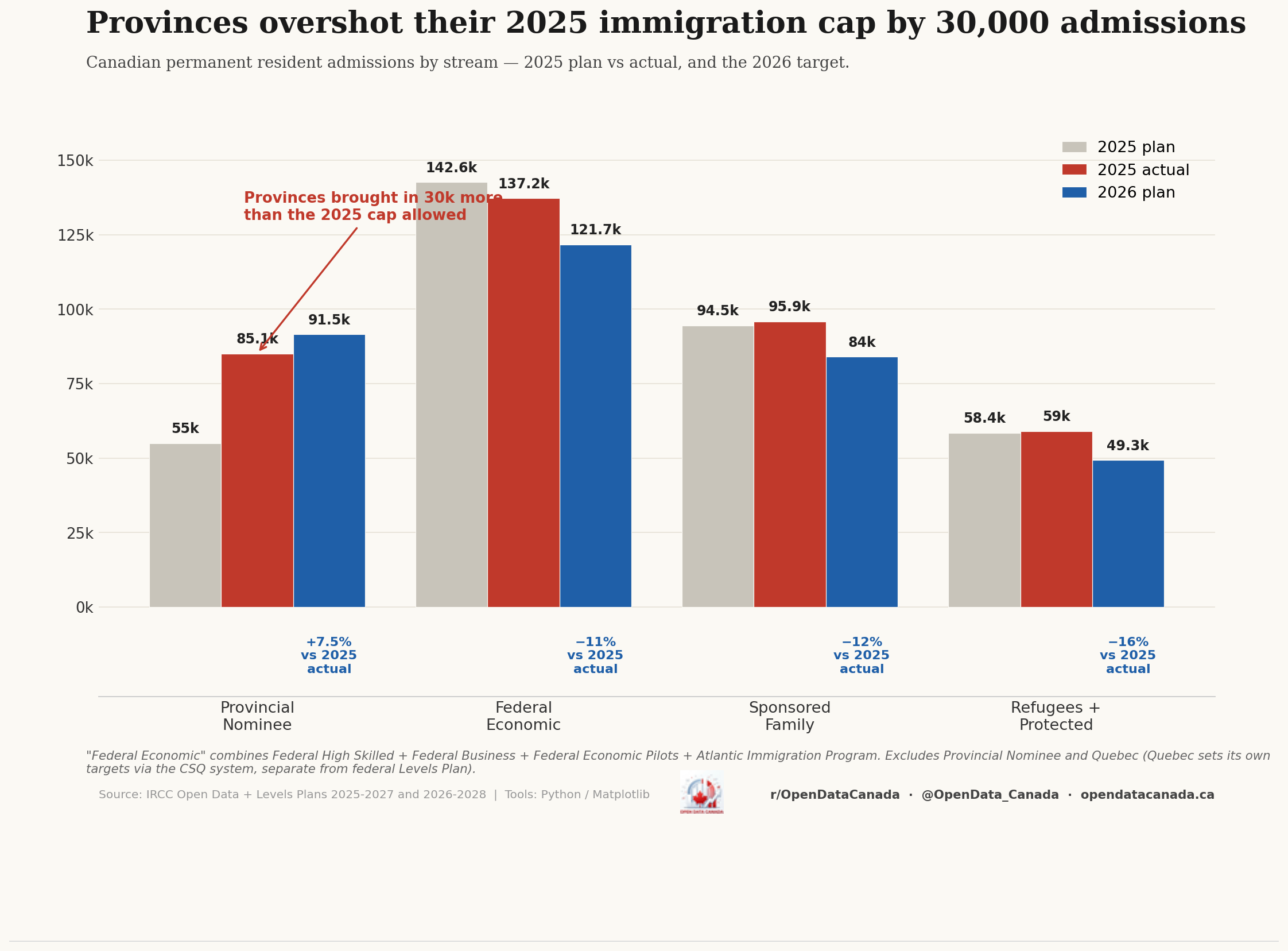
How many permanent residents Canada admits is set by the levels plan. The 2026–2028 plan holds the target at 380,000 a year in each of 2026, 2027 and 2028. The previous plan set 395,000 for 2025, so the 2026 target is 3.8% lower. IRCC says Canada welcomed about 393,500 permanent residents in 2025.
| 2026 permanent resident target | Admissions |
|---|---|
| Economic immigrants | 239,800 |
| of which Federal High Skilled (Federal Skilled Worker, Federal Skilled Trades, Canadian Experience Class) | 109,000 |
| of which Provincial Nominee Program | 91,500 |
| Family | 84,000 |
| Refugees, protected persons, humanitarian and other | 56,200 |
| Total | 380,000 |
The Provincial Nominee Program and Federal High Skilled lines are parts of the economic total, not additions to it. The next plan, for 2027–2029, had not been released when this was published. For how admissions tracked the plan by stream, see How Canadian provinces took control of immigration policy.
Who gets picked from the Express Entry pool is what the November 3 change is about. It changes the ranking, not the number of admissions.
Temporary residents are a third question, and two different measures get confused. The 2026–2028 plan targets 385,000 new temporary resident arrivals in 2026 (155,000 students and 230,000 workers). The previous plan targeted 673,650 for 2025, so the planned figure is 42.8% lower. Those are plan targets, not counted arrivals. The number of temporary residents living in Canada is a separate stock: Statistics Canada estimated 2,779,774 non-permanent residents on July 1, 2026, 6.65% of the population. The plan commits to bringing that share below 5% by the end of 2027. More in StatCan revisions erase Canada's reported population decline and Canada's immigration is now declining in every stream.
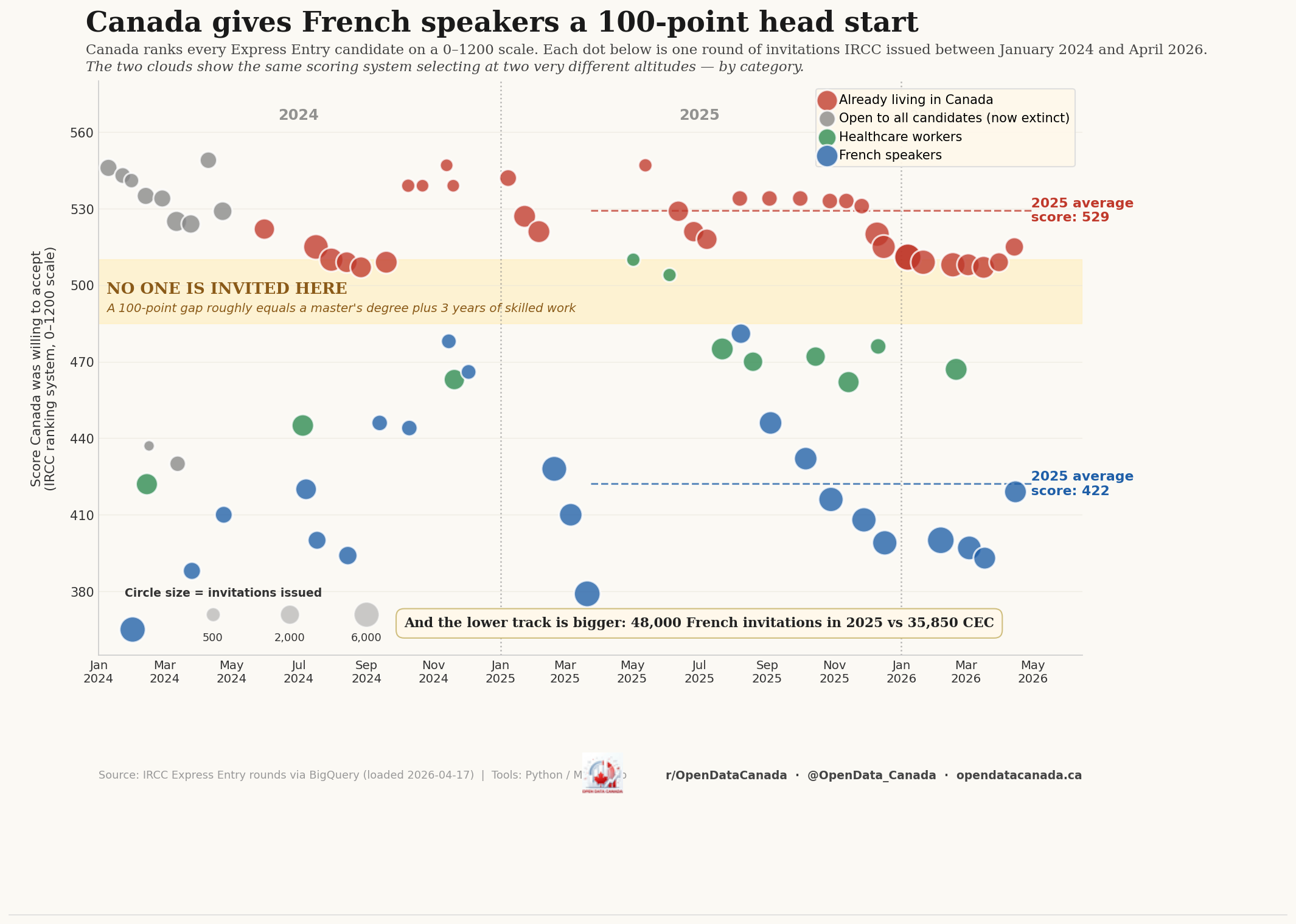
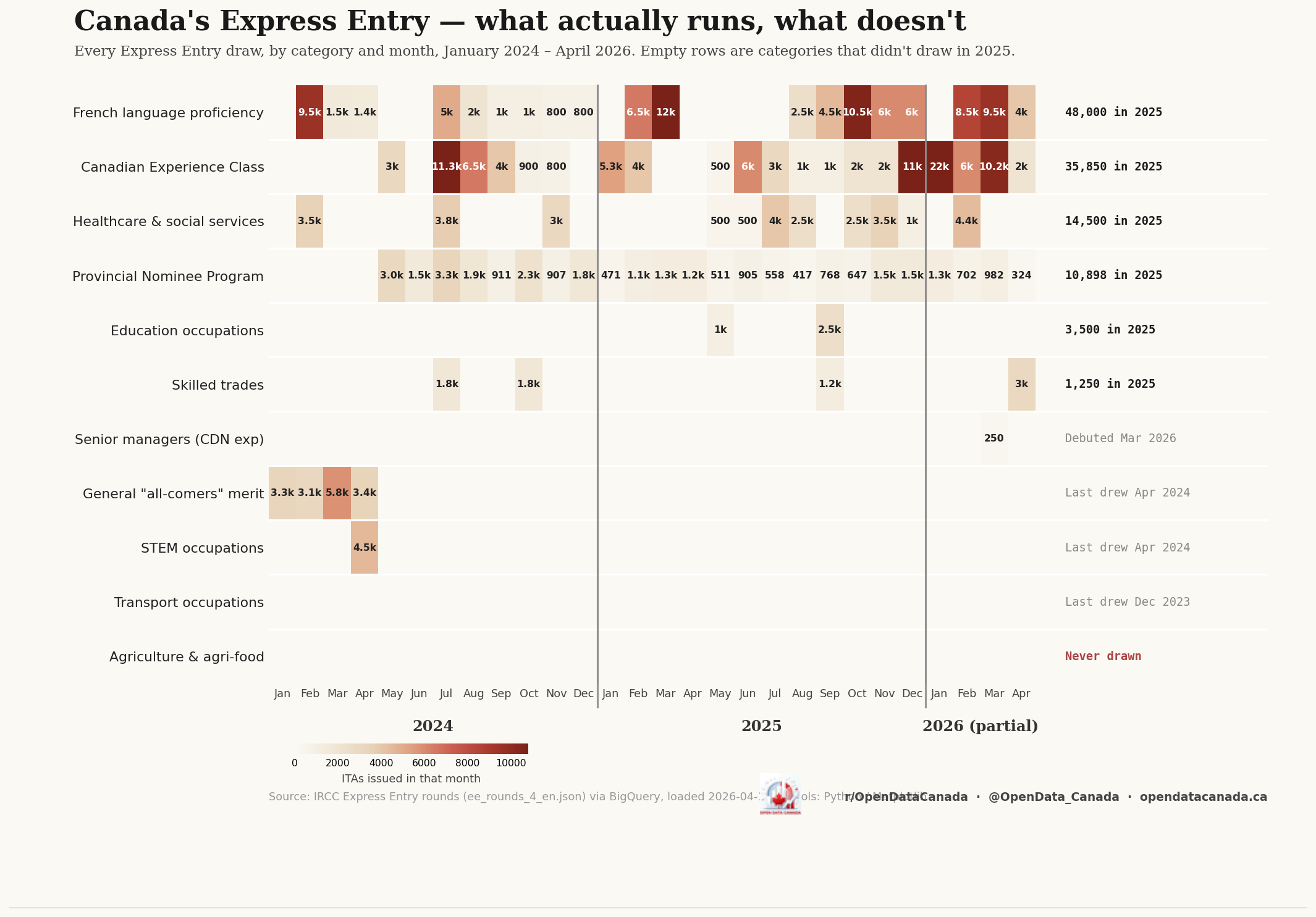
For how Express Entry rounds have been used so far, see the Express Entry categories that barely run and the French-language CRS gap.