Economy
Ottawa is buying into Cohere. Here's how its last two big stakes turned out.
The federal government will put up to 1.6 billion dollars of equity into Cohere, the Toronto AI company, in stages. The real test is whether that buys Canada lasting economic value, and getting the money back is only one measure. Ottawa's pandemic stake in Air Canada made money. The 2009 auto rescue did not.
Prime Minister Mark Carney announced on October 29 that the federal government has committed to buy shares in Cohere, the Toronto company that builds AI systems for businesses and governments. The investment is worth up to 1.6 billion dollars. It will be made in stages, with regular reporting on progress against what the company has promised. The release does not say whether those reports will be public.
As part of the deal, Cohere will:
- create at least 1,000 new Canadian technical jobs by 2030
- commit at least 1.7 billion dollars to more computing capacity in Canada by 2030
- keep its Canadian incorporation and a Canadian headquarters
- fund research partnerships and openings for students and recent graduates
- keep working with the Canadian AI Safety Institute
The release calls the money "a commercial investment" and says Canada "will share in the company's success."
What Canada gets for 1.6 billion dollars
The release does not say what share of Cohere the money buys, what kind of shares they are, whether Ottawa gets a seat on the board, or what triggers each stage.
Cohere's own release adds some context. It announced the "initial close" of a funding round that aims to raise up to 7 billion dollars, led by the companies of Germany's Schwarz Group. Bell Ventures, Bullhound Capital and the Government of Canada are new investors. Inovia Capital, NVIDIA and Prosperity7 Ventures are returning. Cohere did not say how much the initial close raised.
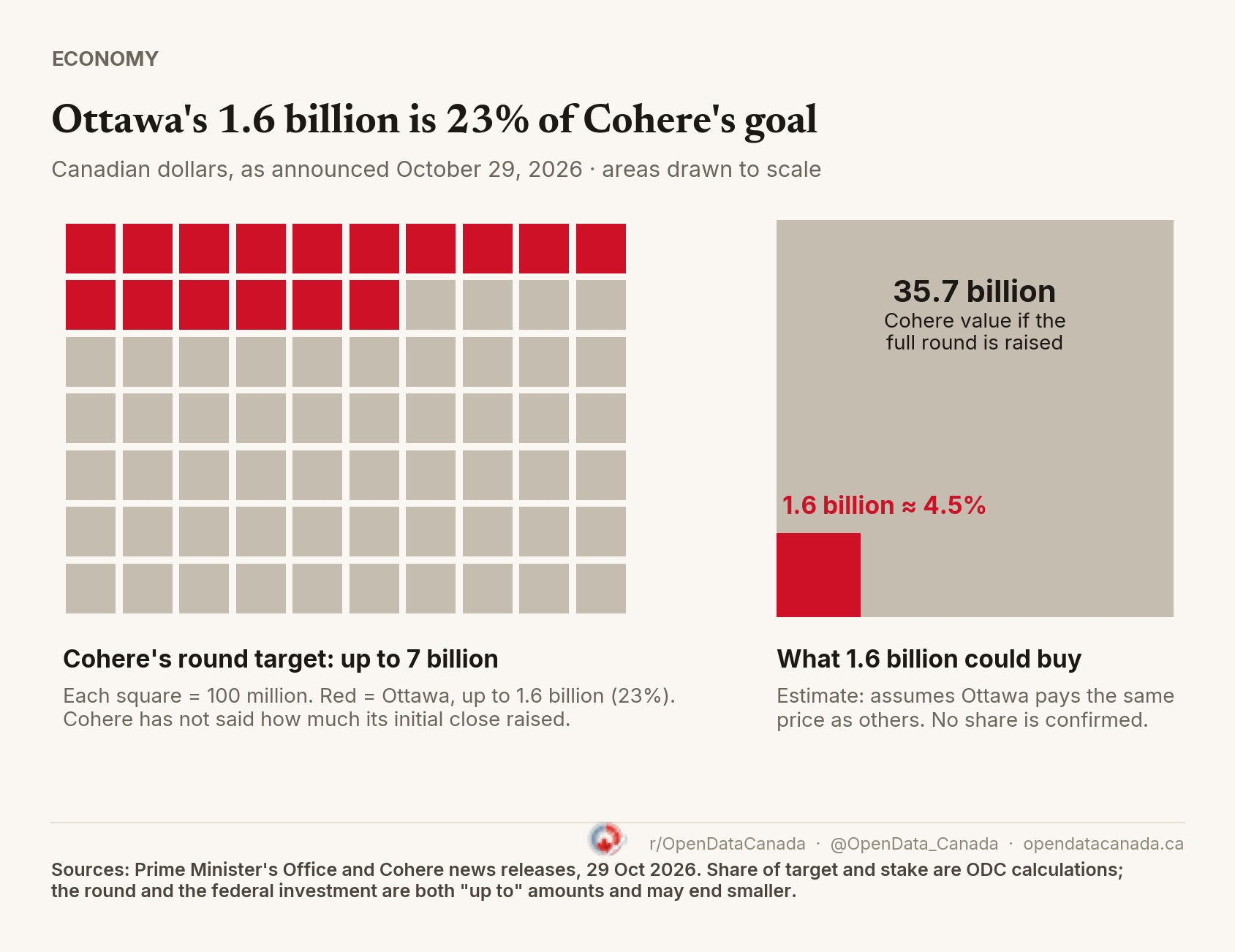
If the round and the federal money both come in full, Ottawa would supply about 23 per cent of the round. Cohere says a full round "would represent" a value of 35.7 billion dollars. Divide 1.6 billion by that and the federal stake comes out near 4.5 per cent. That is an Open Data Canada estimate. It assumes Ottawa pays the same price per share as other investors, counted after the new money is in. Neither the government nor Cohere has confirmed it.
A Canadian company with a second home in Berlin
Six weeks earlier, on September 16, Cohere signed an agreement to combine with Aleph Alpha, a German AI company. The combined company plans headquarters in both Toronto and Berlin, will keep Aleph Alpha's research office in Heidelberg, and will have more than 1,000 employees across both continents. The deal still needs final regulatory approval. Cohere also agreed to work with the Schwarz Group companies to offer its AI through STACKIT, Schwarz's European cloud.
That matters for the conditions. Ottawa asks Cohere to keep its Canadian incorporation and a Canadian headquarters, not its only headquarters. The 1,000 jobs Ottawa asks for are new jobs in Canada. The 1,000-plus figure in the Aleph Alpha announcement counts current staff in both countries. In an October 30 update, Cohere said its Canadian plans would create more than 1,500 jobs through 2031.
Air Canada made money, the auto rescue lost a quarter
Two past federal company stakes with a final result went opposite ways.
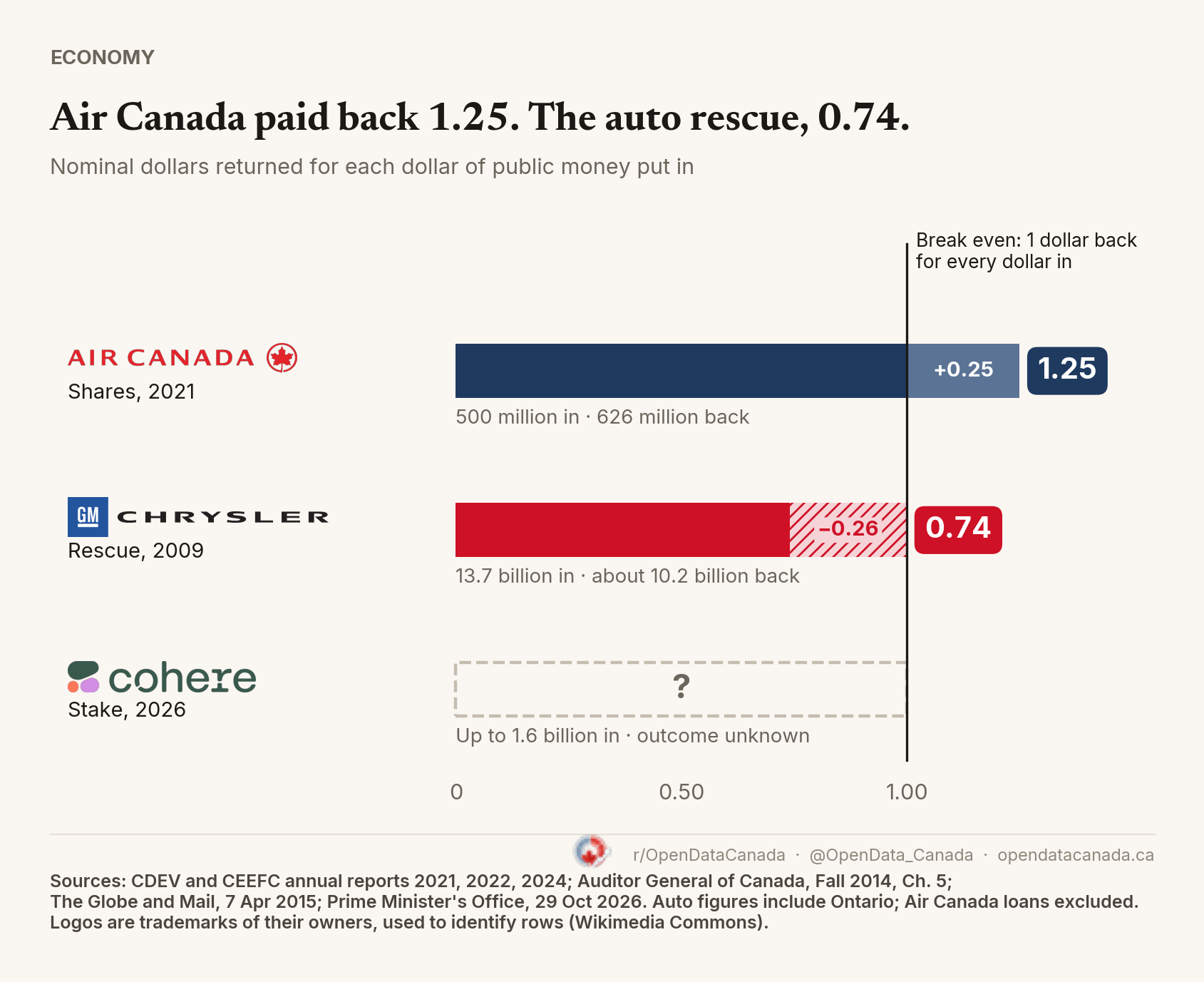
Air Canada. In April 2021, during the pandemic shutdown of air travel, a subsidiary of the Canada Development Investment Corporation (CDEV), the federal Crown corporation that manages government holdings, bought 500 million dollars of Air Canada shares. It also received warrants, rights to buy more shares, as part of a loan deal worth up to 4 billion dollars. Those loans were cancelled unused in November 2021, and half the warrants with them. Air Canada bought back the rest for 82 million dollars in January 2022. CDEV sold all the shares in December 2024 for 544 million. It puts the total profit at 126 million dollars, about 1.25 dollars back for each dollar put in. A separate 1.27 billion dollar loan to refund customers for cancelled flights is not counted here.
GM and Chrysler. In 2009 Ottawa and Ontario gave the two automakers 13.7 billion dollars of support, 10.85 billion to GM and 2.88 billion to Chrysler, about two thirds of it federal, according to the Auditor General. Most of the loans to GM were swapped for shares. Canada's roughly 2 per cent of the new Chrysler was sold to Fiat in 2011 for 132 million dollars. The last 73.4 million GM shares were sold in April 2015, bringing in 3.29 billion Canadian dollars at settlement. By the Globe and Mail's count, the two governments got back about 10.2 billion in total, roughly 3.5 billion short: about 74 cents for each dollar.
These are nominal dollars returned per dollar of public support, not adjusted for inflation, and both were rescues of companies in crisis. The Auditor General found in 2014 that it was "impossible" to get a complete picture of the auto money recovered and lost, because the information was scattered across separate reports and Parliament never received a full one.
Money back is only one test
Cohere is not a rescue. It is a growing company raising money alongside private investors, in what it calls the largest private financing round ever by a Canadian technology company. Neither release gives a date or a plan for the government to sell.
The larger promise is lasting value: well-paid jobs, computing capacity built in Canada, and a company that keeps a base in the country. The conditions name those goals. Whether Canadians can check them depends on reporting the release describes but does not promise to publish.
Public money for AI is a hard sell. In a Nanos poll of 1,104 people in late July, between 61 and 67 per cent of every age group opposed government incentives for AI data centres. That question was about incentives for data centres, not this investment. A share purchase is not a subsidy, and unlike one, it can come back.
Ottawa has written down what Cohere owes Canada: 1,000 jobs and 1.7 billion dollars of computing by 2030. It has not written down what Canada owns.