Foreign policy · 4 min read
Canada pledges 780 million dollars to join the EU's Ukraine loan. Here is what it buys.
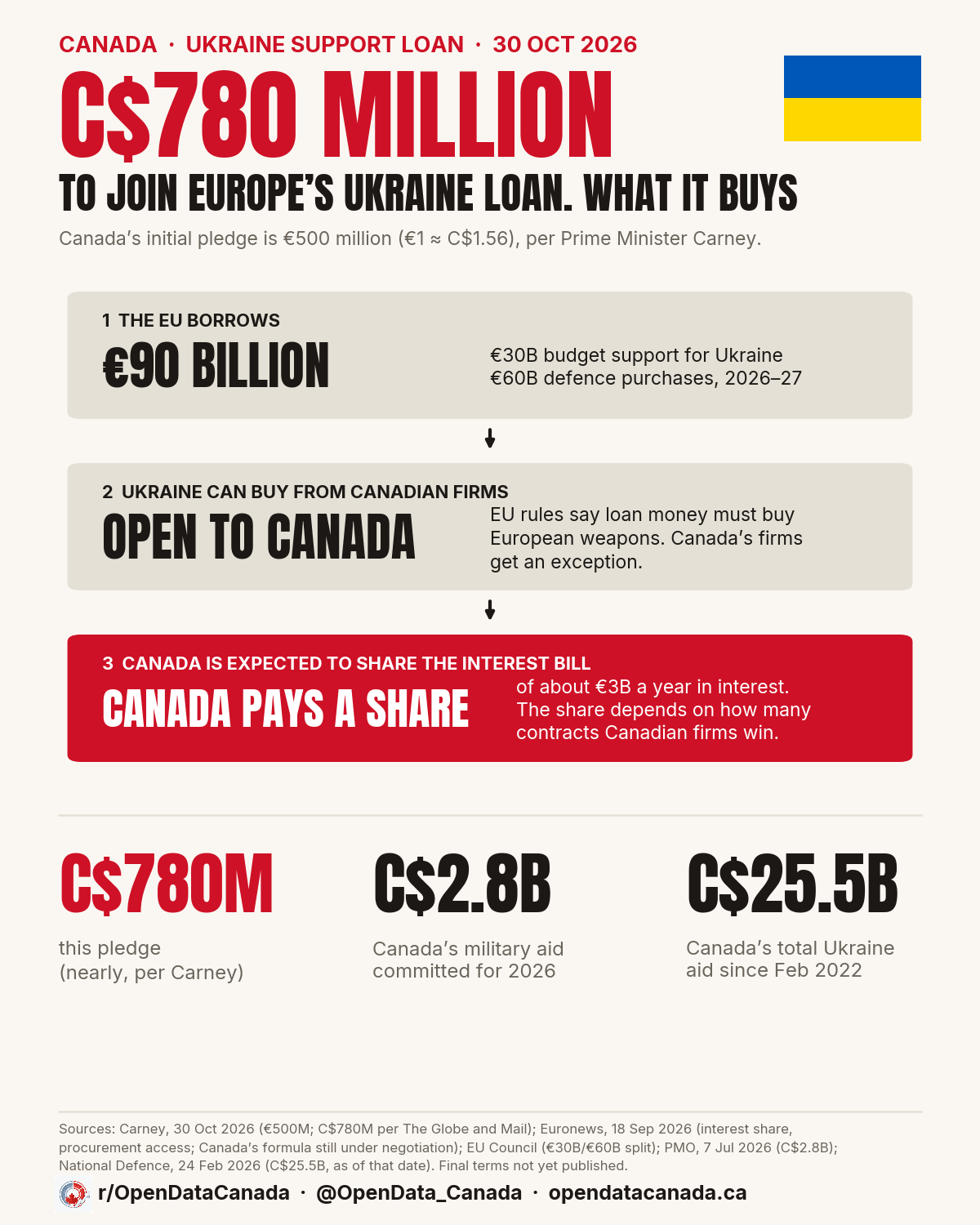
Canada will initially put in 500 million euros, nearly 780 million Canadian dollars. The arrangement could let Ukraine spend EU money on Canadian weapons, and Canada shares the cost of the borrowing. The final terms have not been published.
Prime Minister Mark Carney announced at the end of the Canada-EU summit in Montreal on 30 October that Canada will join the European Union's Ukraine loan with an initial 500 million euros, which The Globe and Mail put at nearly 780 million Canadian dollars.
That is a lot of money, and the documents published so far do not say exactly what it pays for. Euronews's September reporting points to the cost of joining a European borrowing scheme, not a direct payment to Ukraine.
The EU borrows, Canada shares the interest
The Ukraine Support Loan is a 90 billion euro European Union facility for 2026 and 2027: 30 billion euros for Ukraine's budget and 60 billion for defence purchases. The EU raises the money on capital markets, with its own budget backing the borrowing. Euronews put the interest at about 3 billion euros a year, paid in proportion by 24 member states.
Countries outside the EU can join, and that is where Canada comes in. As Euronews reported on 18 September, Ukraine could then buy weapons and ammunition from the joining country's defence firms, outside the loan's "Made in Europe" requirement. In return, Euronews wrote, Ottawa "will have to pay a share of the €3 billion in interest rates, depending on how much its firms benefit." Euronews added that the specifics of the Canadian contribution were still under negotiation.
So Canada's money buys two things: a seat in the arrangement, and access for Canadian manufacturers to contracts paid for by European borrowing.
What is confirmed and what is not
The joint statement signed in Montreal says only: "We welcome Canada's intention to join the Ukraine Support Loan." It gives no amount, no repayment terms and no payment schedule. The 500 million euro figure comes from Carney's remarks, and the word he used was "initially."
Not yet stated in anything available on 30 October:
- whether the 500 million euros is an upfront payment, an estimate of Canada's share of the interest, or a cap
- whether Canada's share is tied to the value of contracts won by Canadian firms
- what Canada pays if few contracts arrive
- whether the money is new or comes from funds already budgeted
The Canadian-dollar figure is also rounded. The euro amount is the fixed number; the dollar value moves with the exchange rate.
Not the World Bank loan from September
A separate deal made headlines earlier. On 14 September, Ukraine's Cabinet said it would receive 841 million US dollars from the World Bank to reimburse pension payments already made, "under the guarantees of the Government of Canada." That is a World Bank loan to Ukraine with a Canadian promise behind it. A guarantee means Canada covers losses if Ukraine does not repay. It is not cash handed over.
Canada's December 2025 package included "a loan guarantee of up to $1.3 billion in 2026" to the World Bank, according to the Prime Minister's Office. No source ties the 841 million to that amount, and the release does not state the currency. What the guarantee costs Canada, and its maximum exposure, has not been published.
How it compares with Canada's other Ukraine money
Canada's military support for Ukraine in 2026 is set at 2.8 billion dollars, according to the Prime Minister's Office on 7 July, when Carney announced 475 million for ammunition, nearly 400 million for 35 Canadian-made armoured vehicles and 50 million for technology and engineering equipment. Total aid since February 2022 stood at more than 25.5 billion dollars on 24 February, of which 8.5 billion was military.
Against those, 780 million dollars is a large single decision, larger than any one of the July items. It is not a like-for-like comparison: the July money buys equipment directly, while the loan pledge pays for access and borrowing costs.
The question to put to Ottawa is whether the contracts that follow are worth what Canadians are paying to unlock them.