Article · Government · 8 min read
Canada Spent C$14 Billion on Foreign Aid in 2025: Here's Where It Actually Went
While the United States slashed foreign aid by 57 percent and the rich-country average fell by nearly a quarter, Canada trimmed just over 2 percent. Yet a look at where the money went shows more than half of it now goes to Ukraine or is spent inside Canada on refugees, leaving the smallest share for the developing world in years.
2025 was the year foreign aid fell off a cliff. Official development assistance (ODA), the money rich governments spend to reduce poverty in poorer countries, dropped 23 percent in real terms across the 33 members of the Development Assistance Committee (DAC) at the Organisation for Economic Co-operation and Development (OECD). It was the steepest single-year fall in more than three decades. Three-quarters of the drop came from one country: the United States cut its aid budget by 57 percent.
Against that backdrop, Canada looks steady. Its ODA slipped just 2.3 percent in real terms, one of the smallest cuts of any major donor. Most peers went much further. Germany cut 17 percent, and France and the United Kingdom cut around 11 percent each.
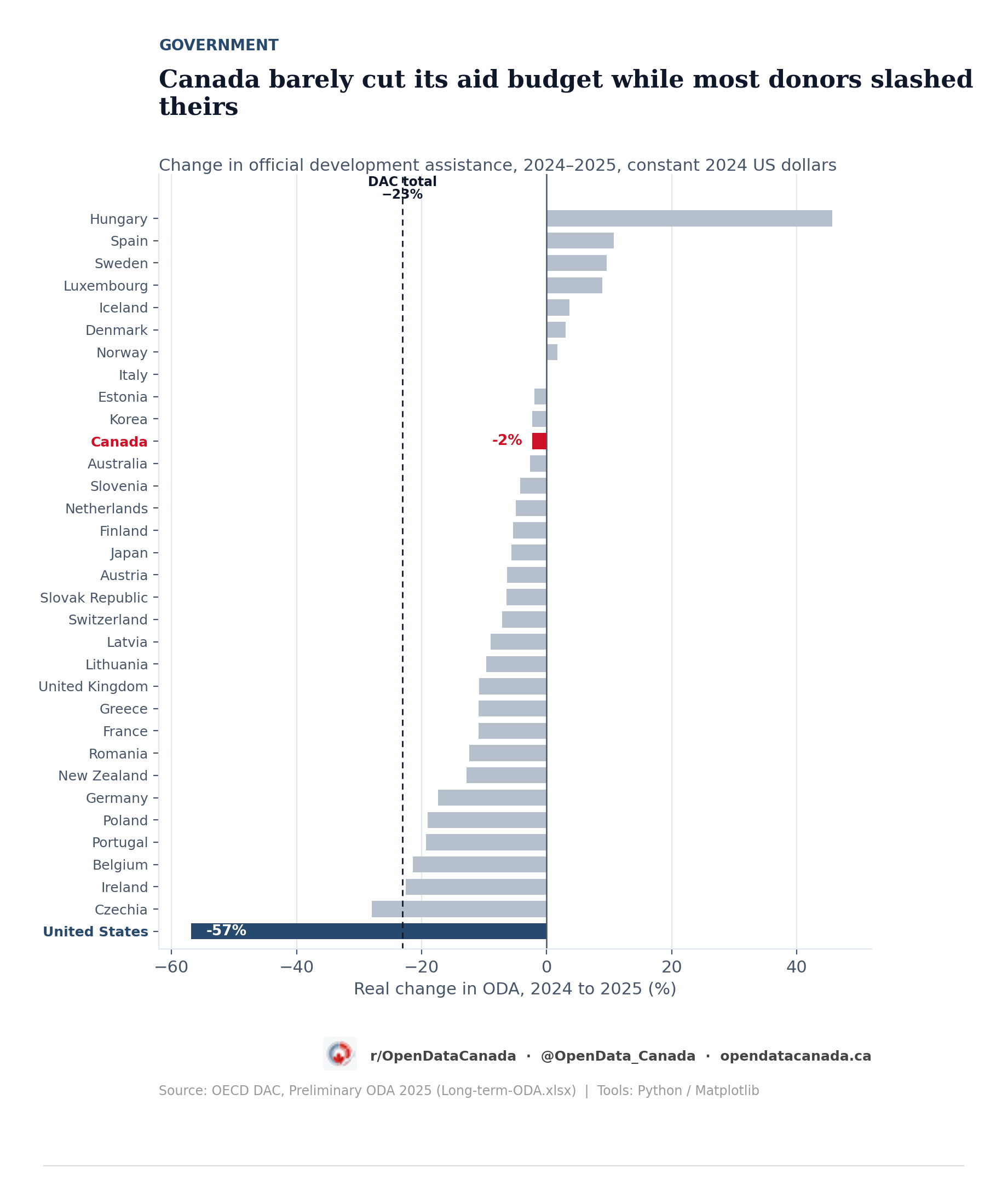
But a stable total hides what changed underneath it. The more revealing question is not how much Canada gave, but where the money went.
Where Canada's aid actually goes
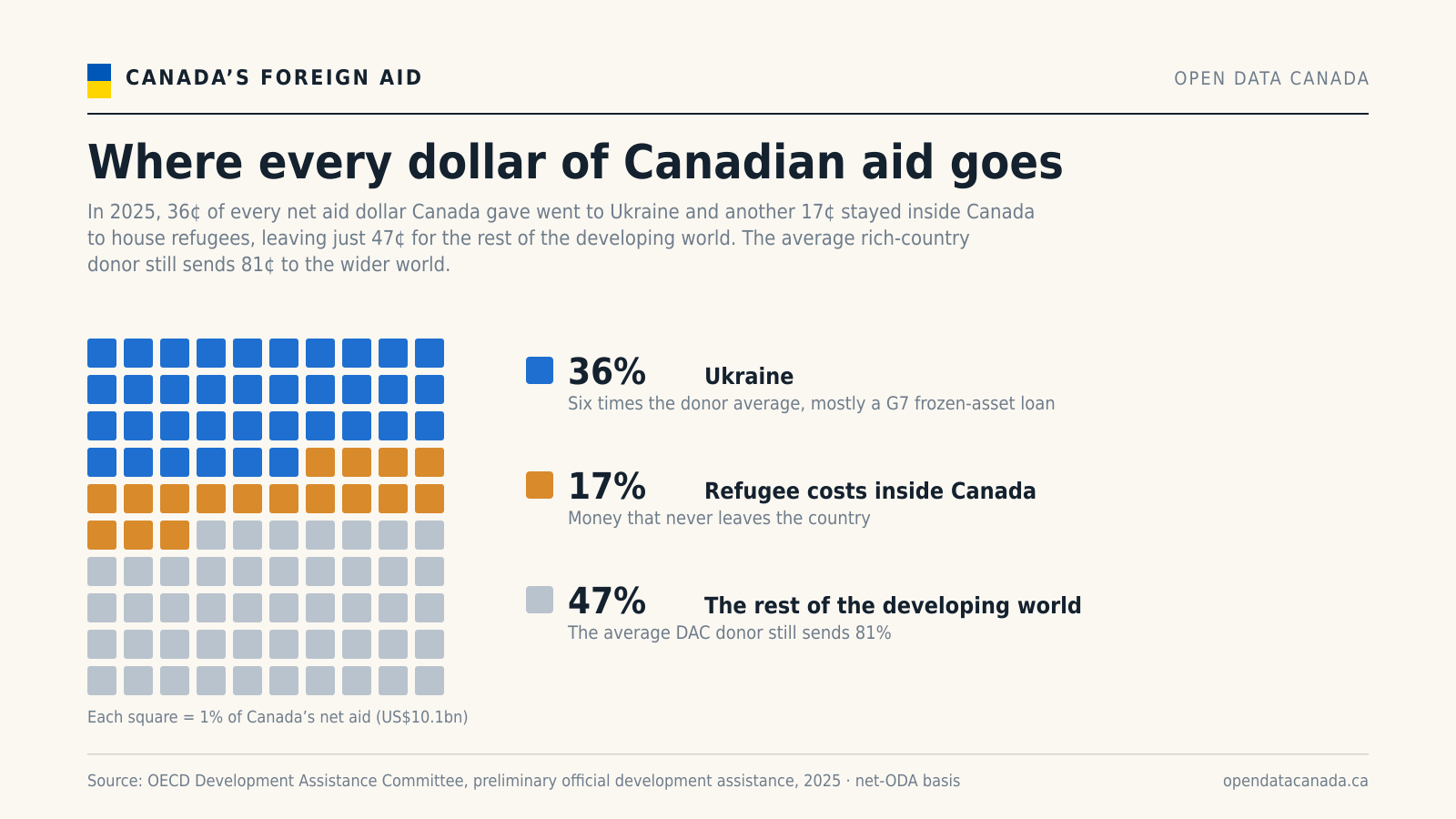
Two categories now dominate Canada's aid budget. The first is Ukraine. The second is money Canada never sends abroad at all: the cost of housing and settling refugees during their first year inside Canada, which international rules allow donors to count as foreign aid.
Put together, they crowd out almost everything else.
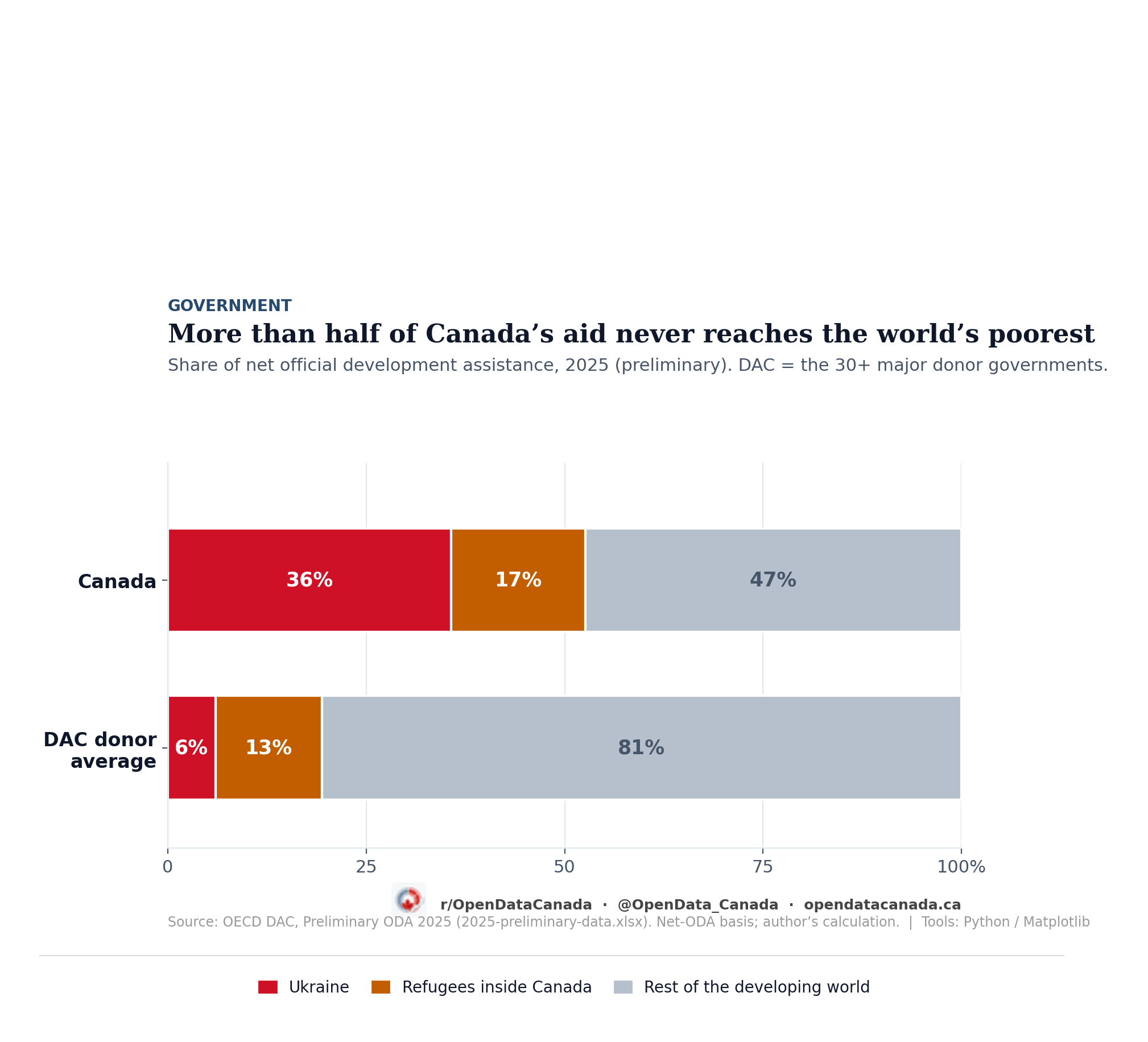
Roughly 36 cents of every dollar of Canadian net aid went to Ukraine in 2025, six times the DAC average of 6 percent. Another 17 cents was spent inside Canada on refugees, above the donor average of 13 percent. Together that is 53 cents of every aid dollar going to Ukraine or staying in Canada. For the average rich-country donor, the equivalent figure is 19 cents.
A single loan reshaped the budget
Canada's Ukraine number did not creep up. It jumped. Before Russia's full-scale invasion, Canada sent Ukraine around 35 million US dollars a year in aid. That leapt to 2.2 billion in 2022, drifted down through 2023 and 2024, and then nearly doubled again in 2025 to 3.6 billion.
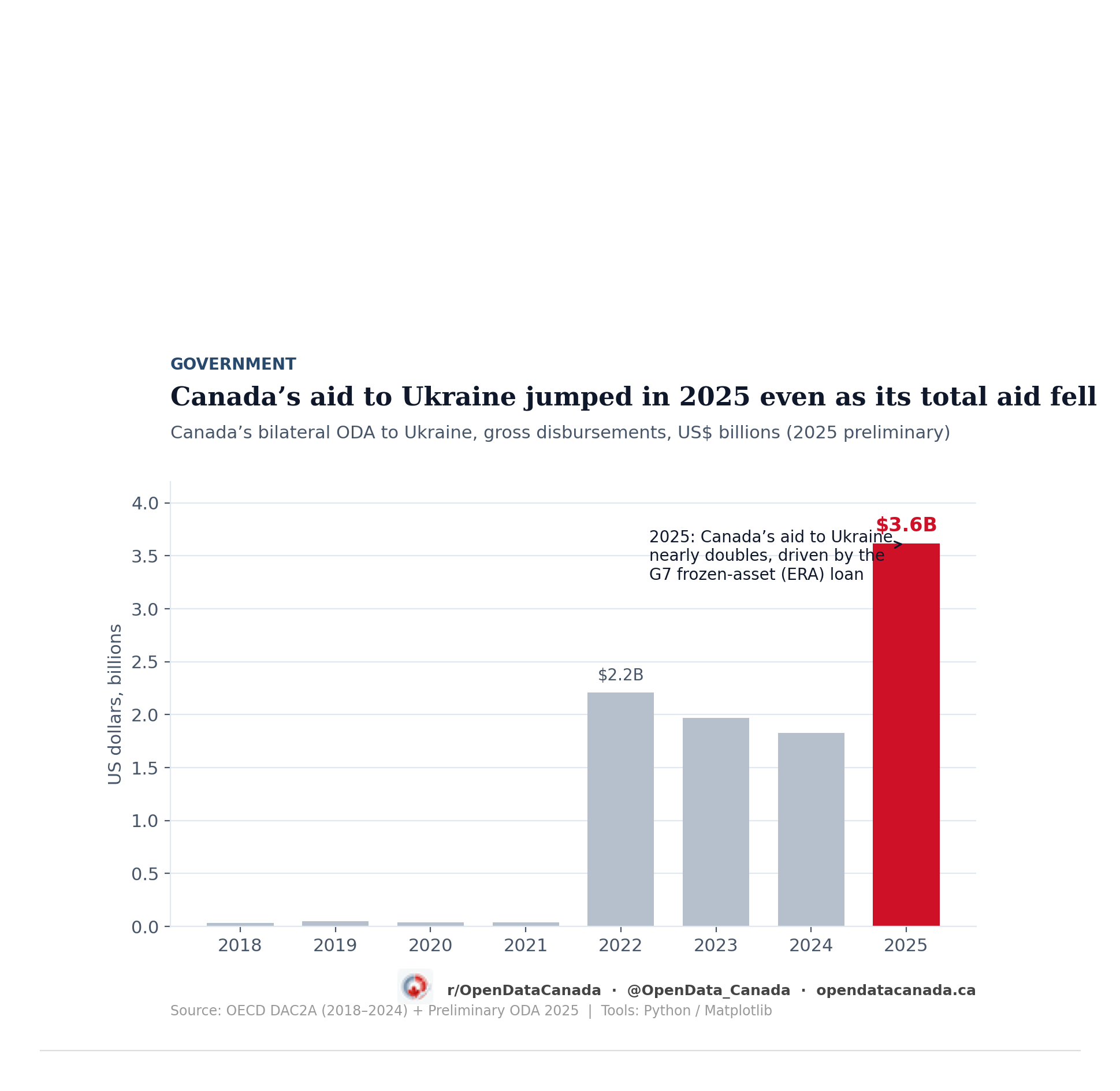
The 2025 spike is largely one item: Canada's share of the Group of Seven (G7) Extraordinary Revenue Acceleration facility, a 5-billion-dollar Canadian loan to Ukraine whose repayments are meant to come from the profits on frozen Russian assets rather than from Ukraine itself. Its first tranche, worth about 1.7 billion US dollars, was disbursed in March 2025. Because it was recorded as aid when it was disbursed, the full value of that tranche counts toward Canada's official development assistance for 2025.
That raises a fair question the headline numbers gloss over: when aid is a loan that will be repaid out of a sanctioned country's own frozen wealth, is it aid in the sense most Canadians picture, or something closer to wartime finance wearing the aid label?
Which countries actually get it
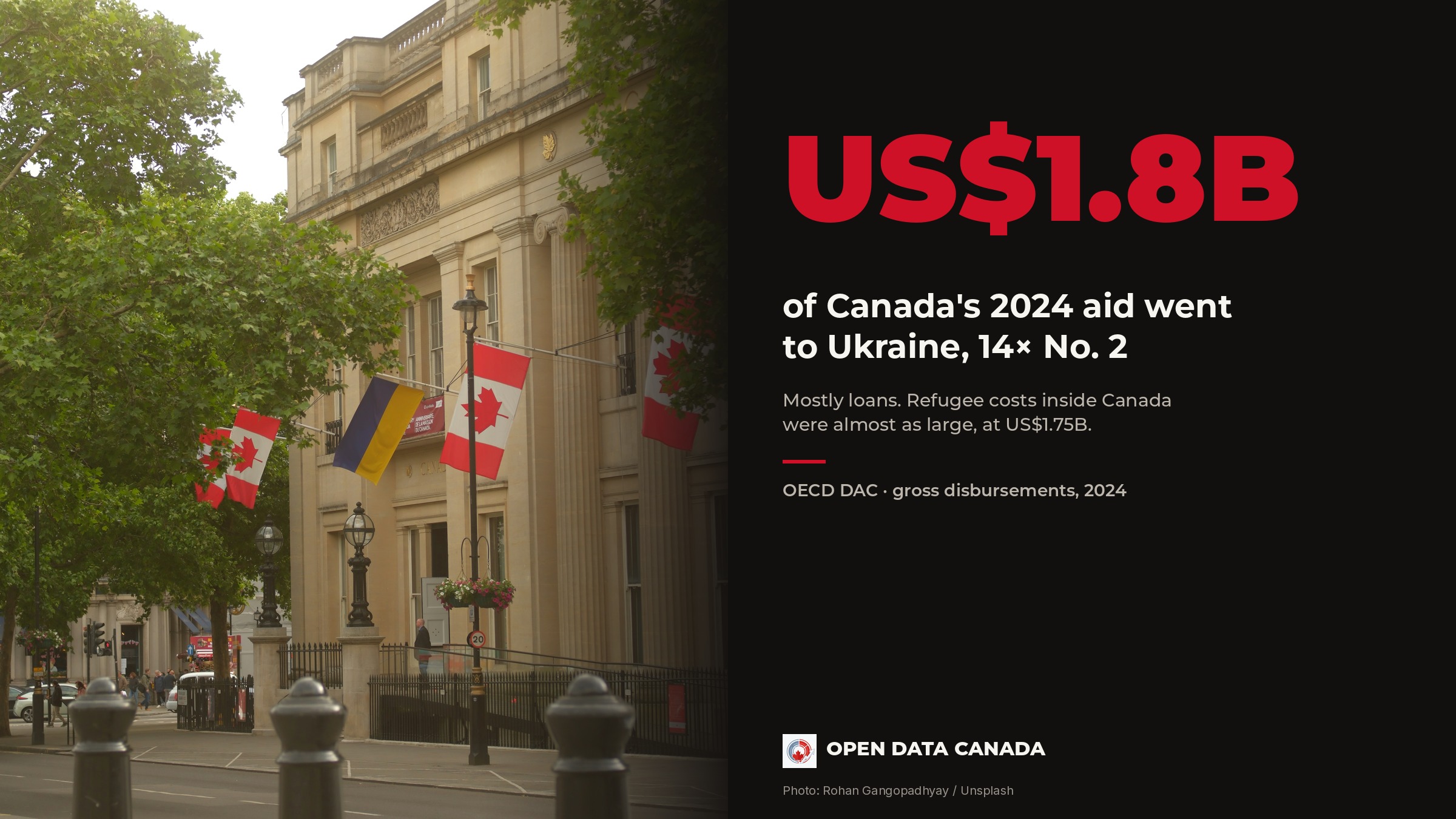
Ukraine's pull on the budget is easier to see when the money is laid out by destination. In 2024, the most recent year for which the OECD has published a full country-by-country breakdown, Canada sent aid to more than a hundred countries. One of them received about 14 times as much as the next. For the full ranked list of every recipient, and why Ukraine drops to sixth once loans are set aside, see Canada's foreign aid by country.
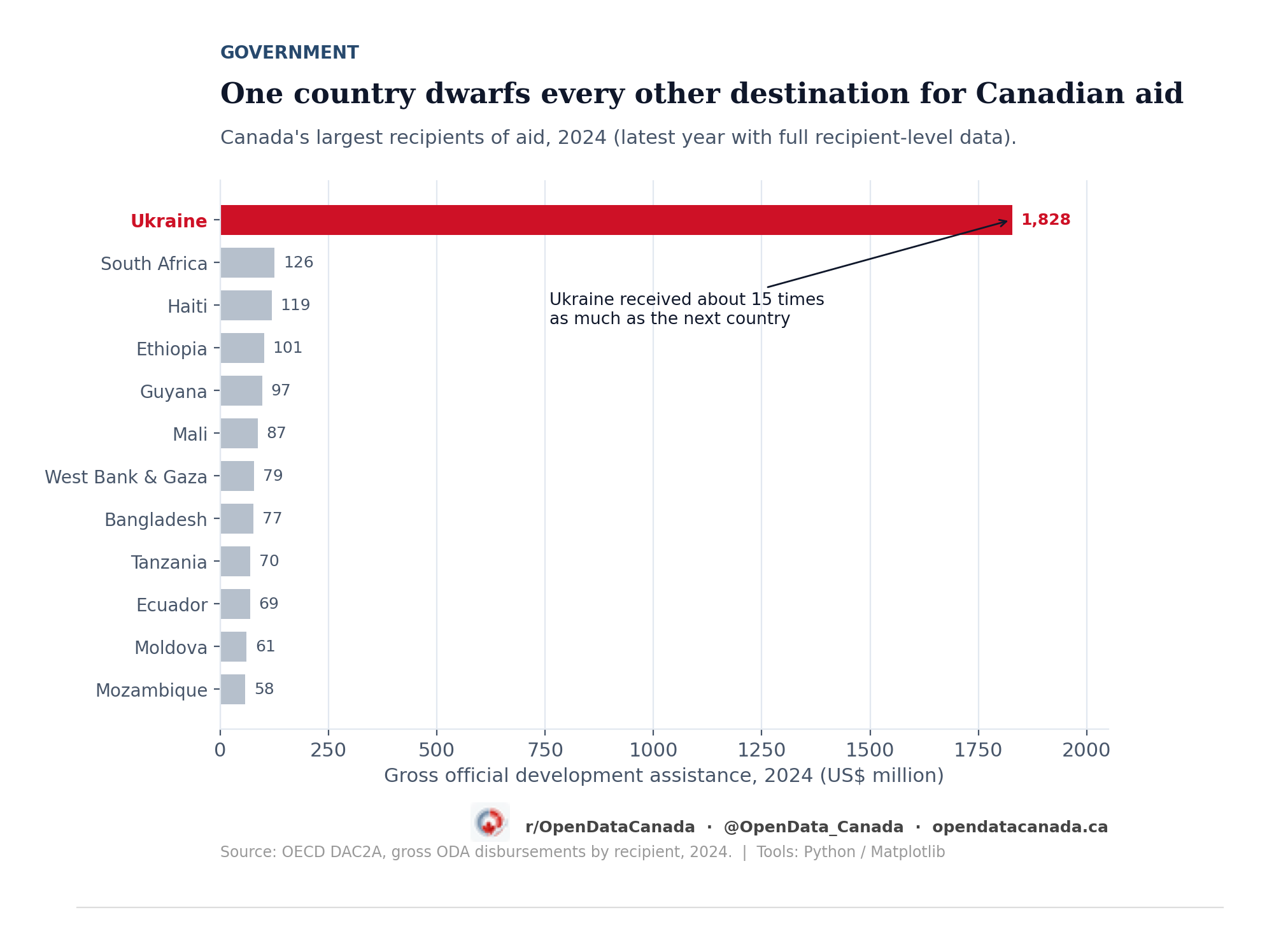
Below the top line, the pattern is familiar. South Africa, Haiti, Ethiopia and a run of countries across Sub-Saharan Africa each received somewhere between 50 and 130 million US dollars, the kind of health and humanitarian spending most people have in mind when they think of foreign aid. Ukraine alone received 1.8 billion.
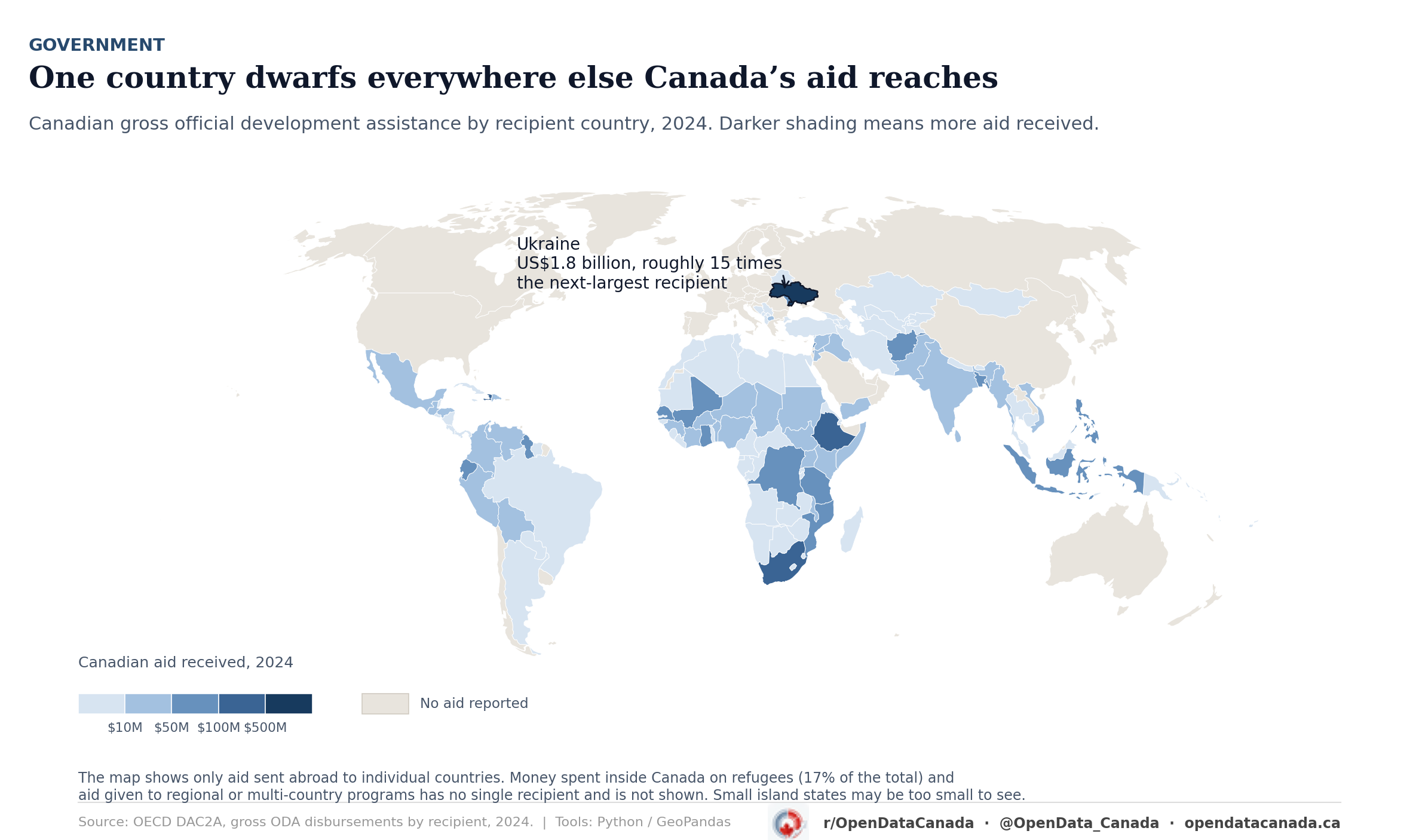
Two things the map leaves out are worth holding in mind. It shows only aid that leaves the country and lands somewhere specific, so the money spent inside Canada on refugees does not appear anywhere on it. And it uses 2024 figures, because recipient-level data for 2025 will not be published until December 2026. Canada's aid to Ukraine rose again in 2025, so the concentration on a single country is now greater than the map shows, not smaller.
The context that gets lost
None of this makes Canada an outlier for supporting Ukraine, and the humanitarian case for that support is real. But the arithmetic has a cost elsewhere. As Ukraine and in-country refugee spending absorbed a bigger slice of a roughly flat budget, the money reaching Sub-Saharan Africa and other development programs shrank as a share of the whole.
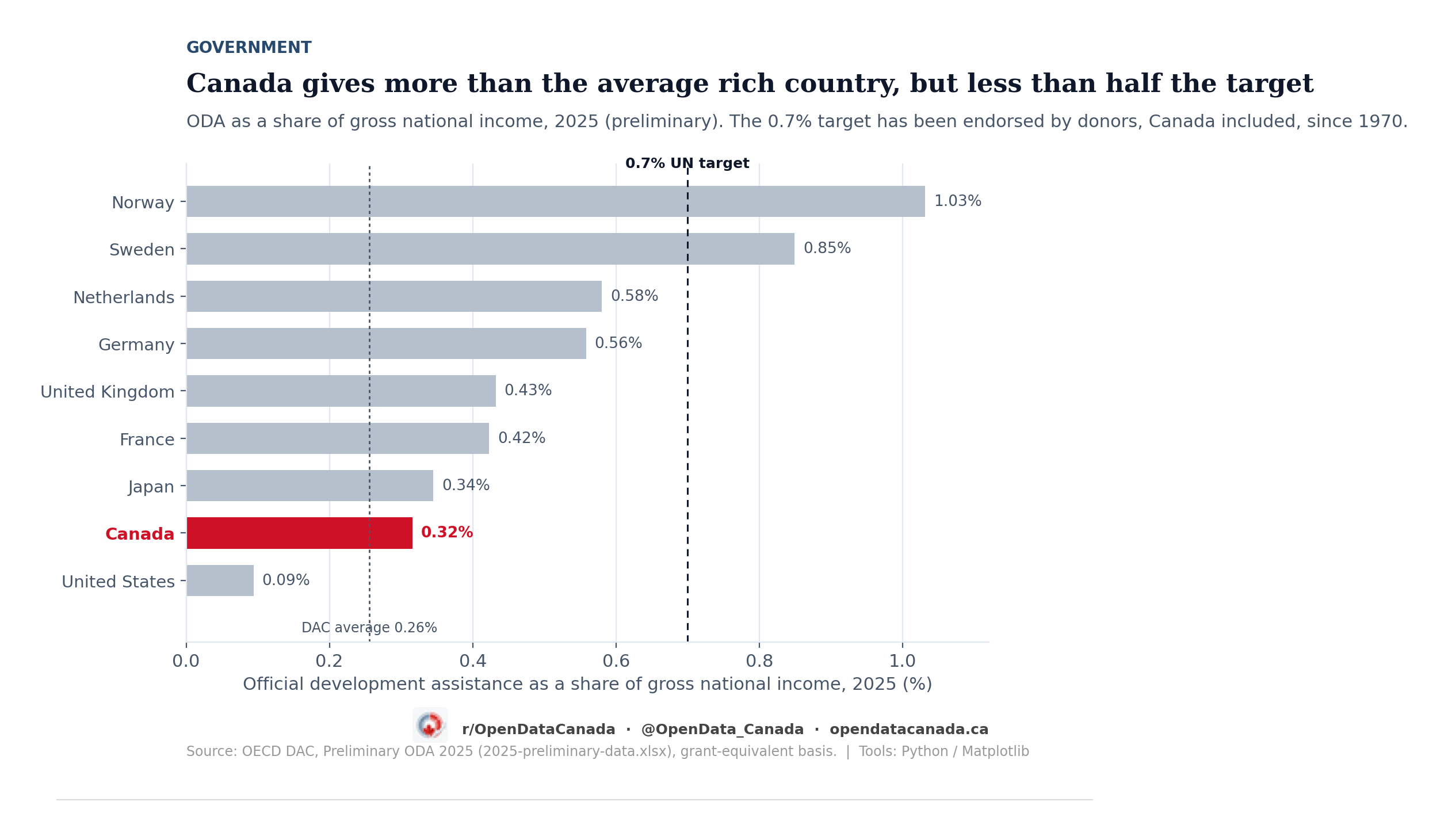
Canada's aid measured against the size of its economy tells the same story. In 2025 Canadian ODA was 0.32 percent of gross national income, less than half the 0.7 percent target that donor countries, Canada among them, have endorsed for more than fifty years.
That leaves Canada in the middle of the donor pack. It gives a larger share of its economy than the average member of the Development Assistance Committee, and far more than the United States, whose aid collapsed to less than 0.1 percent in 2025. But it trails the European donors it is usually compared with.
For all the debate it attracts, aid is a small line in the federal ledger. Canada's net aid in 2025 was about 14 billion Canadian dollars, which works out to roughly 244 US dollars, or about 340 Canadian dollars, for every person in the country over the whole year. Measured against what Ottawa spends on programs, it is smaller still.
The preliminary figures will be revised when the OECD publishes its full, activity-level data in December 2026. The direction is unlikely to change: a donor that held its budget steady while quietly redirecting more than half of it toward one war and its own borders.