Article · Labour · 6 min read
Bombardier sought 40 foreign aircraft assemblers in one posting, more than its last nine quarters combined, after $306.5M in federal funding
Bombardier Aviation is currently asking Ottawa to approve 40 foreign workers for a single aircraft-assembler posting at its Saint-Laurent, Quebec plant: more foreign positions in one request than the company has had approved in the previous nine quarters combined, and more than three times its entire 2025 approval total. The request coincides with 306.5 million dollars in federal funding for Bombardier's aerospace business, part of a package the government said at the time would "support thousands of good middle-class jobs." It also lands during what's commonly termed a technical recession, with manufacturing unemployment rising.
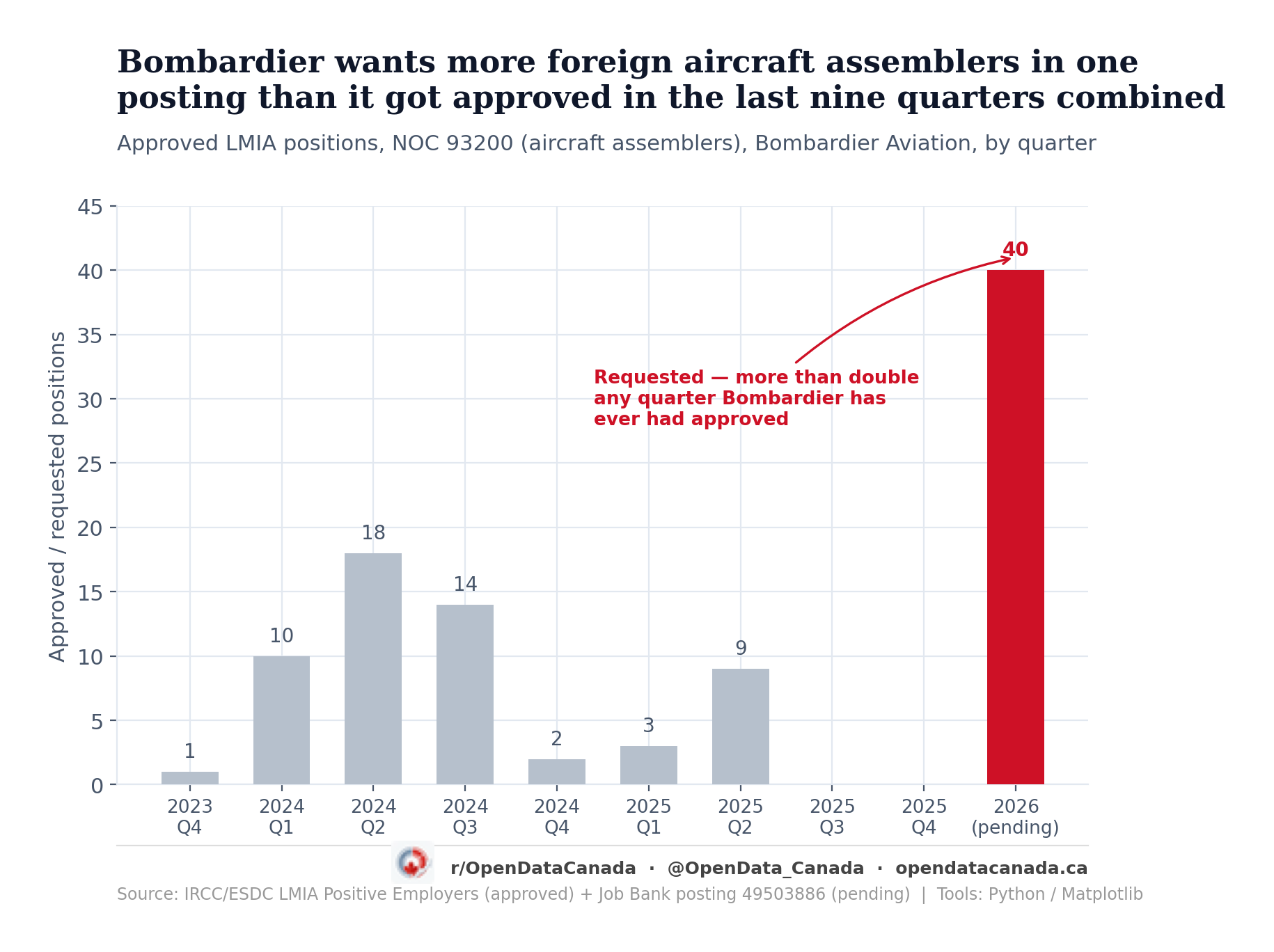
Quarterly approvals are lumpy and reflect application and processing timing, not a continuous or evenly-paced hiring demand.
On May 13, 2026, Bombardier Aviation posted a Job Bank listing for "aircraft fitter-assembler — aircraft assembly" naming two work locations: 1800 Marcel-Laurin Blvd in Saint-Laurent, Quebec, its main business-jet final assembly complex, and a second site in Dorval. The posting, job number 3569275, asks for 40 vacancies, pays $34.62 to $44.06 an hour, and is flagged "LMIA requested," meaning the company is requesting a Labour Market Impact Assessment (LMIA), the federal permission to hire temporary foreign workers after attesting it could not fill the roles domestically. To be clear from the outset: "requested" is not "approved." This is a pending application, not a completed hire, and Service Canada can approve fewer positions or reject the request outright.
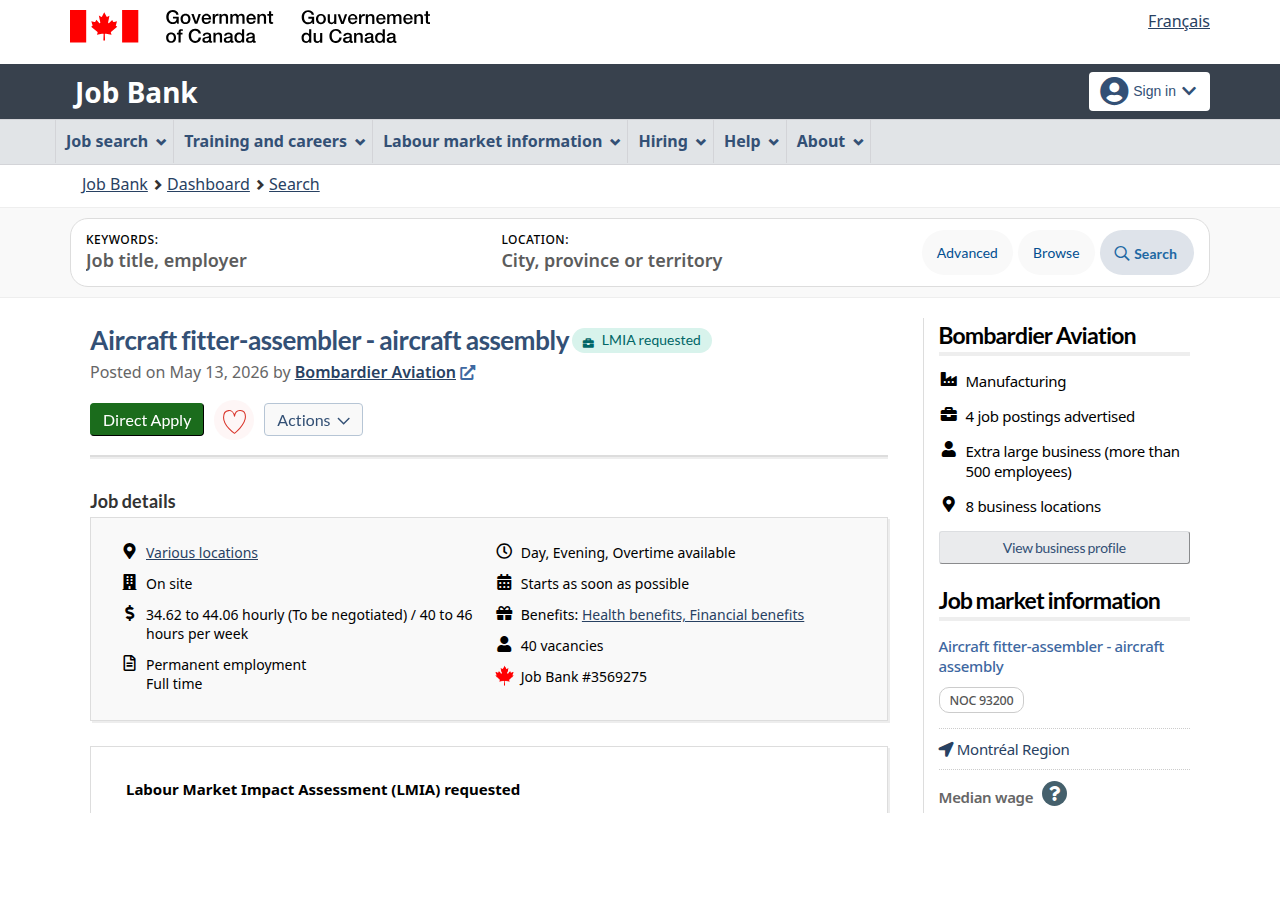
The posting as it appeared on Job Bank on July 10, 2026, archived by Open Data Canada. It is advertised until July 21, 2026.
Forty vacancies in one posting is unusual on its own. It becomes more striking set against Bombardier Aviation's own track record: in the two years of quarterly LMIA-approval data available for this exact occupation, the company has never had more than 18 positions approved in any single quarter. Even if approved in full, this single request would be more than three times Bombardier's total approved aircraft-assembler positions across all of 2025 (12).
The LMIA process itself requires employers to advertise the position and attempt domestic recruitment before a request is submitted, though the underlying recruitment record (how many Canadian applicants applied, and why they weren't hired) is not publicly disclosed alongside the approval data used in this piece.
What these jobs are worth
The posting itself is specific about pay and conditions: $34.62 to $44.06 an hour (negotiable), 40 to 46 hours a week, permanent full-time, on-site only, with day, evening and overtime shifts available. It also lists a full benefits package tied to a collective agreement (dental, health care, disability, vision care and paramedical coverage, plus a pension plan), indicating these are unionized positions, not gig or contract work.
At a standard 2,080-hour work year, that hourly range works out to $72,010 to $91,645 per worker, per year, in base wages alone, before the value of benefits and pension. Multiplied across all 40 requested positions, that's $2.88 million to $3.67 million a year in wages Bombardier is asking to bring in foreign workers to fill. These are not marginal or minimum-wage roles; they are solidly middle-class, unionized manufacturing jobs with full benefits. (See the callout above for the full figure alongside the approval-history comparison.)
What the data actually says
Two datasets, matched on the same employer and the same National Occupational Classification code (93200/9521, aircraft assemblers and aircraft assembly inspectors), tell this story:
| Quarter | Approved positions (NOC 93200) |
|---|---|
| 2023 Q4 | 1 |
| 2024 Q1 | 10 |
| 2024 Q2 | 18 (highest on record) |
| 2024 Q3 | 14 |
| 2024 Q4 | 2 |
| 2025 Q1 | 3 |
| 2025 Q2 | 9 |
| 2025 Q3 | 0 |
| 2025 Q4 | 0 |
| 2026 (pending) | 40 requested |
The 40-vacancy request is more than double the company's best-ever quarter, and more than the last three quarters of approvals (2025 Q2–Q4: 9 total) combined several times over. It is also larger than the full nine-quarter total of 57 approved positions across the entire visible history.
Bombardier's own approval history shows real quarter-to-quarter volatility, including two consecutive quarters (2025 Q3–Q4) with zero approvals in this occupation. But the scale of the request, on its own, is the story: it is a bet that Ottawa will approve a jump the data has never shown before.
The money behind the plant
Bombardier Aviation and its parent have drawn substantial federal funding tied to the aerospace business now doing this hiring. Federal grants and contributions records (Canada's proactive disclosure database) show two agreements:
| Agreement | Value | Recipient | Program | Purpose |
|---|---|---|---|---|
| #510811 (2015-05-01 to 2022-09-30) | 54 million dollars | Bombardier Aerospace | Technology Demonstration Program | "Project Horizon" |
| #511378 (2016-10-07 to 2019-12-31) | 252.5 million dollars | Bombardier Inc., as represented by Bombardier Aviation | Strategic Aerospace and Defence Initiative | "The Global 7000 Development project introduces a new family of business aircraft, comprised of the largest cabin and longest range in the ultra-long-range market segment" |
Combined, that's 306.5 million dollars in disclosed federal contribution agreements. The second and larger of the two, at 252.5 million dollars, is explicitly tied by its own disclosure record to developing the Global 7000, the newest aircraft in the business-jet lineup this same Saint-Laurent complex builds.
Both agreements were rolled into a public announcement on February 7, 2017, when the government confirmed a 372.5 million dollar funding package for Bombardier. The announcement, from Innovation, Science and Economic Development Canada, quoted then-Minister Navdeep Bains directly:
"This funding will be provided over four years and will support thousands of good middle-class jobs, strengthen the long-term competitiveness of Bombardier and help to build the aircraft of the future." — The Honourable Navdeep Bains, Minister of Innovation, Science and Economic Development
That is the government's own framing, in its own words, at the time the money went out: jobs, competitiveness, and building aircraft. The contribution agreements themselves do not include any publicly disclosed hiring targets or conditions; the "middle-class jobs" language is the minister's framing of the funding's purpose at announcement, not a term written into the agreements. Nearly a decade later, the aircraft-assembly line that funding was meant to support is asking to bring in more foreign workers in one posting than it has ever had approved before.
This isn't new, and it isn't one government's or one party's doing
The $306.5 million described above is federal funding tied specifically to the Global 7000 program at this Saint-Laurent plant, announced under Justin Trudeau's Liberal government in 2016–2017. It's also a small slice of a much longer pattern: the Montreal Economic Institute, a Quebec-based policy-research organization, estimates Bombardier has drawn more than $4 billion in combined federal and provincial support since its first government subsidy in 1966. That figure is widely cited in Canadian media, but it comes from outside research rather than a single official audited government total, so it's treated here as an estimate, not a precise sum: a mix of program-level disclosures and outside research rather than one standardized public ledger, and not directly comparable across jurisdictions or funding types (loans, equity stakes, and contracts are all counted differently). That broader funding history provides context for the scale of scrutiny around Bombardier's current hiring request, even though the LMIA process itself is a separate, case-by-case system unconnected to any specific funding agreement. Most of these packages, including the $306.5 million above, have been structured as repayable contributions or loans rather than outright grants, though repayment terms are not part of the public disclosure record reviewed for this piece, and actual repayment outcomes are not consistently tracked in any standardized public dataset.
Within that longer history, a few episodes stand out, spanning different parties and levels of government, usually for different aircraft or plants than the one this piece covers:
- 2008, federal Conservative government (Stephen Harper): Ottawa committed $350 million in repayable contributions to the C Series program, the aircraft line that became the Airbus A220, built at Bombardier's Mirabel, Quebec facility, not the Global 7000 line at Saint-Laurent this piece covers. Repayment was structured as royalties on aircraft sales rather than direct cash payments.
- 2015–2016, Quebec's Liberal provincial government (Philippe Couillard): Investissement Québec, the province's Crown investment arm, committed US$1 billion for a 49.5% equity stake in the C Series program, again the C Series/A220, not the Global 7000 or the Saint-Laurent plant. Quebec's Liberal Party (the PLQ) is a distinct provincial party from the federal Liberal Party; the two shouldn't be conflated.
- 2016–2017, federal Liberal government (Justin Trudeau): The $306.5 million detailed above, tied specifically to the Global 7000 program at Saint-Laurent, the subject of this piece.
- 2025–2026, federal Liberal government (Mark Carney): The Royal Canadian Air Force signed a $753 million contract in December 2025 for six Bombardier Global 6500 jets to replace its aging Challenger fleet, part of a broader defence-industrial funding push. The Global 6500 is assembled at Bombardier's Toronto facility, not Saint-Laurent. This funding has no connection to the aircraft-assembler posting or the Global 7000 program this piece is about, and is noted here only as background on the company's ongoing relationship with the federal government under the current administration.
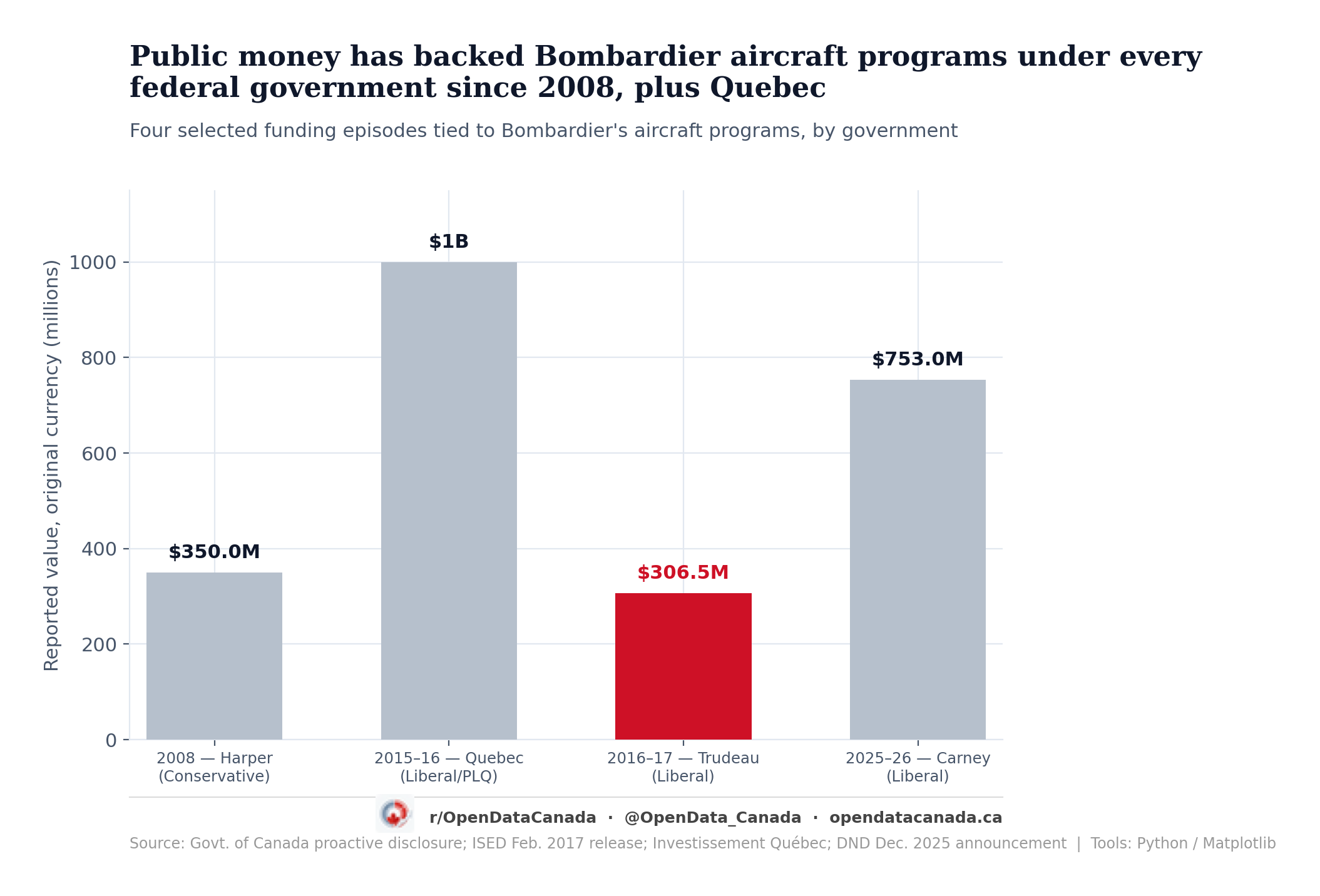
Figures shown in their originally reported currency and funding mechanism (repayable loan, equity stake, or contract); not directly comparable across jurisdictions or program type.
Bombardier's use of government support has also been the subject of international trade disputes, including World Trade Organization (WTO) rulings against Canada's aircraft export-financing tools in 1999–2000 and a high-profile 2017 dumping complaint by Boeing, which ultimately failed when the U.S. International Trade Commission found Boeing had suffered no injury and the proposed tariffs never took effect.
No matter which party has held power federally or in Quebec, Bombardier's aircraft programs have consistently drawn public investment, and consistently drawn scrutiny over it. The pattern is bipartisan and six decades old. That makes it more worth scrutinizing, not less.
The backdrop: a recession, not a boom
The request also lands at a specific moment in the Canadian economy that's worth being precise about, because it cuts against the easy assumption that foreign-worker demand simply tracks a hot labour market.
Real gross domestic product (GDP) has now contracted for two consecutive quarters. Statistics Canada's expenditure-based GDP series (chained 2017 dollars, seasonally adjusted at annual rates) shows a 0.30% decline in Q4 2025 and a 0.29% decline in Q1 2026, the most recent data available. Two straight negative quarters is the commonly used shorthand definition of a technical recession, a rule of thumb rather than an official designation that all economists apply uniformly.
National unemployment has risen sharply from its recent low. It bottomed at 4.5% in December 2022 and has climbed to a 6.6–7.1% range over the last six months of available data.
Manufacturing unemployment specifically has risen even more, proportionally. It bottomed at 2.5% in December 2022 (the same month as the national low) and has since climbed to a 3.1–4.6% range, nearly double in relative terms.
None of this proves anything about Bombardier's specific hiring decision. A shortage in one specialized trade (aircraft structural assembly) can coexist with a soft labour market overall, and the LMIA process exists precisely to test employer claims that domestic candidates aren't available. But the broader claim sometimes used to wave off LMIA scrutiny ("there's a labour shortage, unemployment is low") does not hold up against Statistics Canada's own numbers right now. Unemployment, including in manufacturing, is rising, not at a record low.
Objections worth taking seriously
"Requested doesn't mean approved. This could get rejected or scaled down." True: the 40 figure is a live request, and Service Canada could approve fewer positions, or none. But that is not a reason to wait quietly for the outcome. An ask this far outside the company's own record deserves scrutiny before it is granted, not after.
"Aircraft structural assemblers are a genuinely specialized trade. A real shortage is plausible." This is the strongest counterpoint. Aerospace-specific manual assembly skills are not interchangeable with general manufacturing labour, and Quebec's aerospace cluster has seen real hiring competition among Bombardier, Airbus, Pratt & Whitney Canada, and their suppliers. Quebec's aerospace sector supports roughly 36,000 jobs under the provincial government's Aerospace Strategy Horizon 2026, and Aéro Montréal's own 2025 annual report, which describes a record year for sales and employment, separately flagged labour shortages as an ongoing industry challenge. This piece does not claim the shortage is invented. But the shortage claim rests on employer attestation, and the evidence that would settle it (the domestic recruitment record: how many Canadians applied, and why they were passed over) is the one part of the process the public never gets to see.
"Aerospace is subsidized everywhere. This is normal industrial policy, not a scandal." Aerospace manufacturing is capital-intensive and long-cycle, and most countries with a domestic industry (the U.S., France, Brazil, the U.K.) subsidize it in some form, whether through direct grants, defence contracts, or export financing, which is exactly what the WTO rulings above were about. Bombardier itself points to its economic footprint: a September 2025 economic-impact study commissioned by Bombardier from PwC Canada found the company contributed $7.4 billion to Canadian GDP and supported roughly 50,000 jobs in 2024. But "every country subsidizes aerospace" is an argument for the subsidies. It is not an argument for staffing the subsidized assembly line with imported labour while Canadian manufacturing unemployment climbs.
"The federal funding wasn't a jobs guarantee. It doesn't legally bind Bombardier to hire only Canadians." Neither the federal grants disclosure record nor the LMIA datasets show any contractual jobs-commitment clause tied to the 2015 or 2016 agreements. The "support thousands of good middle-class jobs" language is the minister's framing at announcement, not a binding condition in the agreements. That is exactly the problem. The jobs promise lived in the press release, not the contract, and if governments keep selling corporate subsidies as jobs programs while writing agreements that require no such thing, the failure is Ottawa's as much as Bombardier's.
What we still do not know
The 2026 LMIA approval data isn't in the historical dataset yet: it runs quarterly and the most recent complete quarter is 2025 Q4, so there's no way yet to know whether this specific 40-position request will be approved, reduced, or refused. The federal grants disclosure record also does not show what portion of the 372.5-million-dollar February 2017 package beyond the 252.5-million-dollar Global 7000 agreement was allocated to which specific project; the announcement bundled multiple Bombardier programs together. And the LMIA process itself involves a labour-market impact test that this dataset cannot independently verify was applied correctly in this case.
The data does not resolve whether Bombardier's current hiring reflects a genuine skills shortage, a cyclical labour mismatch, or a structural reliance on foreign recruitment, but it does show a clear break from the company's own recent historical pattern.
What the data does support: a company whose flagship new aircraft program received a quarter-billion dollars in federal funding explicitly framed around jobs is now requesting, in a single posting, more foreign workers for that aircraft's assembly line than it has ever had approved before, at a time when national and manufacturing unemployment have both risen from recent lows.
Service Canada now has to decide whether a request that far outside precedent survives its labour-market test. If it sails through while manufacturing unemployment climbs, Canadians are entitled to ask what the test actually tests.