Population · OECD comparison
Canada's new international student permits fell 57%, the biggest OECD drop
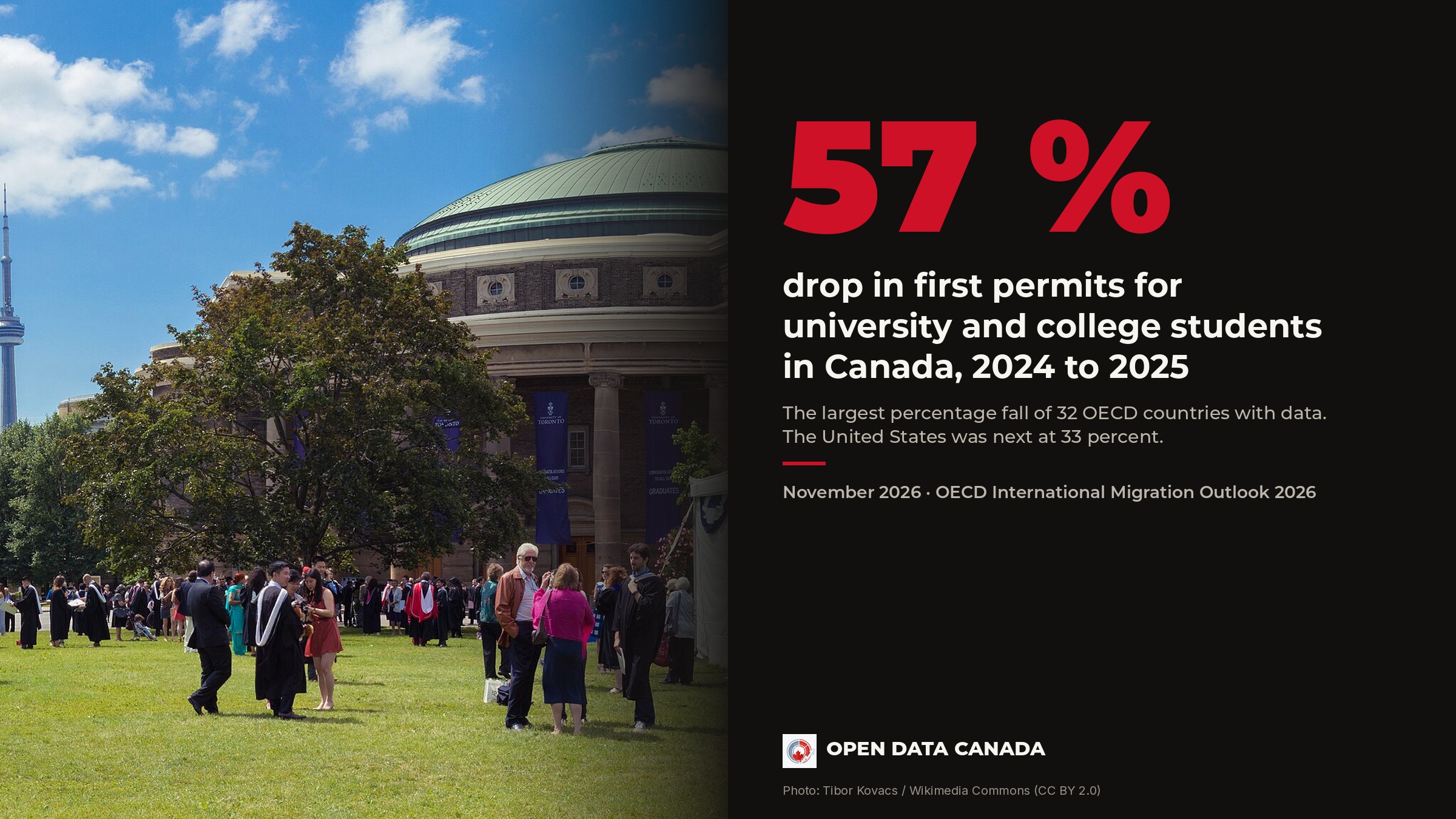
First permits for university and college students fell 57 percent in 2025, from 212,600 to 90,800. Canada dropped from third to sixth among OECD destinations, behind France.
In 2023 Canada was the third-biggest destination in the developed world for new international students, behind only the United Kingdom and the United States. In 2025 it was sixth.
The Organisation for Economic Co-operation and Development (OECD) published its annual migration report this month. Its count of first-time permits for university and college students shows Canada issuing 90,800 in 2025, down from 212,600 in 2024 and 350,900 in 2023. That 57 percent one-year drop is the steepest percentage fall of the 32 member countries with data. The United States came next, down 33 percent, though its loss was larger in number.
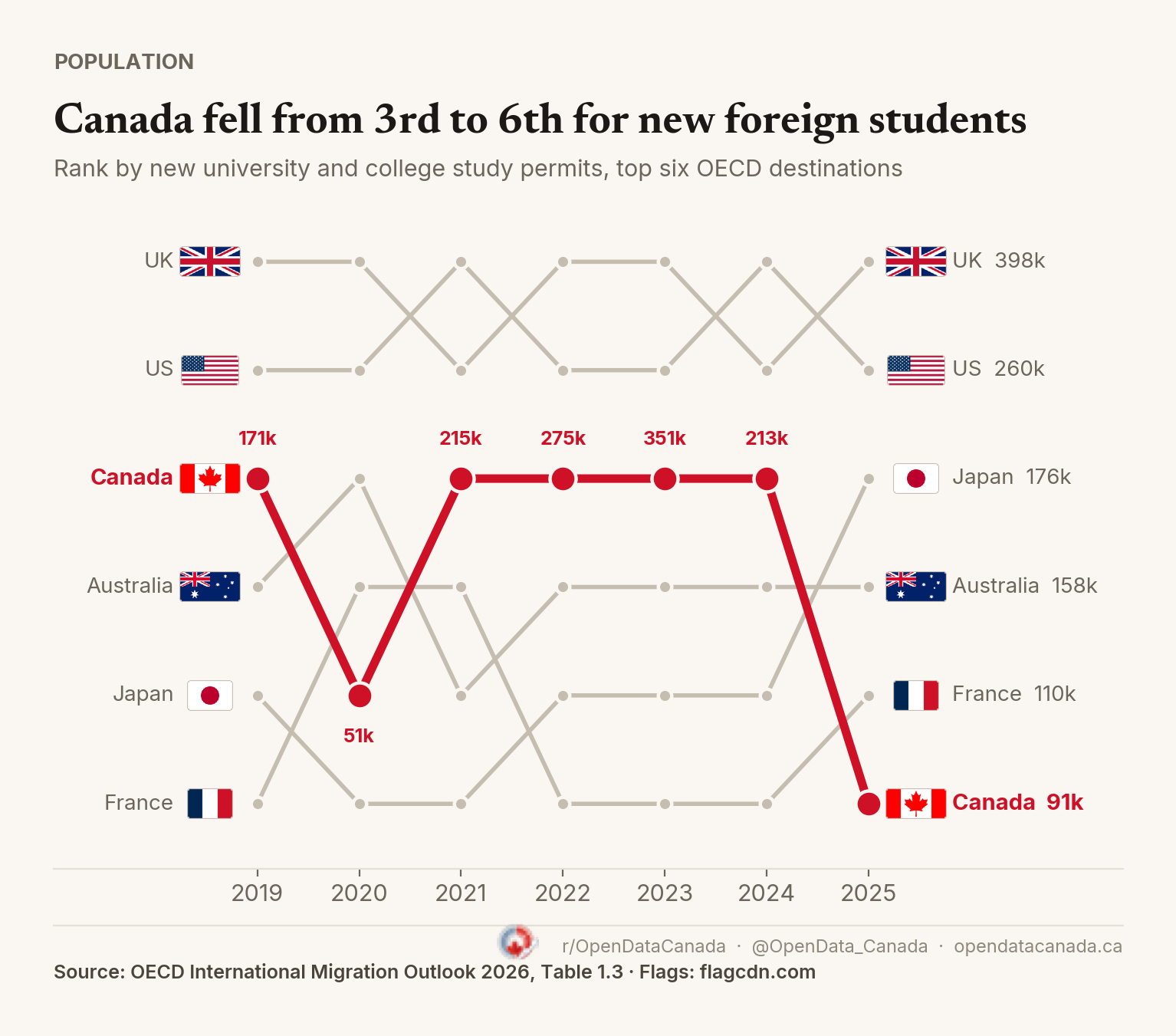
Canada now takes in fewer new students than Japan, Australia or France. Leaving aside the pandemic year of 2020, the 2025 figure is back near 2015's 84,100.
The rest of the OECD did not absorb the decline
One question is whether the students simply took their tuition to Europe instead. Europe did grow. OECD countries in the European Union and the European Free Trade Association took in 465,600 new students in 2025, up from 430,900. Italy rose 76 percent and Germany 45 percent.
But that gain covers less than a third of what Canada alone lost, which was 121,800. Add the American drop of 130,100 and the two North American countries shed about 252,000 new students in a single year. Every other OECD country combined gained about 40,000. The OECD total fell 11 percent, to 1.64 million.
The increase elsewhere in the OECD was nowhere near enough to offset the decline in Canada and the United States. The OECD figures do not show where those prospective students went instead. Some may have chosen countries outside the OECD, while others may have stayed home.
Canada's own numbers fell even further
The OECD count covers university and college students only. Figures from Immigration, Refugees and Citizenship Canada (IRCC) cover students at all levels, including primary and high school, and show an even steeper decline. It recorded 292,850 new student arrivals in 2024 and 114,920 in 2025, a drop of 61 percent.
The number of people holding study permits has shrunk with it, from 1,023,450 in January 2024 to 602,115 at the end of August 2026.
The drop came after a run of policy changes. Ottawa announced its first cap on study permits in January 2024 and tightened it for 2025. The current immigration levels plan, released on 5 November, sets a target of 150,000 new student arrivals for 2027. It pencils in the same for 2028 and 2029, but those two years are provisional and can be adjusted in later plans.
Arrivals are running far below Ottawa's own targets
The levels plan tabled in October 2024 set the 2025 target for new student arrivals at 305,900. IRCC counted 114,920, about 38 percent of the target. The 2026 target was cut to 155,000. Through August, IRCC counted 65,240.
Neither the OECD nor IRCC figures say why the gap is so large: fewer applications, more refusals, and the provincial allocation system that rations permits are all possible. What the numbers do show is the result: Canada is no longer a top-three destination, and gains elsewhere in the OECD made up only a small part of what Canada and the United States lost.
Earlier: the colleges took most of the hit · Canada's immigration slowdown, stream by stream