Population · Explainer · 6 min read
How many work permits did Canada issue in 2026?
From January to August 2026, 728,960 work permits took effect in Canada, the most for those months in IRCC data going back to 2015. The count includes renewals and extensions, so it isn't a count of new workers. Statistics Canada's count of people holding a work permit fell from January 1 to July 1.
Key facts
- 728,960 work permits took effect from January to August 2026, up 39% from 524,100 in the same months of 2025. The count includes renewals and extensions.
- Recent international graduates got 277,245 of them. That's 38% of all permits and 83% of the increase.
- 100,395 permits have no program listed. Their spike in March and April lines up with Ukrainians extending emergency work permits before a March 31 deadline, though IRCC doesn't label them.
- Statistics Canada counted 30,495 fewer temporary residents holding a work permit on July 1, 2026 than on January 1.
- The surge eased sharply by summer. August's 57,905 permits were below August 2025.
How many work permits did Canada issue in 2026?
From January to August 2026, 728,960 work permits took effect in Canada, according to Immigration, Refugees and Citizenship Canada (IRCC). That's 204,860 more than in the same months of 2025, a 39% increase, and the highest January-to-August total in data going back to 2015.
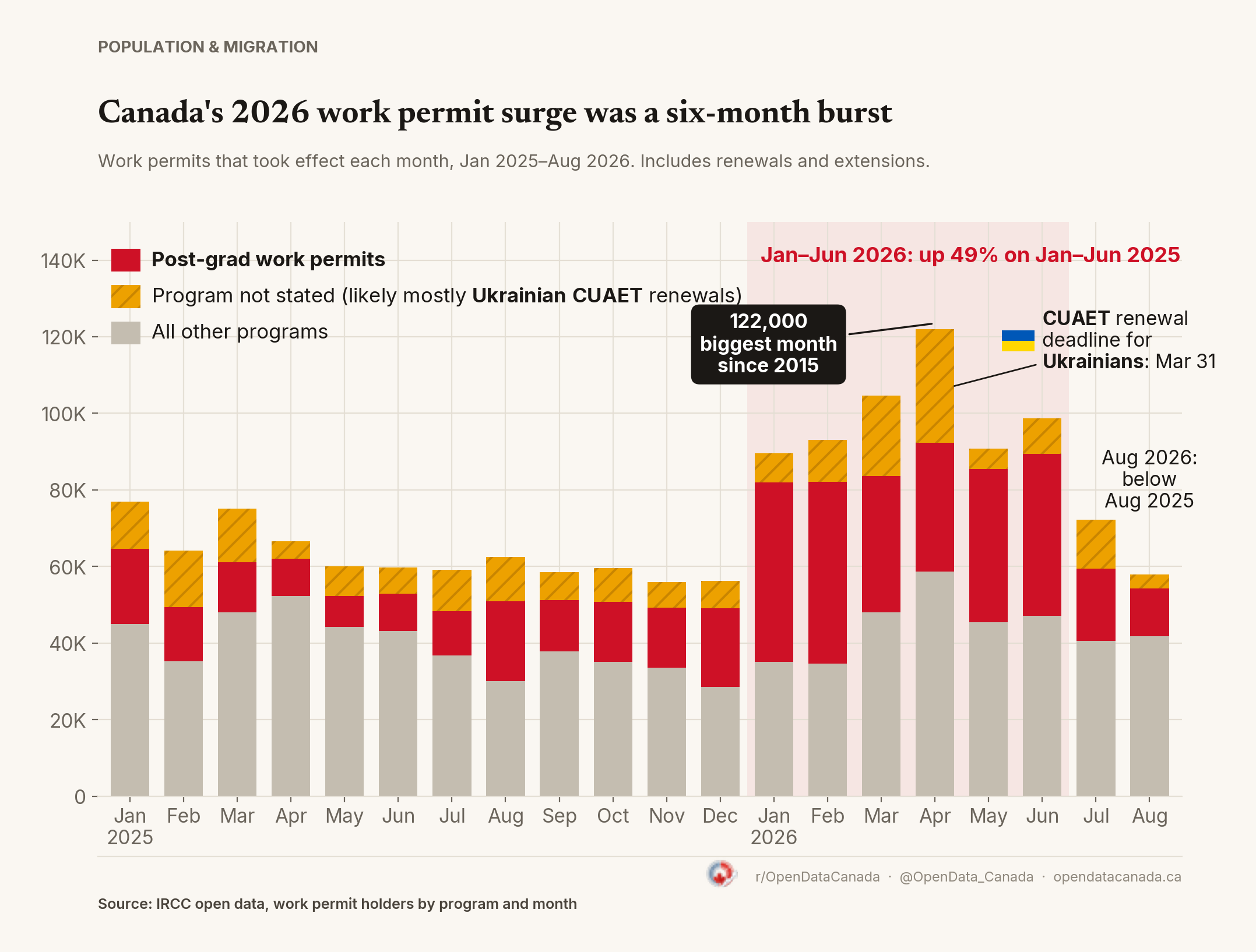
April alone had 122,000, the biggest month in the data. From January to June, permits ran 49% above the same months a year earlier.
Two federal programs hand out work permits. The Temporary Foreign Worker Program is for jobs where an employer has to show no Canadian could fill the position. The International Mobility Program covers everyone else, including recent graduates, spouses of workers and students, young people on working holidays and people moving under trade agreements.
The 728,960 counts permits, not people. IRCC adds up the permits that take effect each month, so someone who got two permits in different months shows up twice. IRCC's own totals for the year so far, which count each person once, add up to 722,680. This article uses the monthly counts because they allow the same January-to-August comparison for every year.
Does that mean more temporary workers live in Canada?
No. Statistics Canada counts people instead of permits, and its number went down. On January 1, 2026, 1,747,513 temporary residents held a work permit. Its preliminary estimate for July 1 is 1,717,018.
Both figures can be right because a new permit doesn't always mean a new person. IRCC's count includes renewals, extensions and people switching from one kind of permit to another. In a March 2026 briefing for the House of Commons immigration committee, IRCC described its own post-graduation count as "new and extensions." An international student who goes from a study permit to a work permit adds a permit and no new resident. Over the same months, other permits expired, people left and some became permanent residents. Those exits outnumbered the new permit holders.
Statistics Canada publishes its estimate every three months, so its latest comparison runs from January 1 to July 1, a month short of the IRCC count.
Who got the permits?
Recent graduates got the most. Post-graduation work permits let international students stay and work after finishing a Canadian program. They made up 277,245 of the 728,960 permits, or 38%.
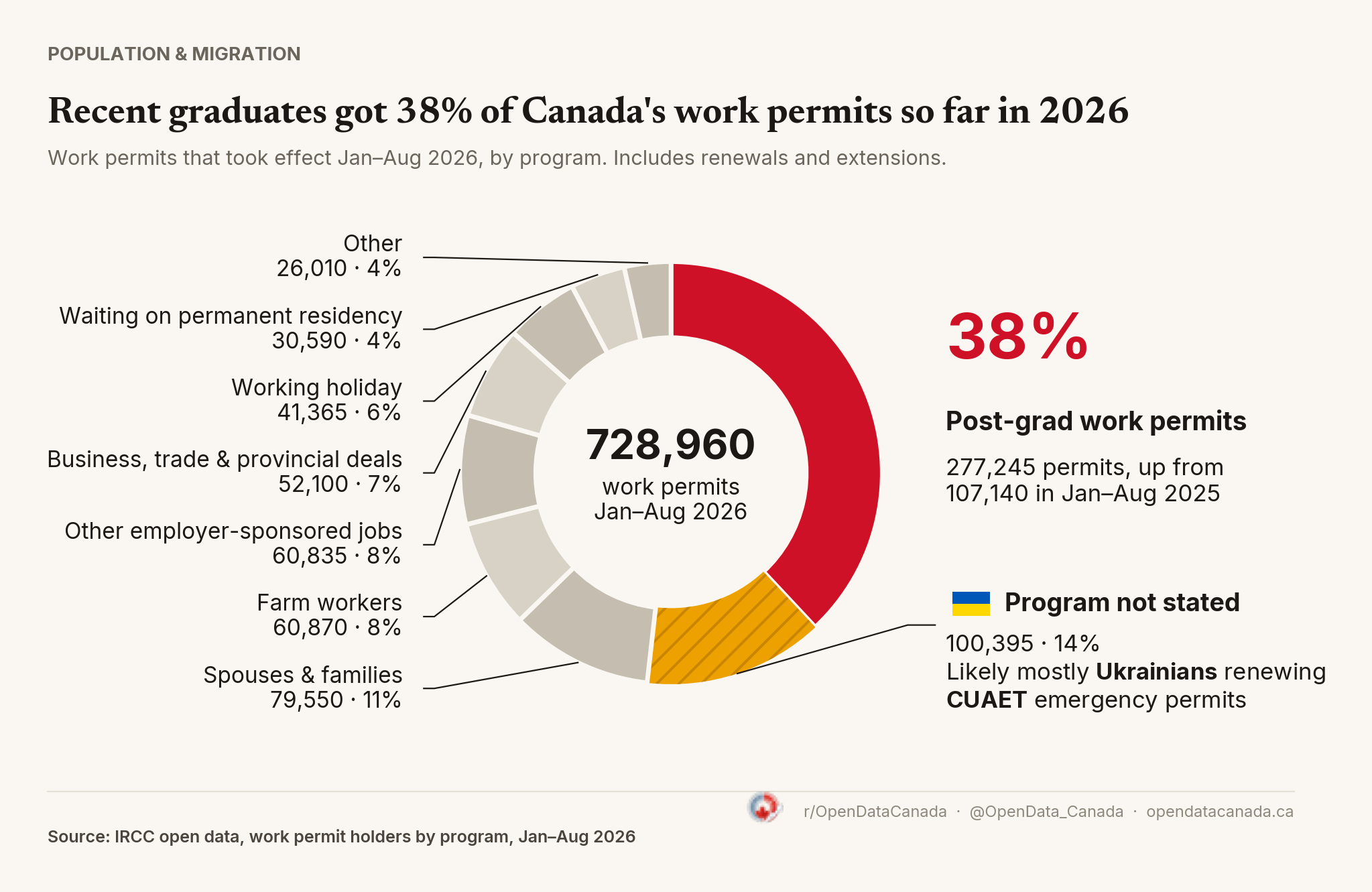
Next came 100,395 permits, or 14%, with no program recorded. Spouses and family members of workers, students and permanent residence applicants got 79,550. Farm workers got 60,870 and other employer-sponsored workers 60,835. Another 30,590 went to people already in Canada who have applied for permanent residence and needed a permit to keep working while they wait.
Why did post-graduation permits jump?
Post-graduation permits went from 107,140 in January to August 2025 to 277,245 in the same months of 2026. That's more than in any full year in the data. The old record was 241,570, for all of 2023. These permits account for 170,105, or 83%, of the 204,860 increase.
The jump hit every large province at the same time. Comparing January to June of each year, Ontario went from 44,115 to 143,245, British Columbia from 13,535 to 39,395, Quebec from 5,905 to 20,470 and Alberta from 3,950 to 19,045. Each roughly tripled or more. Faster processing at IRCC is one possible explanation for a jump that lands everywhere at once. IRCC hasn't given one.
The jump also went against IRCC's own forecast. Its March 2026 committee briefing said "the projected number of PGWPs issued is anticipated to decrease," pointing to fewer study permit holders and the tighter eligibility rules brought in during 2024. The number of international students who could later apply has been shrinking since Ottawa capped study permits.
It didn't last. Post-graduation permits ran between 33,660 and 47,520 a month from January to June, then fell to 18,985 in July and 12,435 in August, back within the range of 2025.
What are the permits with no program listed?
IRCC lists 100,395 of this year's permits under "program not stated." The count jumped to 20,870 in March and 29,730 in April.
Permits to Ukrainians jumped in the same two months. IRCC's breakdown by citizenship shows 18,790 International Mobility Program permits went to Ukrainian citizens in March 2026 and 26,600 in April, compared with 6,880 and 1,805 a year earlier. Since 2022, the two monthly counts have risen and fallen together.
The timing matches a deadline. The Canada-Ukraine Authorization for Emergency Travel (CUAET) opened on March 17, 2022, after Russia's full-scale invasion of Ukraine. It let Ukrainians and their families stay in Canada for up to three years, and IRCC encouraged them to apply for a three-year open work permit at the same time. CUAET ended on July 15, 2023, and people had to arrive by March 31, 2024. About 300,000 people came under it, according to IRCC.
Work permits issued in spring 2022 started running out in spring 2025. Holders could extend once, for up to three years, under a temporary policy whose own text says it "expires on March 31, 2026." On March 31, IRCC announced that CUAET permit holders "now have until March 31, 2027, to apply to extend their work permit for up to three years."
IRCC confirms the deadline and the extension rules. It doesn't say which program the "not stated" permits belong to, so the Ukrainian explanation is an inference from timing and citizenship data. If it holds, these were people already living in Canada, since Ukrainians had to have arrived by March 31, 2024, or by the end of 2024 in some cases, to qualify. A similar spike happened in March 2024, the month of the arrival cutoff, when 37,240 International Mobility Program permits went to Ukrainians.
Did other work permits grow?
A little. Leave out post-graduation and "not stated" permits, and everything else, from spouses to farm workers to working holidays, rose 5%, from 334,660 to 351,320. Temporary Foreign Worker Program permits fell 5%, from 128,485 to 121,705. In May, every major immigration stream was falling, and the 2026 permit record doesn't change that.
Is the surge over?
It has eased sharply. July's 72,290 permits were still 22% above July 2025, mostly because of post-graduation and "not stated" permits. August's 57,905 were below August 2025's 62,540.
About nine-tenths of the increase in permits came from post-graduation permits and the unlabelled spike around the Ukrainian deadline. Over roughly the same months, Statistics Canada counted 30,495 fewer people holding a work permit. Anyone citing 728,960 as the number of new workers in Canada is citing the wrong number.