Article · Population · 6 min read
89% of Ukrainians who came under CUAET are still in Canada — and 61% of newcomers overall aren't planning to go back
Two 2025 surveys of Ukrainians in Canada point the same way, most aren't leaving. The one dedicated path to permanent residence closed in 2024. Temporary status keeps getting extended, but four years after the program launched as a temporary "safe haven," no broad path to stay permanently has replaced it.
Canada's Ukraine travel program was built as a stopgap: a place to wait out the war, not a new home. Four years on, two separate 2025 surveys of Ukrainians living here point the same way: most say they aren't leaving. In one of them, a CUIAS Immigrant Services survey, 89% of CUAET respondents said they were still living in Canada in 2025. That's a survey finding, not an official count, and it matters, because as the section below shows, Canada's own agencies don't agree on how many of the 298,128 people who came under the program are actually still here.
A program built around going home
The Canada-Ukraine Authorization for Emergency Travel, or CUAET, was never a refugee designation. From the Ukrainian Canadian Congress's own brief to the House of Commons Immigration Committee:
"Ukrainians arriving under the CUAET program were not considered to be UN Convention Refugees. As a result, they have not been eligible for the longer-term government supports afforded Convention refugees in Canada."
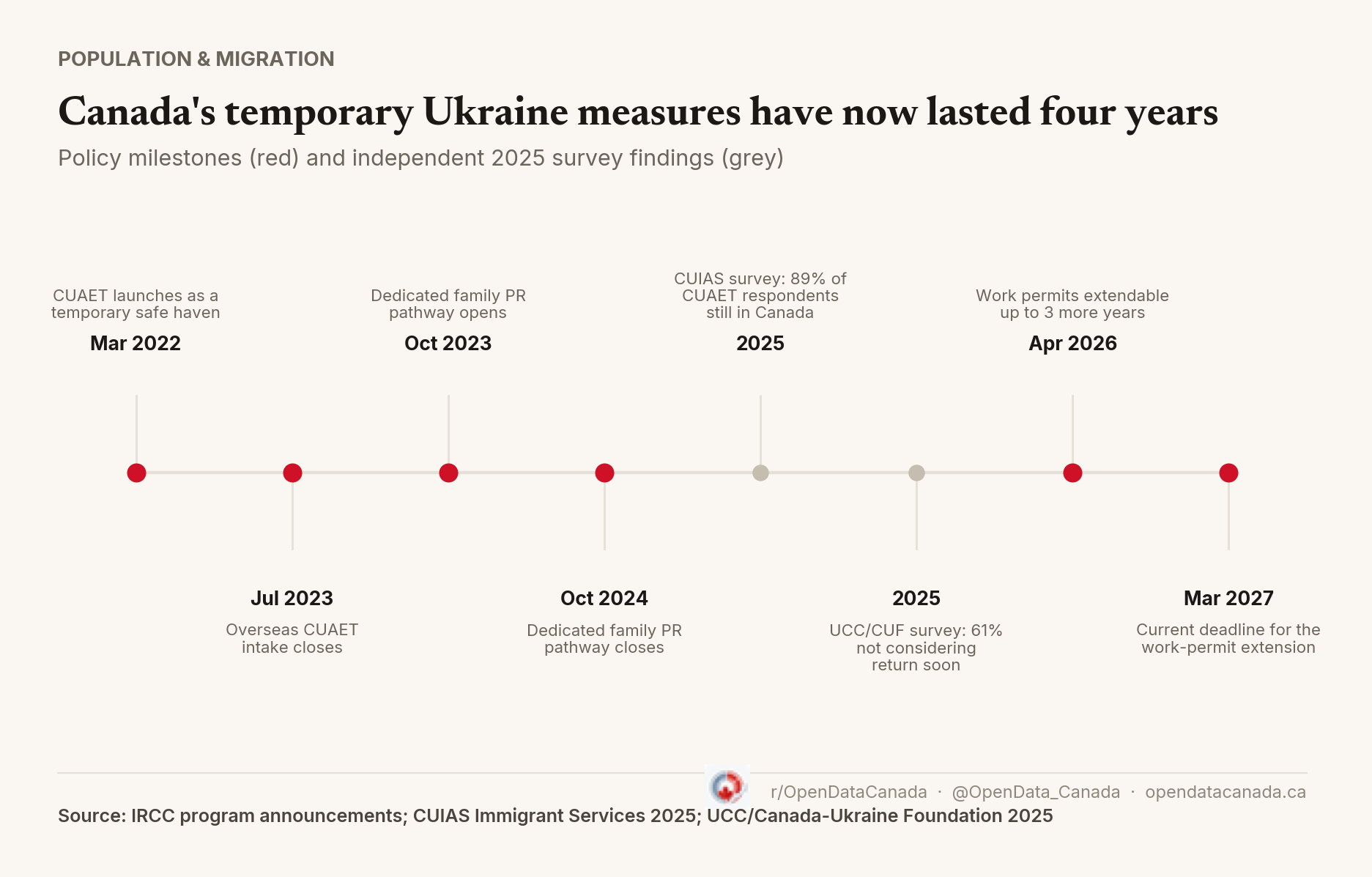
It's a temporary resident visa and work-permit stream. IRCC's language at launch in March 2022 described a "temporary safe haven" for people who would "eventually return home to contribute to Ukraine's recovery and reconstruction." CUAET's visa intake closed July 15, 2023. People already in Canada kept their status through separate, later extensions.
What two surveys found in 2025
Neither survey is a random, weighted sample, and both organizations say so themselves. Treat the numbers below as two different self-selected groups pointing in the same direction, not a precise population count.
CUIAS Immigrant Services surveyed more than 3,000 people who arrived under CUAET specifically, in April and May 2025.
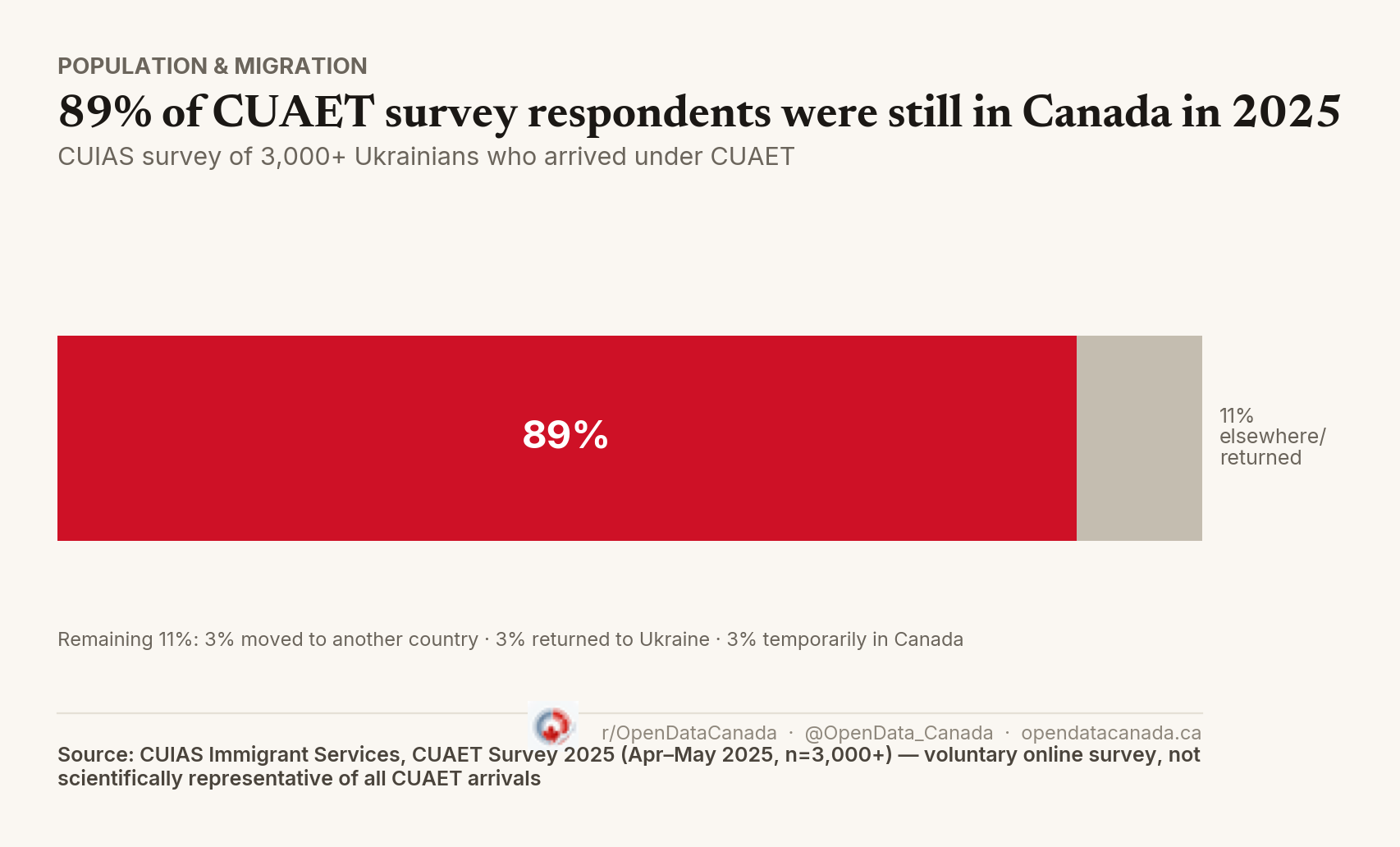
89% were still living in Canada. 3% had returned to Ukraine, 3% had moved to a third country, 3% were in Canada only temporarily. Among reasons given for staying, 70% cited planning to apply for permanent residence and 61% cited safety and stability.
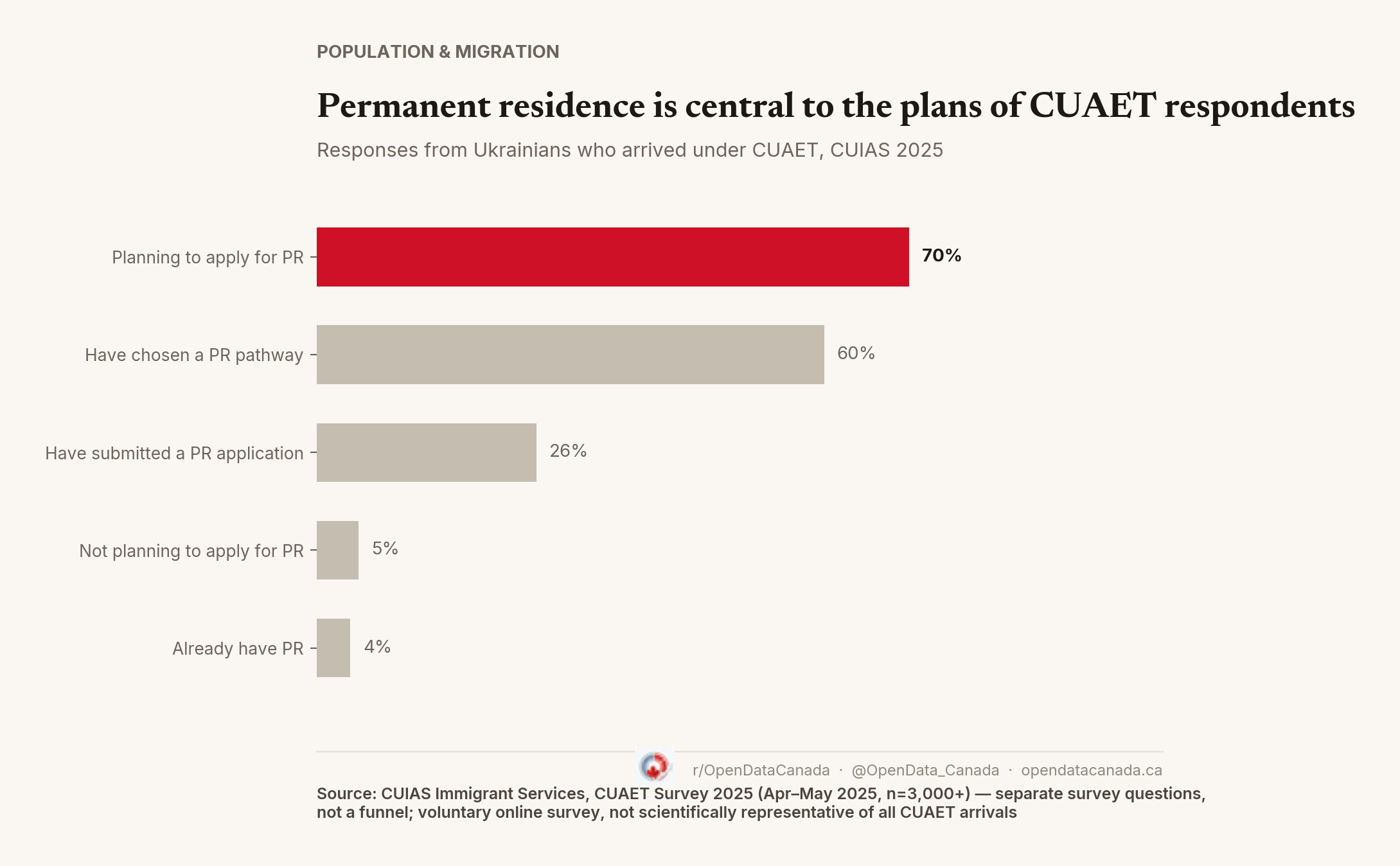
On PR status specifically: 60% had chosen a pathway, 26% had already submitted an application, and 4% already had PR. Only 5% said they weren't planning to apply at all. The small group who left cited housing affordability (40%) and lack of employment (38%) most often.
UCC and the Canada-Ukraine Foundation ran a separate, larger survey of 4,211 Ukrainian newcomers, fielded May 20 to July 1, 2025.
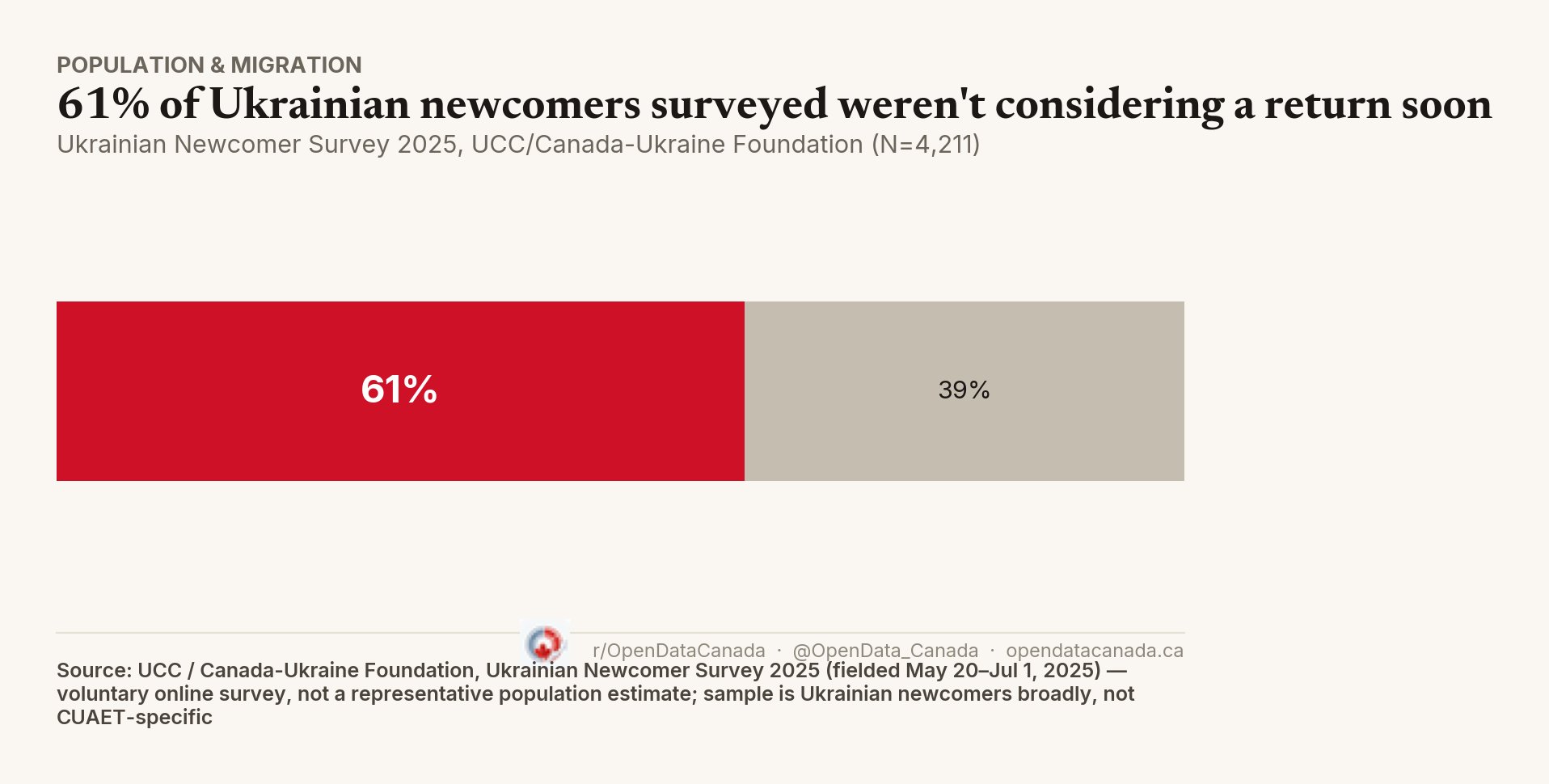
This survey is not CUAET-specific: it defines its sample as anyone who arrived from Ukraine in the past ten years, a broader group than CUAET alone. Its headline number: 61% weren't considering a return to Ukraine in the near term. Among respondents 56 and older, that dropped closer to 20%, with family ties cited as the main reason to consider going back.
In practice, that ten-year pool is mostly CUAET arrivals anyway. IRCC's own data shows Canada admitted roughly 2,000 to 3,300 Ukrainian permanent residents a year before the war, about 20,000 total across 2015 to 2021. CUAET alone brought in 298,128 people in a little over two years. So while the 61% figure isn't formally limited to CUAET arrivals, most of the people it describes likely came in under the program. A CUAET-specific sample says most people are staying and actively pursuing PR. A broader newcomer sample, made up mostly of the same population, says most aren't planning to go back either. Same direction, from two different survey designs.
The PR pathway that closed
CUAET holders' only routes to permanent residence are the general ones available to any newcomer, and per IRCC data reported in UCC's brief, as of May 31, 2025, each is narrow.
The family reunification pathway opened in October 2023 and closed October 22, 2024: 25,500 applications received, 1,540 approved, a 6.0% approval rate. Humanitarian and compassionate grounds: 16,495 received, 2,050 approved, 12.4%, and slow. Across all PR applications from CUAET holders combined, about 31,845 were submitted and 12,055 processed. IRCC hasn't published how many were approved.
Express Entry, the standard economic route, has no application or approval count published for this group at all. CUAET holders can face real barriers meeting its language bar (levels 5 to 7 across all four skills) or its typical age cutoffs, and some lost documents fleeing the war, though the data doesn't show what share are actually blocked by any single factor.
UCC is lobbying for a dedicated pathway modeled on Canada's Hong Kong program, with a lower language requirement (level 4 instead of level 5). These are UCC's own estimates, not government figures, and they're inconsistent: the organization has put the number of CUAET holders who want PR at about 60,000 in its formal brief to Parliament, and about 100,000 in a February 2026 interview with the Canadian Press. That gap hasn't been explained.
Nobody agrees on how many people are still here
That 89% figure is one survey's finding, not a population count, and here's why the distinction matters: Canada does not have a reliable administrative count of how many CUAET arrivals are actually still in the country. IRCC's own cumulative count is 298,128 arrivals, from March 2022 to April 2024, but that measures people let in, not people currently present. UCC's brief to Parliament says "best estimates are that less than one half of the arrivals remain in Canada," a floor near 149,000, though UCC's CEO has continued to cite roughly 300,000 in the same period. UNHCR's tracked count of Ukrainian "persons of concern" in Canada is 172,945 for 2025, using yet another method; that category covers people registered under Canada's temporary protection measures for Ukrainians, not a verified count of who is still physically in the country.
None of those three numbers was designed to answer the same question, and a federal expert panel has said Ottawa doesn't have good visibility into who has actually left the country versus who has simply let a permit lapse. That's a government-wide data gap, not one specific to Ukrainians, but it means the 89%-still-here survey finding and UCC's "less than half" floor can both be someone's honest read of a genuinely uncertain picture. Neither is a headcount.
What people are running into
UCC's newcomer survey found the top settlement challenges were access to employment services, then housing support. Nearly half of respondents cited language barriers, more so among people 56 and older. CUIAS found the small share of people who left Canada cited housing costs and lack of work most often. Neither survey has much data on credential recognition or mental health, a gap worth flagging rather than filling in with numbers that don't exist.