Government · Follow-up
Canada's Foreign Aid by Country: Ukraine Got 14 Times More Than Anyone Else, Almost All of It as Loans
Canada sent aid to 135 countries in 2024, but Ukraine took 1.83 billion US dollars, more than the next 34 recipients combined. Strip out loans and Ukraine drops to sixth, behind Haiti, Ethiopia, Mali, the West Bank and Gaza, and Bangladesh. Less than half of all Canadian aid can be traced to a single country at all.
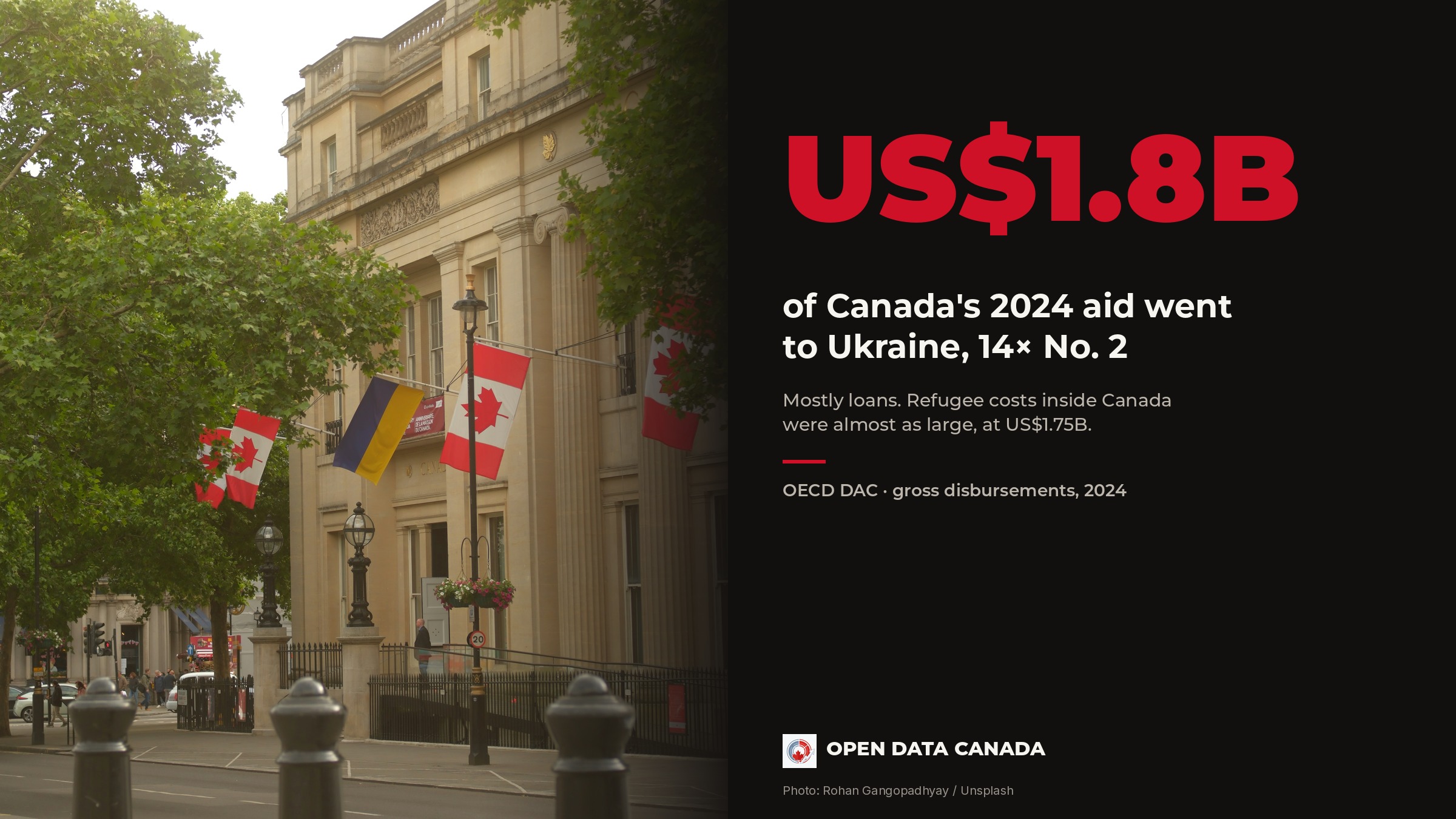
If you want to know which countries get Canada's foreign aid, the answer starts with one name and then falls off a cliff. In 2024, the latest year with a full country breakdown from the Organisation for Economic Co-operation and Development (OECD), Canada disbursed 1.83 billion US dollars of official development assistance (ODA) to Ukraine. The second-largest recipient, South Africa, got 130 million. Every figure in this piece is a gross disbursement in current US dollars unless marked as inflation-adjusted, the way the OECD's Development Assistance Committee (DAC) reports it, with Canadian-dollar equivalents at the Bank of Canada's 2024 average rate of 1.3698.
That is a different basis from our earlier look at how much Canada spends on foreign aid, which used preliminary 2025 net totals. The two do not clash: 2025 recipient detail won't be published until December 2026, so 2024 is as close as a by-country list can get.
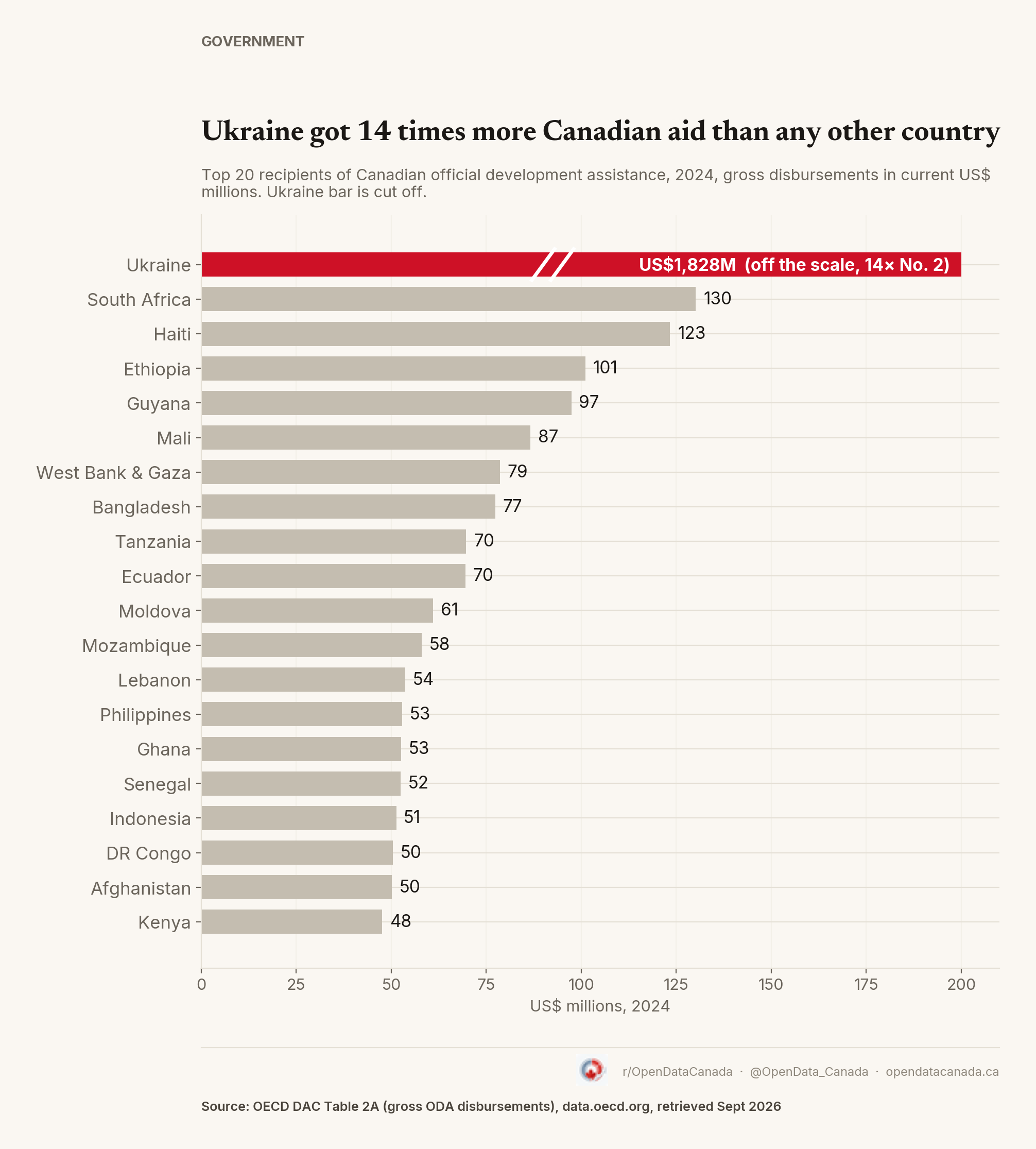
Which countries get the most Canadian foreign aid?
After Ukraine, the list reads like a conventional aid budget: Haiti, Ethiopia, Mali, the West Bank and Gaza, Bangladesh, Tanzania, Mozambique. Most are fragile or low-income states, the majority of them in Africa. Haiti has been in Canada's top 15 recipients every year since 2014.
Scattered through that list are a few names that look out of place. South Africa, Guyana, Ecuador and Moldova are not countries most Canadians would think of as major aid partners, and in 2019 Canada gave each of them less than 7 million US dollars, measured in 2024 dollars. Now all four sit in the top 11. The reason is in the next column of the table.
How much of it is loans?
For a handful of countries, nearly all of it. Of Ukraine's 1.83 billion, 1.75 billion (96 percent) was disbursed as loans, not grants. South Africa's 130 million was 91 percent loans, Guyana's 90 percent, Ecuador's 85 percent and Moldova's 97 percent. In total, 2.32 billion of Canada's 8.48 billion in gross aid went out as loans in 2024, about 27 percent, and ten countries account for almost all of it.
Loans count as aid under OECD rules if they are concessional, and the gross figures here count them at full face value. They are still real money leaving Canada. But a dollar lent is not the same commitment as a dollar given, and it changes the ranking completely.
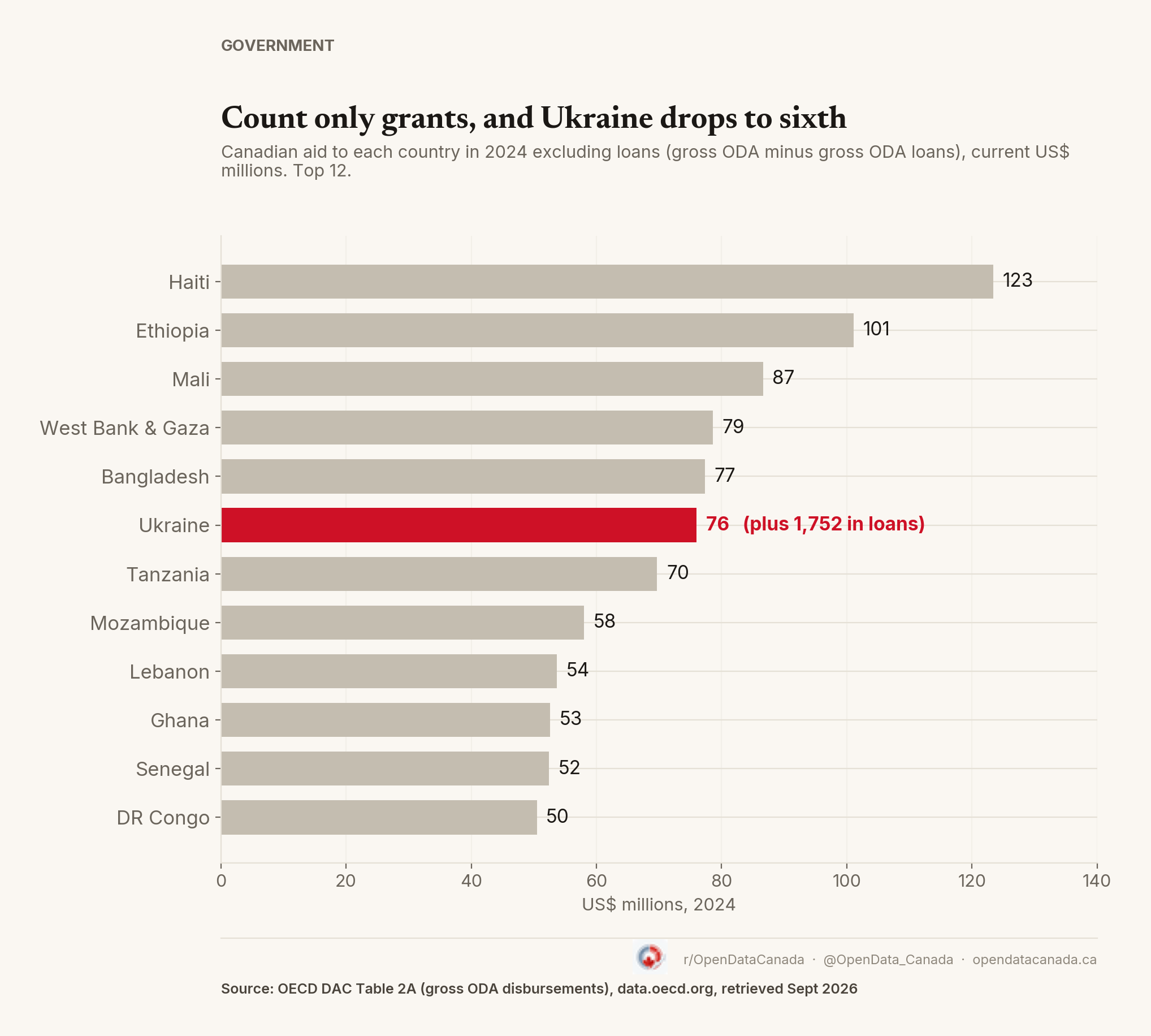
Count only grants, and Ukraine received 76 million US dollars in 2024, sixth on the list. Haiti, at 123 million, is Canada's biggest grant recipient. South Africa falls out of the top 30.
Where does the rest of Canada's aid go?
Here's the part the country rankings hide. All 135 named countries together received 4.03 billion US dollars, 47.5 percent of the total. The other 52.5 percent never gets attached to a country in the OECD tables.
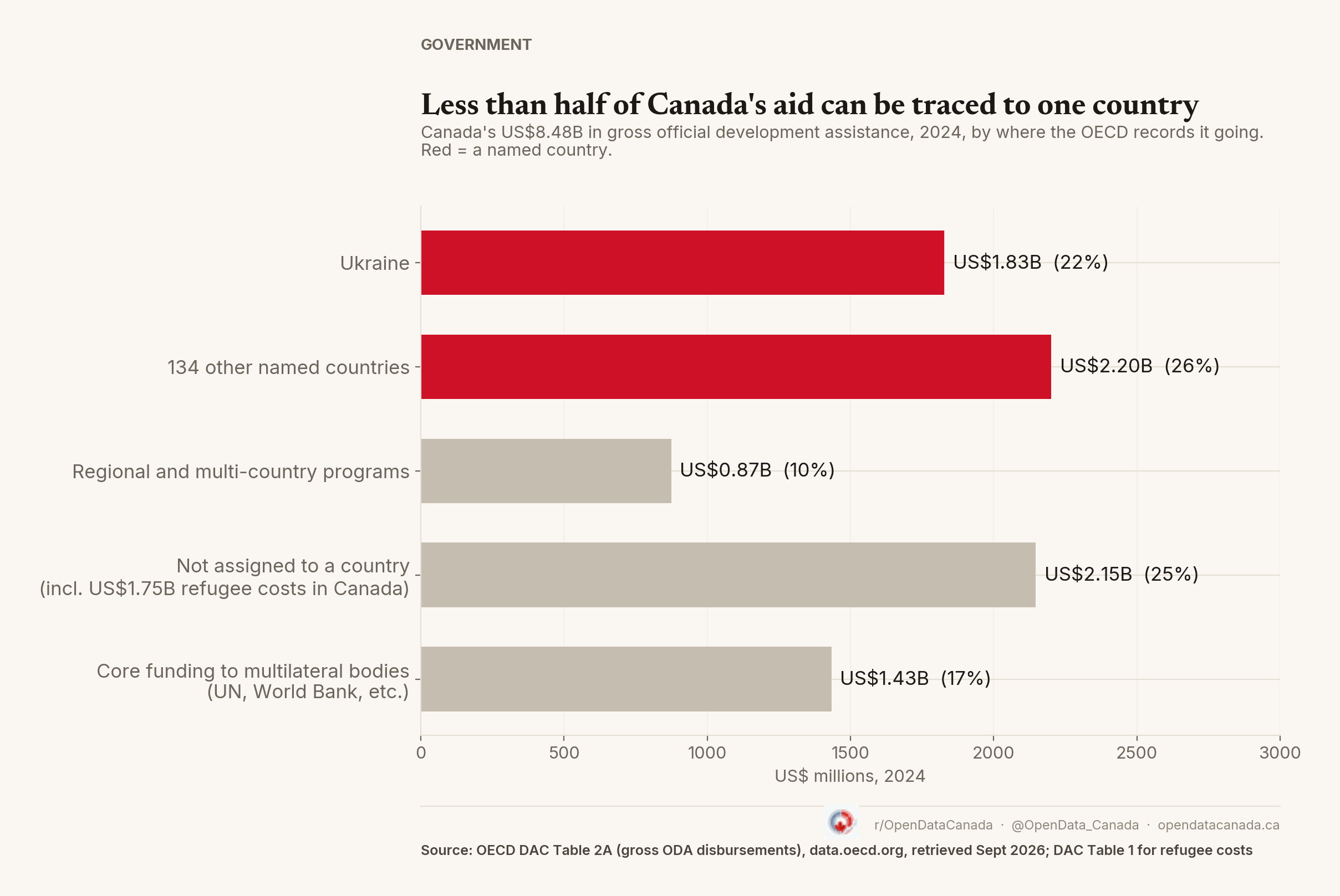
It falls into three buckets:
- Not assigned to any country: 2.15 billion (25 percent). The OECD files this under "developing countries, unspecified." For Canada, it is dominated by the cost of supporting asylum seekers and refugees in their first year in Canada, which donors are allowed to report as aid. That line alone was 1.75 billion US dollars in 2024. Administrative costs of running the aid program (326 million) sit here too.
- Core funding to multilateral bodies: 1.43 billion (17 percent). Money paid into the World Bank's International Development Association, United Nations agencies, regional development banks and other funds. It is spent in developing countries eventually, but the OECD does not trace Canada's share back to any one of them.
- Regional and multi-country programs: 0.87 billion (10 percent). Projects booked to "Sub-Saharan Africa" or "South America" rather than a single country.
So when someone asks how much foreign aid Canada gives a particular country, the honest answer is that the country total captures less than half the program. Spending on refugees inside Canada is almost as large as everything Canada disbursed to Ukraine.
Did Ukraine's aid come out of other countries' share?
The obvious suspicion is that Ukraine was funded by cutting everyone else. Adjusted for inflation, the data doesn't show that in the aggregate. Measured in constant 2024 US dollars, Canada's total gross aid rose from 5.64 billion in 2019 to 8.48 billion in 2024, an increase of about 50 percent. All of that growth, and then some, went to two places: Ukraine (up from 56 million to 1.83 billion) and the unassigned bucket that holds refugee costs in Canada (up from 764 million to 2.15 billion).
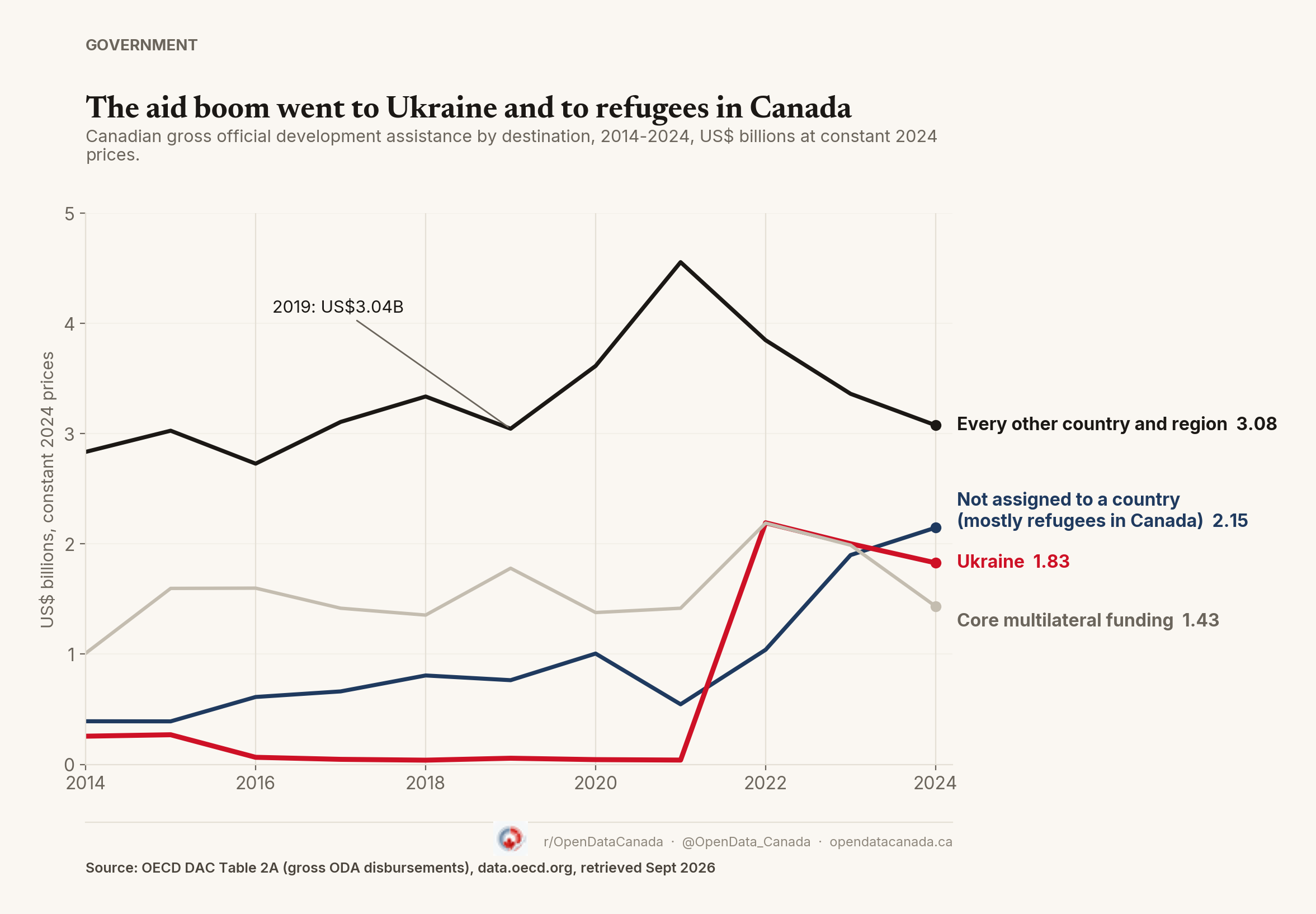
Aid to every other country and region combined was 3.04 billion in 2019 and 3.08 billion in 2024. It spiked to 4.55 billion in 2021 and has fallen every year since. The rest of the world didn't lose ground to Ukraine relative to 2019. It lost the 2021 peak, and got none of the growth.
Inside that flat total, the mix shifted. Aid to Asia, including the Middle East, fell from 1.13 billion in 2019 to 864 million. Afghanistan, Canada's top recipient every year from 2018 to 2021, went from 139 million to 50 million, and Syria from 112 million to 36 million. Sub-Saharan Africa edged up from 952 million to 1.09 billion, and the Americas from 561 million to 676 million, helped by the new loans to Guyana and Ecuador. Core multilateral funding, meanwhile, fell from 1.78 billion to 1.43 billion.
The full list: Canada's top 30 aid recipients, 2024
Gross disbursements of official development assistance, current prices. Canadian-dollar figures use the Bank of Canada 2024 annual average of 1.3698 Canadian dollars per US dollar. The full list of 135 countries is in the data file (CSV).
| Rank | Country | US$ millions | C$ millions | Of which loans (US$ M) |
|---|---|---|---|---|
| 1 | Ukraine | 1,827.8 | 2,504 | 1,751.8 |
| 2 | South Africa | 130.2 | 178 | 118.2 |
| 3 | Haiti | 123.4 | 169 | – |
| 4 | Ethiopia | 101.1 | 138 | – |
| 5 | Guyana | 97.4 | 133 | 87.5 |
| 6 | Mali | 86.6 | 119 | – |
| 7 | West Bank and Gaza | 78.6 | 108 | – |
| 8 | Bangladesh | 77.4 | 106 | – |
| 9 | Tanzania | 69.7 | 96 | – |
| 10 | Ecuador | 69.5 | 95 | 59.1 |
| 11 | Moldova | 61.0 | 84 | 59.1 |
| 12 | Mozambique | 58.0 | 80 | – |
| 13 | Lebanon | 53.7 | 74 | – |
| 14 | Philippines | 52.8 | 72 | 30.7 |
| 15 | Ghana | 52.6 | 72 | – |
| 16 | Senegal | 52.4 | 72 | – |
| 17 | Indonesia | 51.3 | 70 | 30.7 |
| 18 | DR Congo | 50.5 | 69 | – |
| 19 | Afghanistan | 50.2 | 69 | – |
| 20 | Kenya | 47.6 | 65 | – |
| 21 | Jordan | 44.8 | 61 | – |
| 22 | South Sudan | 39.5 | 54 | – |
| 23 | Burkina Faso | 37.2 | 51 | – |
| 24 | Syria | 36.1 | 50 | – |
| 25 | India | 34.0 | 46 | 30.7 |
| 26 | Sudan | 33.0 | 45 | – |
| 27 | Pakistan | 31.4 | 43 | – |
| 28 | Myanmar | 27.0 | 37 | – |
| 29 | Colombia | 26.8 | 37 | – |
| 30 | Peru | 26.6 | 36 | – |
For the Ukrainians who came to Canada instead, see our look at who stayed under the emergency visa program.
Ranked by country, Canada's aid budget looks like a list of foreign places. Ranked by where the money actually went, the second-biggest line in 2024 after Ukraine was not abroad at all. It was Canada's own refugee system.