Education · 5 min
Students at Ontario's private career colleges got more OSAP grant money than university students
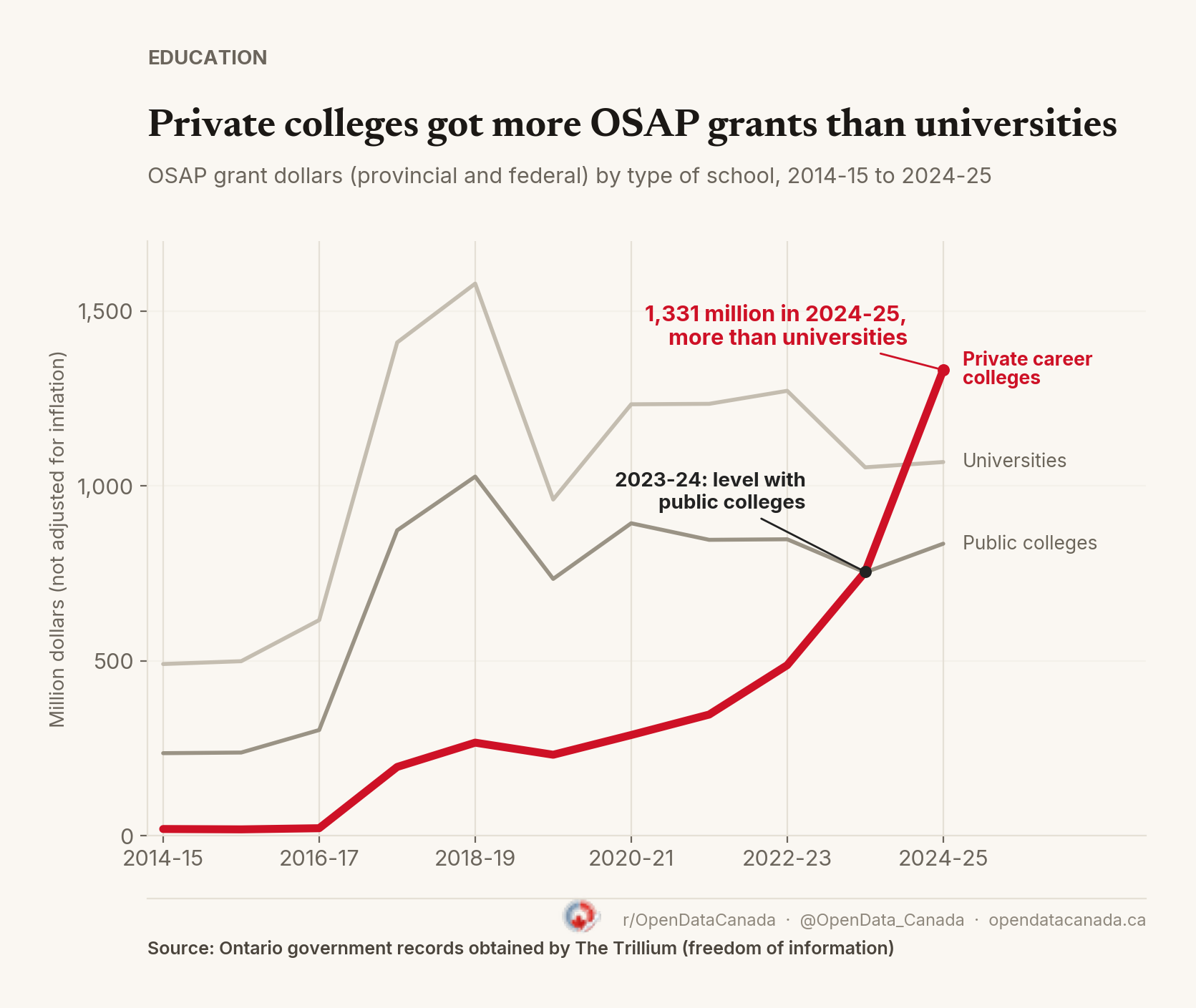
Students at private career colleges received 1,331 million dollars in OSAP grants in 2024-25, more than university students. Ontario has since moved career-college students to loans only and paused all OSAP payments associated with private postsecondary institutions during an audit.
In 2024-25, students at private career colleges received 1,331 million dollars in OSAP grants: about 994 million from Ontario and 338 million in federal grants paid through OSAP, The Canadian Press reported. University students got 1,068 million. Students at public colleges got 835 million. Ten years earlier, private career college students got 20 million, about 3 percent of all OSAP grant money.
OSAP is the Ontario Student Assistance Program. Grants are the part students don't pay back. The figures come from government records The Trillium obtained through freedom of information. The yearly series is rebuilt from the charts it published.
In February 2026 Ontario announced that career-college students would get all their provincial OSAP aid as loans, for programs starting on or after Aug. 1, 2026. Federal grants for full-time private college students also ended in August, The Trillium reported. On Oct. 6, the colleges minister, Nolan Quinn, paused all OSAP payments associated with private postsecondary institutions while the accounting firm KPMG audits the program. The government told the Auditor General and referred the matter to the Ontario Provincial Police. Quinn said early findings included colleges sharing locations with immigration services firms and "unusually high concentrations of OSAP applications submitted from the same geographic locations." The statement does not name any school, and none of the allegations has been proven in court.
Update, Nov. 15: This article now adds an estimate of how far career-college grants ran above their earlier trend, new Canadian Press figures on one college that wasn't among the six cut off in May, and the bill Quinn plans to table on Nov. 16.
How fast did it grow?
Private career colleges had 8 percent of OSAP grant dollars in 2017-18. They had 28 percent in 2023-24 and 40 percent in 2024-25, a jump of almost 12 points in one year.
The number of students getting a grant at these colleges went from 25,678 in 2021-22 to about 87,400 in 2024-25, 3.4 times as many. Over the same three years, recipients rose 3 percent at universities and 10 percent at public colleges.
How far above trend did the money run?
From 2017-18 to 2021-22, grants to private career college students grew about 15 percent a year. Had that pace held, they would have reached about 530 million dollars in 2024-25. They reached 1,331 million.
Add up the three years from 2022-23 to 2024-25 and grants ran about 1.2 billion dollars above that trend. Holding career colleges at their 2021-22 share of all OSAP grants gives about 1.4 billion instead.
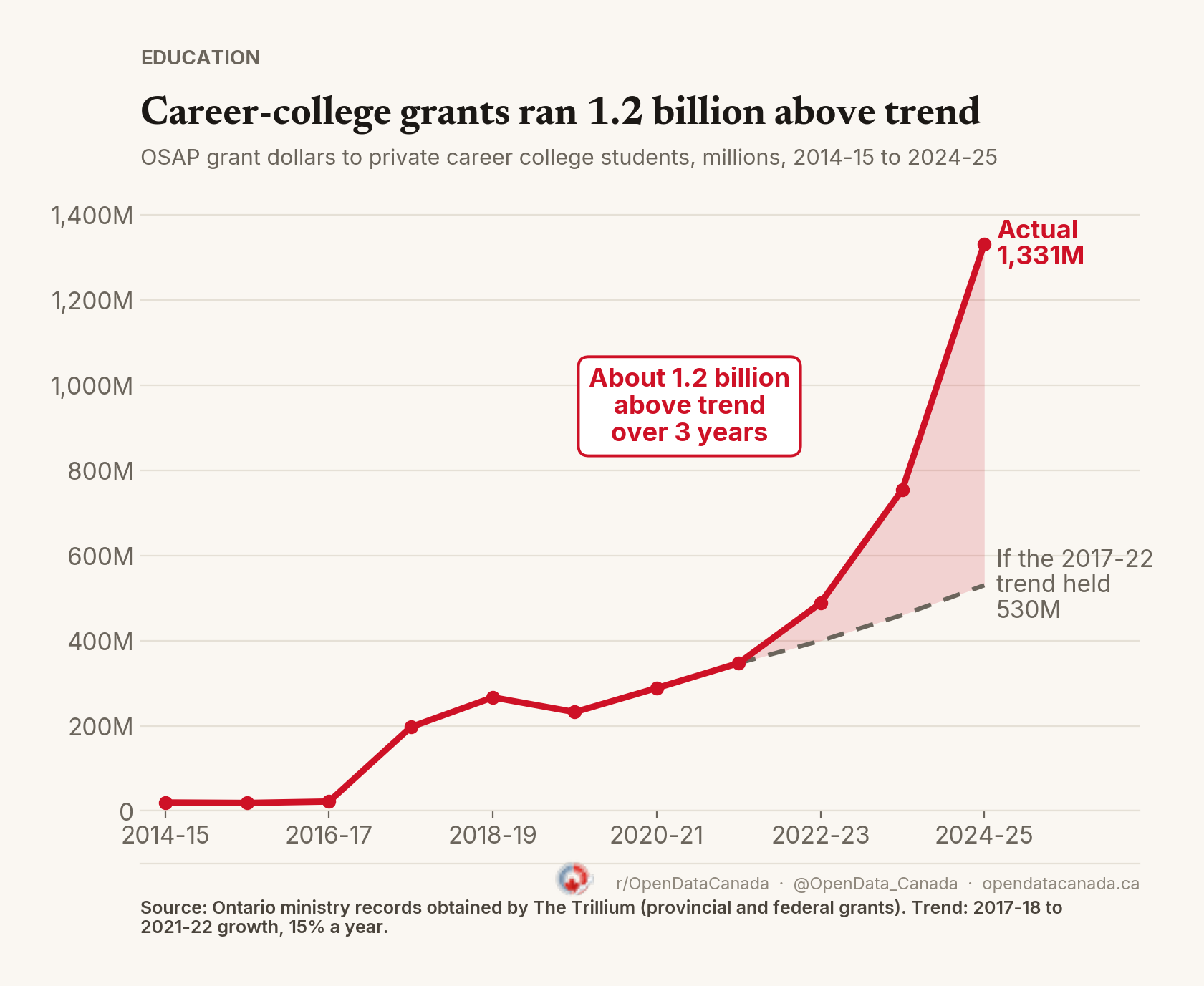
Money above trend is not the same as money misused. Rising enrolment and larger grants would also push spending above trend. But the province's audit, police referral and campus bans all followed this run-up.
Why is the average grant so much bigger?
The average private career college grant was 15,236 dollars in 2024-25. At public colleges it was 6,910 and at universities 5,665. In 2017-18, the private average was 1.85 times the university average. By 2024-25 it was 2.7 times.
OSAP grants depend on need, program length and costs, so a bigger average doesn't prove anything improper. It does explain the gap between 21 percent of students and 40 percent of dollars.
How concentrated was the money?
Ontario doesn't publish grants by school, but three sets of records point to a small group. The Trillium reported that about half of all OSAP funding for private-college students in 2024-25 went to 10 of 177 institutions. The Canadian Press reported that seven career colleges got about 385 million dollars in provincial OSAP grants that year. Career Colleges Ontario, the industry association that processes OSAP applications for career colleges, told the ministry in January 2025 that ten schools had seen applications rise 855 percent on average from 2022 to 2024. One went from 107 applications to 2,992.
The newest figures came on Nov. 13. The Canadian Press reported that the Canadian College of Business, Science and Technology, with four Greater Toronto Area campuses, went from 562 students on OSAP in 2021-22 to 17,157 in 2024-25. Its students got about 151 million dollars in provincial grants in 2024-25. More than 97 percent were in online programs, up from 6 percent. Growth at its campuses ranged from about 1,660 to 5,955 percent, against roughly 650 to 1,375 percent at the six campuses the province cut off in May (four Academy of Learning and two Citi College campuses, which deny wrongdoing). Fast growth alone is not evidence of wrongdoing, and the province has not publicly named the college in any allegation. The college didn't answer the news agency's requests for comment, and a spokesperson for the minister wouldn't say whether it was on the government's radar.
These come from different records, so they are not added together.
What does the enforcement record show?
Ontario's public enforcement file says little about OSAP. It lists restraining orders, financial penalties, compliance orders and refusals, suspensions or revocations of registration under the Ontario Career Colleges Act, 2005. From 2018 to 2025 it has 4 to 10 a year involving registered colleges. Actions against unregistered operators peaked at 20 in 2022 in that period. The file doesn't track OSAP eligibility or fraud, so it can't say how closely the money was watched.
Are private career colleges eligible for OSAP now?
Ontario's OSAP school search lists the schools whose students can use OSAP. On Oct. 7, the 2025-26 list had 304 Ontario entries, including 226 private career college campuses and 18 other private schools. The 2026-27 list had 60, all public.
That is a snapshot. The search page says Ontario's private schools "are approved annually," usually in early to mid-summer, and a school not listed is "currently not approved." On Oct. 7, no private school had been approved for 2026-27. The Oct. 6 statement says private schools will have to meet "stricter criteria before regaining OSAP eligibility." A fresh check on Nov. 15 found the same result: no private Ontario school on the 2026-27 list.
Three Academy of Learning campuses (Bay Street, North York and Brampton East) are barred from OSAP until 2029-30, the Canadian Press reported on Oct. 14. The ministry alleges in court filings that more than half of 2025-26 applications at two of them came from a single internet address. The schools deny wrongdoing and are fighting the decision in court. They say shared addresses can come from people living at the same address. The allegations are unproven.
What is still unknown?
- A restart date. Quinn said on Nov. 12 the aim is to bring OSAP back "by the new year," but gave no date. The KPMG audit has no public timeline.
- How many students are affected. No count has been published for this year. In 2024-25, more than 87,000 students at private institutions got OSAP, The Trillium reported. The 2025-26 OSAP list had 226 career-college campuses and 18 other private schools in Ontario.
- How schools get back in. The province says "stricter criteria" are coming, without details. A bill due Nov. 16 would cap OSAP-funded enrolment growth at private schools, make mainly-online programs ineligible, require a physical campus, limit ties to immigration and recruitment firms, and make schools liable for their students' loans. As of Nov. 15 it had not been tabled.
- Help for students now. The province says it is working with banks on low-interest loans. There is no timeline.