Cost of living · Parliament
Surveillance pricing in Canada: can grocers charge you more for what they know about you?
MPs began studying surveillance pricing this week. There is no public evidence that Canadian grocery stores do it. But no regulator routinely tests for it, and Ottawa's privacy bill leaves much of the detail to a future regulator.
Picture two neighbours buying the same cereal, from the same store's app, at the same minute. One pays more. Neither knows.
"Myself and my neighbours could be getting a range of prices, none of us really the wiser," Keldon Bester of the Canadian Anti-Monopoly Project told the House of Commons ethics committee on Wednesday. It was the committee's first meeting on what witnesses call surveillance pricing.
The term covers something narrower than prices that move. Airline seats and hotel rooms get pricier as demand rises, for everyone at once. That is dynamic pricing. Surveillance pricing is when a company uses what it knows about you (where you are, what you've bought, how much you seem to need something) to set the price you personally see. Electronic shelf labels, now spreading through Canadian grocery stores, make it easy to change a price for the whole store. On their own they don't mean anyone is being charged a personal price.
What happened when US researchers checked
The clearest test so far was in the United States. Last year Consumer Reports, the think tank Groundwork Collaborative and the news outlet More Perfect Union had 437 volunteers fill the same Instacart cart from the same store at the same moment, then stop before paying. Researchers compared the prices each shopper was shown, using the 193 submissions that were complete and usable.
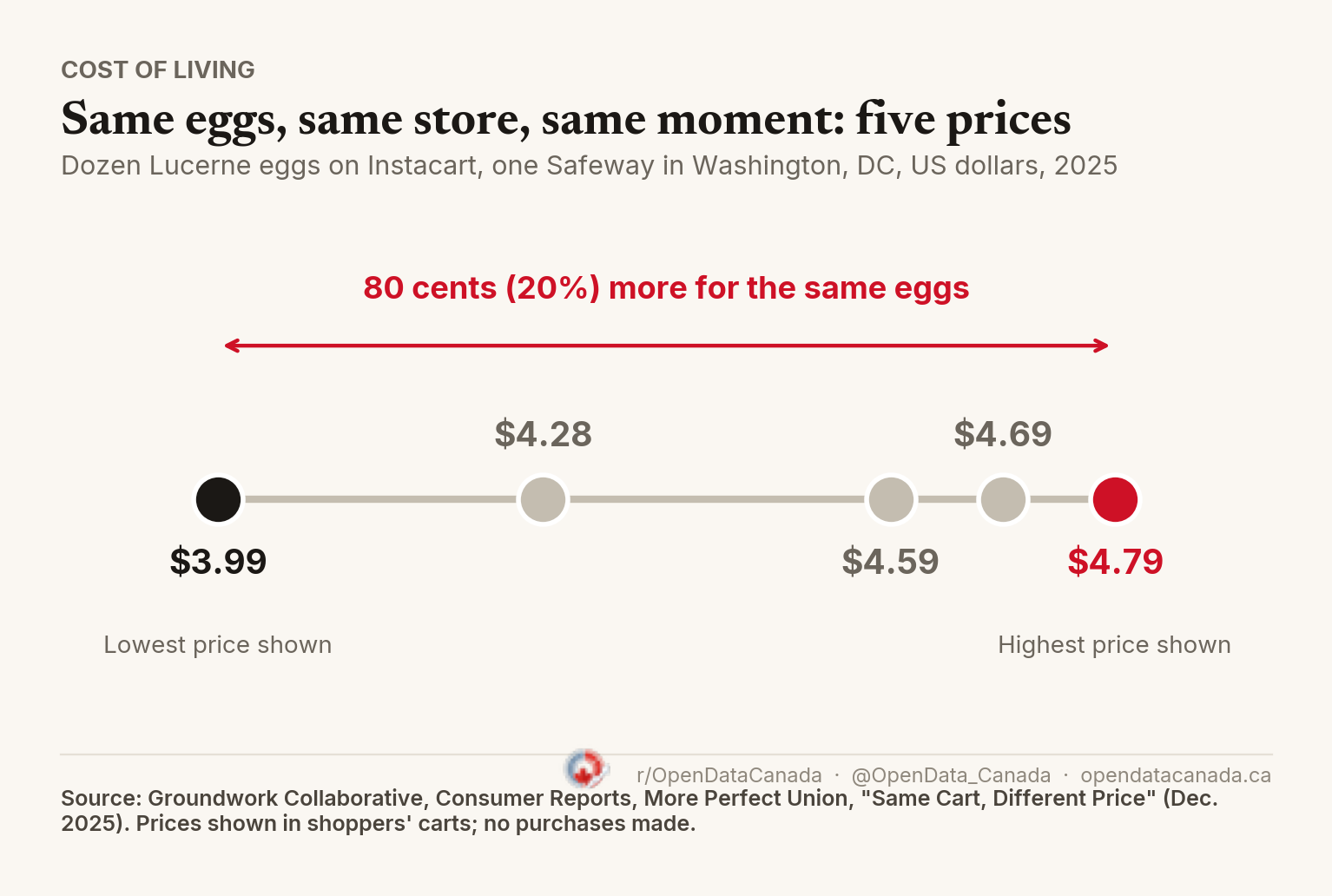
Nearly three quarters of the items appeared at more than one price. A dozen eggs at one Safeway in Washington came up at five. Across a whole basket the gap averaged about 7 per cent, which the researchers estimated would add up to roughly 1,200 US dollars a year for a family of four that shops this way. That figure is an extrapolation, not money anyone was shown to have lost. Instacart ended the price tests less than two weeks after the report came out.
No Canadian regulator has published anything like it.
What MPs heard
The most striking moment of the hearing was not about groceries at all.
Emily Osborne of the Canadian Shield Institute told MPs that some US nursing apps use nurses' personal information, "including even their credit score," to offer lower pay to those who seem to need the work more. Pricing shoppers and paying workers, she said, are "inverses of the same equation… it's always about calculating a desperation score and then using that to extract as much as possible from either a consumer or from a worker."
A 2024 Roosevelt Institute study of gig nursing apps, based on 29 interviews, is more careful. It says the apps "may" set pay using what a nurse accepted before or "how much credit card or other kinds of debt they might hold." It does not mention credit scores, and it does not show that any app does this. That gap between what is possible and what has been shown ran through the whole hearing.
Sylvain Charlebois of Dalhousie University's Agri-Food Analytics Lab put it plainly: "We have no evidence that it's happening right now in Canada, at least physically, in physical stores. But… we have little data about this issue."
Who can check in Canada
Regulators here are not powerless. The federal Privacy Commissioner can start an investigation on his own when he has reasonable grounds, and can compel a company's records and audit how it handles personal information. The Competition Bureau can investigate pricing that harms competition or misleads buyers.
What doesn't exist is anyone whose job is to look routinely. The Privacy Commissioner can't fine a company or order it to stop. No retailer has to disclose that a price was set from personal data, which means a shopper has little to complain about. The Competition Bureau asked the public about pricing software in 2025 and published the responses in January, noting they do not necessarily reflect its views. Its investigation into rent-setting software closed in November 2025 after finding landlords had not used the tools widely enough to substantially harm competition. Bester's ask to MPs: give a regulator the power to demand the data.
Meanwhile the technology arrives. Sobeys, one of the four chains that sell two-thirds of Canada's groceries, signed a 51 million US dollar deal this spring to put electronic shelf labels in an estimated 300 to 350 stores. That shows the equipment is spreading, not that anyone is misusing it. A Walmart patent for such labels includes the example Osborne cited: "if a customer has tuna fish, they may be offered a different price for mayonnaise." A patent describes what a company could build; Walmart says it does not price that way. Loblaw has published a pledge that "the price on the shelf is the price everyone pays for that item at that store." No federal law requires any of them to prove it.
Manitoba wrote a rule. Ottawa wrote a promise
| Where | What the rule does |
|---|---|
| Manitoba | Since July 1, 2026: demanding a higher price at the till because of personalized algorithmic pricing, including on electronic shelf labels, is an unfair practice. Online sellers need your express consent, given after they disclose it |
| Maryland | Since Oct. 1, 2026: grocery stores over 15,000 square feet and delivery apps can't set personal prices from shopper data. Loyalty programs and openly advertised discounts are exempt |
| New York | Since Nov. 2025: prices set using personal data must say so. Disclosure, not a ban |
| Quebec | Since 2023: companies must tell you before using technology that can profile you. Pricing isn't singled out |
| Federal | Nothing in force. Bill C-36 hasn't had a day of debate since it was tabled in June |
The day it tabled C-36, the federal government said the bill would "prevent unfair or inappropriate uses such as surveillance pricing." The bill's text never uses the term. It has broader rules requiring personal information to be used for appropriate purposes, but no specific rule on personal prices. Artificial Intelligence Minister Evan Solomon has said that once the law passes, his first step would be to have the new regulator issue guidance on what counts. That regulator, a new Digital Safety and Data Protection Commission, is expected to take about 18 months to set up, so not before 2028.
The public is ahead of the government. An Abacus Data poll of 1,931 Canadians in March found 52 per cent want algorithmic pricing banned and another 31 per cent want it allowed only with stricter rules. The poll asked about algorithmic pricing in general, not only prices set from personal data. Ontario's Human Rights Commission warned in October that prices based even partly on data linked to someone's sex, disability or ethnic origin could break the province's Human Rights Code.
MPs split on what to do. One asked whether this is just old-fashioned price discrimination with new tools. Hardy floated making surveillance pricing illegal for food and housing for two years. Charlebois asked Parliament to prohibit using personal information to push food prices higher, and for a coordinated investigation by competition and privacy authorities that reports within 12 months. Asked about Hardy's two-year idea, though, he said a clear message to the industry might be enough for now.
The Privacy Commissioner is due before the committee on November 23. The question for him is simple: if a Canadian grocer started pricing shoppers by their data tomorrow, who would notice?