Economy · Groceries · 4 min read
Four companies control two-thirds of Canada’s grocery market. In the US, the top four account for about a third.
Loblaw, Sobeys, Metro and Costco sell about 67 cents of every dollar Canadians spend on groceries, by a USDA estimate. The four biggest US food retailers sell about 35 cents.
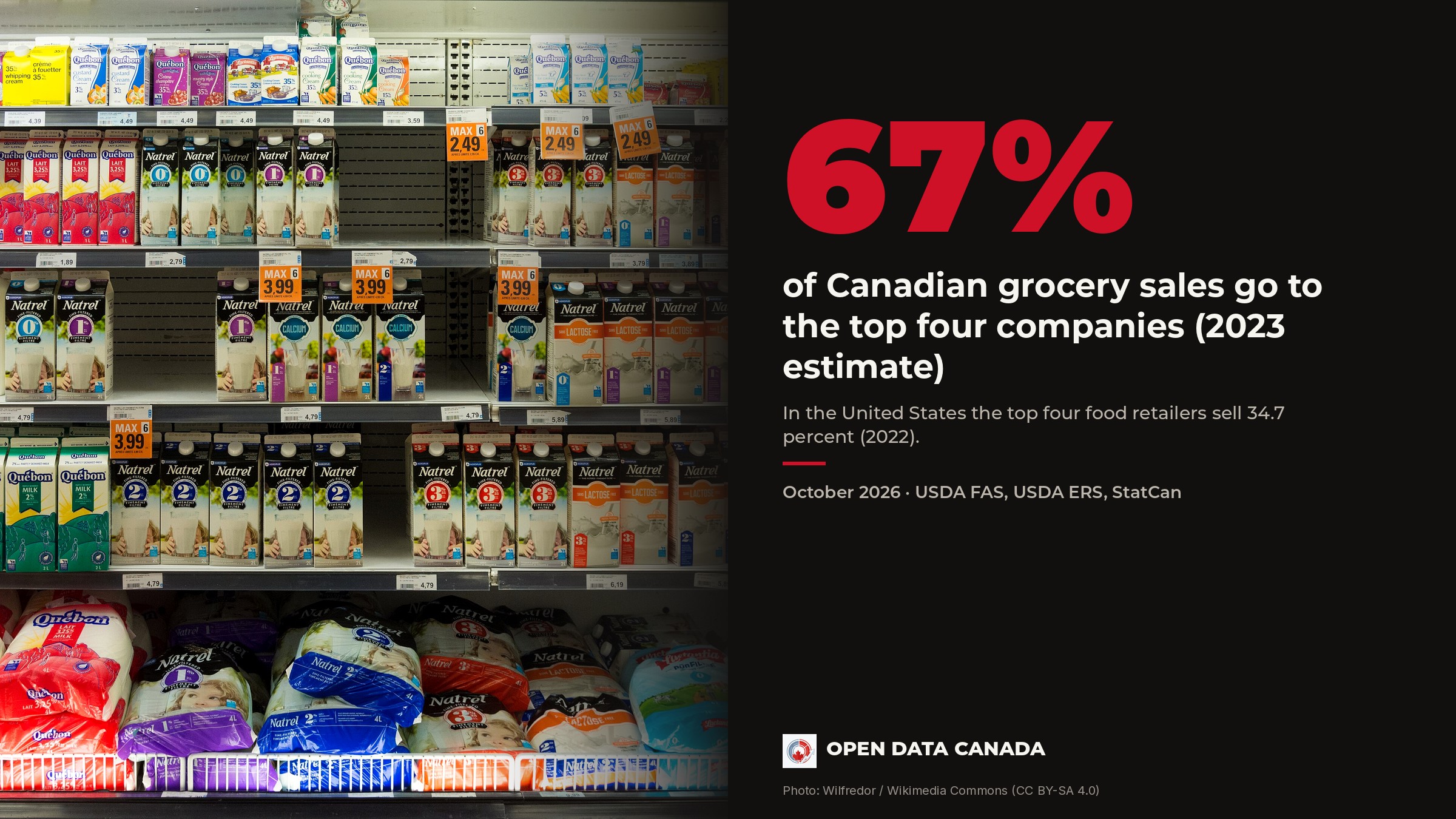
Spend a dollar on groceries in Canada and about 67 cents goes to Loblaw, Sobeys, Metro or Costco. That is the US Department of Agriculture's estimate for 2023: Loblaw 28 cents, Sobeys 19, Metro 11, Costco 9.
In the United States, the four biggest food retailers share 34.7 cents. Loblaw and Sobeys alone, at 47, beat the whole American top four combined.
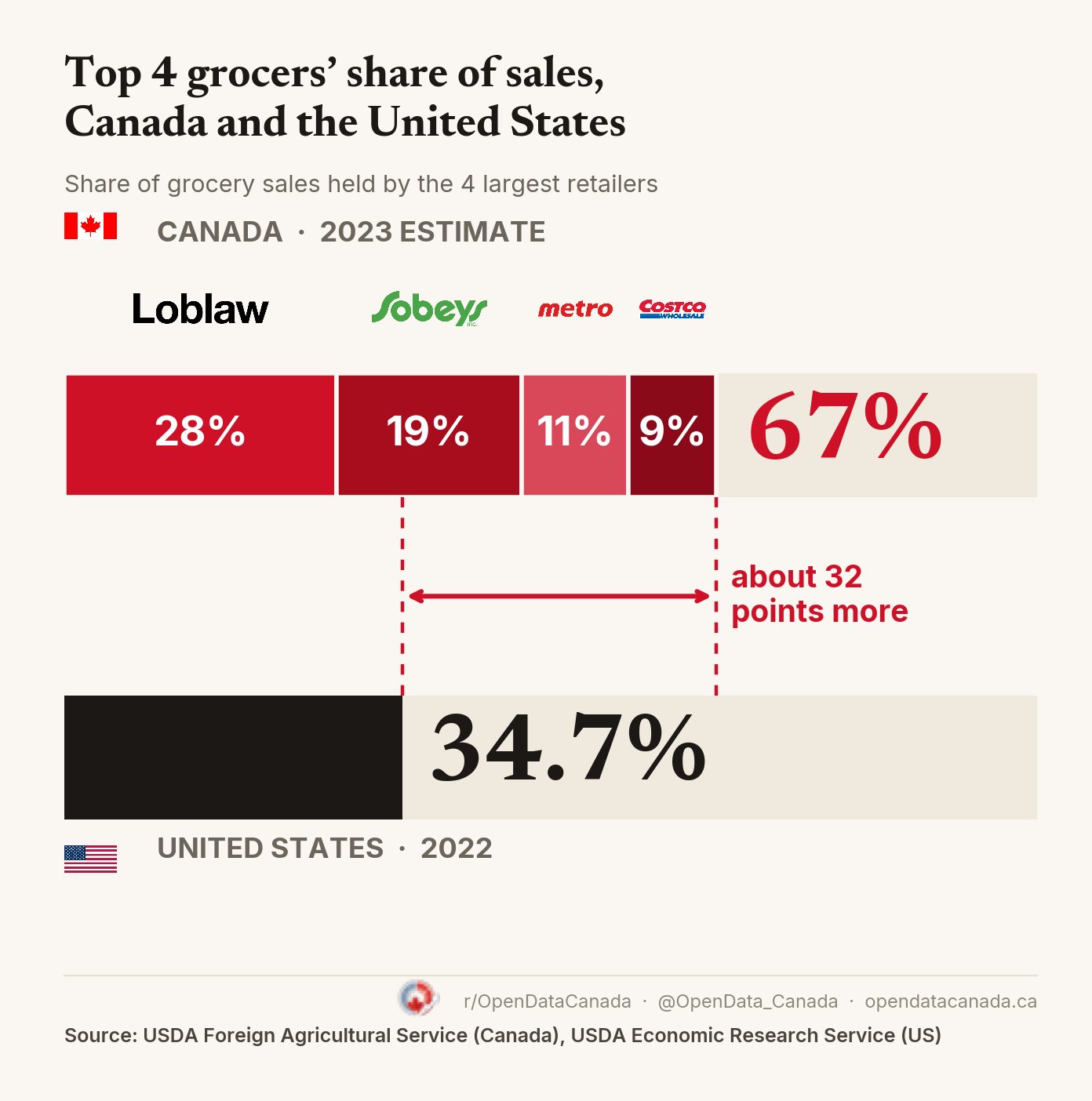 Download chart · Download data (CSV)
 The two sides are measured differently: the US figure covers food sales only, and the Canadian estimate comes from a different source and year. The gap is about 32 points.
Where the Canadian number comes from
The US figure comes from the Economic Census. Canadian estimates are built by others. The USDA's Canadian office uses trade rankings and company reports, and a federal-provincial report put the top five at about 80 percent for 2020, citing a bank's custom tabulation with no published method.
| Source | Year | Who | Share |
|---|---|---|---|
| USDA FAS (Canadian Grocer) | 2023 | Top 4 | 67% |
| USDA FAS (Canadian Grocer) | 2020 | Top 5 | about 76% |
| Federal-provincial retail fees report | 2020 | Top 5 | about 80% |
These rows use different years, company counts and sources.
Five Canadian grocers outsell the eight biggest in the US
Go one step further. The US top eight sell 54.1 percent of American food, according to the same USDA series. Canada's top five were estimated at 76 to 80 percent in 2020. Five companies hold a bigger slice of one market than eight do of the other.
Why local markets matter
When the US Federal Trade Commission challenged the Kroger-Albertsons merger in 2024, it argued that a deal creating a firm with more than 30 percent of a market, and raising concentration by a set amount, is presumed illegal. That test runs on local markets, where shoppers actually choose between stores, so a national share is only the starting point. In December 2024 federal and Washington state judges blocked the deal and the companies called it off. The fight moved to Delaware, where Albertsons is suing Kroger for about 8 billion dollars and a trial is set to begin on 19 October. In Canada, that starting point is about two-thirds.
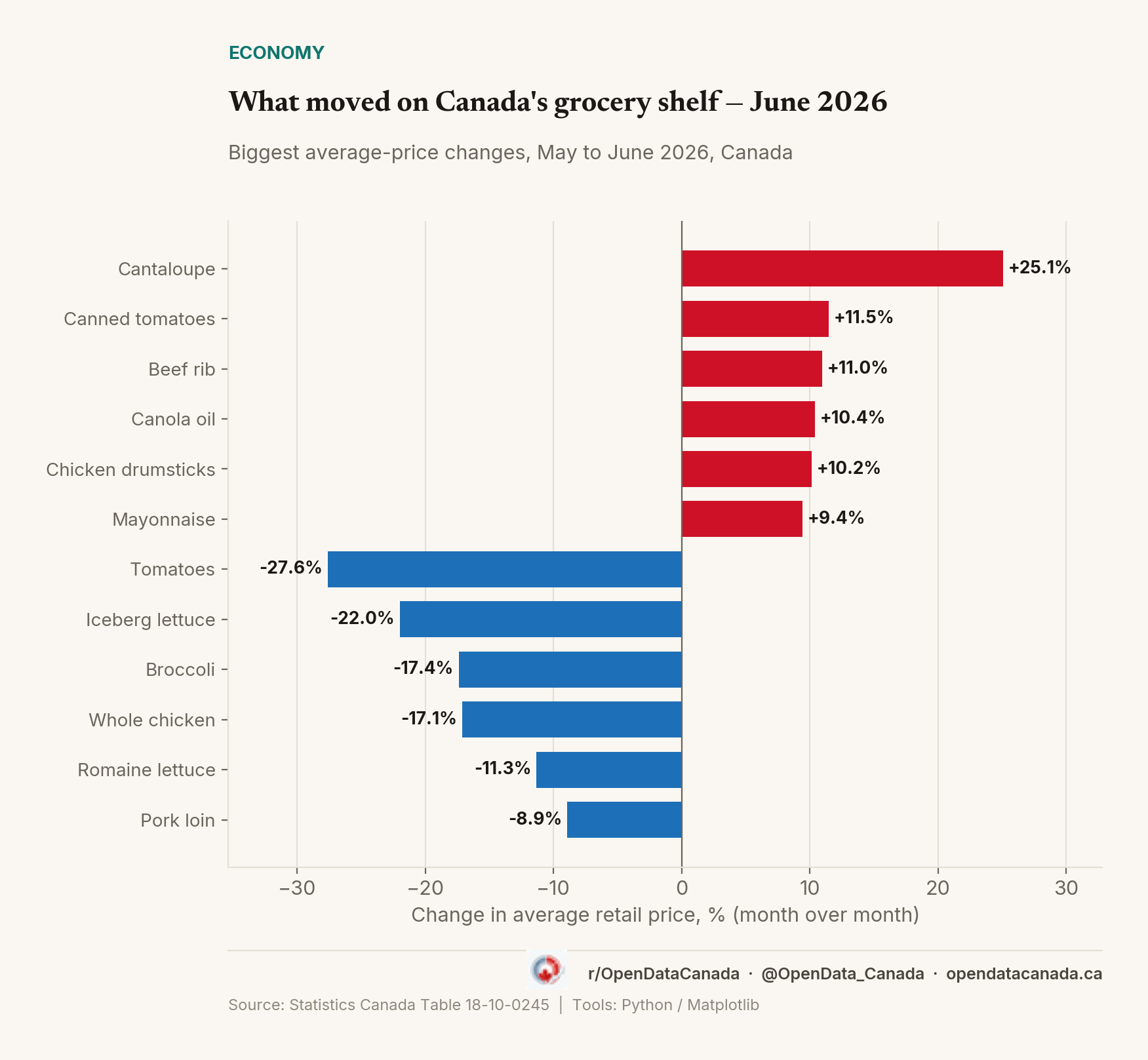
For what the same groceries cost now, see what got more expensive in Canada in June 2026.