Investigation · Economy · 8 min read
Canada's mobile prices remain among the priciest in the G7 — and they're rising again.
Ottawa spent two years tracking wireless prices down and declared victory in January 2022. A federal price-comparison study shows Canada has stayed among the three most expensive places for a basic mobile plan among G7 countries plus Australia, at every plan size tracked, and by late 2025 the prices that did fall were climbing again.
In January 2022, the federal government held a press conference to announce it had done something it said it would do. Three months ahead of schedule, Innovation, Science and Economic Development Canada (ISED) reported that mid-range wireless plans at Bell, Rogers and TELUS had fallen 25 percent since the benchmark prices collected in early 2020, matching a target the Liberal government had set two years earlier. Minister François-Philippe Champagne called it a win for affordability.
The number was real. It just wasn't the number that determines whether Canadians pay more for a phone plan than anyone else in the G7.
ISED runs a separate, quieter exercise: an international price comparison, now in its 17th edition, that puts Canadian wireless prices side by side with seven peer countries, the rest of the G7 plus Australia, using standardized plan tiers and purchasing-power-adjusted Canadian dollars to make prices more comparable across countries. That study, covering 2024, shows Canada holding the same position it has held through most of the tracking period: at or near the most expensive end of the table, at every plan size that has enough data to compare.
One caveat is worth naming plainly before the numbers: ISED's own study lists Canada's price as a multi-city average, while most peer countries are represented by a single metro (Tokyo, Paris, Berlin, Rome). Averaging across Canadian cities could pull the number in either direction depending on which cities are sampled, and the study doesn't publish that city list in the summary tables, so it isn't possible to say from the public data whether that inflates or understates the gap. It's a limitation of the comparison, not a reason to dismiss it: Canada's position holds up across every plan tier the study tracks, a result that doesn't depend on which cities got averaged into any single number.
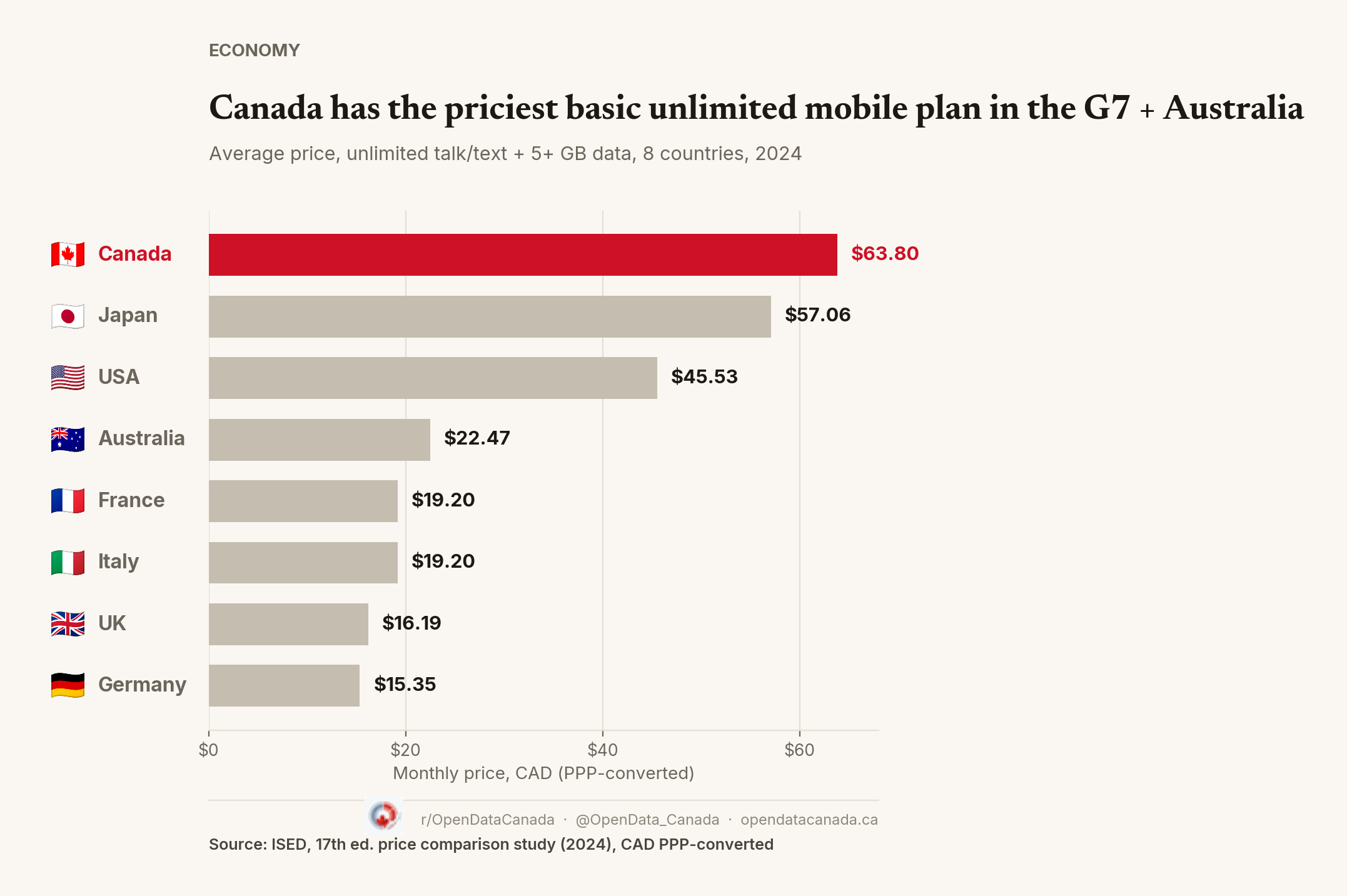
At the first data-inclusive tier ISED tracks (unlimited talk and text with 5 or more gigabytes of data), Canada's average price for the basket was 63.80 dollars a month in PPP-adjusted Canadian dollars. Japan is second at 57.06. The United States, a country Canadians are reflexively told has worse phone bills, comes in third at 45.53, about 71 percent of what Canada charges. Germany, at the bottom of the table, averaged 15.35, about one-quarter of Canada's price for the same basket of minutes, texts and data.
The rank doesn't move when the plan size does
A single tier could be an outlier: a quirk of how one carrier prices one specific bundle. It isn't. ISED tracks four other plan sizes, from a bare 450-minutes-plus-300-texts starter plan up to a 100-gigabyte allowance, and Canada finishes in the top three of every one that has enough countries to rank. Second place at the smallest tier, first at 5 gigabytes, second at 20, third at 50, third at 100. There's a sixth tier in the study, unlimited data at speeds above 150 Mbps, that Canada can't even be ranked on, because no Canadian carrier sells a plan that qualifies.
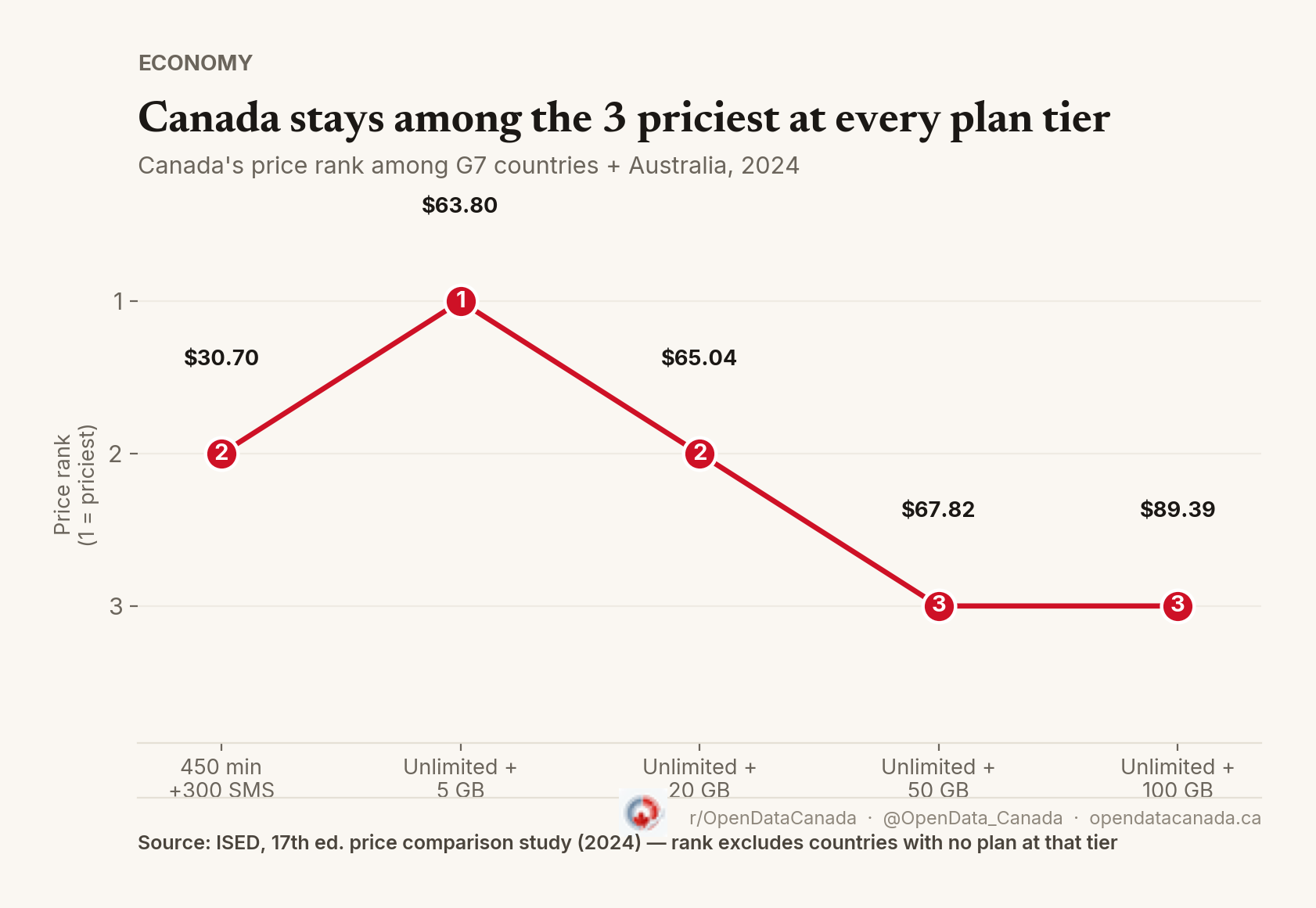
The rank is close. The prices aren't.
A rank chart shows Canada never leaves the top three. It doesn't show how much separates first place from eighth, and at some tiers that gap is enormous.
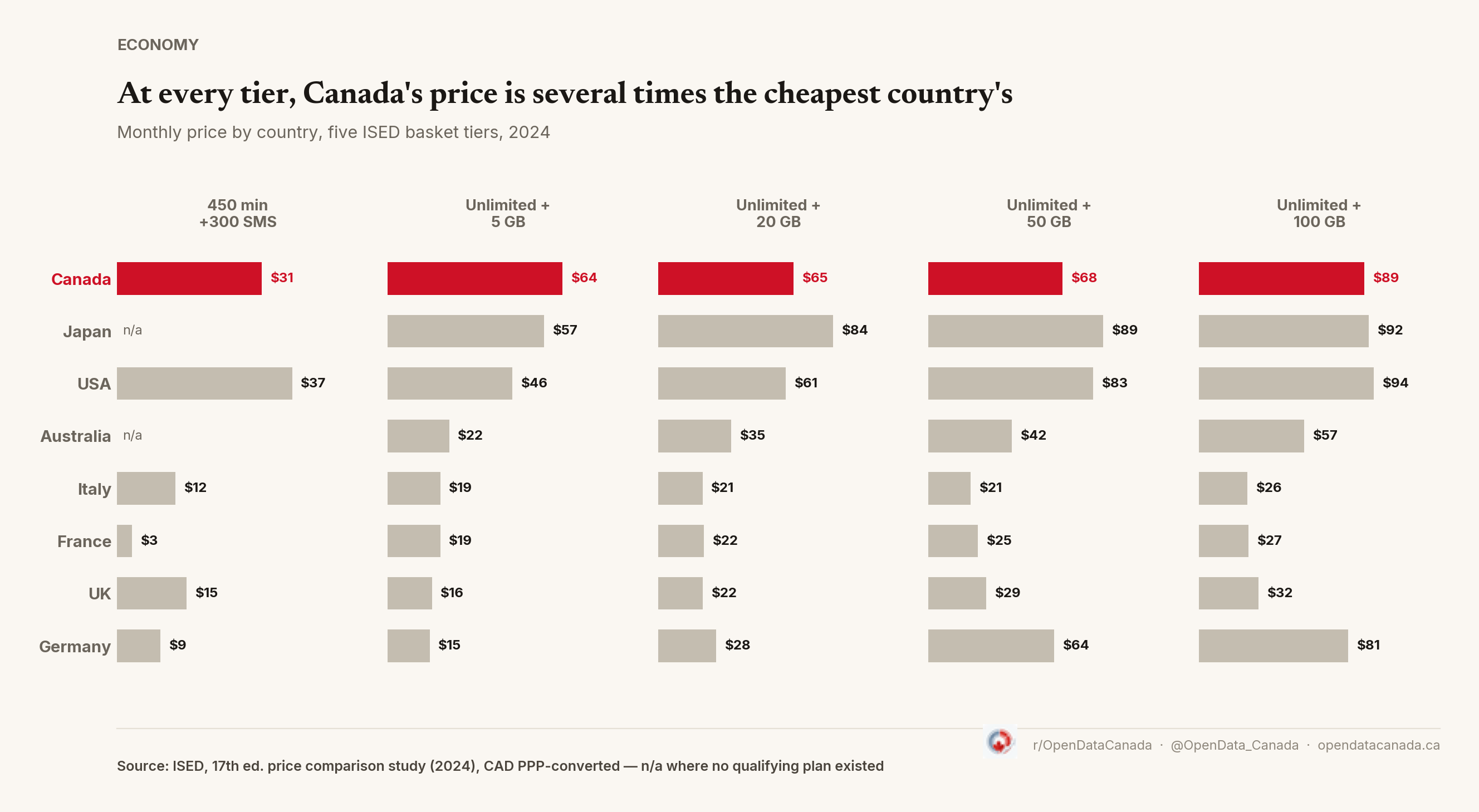
At the 5-gigabyte tier, Canada's 63.80 dollars is more than four times Germany's 15.35. At 20 gigabytes, Canada's rank slips to second, but the dollar gap barely narrows against the cheapest half of the table: Italy and the UK are still charging roughly a third of the Canadian price for the same allowance. The pattern holds through every tier the study tracks: Canada's rank moves narrowly between first and third, but the dollar gap with the cheapest countries in the comparison stays wide by multiples, not by narrow margins.
That consistency reframes what the government's January 2022 announcement actually proved. Ottawa's tracking exercise measured a real 25 percent domestic decline, and that number holds up on its own terms; it isn't in dispute. What it didn't do is close the gap with peer countries. Canada hit its own domestic target and still finished the tracking period among the most expensive places in the G7 to buy a basic phone plan.
Two different measurements, two different questions
The government's tracking exercise and ISED's international study aren't measuring the same thing, and the gap between them is where the misleading part of the "we delivered" claim lives. The 2022 announcement tracked mid-range plans at exactly three companies (Bell, Rogers and TELUS, across their brands) against a single benchmark from early 2020. It says nothing about how those prices compare to what a carrier in Berlin or London charges for the same plan. The international study does exactly that, holding the plan definition constant across eight countries. Both are accurate. Only one of them tells a Canadian how their bill compares to Berlin's or London's.
The federal government's actual lever for lower wireless prices was never the price-tracking exercise: it was regulation aimed at forcing more competition into a market three companies have long dominated. In 2021, the CRTC ordered Bell, Rogers, TELUS and SaskTel to open their networks to wholesale mobile virtual network operators, with further orders refining that access through 2025. The market consolidated at the same time it was supposed to be opening up: Rogers' roughly 26-billion-dollar acquisition of Shaw closed in 2023, with Minister Champagne requiring Shaw's Freedom Mobile (a real fourth wireless competitor in Ontario, B.C. and Alberta) be sold to Quebecor's Videotron rather than absorbed by Rogers. Two of the biggest moves in Canadian telecom that decade pointed in opposite directions on the same market at the same time.
The prices that fell are rising again
Statistics Canada's cellular services price index dropped sharply through 2023, down roughly 18 percent year over year, and kept falling through 2024, though StatCan changed how it calculates that index starting with the August 2024 release, which breaks strict before-and-after comparisons across that point.
What isn't ambiguous is the direction reversal. By late 2025, the decline had flipped. StatCan's cellular price index was up 7.7 percent year over year in October 2025 and 12.7 percent in November. The CRTC's own 2025 market report confirms the shift in its own words: after several years of price decline, some mobile plan prices increased in 2025.
That reversal happened in the same window the CRTC was rolling out its next round of consumer protections. A policy the commission published in March 2026 banned activation and plan-switching fees outright and barred cancellation fees on any contract that isn't subsidizing a device, taking effect this past June. Cheaper to switch carriers doesn't automatically mean cheaper to stay with one, and the price data through the back half of 2025 suggests it hasn't, at least not yet.
What would change the picture
Two things would meaningfully test whether Canada's position in this ranking is durable rather than structural. The first is ISED publishing an 18th edition of the international study; the 17th, covering 2024, is still the newest available as of this writing, so there's no international comparison yet that reflects the 2025 price increases StatCan and the CRTC have both recorded. The second is whether the CRTC's wholesale MVNO framework produces a durable low-cost entrant the way it was designed to, rather than another player getting absorbed the way Freedom Mobile nearly was. Until one of those shows up in the data, the honest read of the record is this: Canada's domestic wireless prices fell for several years and have started climbing again since 2025, while its position in the international comparison never left the three most expensive spots in the G7 plus Australia, at any plan size, across the whole period.