Economy · August 2026 CPI
Canada's 3% inflation rate masks a much wider provincial split
From 2.41% in Ontario to 5.10% in Nova Scotia — most of the gap traces back to one line on the receipt: shelter.
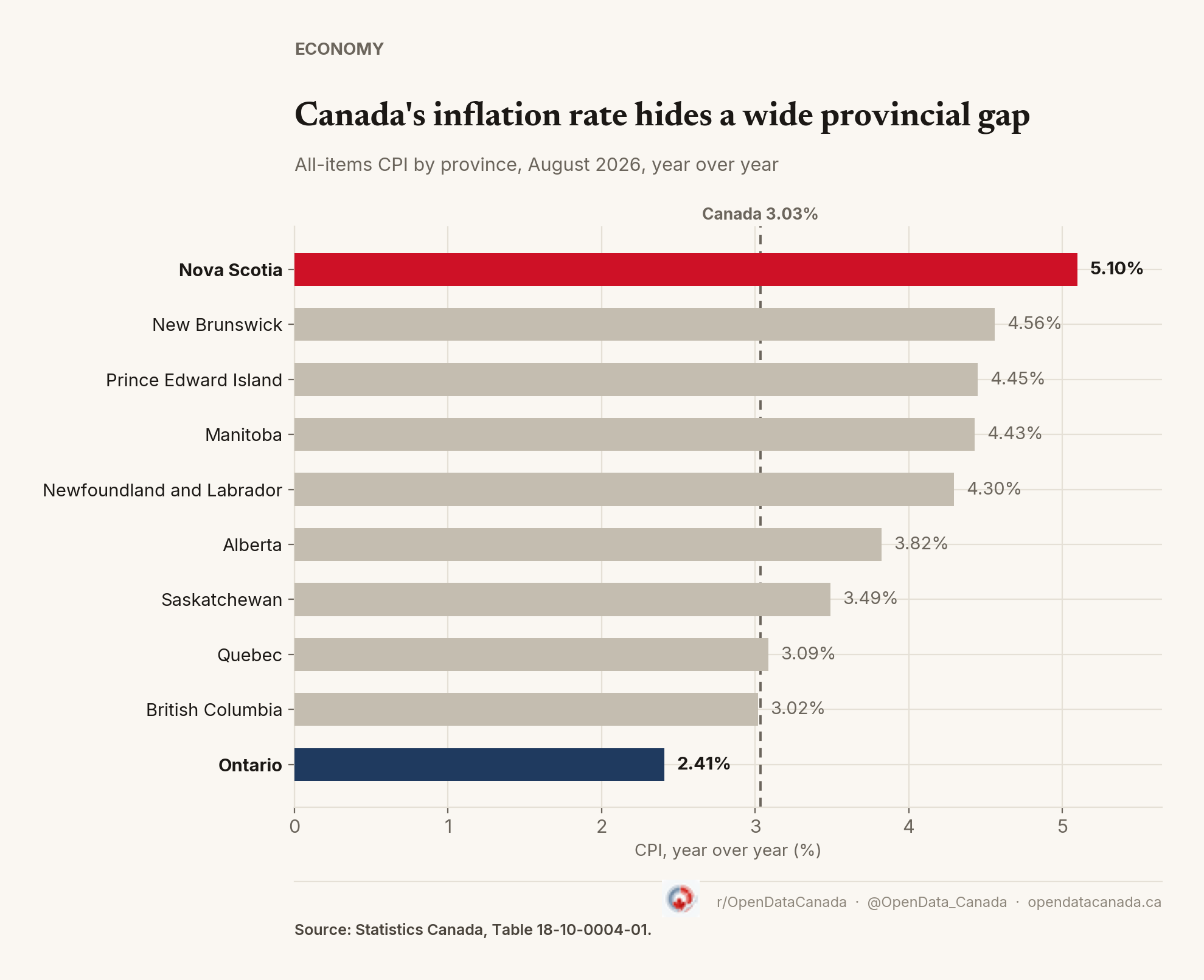
Statistics Canada's Consumer Price Index for August held near 3% nationally — still above the Bank of Canada's 2% target, and up from 1.7% a year ago. That single number also hides one of the widest provincial inflation gaps of the past year.
Inflation ranged from 2.41% in Ontario to 5.10% in Nova Scotia year over year — more than double. That's not a rounding quirk of one province having an unusually cheap or expensive year across the board. It traces back to a single category: shelter.
Not a broad-based gap — a shelter gap
If Nova Scotia were simply having a more expensive year across the board, its inflation rate would run a bit hotter than Ontario's on most things people buy. It doesn't: one category does almost all the work of splitting the two provinces apart.
Shelter costs rose 7.15% year over year in Nova Scotia. In Ontario, they rose 0.11% — functionally flat. Rent alone: 8.03% in Nova Scotia versus 2.37% in Ontario.
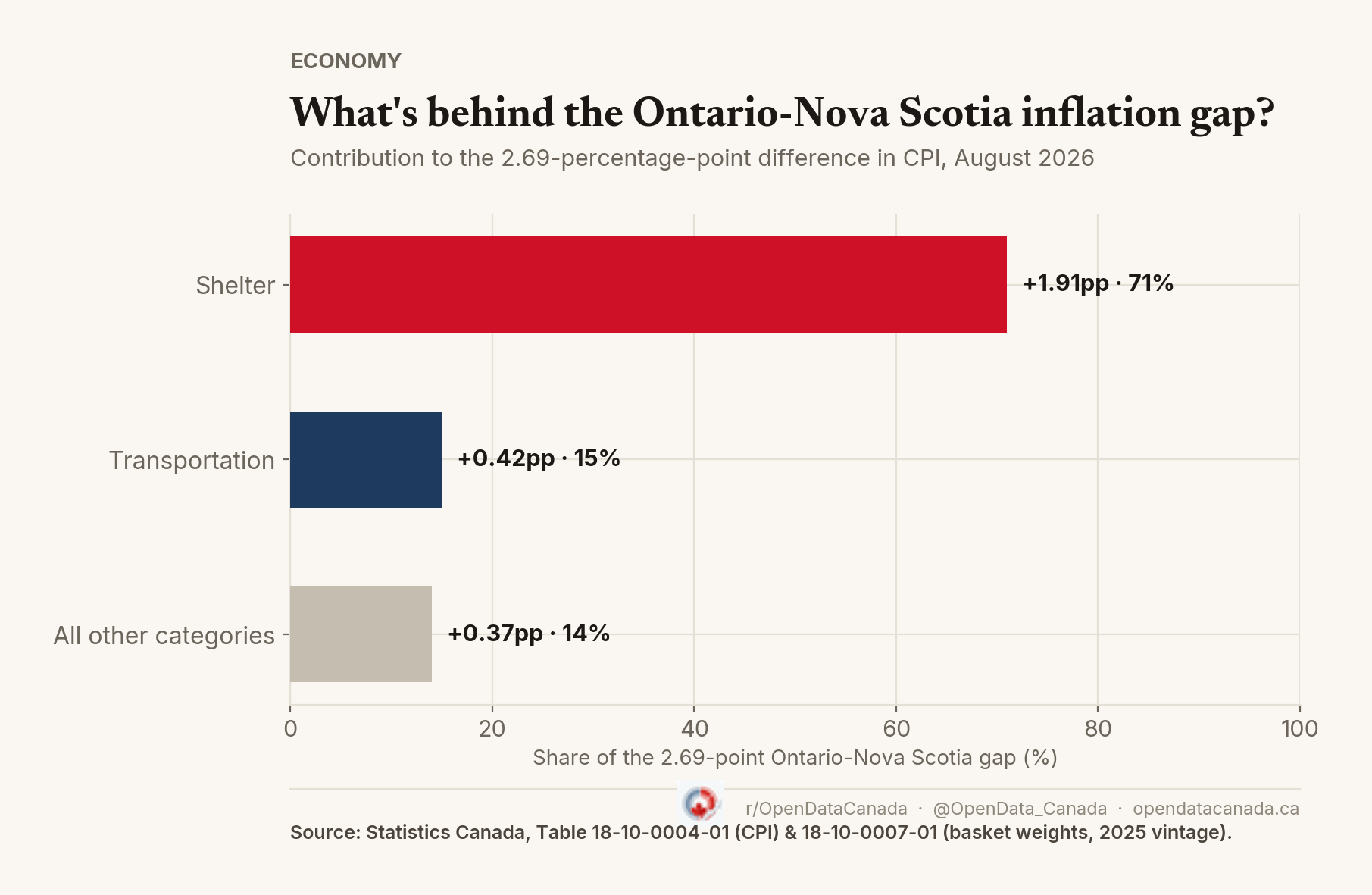
Weighting each category by its actual share of household spending (Statistics Canada's basket weights, Table 18-10-0007-01) turns that into a precise answer, not just a striking pair of numbers: of the 2.69-point gap between Nova Scotia's and Ontario's inflation rates, shelter accounts for about 71%. Transportation as a whole adds another 15% — even though gasoline specifically isn't the reason; other transportation costs (vehicle purchase, insurance, maintenance) are doing that work. Every other category combined explains the remaining 14%.
Gasoline is a partial exception worth naming directly: it's risen sharply almost everywhere in the country this year, from 18.8% in Quebec to 28.0% in Newfoundland and Labrador — including a 25.0% increase in Ontario, higher than Nova Scotia's 24.6%. Because it's hot nearly everywhere, it doesn't explain why provinces differ from each other; it explains why every province's headline number is elevated versus a year ago.
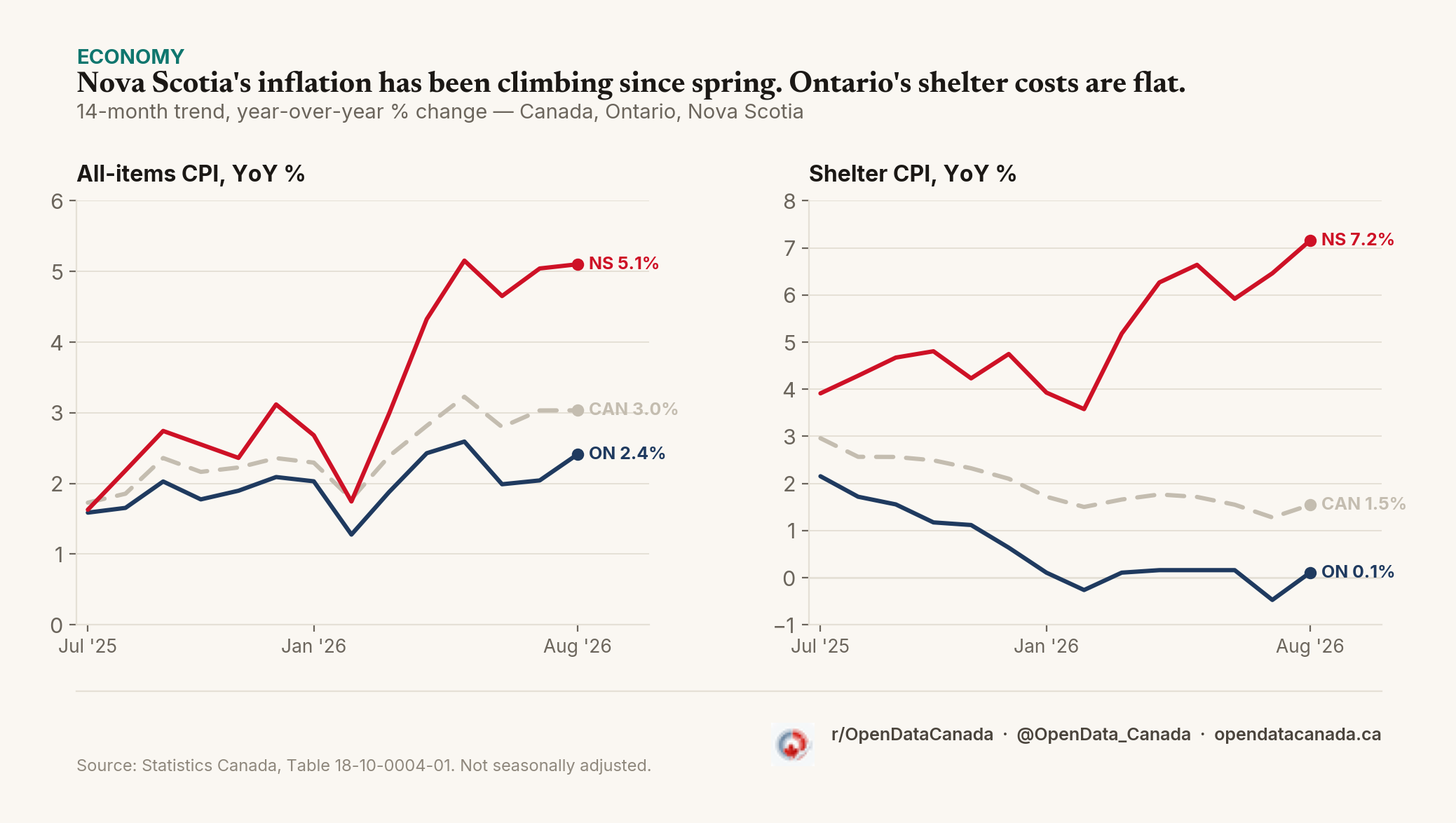
The shelter panel is where the story actually lives. Ontario's shelter inflation has been pinned near zero for the past eight months, dipping briefly negative in February and again in July. Nova Scotia's has done the opposite, climbing from 3.9% last summer to 7.2% today. This isn't a one-month statistical wobble: Nova Scotia has posted the country's highest provincial inflation rate, and Ontario the lowest, for five consecutive months (April through August 2026).
Is this unusual?
Somewhat — but not a record. Looking at the trailing 14 months of provincial data, August's 2.69-point spread is the second-widest of the period, behind only July's 3.00 points. The 14-month average spread is 1.95 points. So the current gap is real and part of a genuine multi-month widening trend since March 2026 — but it isn't unprecedented, and it may have already peaked in July.
Canada's headline inflation rate held near 3% in August, but that number describes no single province well. Nova Scotia is running inflation more than double Ontario's, almost entirely because of what's happening to shelter costs in each — a gap that has now persisted for five straight months.