Labour market · International comparison
Canada's Youth Unemployment Rate Is Now Above the US and OECD Average
For most of the past two decades, Canada's youth unemployment rate sat below the OECD average. Since late 2023 that has flipped. Canadian youth are now more likely to be unemployed than their peers in the United States or across the OECD as a whole, and Statistics Canada's own numbers confirm it.
Canada's youth unemployment rate has been above the OECD average every month since October 2023, 33 straight months through July 2026. That kind of stretch never happened in the 2008-2023 period shown here. For a country that spent most of the 2010s with one of the better youth labour markets in the rich world, the reversal is stark: as of July 2026, 12.6 per cent of Canadians aged 15 to 24 in the labour force were unemployed, against 11.0 per cent across the OECD, 8.5 per cent in the United States, and 14.9 per cent in the euro area, the one peer group Canada still beats.
A new report from the Ottawa-based Centre for the Study of Living Standards (CSLS), titled "The Weakest Link: Diagnosing the Deterioration of the Youth Labour Market in Canada," examines the deterioration in detail. We pulled the underlying series ourselves, Statistics Canada's Labour Force Survey and the OECD's monthly labour market statistics, to check the numbers and build our own charts.
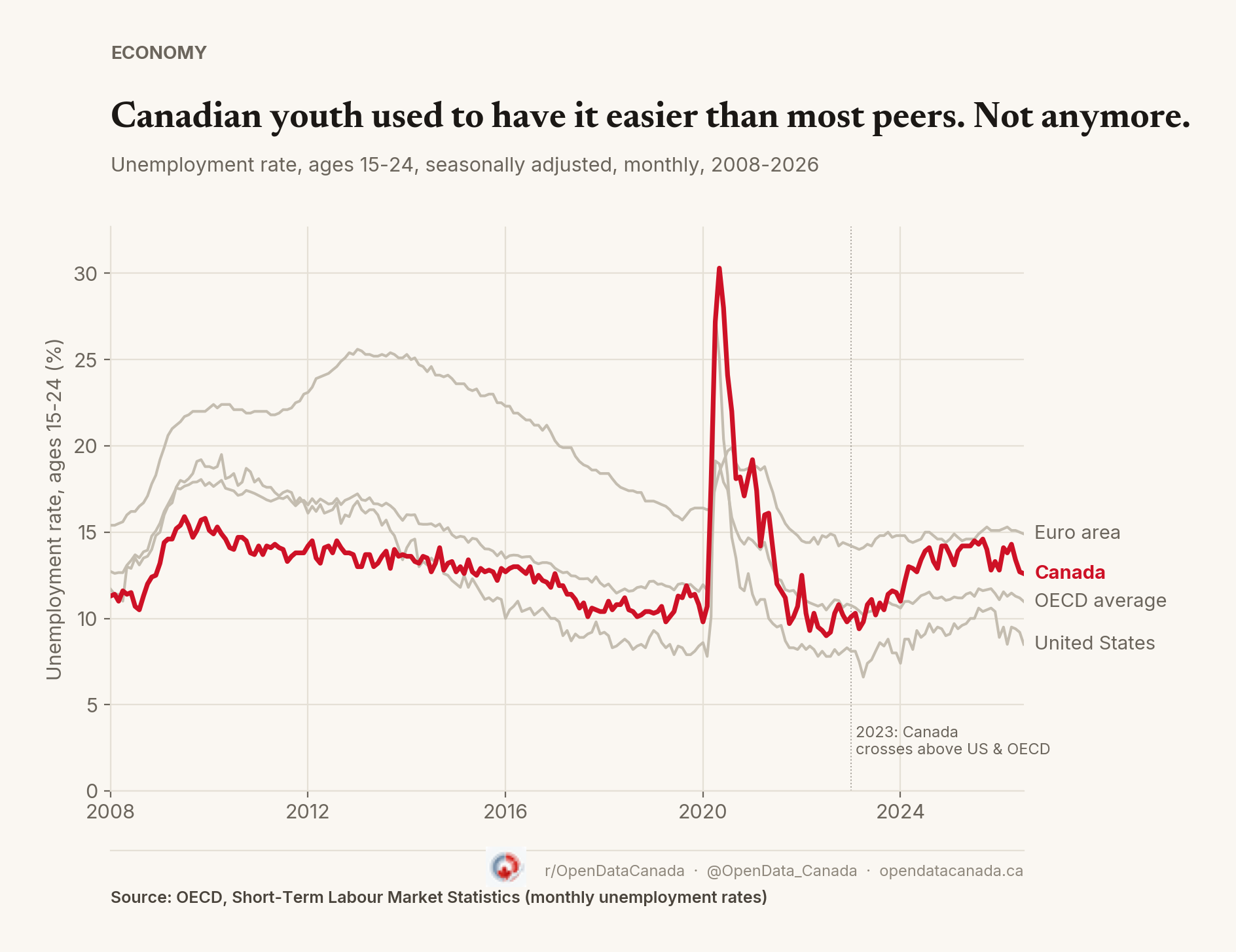
From 2008 through 2019, Canada's youth unemployment rate was below the OECD average in every single month of the series, while its position relative to the United States was more mixed. Since October 2023, that has reversed completely: Canada has been above both the US and OECD averages every month without exception, and the gap against the OECD average, which briefly closed during the pandemic recovery, has reopened to 1.6 percentage points as of July 2026.
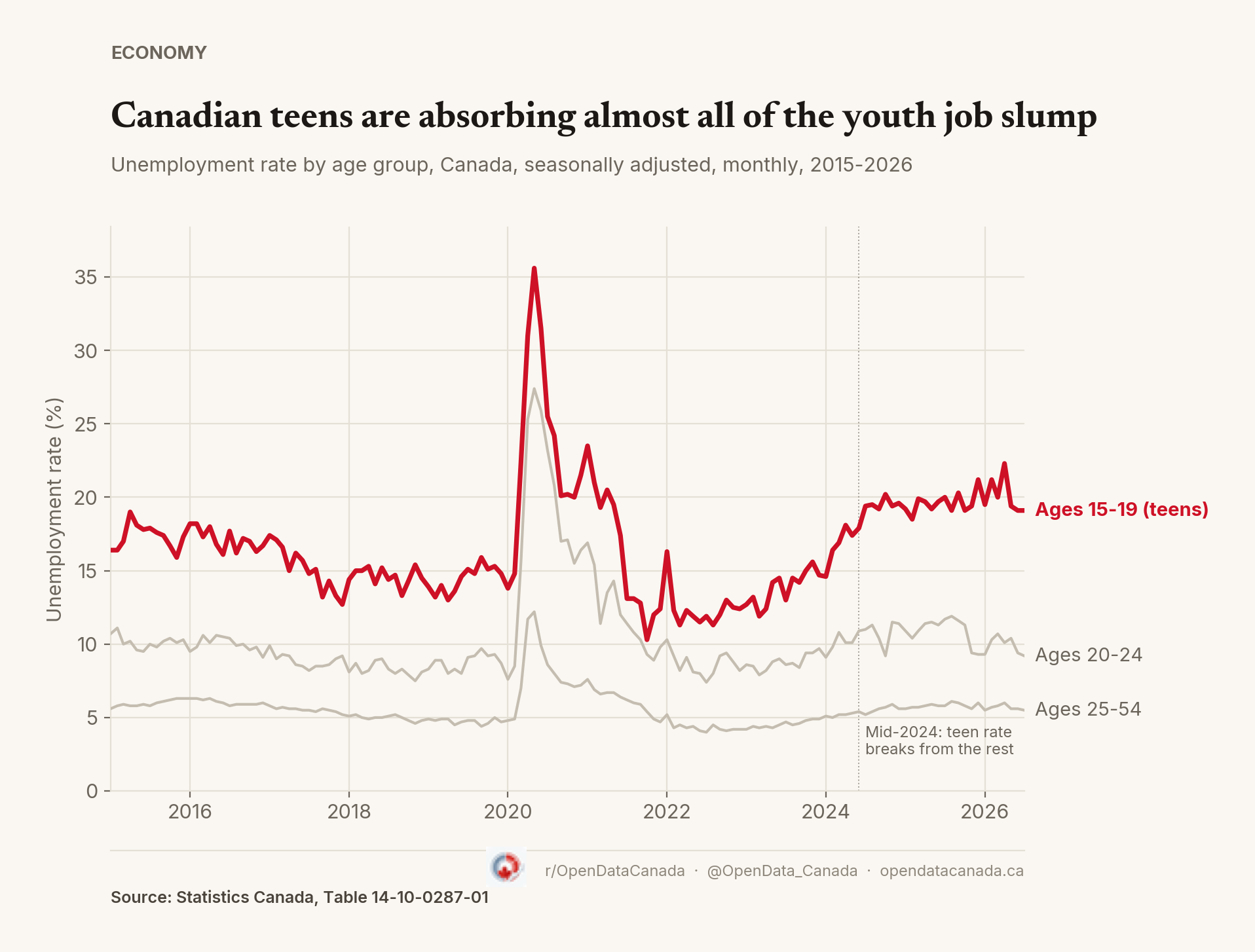
The national number hides where the damage actually sits. Statistics Canada's own age breakdown shows the deterioration is particularly concentrated among teenagers. Teen unemployment was 19.1 per cent in July 2026, 3.5 times the 5.5 per cent rate among Canadians aged 25 to 54 and more than double the 9.2 per cent rate for 20-to-24-year-olds. CSLS's own quarterly figures tell the same story from a different angle: in the second quarter of 2026, 15-to-19 unemployment reached 20.3 per cent, more than twice the 10.1 per cent rate among 20-to-24-year-olds. The teen rate has climbed steadily since the start of 2023, when it was running around 13 per cent, while the 25-to-54 rate has barely moved.
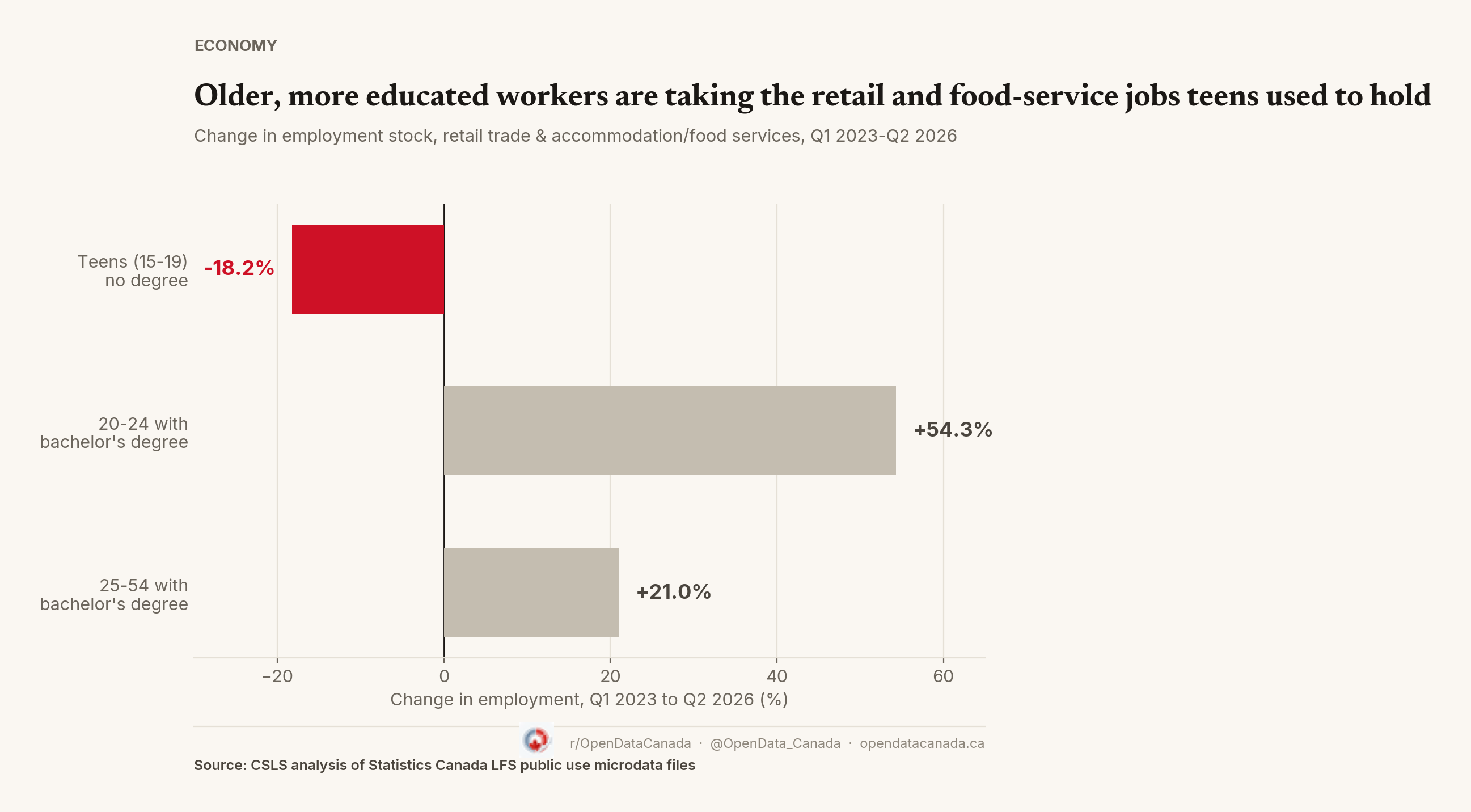
CSLS finds that the rise in youth unemployment has been driven overwhelmingly by weaker job finding rather than increased job separations. Layoffs of young workers have stayed below pre-pandemic levels throughout. In other words, this looks more like a hiring problem than a wave of youth layoffs. The report goes further and asks who is filling the jobs teenagers used to hold. Looking at retail trade and food services, two of the industries where teenagers are heavily concentrated, CSLS found teen employment in those industries fell 18.2 per cent between the first quarter of 2023 and the second quarter of 2026, while employment of degree-holding 20-to-24-year-olds in the same industries rose 54.3 per cent and degree-holding 25-to-54-year-olds rose 21.0 per cent. Those are employment changes within each group, not a measure of one group displacing another, but together they show the composition of those industries has shifted toward older, more educated workers.
CSLS is careful not to pin this on one cause. Beyond the hiring slowdown and productivity gains that may have allowed youth-heavy industries to increase output with fewer workers, the report points to a supply-side factor: non-permanent residents' share of Canada's overall population rose from 3.6 per cent in the third quarter of 2021 to 7.6 per cent by the end of 2024 (that share has since started to decline as policy has tightened), which CSLS says may have intensified competition for the entry-level jobs where youth employment is concentrated. The report is explicit that its data cannot separate the effect of temporary foreign workers from that of new graduates in these dynamics, so it stops short of quantifying how much of the teen hiring slump this supply-side shift actually explains.
CSLS recommends strengthening the transition from school to work and creating earlier employment pathways, but the report stops short of identifying a single policy lever that would restore teen hiring in retail and food service. That is a defensible caution for a research institute. It leaves a harder question unanswered: how much of the deterioration can be explained by weak labour demand and changing employer demand and productivity, and how much by changes in the supply of workers competing for entry-level jobs? Canada's latest PISA results raise a related question about the skills pipeline feeding that market.