Economy · 3 min read
Canada added 75,000 jobs in July. Government cut 27,000 of its own.
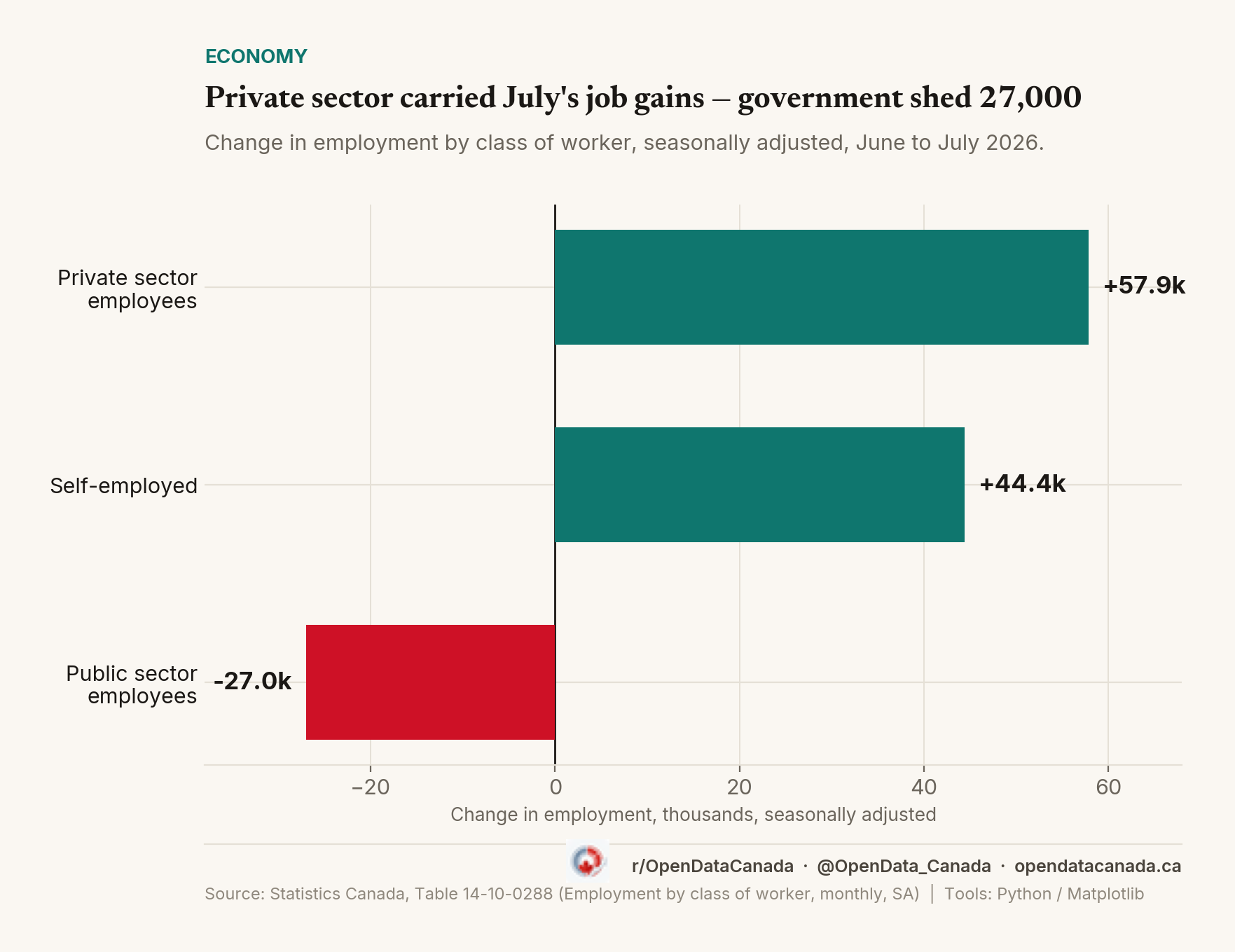
The headline jobs number is genuinely good: full-time and part-time gains were balanced, and unemployment matched a two-year low. But almost 60 percent of July's employment growth came from people going self-employed, private employers added 57,900 jobs, and the public sector cut 27,000 — the piece no outlet covering the release reported.
Statistics Canada's July Labour Force Survey landed better than expected: employment rose 75,000 (+0.4%), the unemployment rate fell to 6.4%, and full-time and part-time gains were close to even — 38,600 full-time, 36,600 part-time. That last detail matters, because a job gain skewed heavily toward part-time work is usually the tell that a "good" report is thinner than it looks. This one isn't. Checked against 31 months of StatCan data back to January 2024, 6.4% ties the lowest unemployment rate Canada has posted since July 2024.
None of that is spin. But the headline number answers "how many jobs," not "who's hiring." Break the same 75,000 down by class of worker, as in the chart above, and a different picture opens up: private-sector employees added 57,900 jobs and self-employment rose 44,400 — nearly 59% of the month's entire employment gain came from people becoming their own employer, not from being hired by one. Public-sector employment fell 27,000.
The public-sector decline wasn't spread evenly either. Of the industries StatCan tracks, public administration alone shed 14,500 jobs in July, the single largest industry-level move behind the government pullback.
The self-employment share is the part worth watching
Self-employment is a legitimate way to gain a job — plenty of it is genuine business formation, not desperation gig work — and StatCan's own full-time/part-time split shows this wasn't a month propped up by precarious hours. Still, self-employment carrying 59% of a month's job growth is unusually high, and it's a softer number than payroll hiring: it rises and falls with less friction, doesn't come with the same benefits or job security, and is more sensitive to people leaving a shrinking public sector and calling themselves contractors rather than being hired into a new role. A single month doesn't prove that link. It's the detail to check again next release.
Take the report at face value and it's a genuinely strong one. Look at who did the actual hiring and it was private employers, almost entirely — government spent July cutting, not adding, and nearly six in ten of the new jobs created went to people working for themselves.