Article · Housing · 7 min read
Asking rents fell this year. The rent Canadians actually pay went up.
Statistics Canada says asking rents fell over the past year. It also says rents rose almost four per cent. Both are correct. One number prices the apartment you'd move into, the other the one you already live in, and the difference explains most of the confusion.
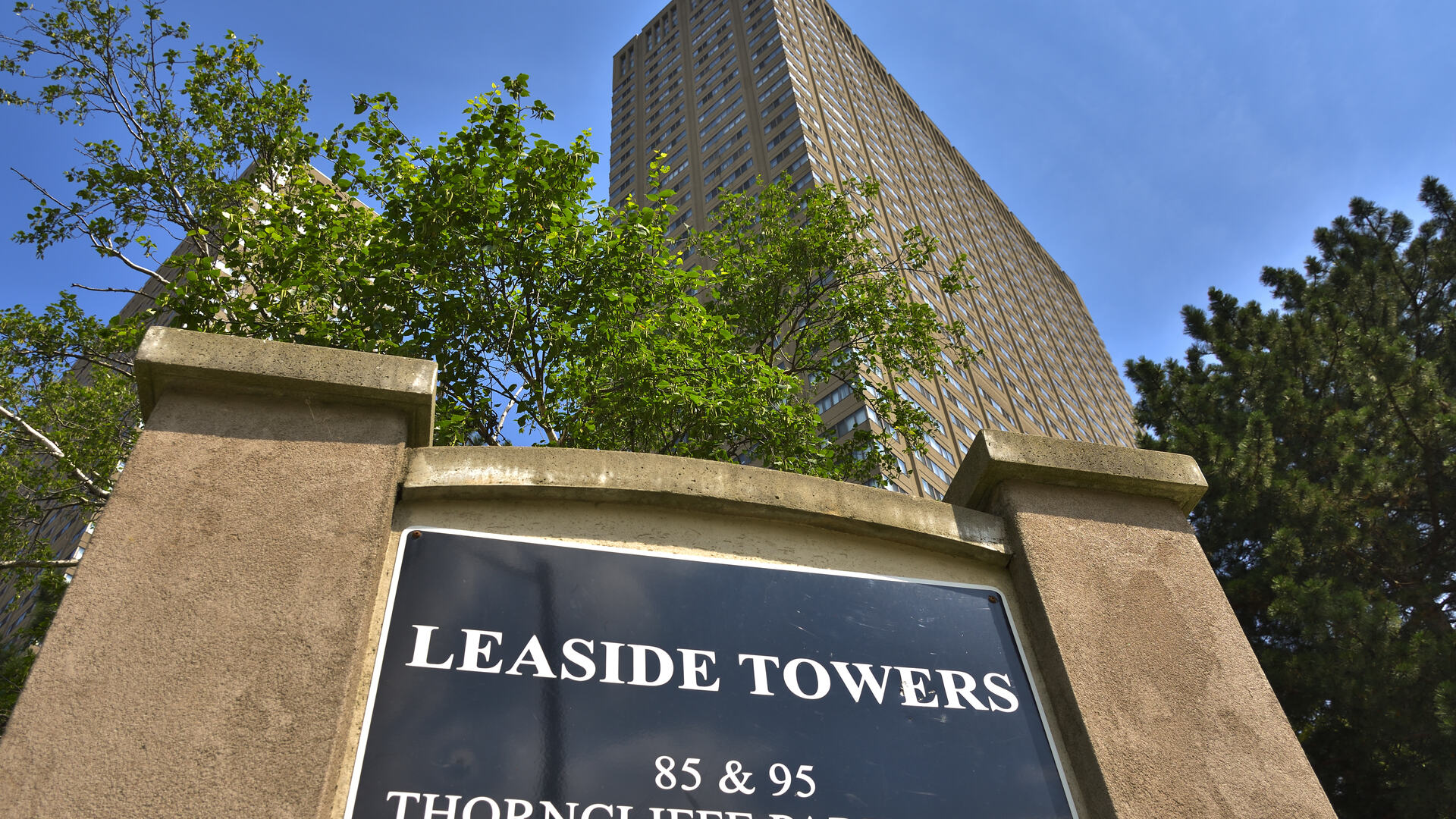
On Tuesday, Statistics Canada released its quarterly asking-rent figures. The average two-bedroom apartment listed for rent across all of Canada's census metropolitan areas asked $2,150 in the first quarter of 2026, down 0.9 per cent from a year earlier and 4.4 per cent below the peak it hit in late 2023.
The same agency's consumer price index tells a different story. The CPI rent index, the one that feeds the inflation numbers the Bank of Canada watches, was up 3.6 per cent year over year as of April.
So are rents falling or rising? Both, depending on which apartment you mean. That one distinction sorts out a lot of the arguments people have about the rental market. A separate piece found Canadian mobile phone plans have stayed among the most expensive in the G7 for years.
Two numbers, two different apartments
The asking-rent series is built from units actually listed for rent on major rental platforms — a joint Statistics Canada/CMHC program, still flagged as experimental. It prices exactly one thing: the apartment that's empty and looking for a tenant. It's the number you face if you move.
The CPI rent index measures what the whole population of tenants pays — including the large majority who aren't moving. Most leases renew with an increase: in rent-controlled provinces by the annual guideline, elsewhere by whatever the landlord asks. So even after the market for new leases turns down, the average rent paid keeps grinding upward as sitting tenants on older, cheaper leases get marked closer to market, one renewal at a time.
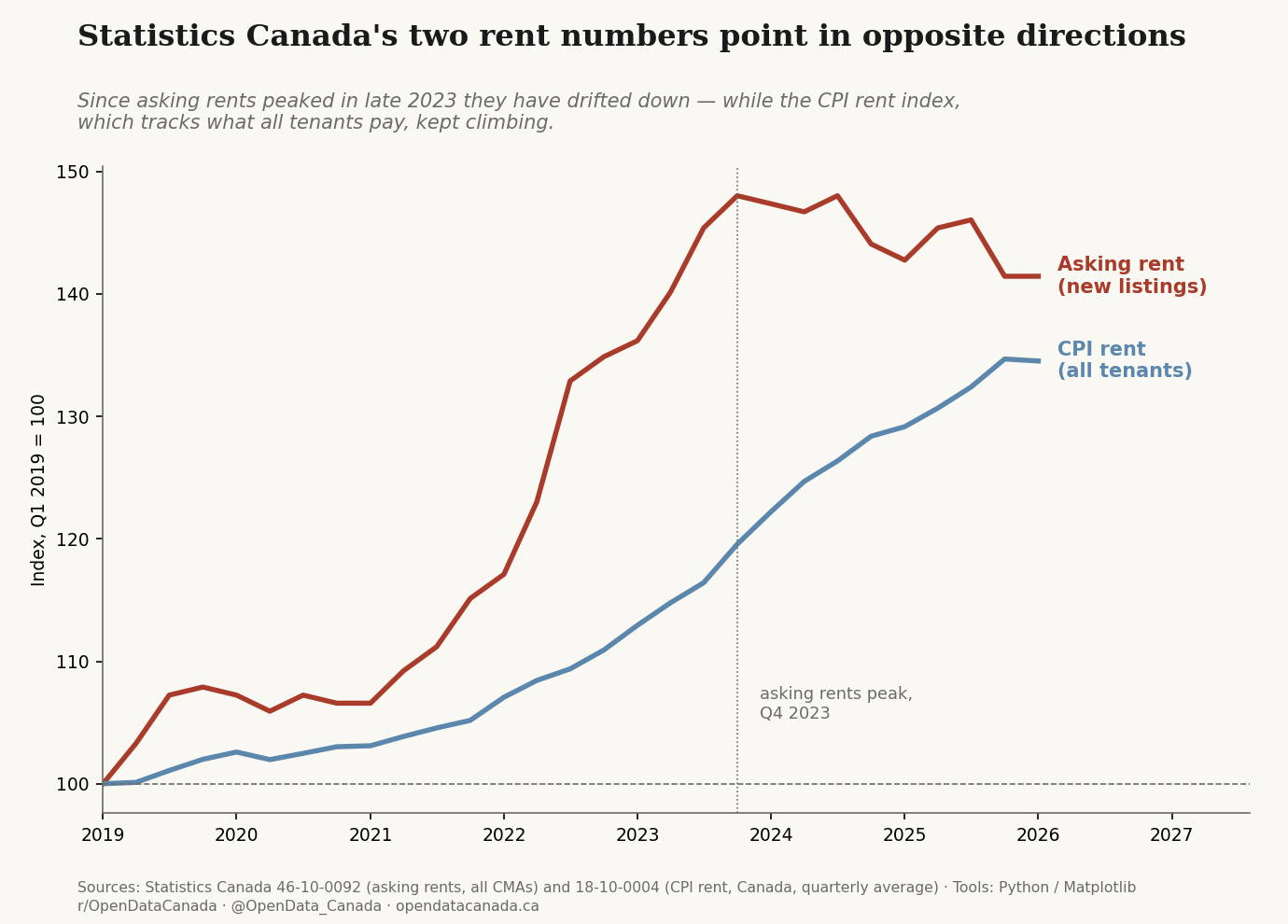
You can see the split in the chart above. Asking rents ran far ahead of the CPI through 2022 and 2023. At the peak a new lease cost nearly 48 per cent more than in early 2019, while average rents paid had risen by less than 20. Since then the two lines have been converging: asking rents drifting down, the CPI still climbing as the backlog of below-market leases catches up.
Neither number is the "real" rent. If you're hunting for an apartment, the asking-rent series is your reality. If you're renewing, the CPI is. The two-and-a-half-year-old peak matters too: every quarter that asking rents stay below it, the pipeline of future renewal increases gets a little shorter.
Falling in most big cities, setting records in the cheap ones
The national average hides a sharper split. Of the 40 metropolitan areas with data this quarter, asking rents for a two-bedroom apartment fell in 23 over the past year, rose in 14, and were flat in 3.
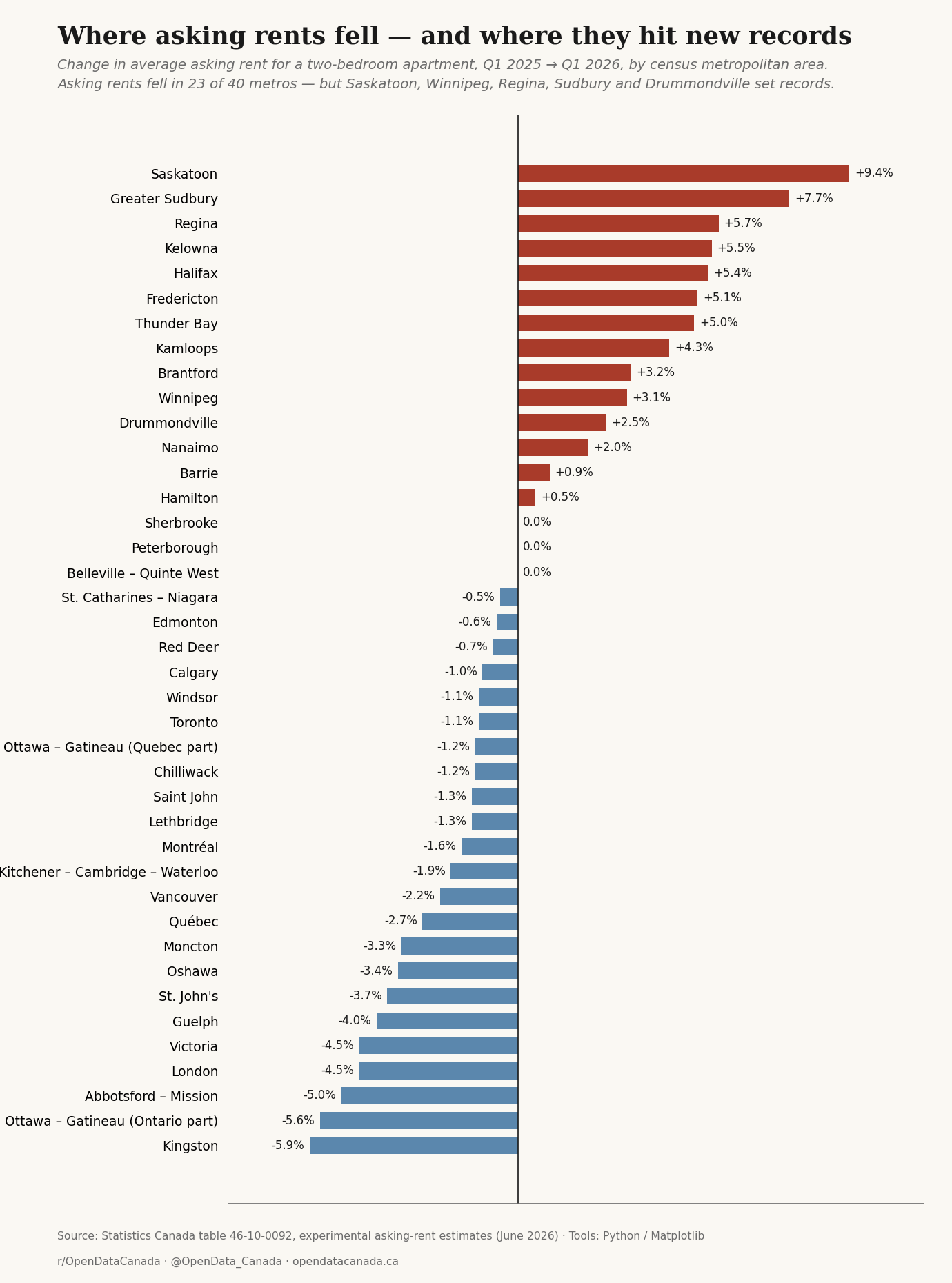
Look at who's where. The declines are concentrated in the markets that got most expensive: Kingston (−5.9 per cent), the Ontario side of Ottawa–Gatineau (−5.6), Abbotsford–Mission (−5.0), Victoria (−4.5), London (−4.5), Vancouver (−2.2), Toronto (−1.1). Calgary, the poster child of the 2023–24 rent surge, now asks 11.6 per cent less for a two-bedroom than at its 2024 peak. Kelowna is 14.7 per cent below its 2022 peak, and still managed to rise 5.5 per cent this year on the way back up.
The increases are concentrated where rent was cheapest. Saskatoon is up 9.4 per cent in a year. Greater Sudbury is up 7.7, Regina 5.7, Halifax 5.4. Saskatoon, Winnipeg and Drummondville set new all-time highs this quarter; Regina and Sudbury sit at theirs.
So the relief is showing up where rents were highest, while the squeeze has moved to the cities people fled to for cheaper rent.
Toronto: seven years, four per cent
The starkest single number in the dataset belongs to Toronto. A two-bedroom apartment listed in the Toronto CMA asked $2,660 in the first quarter of 2026. In the first quarter of 2019, it asked $2,560.
That's a 3.9 per cent increase, over seven years. Consumer prices rose 23.5 per cent over the same stretch. In real terms, the asking rent on a Toronto two-bedroom is roughly 16 per cent below where it stood in early 2019. Vancouver, up 24.5 per cent since 2019 but down 13.4 per cent from its 2023 peak, has given back more of its run-up than anywhere else in the country in dollar terms.

Now run the same seven years in the other direction. Drummondville: $600 to $1,230, up 105 per cent. Sherbrooke: up 89. Halifax: up 82. St. John's: up 74. Montréal, long the big city you could still afford to rent in, is up 68 per cent since 2019, even after a year of small declines.
Toronto renters have spent a decade being told theirs is the unaffordable city, and in level terms it still is: $2,660 buys a two-bedroom in Toronto, or two of them in Drummondville. But the change has happened everywhere else. A Halifax tenant who moved in 2019 faces a market that asks 82 per cent more; a Toronto tenant faces one asking roughly what it asked then.
Why the market turned where it did
The asking-rent data describes what happened, not why. But the timing lines up with two forces we've covered before. Population growth slowed abruptly after Ottawa capped non-permanent residents in 2024 — the boom-to-flat turn we documented in the immigration data, and new-lease demand cooled fastest in the metros where that growth had been concentrated: big-city Ontario and B.C. Meanwhile the markets still rising are the ones that absorbed the spillover of renters chasing affordability — the Prairies, the Maritimes, small-city Québec — where rental stock is thinner and a modest demand shift moves prices fast.
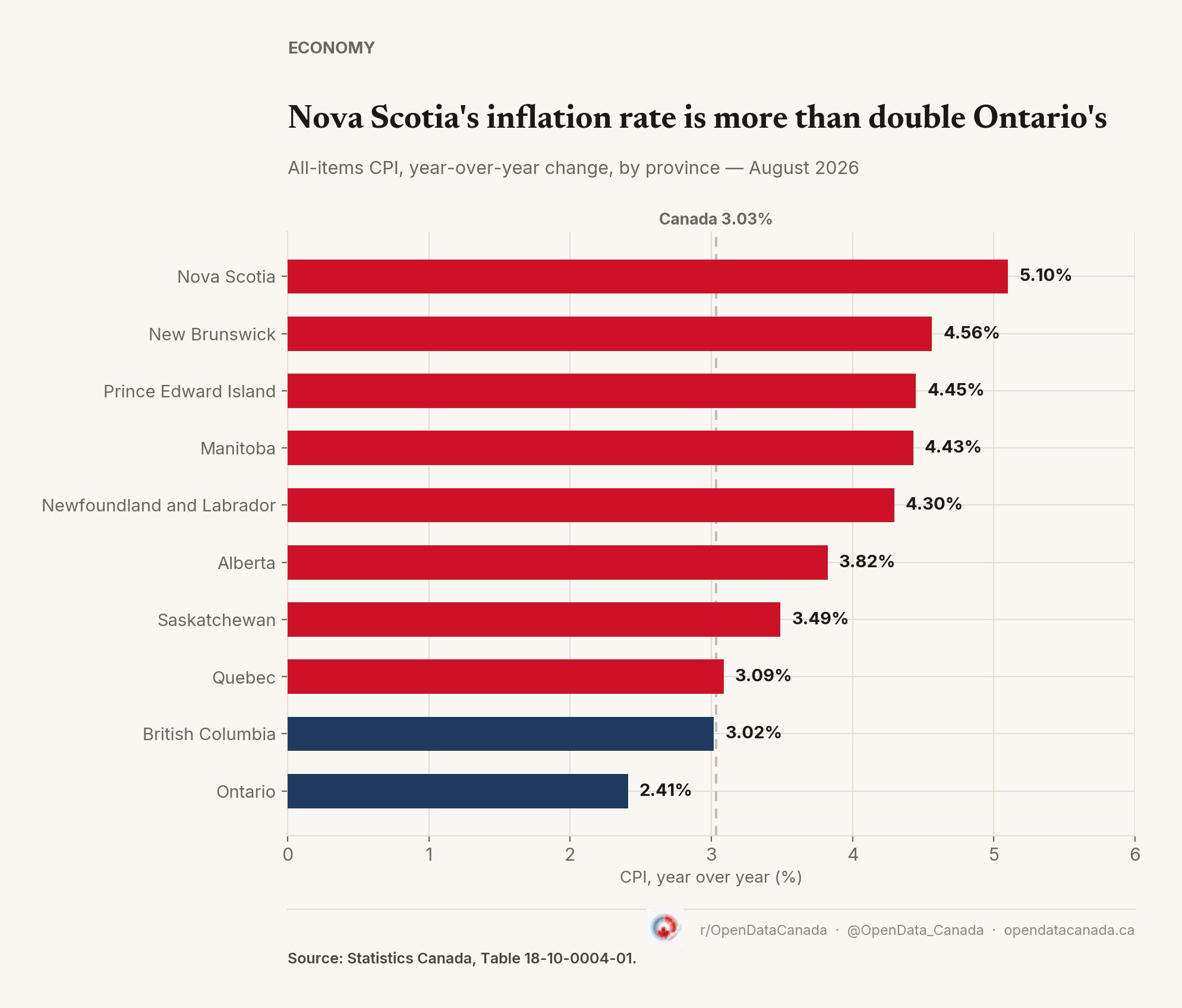
That's also why the CPI keeps rising through all of this. A falling asking rent only reaches a sitting tenant when they move, and when the gap between their lease and the market is shrinking, fewer landlords push, but renewals still step upward toward the (now lower) market level. Unless asking rents fall a lot further, the average rent Canadians actually pay will keep rising for a while yet. Statistics Canada's broader CPI release also shows a wide provincial inflation split, driven mainly by shelter costs.
Caveats worth taking seriously
This is an experimental series, and it has real limits. It measures asking rents: what landlords want, not what they settle for, and not what anyone actually pays. It's built from listings, so quarters with unusual listing mixes (more luxury units, more basement suites) can move the average without any unit getting cheaper or dearer. Values are rounded to the nearest ten dollars. Four smaller CMAs are each missing a quarter of history. And one quarter of decline in a small market — Saskatoon jumped 5.8 per cent in a single quarter — can be noise.
But the broad shape holds up across every cut of this data we ran: asking rents below their 2023 peak in most large metros while the cheap cities set records, and the CPI rent index still climbing through it all.