Economy · Telecom
Quebecor's Telus bid would shrink Canada's independent carriers from 14% of customers to 3%
Freedom and Videotron are the only national-scale challenger to Rogers, Bell and Telus. If Quebecor buys Telus, the share of cellphone customers outside the big carriers falls from 14 percent to about 3, and Canada has few other ways to keep prices in check.
Quebecor, the Montreal company that owns Videotron, Freedom Mobile and Fizz, made its offer for Telus public on Monday. It is offering 6.35 dollars in cash plus 0.17 of a Quebecor share for each Telus share, worth about 19.45 dollars, roughly 60 percent above Telus's price before the news.
Quebecor says the deal would create "a strong pan-Canadian competitor" that could invest more. It points out that Statistics Canada's cellphone price index fell 35.4 percent in the three years after it bought Freedom, from April 2023 to April 2026. Telus's board has not endorsed it. A committee of independent directors said the proposal carries "significant regulatory and execution risks" and would give Telus shareholders a minority of the votes even though they would contribute most of the value. The board added that a more indebted combined company "would be less able to invest."
For customers, the bigger question is what happens to the one sizeable carrier that is not Rogers, Bell or Telus.
In 2024, 14 percent of customers sat outside the big three
Rogers, Bell and Telus had 86 percent of Canada's mobile phone subscribers in 2024, according to the CRTC, and 89 percent of the revenue. The other 14 percent of subscribers were with smaller providers: Quebecor's brands, SaskTel in Saskatchewan, Eastlink in Atlantic Canada and a handful of others.
That group is still growing. Smaller carriers picked up more than half of the new subscribers added in 2024, by CRTC figures.
Quebecor is most of it. It had 4.62 million mobile lines at the end of September, up from 4.33 million a year earlier. At the end of 2024 it had about 4.09 million, roughly 11 percent of the 37.7 million subscribers the CRTC counted that year. Freedom and Fizz now cover much of Ontario, Alberta, British Columbia and Manitoba, and Videotron covers Quebec.
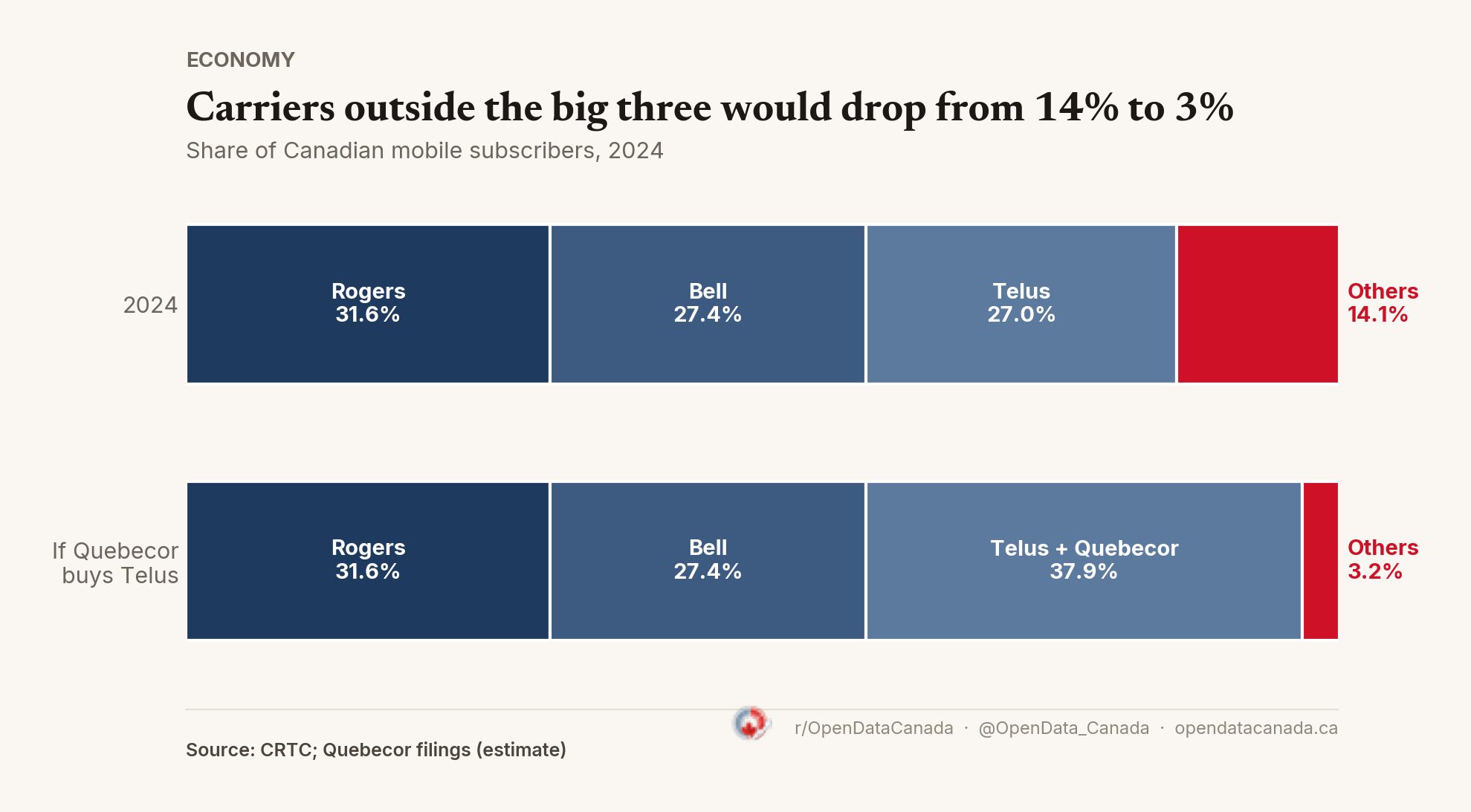
If the deal goes through, Telus and Quebecor together would have about 38 percent of subscribers, more than Rogers. Carriers outside the three biggest owners would be left with about 3 percent, unless regulators make Quebecor sell part of the business, as Rogers had to sell Freedom to buy Shaw.
Few others can fill the gap
A carrier that owns its own towers and spectrum can set its own prices. A reseller, which rents space on someone else's network, can only go as low as its wholesale deal allows.
Canada has few independent resellers. Under a 2021 CRTC decision, Telus, Bell, Rogers and SaskTel must rent network access, but only to regional carriers that run their own networks and hold spectrum licences in that area. A company without its own network does not qualify, and has to negotiate whatever deal a big carrier will give it.
The big three are also less separate than they look. Telus and Bell share their radio networks, with each responsible for the towers and antennas in different parts of the country, according to Telus's 2025 annual report. They still compete for customers on price and plans. A merger takes away that kind of rivalry between owners, even when the towers stay the same.
That leaves Freedom and Videotron as the main national challenger.
In Quebec, where the fourth carrier is strongest, bills are lower
Quebec is Videotron's home market. Carriers other than Bell, Telus and Rogers, mainly Videotron, held 25.7 percent of Quebec's subscribers in 2024, up from 9.3 percent in 2013, according to the CRTC.
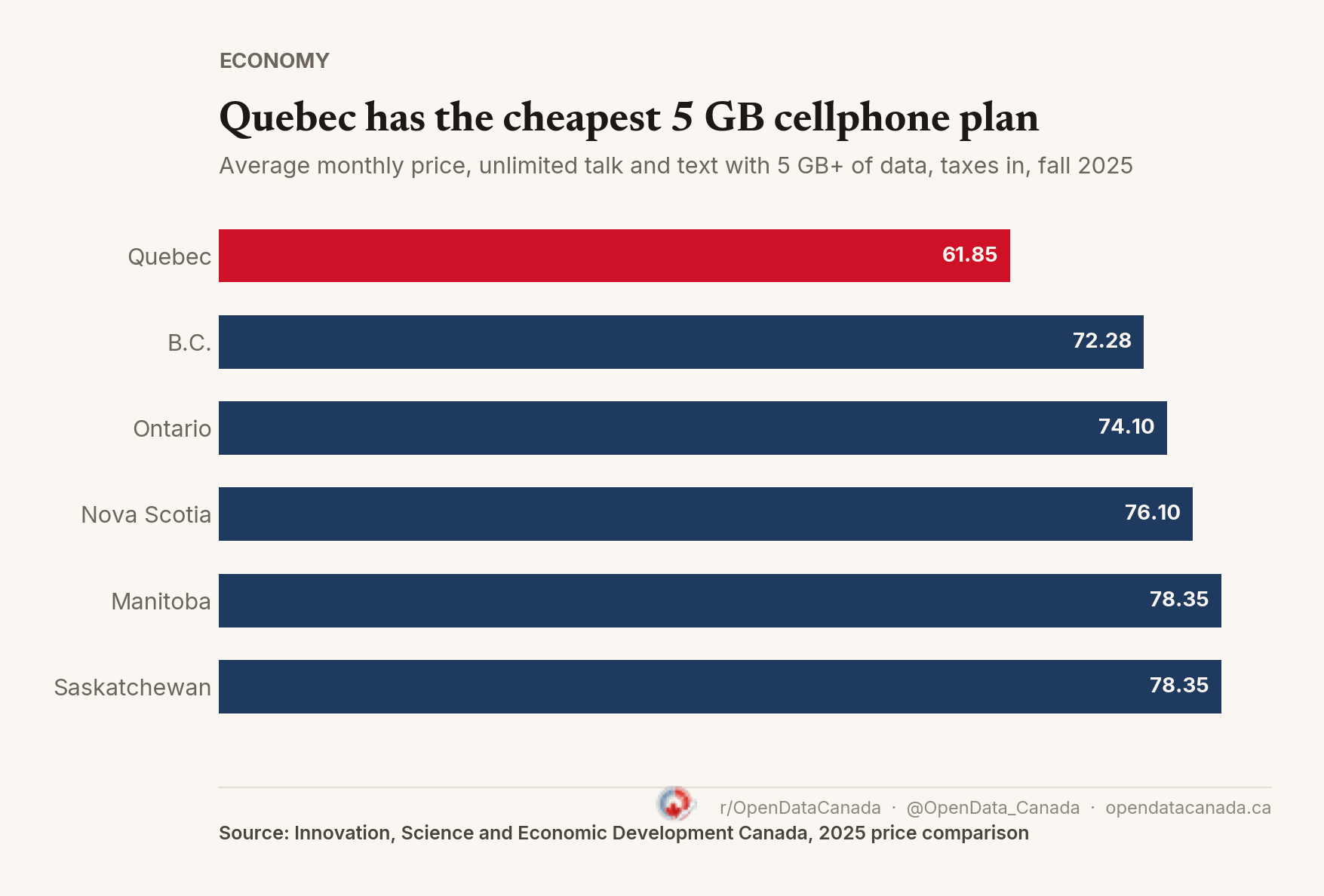
Quebec also had the lowest average price for a 5 GB plan in the latest federal price study by Innovation, Science and Economic Development Canada (ISED), dated May 7. In fall 2025, unlimited talk and text with at least 5 GB of data averaged 61.85 dollars a month in Quebec, against about 70 to 78 dollars in the other regions. Sales taxes are included, and Quebec's are among the highest in the country.
The Competition Bureau made the same point in 2022, when it tried to block the Rogers-Shaw deal. It said its 2019 study found prices "can be 35 to 40% lower" in regions with wireless disruptors. The bureau lost that case. Rogers and Shaw sold Freedom to Videotron so the deal could go ahead.
The pattern has limits. Saskatchewan also has a big fourth player, the provincially owned SaskTel, and it ties Manitoba for the highest average price. As of October 2026, Quebec's cellphone price index was also down less than Ontario's since April 2023, 18 percent against 30 percent, though Quebec started from a lower price.
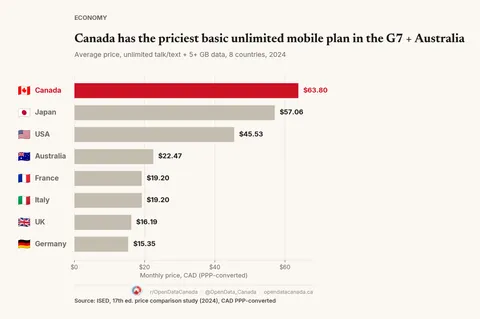
Prices are not on a straight path down, either. The national average for the 5 GB plan rose 11 percent in 2025, to 70.63 dollars, after a year of heavy promotions in 2024. That was the highest of the eight countries ISED compared.
What happened when other countries went from four to three
Austria went from four carriers to three in 2013, followed by Ireland and Germany in 2014. A 2018 review by Europe's telecom regulators (BEREC) found at least some evidence that prices for new customers rose after each merger. The German results were the least firm. In Austria the rise faded by 2016, likely because resellers won customers. The regulators also noted that the wider research is mixed.
A study of 33 countries from 2002 to 2014, by economists Christos Genakos, Tommaso Valletti and Frank Verboven, estimated that a four-to-three merger raises the average bill by about 4 to 7 percent for carriers of different sizes, and 16.3 percent in a market of equal-sized carriers. Investment per carrier went up, but total industry investment did not change significantly. Those are averages across past mergers, not a forecast for this one.
Austria is the case where the damage faded, and resellers did that work. Canada's rules leave them little room.
What Carney said
Asked in Shenzhen on Wednesday, Prime Minister Mark Carney said: "I'm not going to make a direct comment about the number of players in the market, which would necessarily imply a conclusion about any specific transaction." Asked later about phone prices in general, he said: "Depending on the market structure, the form of oligopoly can lead to more competition with fewer players under certain circumstances." He added that "if we can have more competition, lower prices, better service for Canadians, that's where we're going to land."
The deal needs approvals from the CRTC and ISED, and the Competition Bureau can challenge it. Quebecor's pitch is that a bigger Quebecor can compete harder. The question in front of regulators: once Quebecor owns Telus, who is left to undercut the big three?