Article · Environment · 3 min read · Follow-up
Cheap EVs can't replace Quebec's lost rebate before the year is out
Quebec's EV market crashed when its provincial rebate ended in January 2025. The first 2026 numbers are in, and matching last year's total by December would take almost triple the current sales pace, more than a revived federal rebate or a new quota on Chinese imports can deliver.
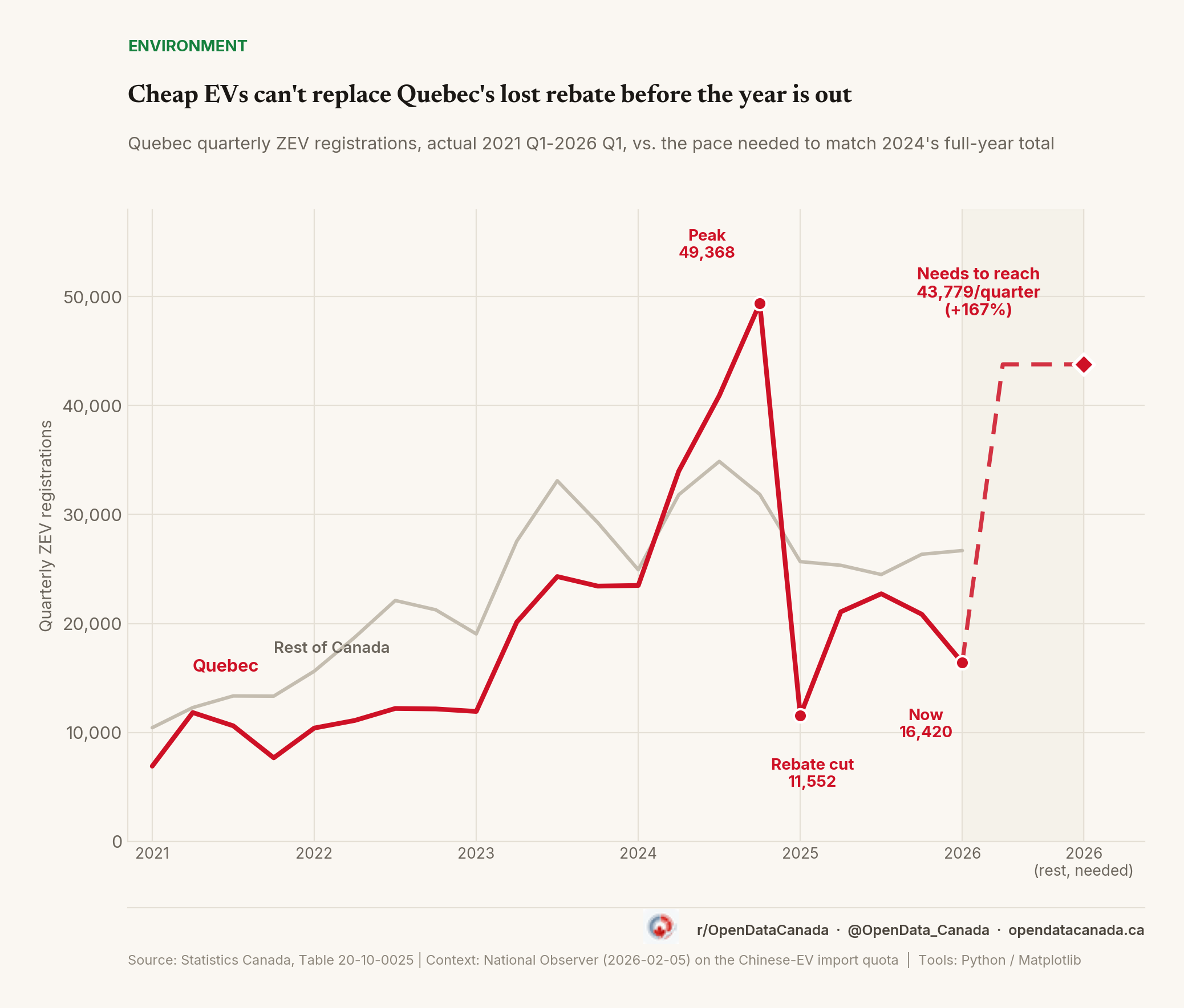
We reported in May on the mechanics of the crash: Quebec's Roulez Vert rebate and the federal iZEV rebate both ended within weeks of each other in January 2025, and Quebec's zero-emission vehicle (ZEV) share fell from 40% to 13% of new registrations in a single quarter. That piece closed on an open question: would 2026 bring a genuine recovery, or another rebate-driven spike and crash? Statistics Canada's first-quarter 2026 registrations are out, and they answer it.
Quebec registered 16,420 new ZEVs in the first quarter of 2026. That's up from the 11,552 trough hit the moment Roulez Vert lapsed, but it's a third of the 49,368 quarterly pace Quebec was running at its late-2024 peak. To match 2024's full-year total of 147,757 vehicles, Quebec would need to average 43,779 registrations a quarter for the rest of 2026, a 167% jump from where it sits now.
No other part of the country is in this position. The rest of Canada needs its ZEV sales to rise just 21% over the same stretch to match its own 2024 total. The asymmetry traces directly to what each market actually lost. Right up until January 2025, a Quebec buyer could stack the federal iZEV rebate ($5,000) on top of the provincial Roulez Vert incentive, which had already been phased down from a $7,000 peak to $4,000. Call it $9,000 combined, on top of a program that started as high as $12,000. Ontario, which cancelled its own EV rebate in 2018, only ever had the federal $5,000. Quebec's market was built on the bigger subsidy, so it has the bigger hole to climb out of.
Two things are supposed to help fill that hole this year, and neither is sized for the job.
Ottawa's replacement federal rebate, the Electric Vehicle Affordability Program (EVAP), launched February 16, 2026, offering up to $5,000 on EVs priced at $50,000 or less. It's real, and it accounts for some of the national recovery. But it restores the federal floor both Quebec and Ontario already had. It does not restore the provincial top-up that was specific to Quebec and is still gone.
The other proposed fix is cheap imports. Canada swapped its 100% tariff on Chinese-made EVs for a straight quota (a 6.1% duty on the first 49,000 vehicles a year) starting January 2026. Run the most generous version of that math: if every one of those 49,000 units landed in Quebec and nowhere else in the country, it would close only about 60% of Quebec's own annual shortfall of 82,077 vehicles. In practice it will do far less than that, because Chinese brands don't have Canadian dealership networks yet. Dongfeng gave its first Canadian showcase in Montreal this past July, targeting certification for 2027. The realistic 2026 contribution from the quota is close to zero, not 49,000.
One Quebec EV number does look healthy, and it's the wrong one for this story. The registration figures above are a flow, new vehicles hitting the road each quarter, and that flow is still depressed. The Association des véhicules électriques du Québec (AVÉQ), using registration data from the Société de l'assurance automobile du Québec (SAAQ), counted 440,554 electric vehicles on Quebec roads as of December 31, 2025, up 17% from a year earlier after a fourth-quarter gain of 14,018 vehicles. That stock keeps growing every quarter, because it only adds; it never subtracts vehicles already on the road. The crash only shows up in the flow.
National Observer reported in February that the 49,000-unit quota "won't come close" to getting Canada to its national EV targets. That argument holds nationally. It holds even harder in Quebec, where the hole is deeper and the timeline is shorter: an incentive that started at $12,000 is down to a federal $5,000, and eight months are already gone from the year Quebec needs to recover in.
There's a second Quebec-specific mechanism absorbing this crash, separate from the rebates: the province's zero-emission vehicle standard, a mandate that requires automakers to earn compliance credits (roughly one per battery-electric vehicle sold, half a credit per plug-in hybrid) equal to a rising percentage of their Quebec sales, or pay a penalty currently set at $20,000 per missing credit. The requirement for model year 2026 is 32.5%. A think tank brief from the Institut économique de Montréal, published as part of the province's public consultation on the standard, estimated Quebec's actual credit generation using that same formula against Statistics Canada's registration data, and it has collapsed alongside the sales numbers.
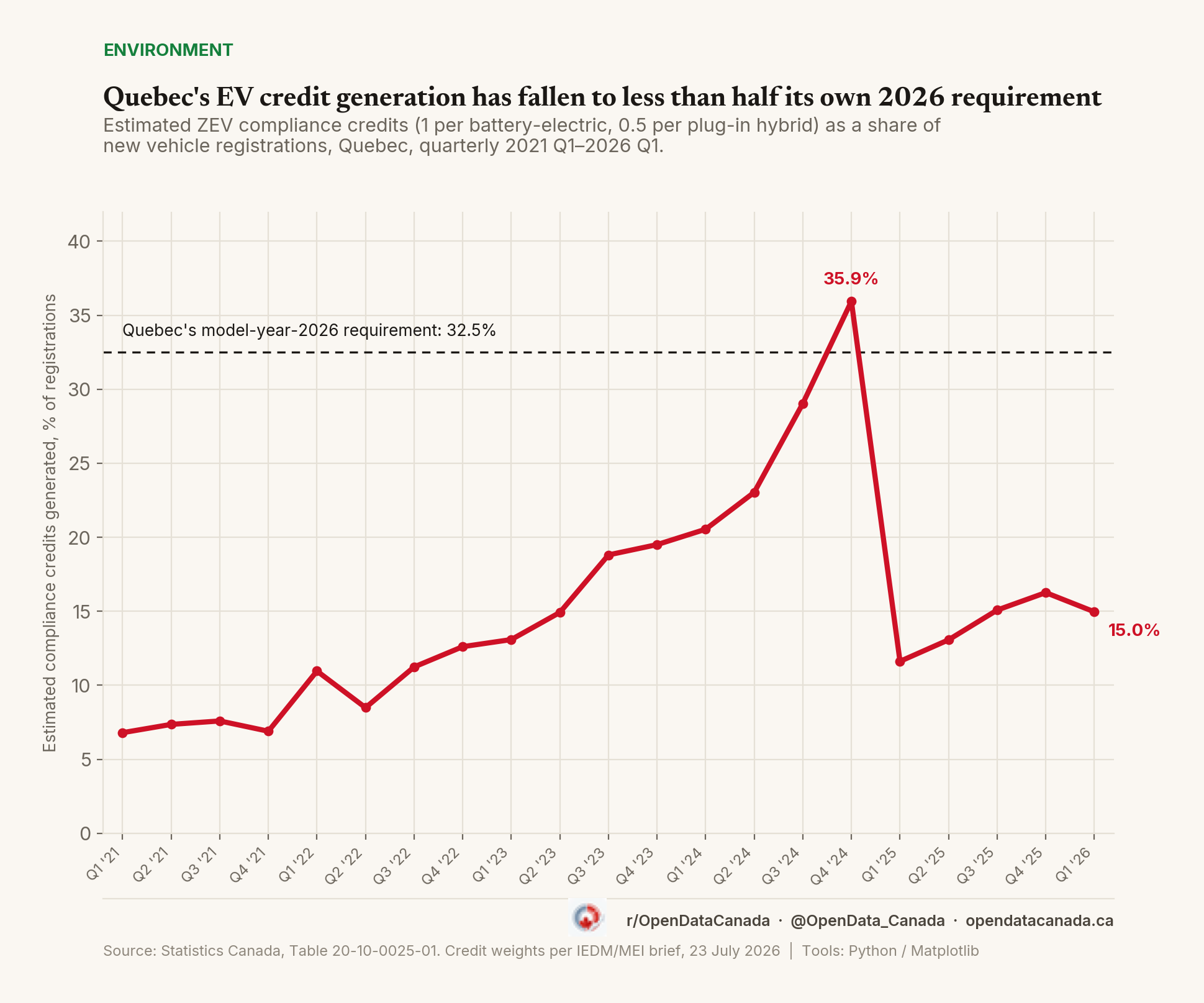
At the Q1 2026 pace, Quebec is generating credits equal to roughly 15% of registrations, less than half the 32.5% required for the model year. Manufacturers can bank surplus credits from stronger years and the compliance window runs multiple years at a time (2025 through 2027 for the current period), so one soft quarter doesn't trigger a penalty on its own. But the credit math and the sales math are the same underlying number, viewed two ways, and both say the same thing: the province built a mandate around a sales pace that its own rebate cancellation then undercut.
Quebec's response, now out for consultation, is to lower the bar rather than fix the gap. The current regulation calls for the ZEV credit requirement to reach 100% by 2035; the draft revision under review would cap it at 80%. The mandate is loosening at the exact moment the market it governs is furthest behind. Read plainly, it's the regulator's own updated planning assumption that a meaningful share of the Quebec market still won't be electric even at the mandate's 2035 endpoint — which undercuts the idea, raised earlier in this piece, that a revived federal rebate or cheap Chinese imports can close the gap on their own.
The province's own cost projections have moved in the same direction. Quebec's regulatory impact analyses for the ZEV standard include an estimate of when a long-range (roughly 640 km) electric vehicle reaches sticker-price parity with an equivalent gasoline car, without subsidy. In July 2023, that estimate was 2031. The revised analysis, released in June 2026 alongside the draft 80% cap, puts it at 2047.
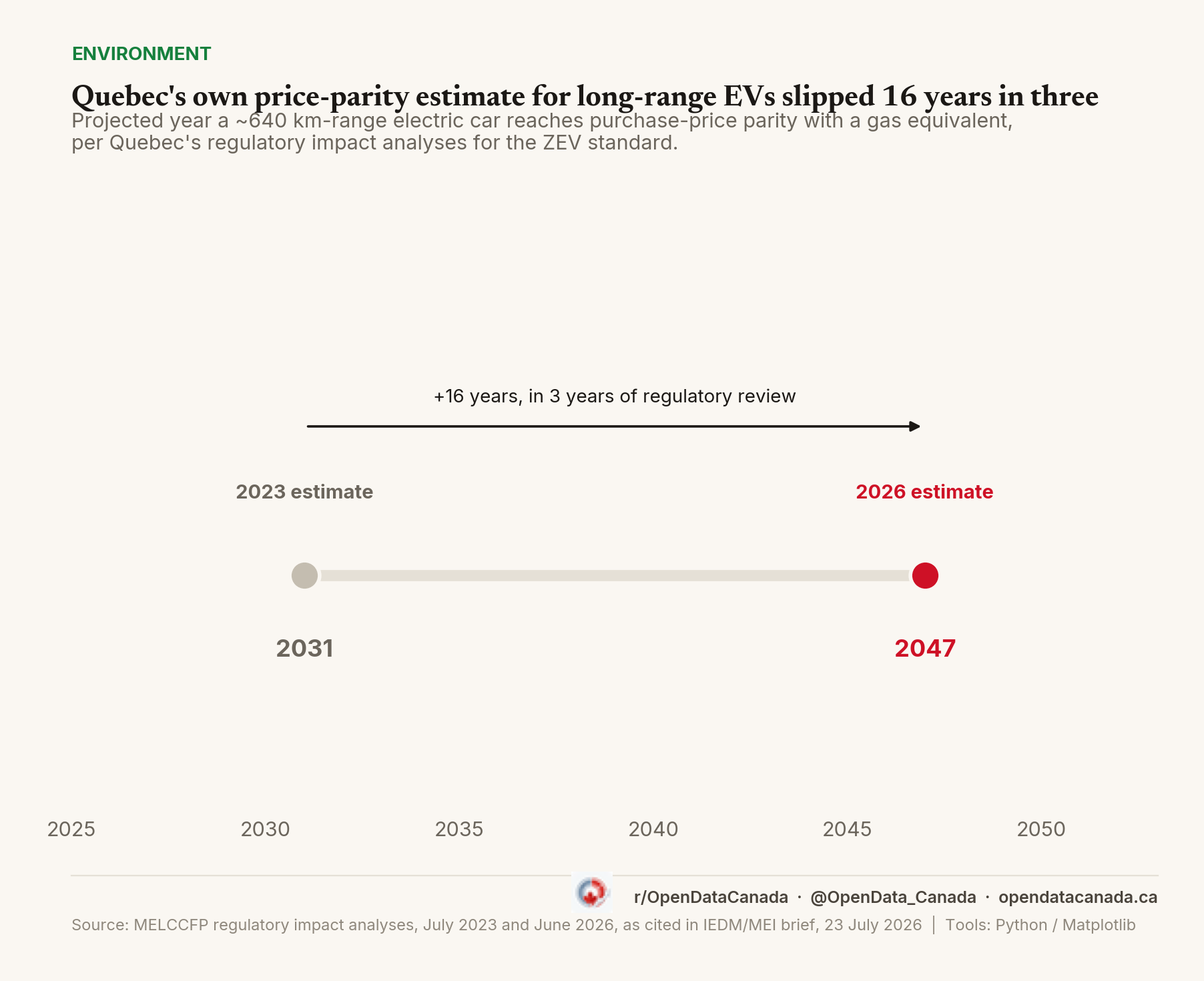
Sixteen years is not a rounding adjustment to a forecast; it is the province's own modelling telling it that the economic case for the mandate it wrote in 2020 no longer holds on the timeline it assumed. A rebate ending on schedule was supposed to matter less each year as EVs got cheaper to make on their own. Quebec's newest numbers say that convergence point moved from just past the mandate's own 2035 target to twelve years beyond it.