Article · Industry · 7 min read
Canada's EV market didn't slow — it was switched off
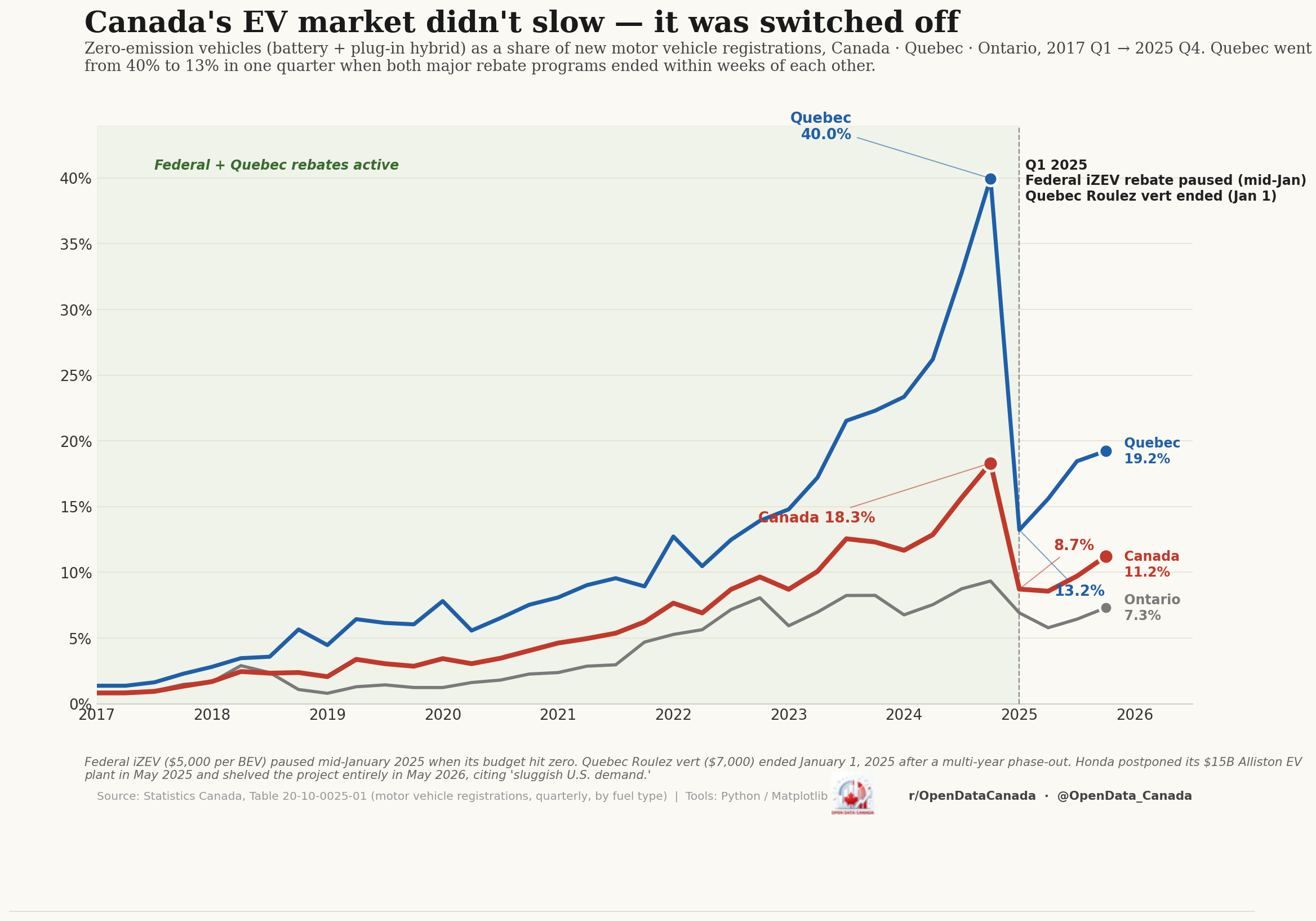
Honda is shelving its C$15 billion Alliston EV investment, citing "sluggish U.S. demand." But the Canadian story is sharper. Quebec went from 40% zero-emission vehicle share to 13% in one quarter when Ottawa and Quebec City ended their two main rebate programs within a month of each other.
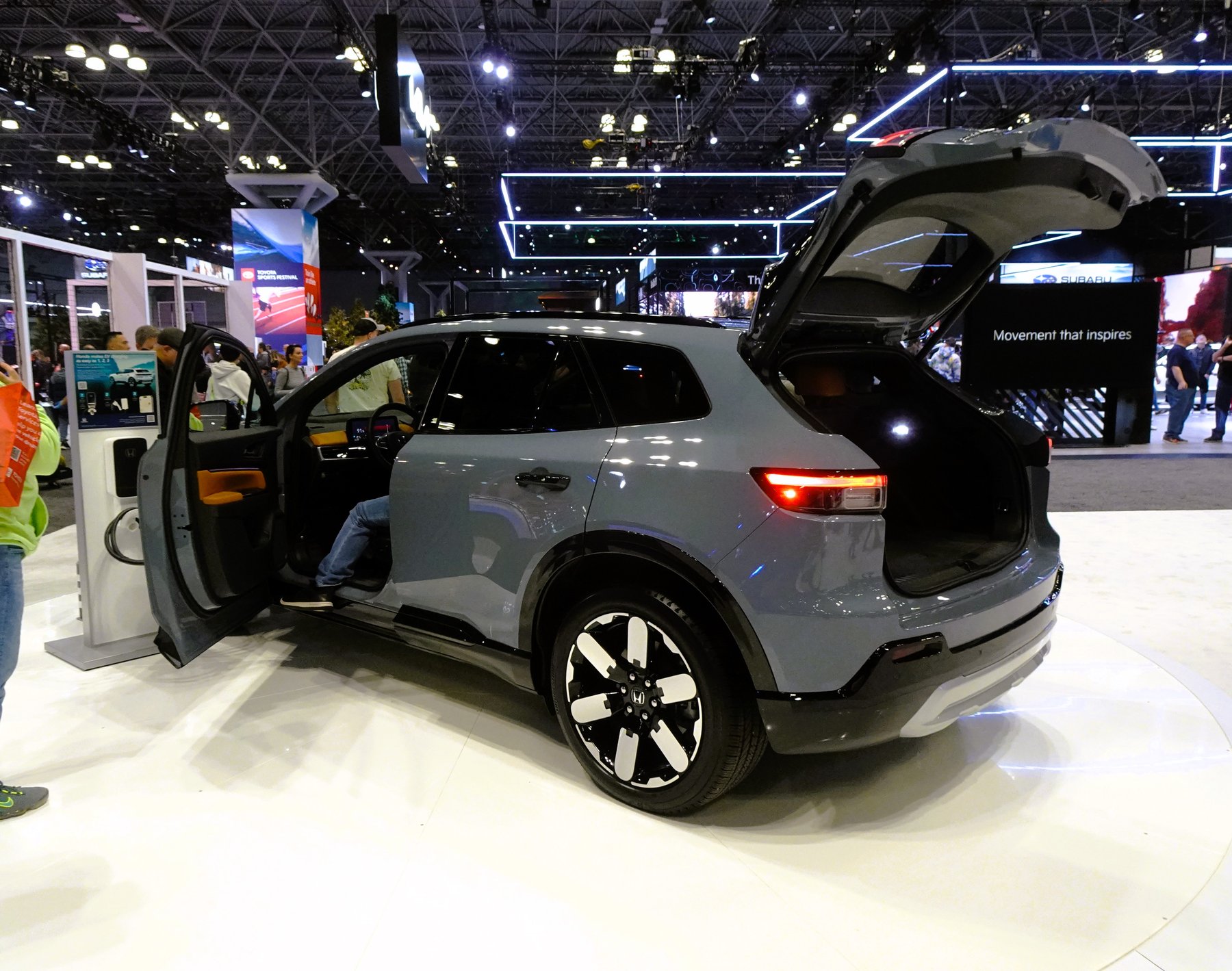
Nikkei Asia reported on 6 May 2026 that Honda is shelving its C$15 billion (US$11 billion) Alliston, Ontario electric-vehicle investment — an escalation of the two-year postponement Honda announced in May 2025. The cited reason is "sluggish U.S. demand," and the company is also discontinuing the GM-collaborated Prologue EV.
The plant was for the North American market. Most of the public conversation that follows a story like this focuses on US ZEV sales — which have indeed softened. But Canadian demand has rarely been pulled apart from US demand in the coverage. It should be. The Canadian story is more dramatic than the US one, and it points at a different mechanism.
What the data actually says
Statistics Canada Table 20-10-0025-01, published quarterly, breaks new motor vehicle registrations by fuel type and province. The series runs from Q1 2017 to Q4 2025. Three lines tell the story:
| Quarter | Canada ZEV share | Quebec ZEV share | Ontario ZEV share |
|---|---|---|---|
| Q1 2017 | 0.8% | 1.4% | n/a |
| Q4 2022 | 9.7% | 13.9% | 7.2% |
| Q4 2023 | 12.3% | 22.3% | 8.2% |
| Q3 2024 | 15.7% | 32.8% | 8.7% |
| Q4 2024 (peak) | 18.3% | 40.0% | 9.3% |
| Q1 2025 | 8.7% | 13.2% | 6.9% |
| Q2 2025 | 8.6% | 15.6% | 5.8% |
| Q3 2025 | 9.7% | 18.5% | 6.4% |
| Q4 2025 (latest) | 11.2% | 19.2% | 7.3% |
Three things stand out.
First, the cliff is real and large. Canada's ZEV share fell 9.6 percentage points in one quarter — the largest single-quarter drop in the series. Quebec's fell 26.7 percentage points. By comparison, the largest prior single-quarter swing in the Quebec series in either direction was the +7.2 point climb from Q3 to Q4 2024 — which was itself partly the rebate-end pull-forward effect.
Second, the cliff aligns with two specific calendar events, not gradual erosion. The federal iZEV rebate ($5,000 per battery EV, up to $2,500 per plug-in hybrid) ran out of money in mid-January 2025; Transport Canada announced an immediate pause, the program was wound down, and remaining commitments were paid out by 31 March 2025. Quebec's Roulez vert provincial rebate ($7,000 at peak, phased down through 2024 to $4,000 in late 2024) ended entirely on January 1, 2025. The two ends were essentially simultaneous, and they applied to the country's two largest ZEV markets. There was no federal replacement for eleven months — the new Electric Vehicle Affordability Program (EVAP, $2.275 billion over five years) only launched on 16 February 2026.
Third, the geography is the proof. Ontario has had no provincial ZEV rebate since the Ford government cancelled it in 2018. Ontario's ZEV share fell only 2.4 percentage points across the same Q4-2024 → Q1-2025 window — about a quarter of the magnitude of the Canadian average and roughly a tenth of Quebec's drop. If the cliff were a North American demand story, Ontario should have moved with the rest. It mostly didn't.
The Q4 2024 spike was partly artificial — the Q1 2025 drop wasn't
A reasonable objection: Q4 2024's 18.3% national share included an end-of-rebate buying surge. Buyers who would have purchased in Q1 2025 pulled forward to take advantage of incentives that were public knowledge as ending. The peak is therefore inflated.
That's true, and the cumulative national ZEV registration count from Q4 2024 (81,200) was indeed elevated — about 7% higher than Q3 2024. But the inflation flows the wrong way for explaining the Q1 2025 number. If buyers pulled their purchases earlier, Q1 2025 is artificially low — meaning the true post-policy baseline is somewhere between the 8.7% Q1 floor and the 11.2% Q4 2025 reading. By Q4 2025, with the pull-forward effect long unwound and any inventory backlog cleared, Canada's ZEV share was still 7.1 percentage points below the Q4 2024 peak. Quebec was still 20.8 percentage points below. Reaching 2024's peak from here means Quebec's EV sales need to almost triple.
This is the floor, not a transient blip. The post-rebate equilibrium is roughly half the rebated equilibrium.
North America had two policy cliffs in 2025, not one demand slowdown
Honda's stated rationale is sluggish U.S. demand. That framing is half-right and half-wrong, and the half-wrong part is interesting.
U.S. ZEV demand did fall — sharply. Cox Automotive's reporting puts the U.S. all-electric share at roughly 10.5% in Q3 2025 and 5.8% in Q4 2025, a 46% quarter-on-quarter collapse. The Q4 drop almost exactly matches Canada's Q1 cliff in shape. But it didn't happen for the reason "sluggish demand" implies. The U.S. federal $7,500 EV tax credit was eliminated under the One Big Beautiful Bill Act, with the cut-off taking effect 30 September 2025. The Q4 2025 collapse is the U.S. equivalent of Canada's Q1 2025 collapse — same mechanism, different quarter, different program.
What that means: 2025 was the year North America ran the policy experiment in stereo. Canada removed its federal and Quebec rebates simultaneously in January. The U.S. removed its federal credit in October. Both jurisdictions saw their ZEV share roughly halve in one quarter. In neither case was the cause a generalised consumer turn against EVs — vehicles, prices, charging networks, and consumer awareness were all stable across the inflection.
The case the data makes isn't that North American consumers don't want EVs. It's that North American consumers responded to rebates, the rebates ended on different timetables in the two countries, and the cumulative effect in 2025 was that the announced North American ZEV demand fell by half. Honda is responding to that announced demand. But the underlying mechanism is policy choice in two governments, not consumer preference in one continent — and Canada's choice in particular has now been partially reversed, with EVAP starting in February 2026.
What the Q4 2025 number does and doesn't tell us
The most recent quarter (Q4 2025) shows partial recovery: Canada at 11.2%, Quebec at 19.2%. Two readings are possible.
The first is that consumers absorbed the rebate end and ZEV share is rebuilding from a new baseline. The case for this reading is straightforward — vehicle economics improve as battery costs fall, used-EV markets grow, and charging networks expand independently of incentives. The recovery is consistent with that.
The second is that the announcement of EVAP in late 2025 was already pulling demand forward in anticipation of February 2026's launch — a re-run of the Q4 2024 dynamic. If true, Q1 and Q2 2026 will show another, smaller spike, followed by another drop when EVAP's annual envelope is exhausted.
Either way, the Honda decision is being made on Canadian data that ends in December 2025. We won't know which reading is right until Q1 2026 registrations are released in mid-2026. By that point, the plant decision is already made. Honda's shelved investment fits a broader pattern: Canada's auto manufacturing has been declining for a quarter century.