Explainer · Justice
Who does Quebec's religious symbols ban affect? The numbers behind Bill 21
The Supreme Court of Canada upheld almost all of Bill 21 on November 27. The law applies to everyone in covered jobs, whatever their faith. Census data shows how different Quebec's Muslim, Jewish and Sikh communities are in size from those in the rest of Canada.
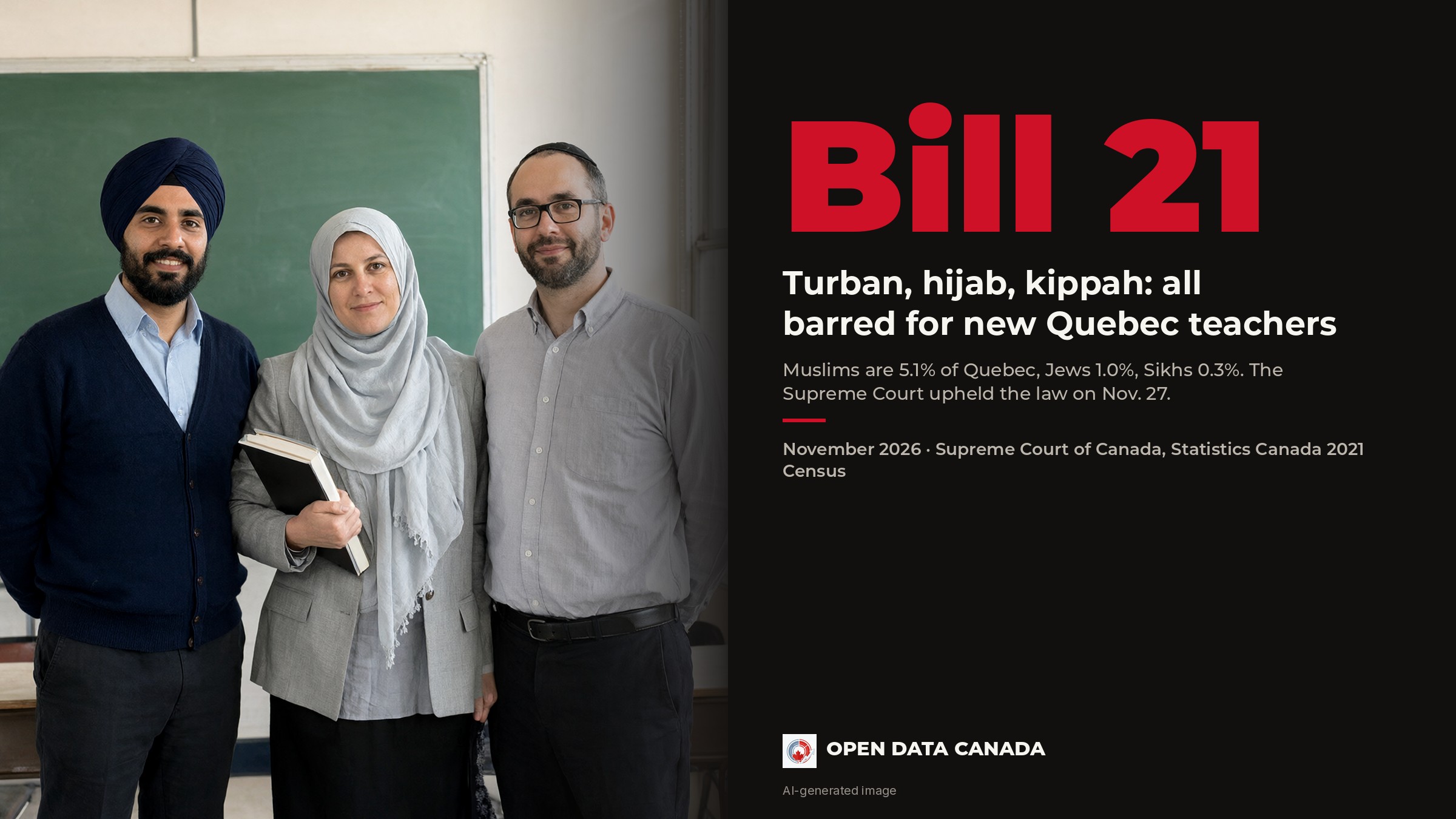
The Supreme Court of Canada has upheld most of Quebec's Bill 21, so the province can keep barring teachers, police officers and other public workers in positions of authority from wearing religious symbols on the job.
The law never names a religion. A cross, a kippah, a turban and a hijab are all covered. But who lives in Quebec shapes who is likely to run into it, and the census shows that the province's religious makeup is not a smaller copy of Canada's. Muslims make up 5.1% of Quebec, a slightly larger share than in Canada as a whole. Sikhs make up 0.3%, against 2.1% nationally.
The ruling also reaches well beyond Quebec. It is the court's clearest statement yet on what the notwithstanding clause can and cannot do.
What did the Supreme Court decide on Bill 21?
The decision, English Montreal School Board v. Quebec (Attorney General), 2026 SCC 41, was signed by seven judges. According to a plain-language summary prepared by court staff:
- The law stands. Six judges found Quebec validly used the notwithstanding clause in the Canadian Charter (section 33) and the matching override in Quebec's own Charter of Human Rights and Freedoms (section 52). That shields Bill 21 from challenges based on freedom of religion, freedom of expression and equality rights.
- One rule fails for elected members. Bill 21 requires people in many public roles to do their jobs with their face uncovered. Seven judges found that, applied to members of Quebec's National Assembly, this infringes section 3 of the Charter, which protects the right to vote and to run for a seat in a legislature. Section 3 is outside the reach of the notwithstanding clause, which covers only section 2 and sections 7 to 15. The summary says the rule keeps elected members whose faith requires a face covering from sitting and taking part in the Assembly's work.
- Courts can still say a law breaks the Charter. Four judges held that the notwithstanding clause does not stop a court from issuing a declaration that a law is inconsistent with Charter rights. A different group of four said no such declaration should be made in this case, so none was.
That third point is the one to watch. A declaration does not cancel a law. While the override is in place, the law keeps working. What the Supreme Court has confirmed is that a court can put on the record that a protected law breaches rights.
The court also also found that Bill 21 does not breach the minority-language school rights in section 23, the English school boards' main argument. It rejected the claim that section 28 of the Charter, which guarantees rights equally to men and women, could strike the law down by itself. Section 28 guides how other rights are read, the court's summary says, but "it alone does not create a distinct right that could be invoked to challenge a law."
How is Quebec's religious makeup different from Canada's?
Quebec is far more Catholic than the rest of the country. In 2021, 53.8% of Quebecers said they were Catholic, compared with 29.9% of all Canadians. Fewer Quebecers reported no religion (27.3% versus 34.6%).
The minority faiths are where the picture gets uneven:
| Religion | People in Quebec | Share of Quebec | Share of Canada |
|---|---|---|---|
| Muslim | 421,710 | 5.1% | 4.9% |
| Jewish | 84,535 | 1.0% | 0.9% |
| Hindu | 47,390 | 0.6% | 2.3% |
| Sikh | 23,345 | 0.3% | 2.1% |
| Catholic | 4,472,560 | 53.8% | 29.9% |
| No religion | 2,267,715 | 27.3% | 34.6% |
Quebec is not less diverse across the board. Its Muslim and Jewish shares are at or above the national level. Its Sikh and Hindu shares are a fraction of it.
Where do Canada's religious communities live?
Another way to read the same data: what share of each community lives in Quebec? Quebec holds 22.9% of Canada's population. If a group were spread evenly, about 23% of its members would live there.
- Jewish Canadians: 25.2% live in Quebec, slightly more than an even share.
- Muslim Canadians: 23.7%, almost exactly an even share. That is roughly one in four.
- Hindu Canadians: 5.7%.
- Sikh Canadians: 3.0%, about one in thirty.
Sikhs are a small community in Quebec: 23,345 people, or 0.3% of the province. The larger minority communities whose members may wear a visible symbol such as a hijab or kippah are Muslims (421,710) and Jews (84,535).
Why Sikhs were at the centre of the case
For an observant Sikh, the turban is not a garment that comes off for work. That is why the World Sikh Organization of Canada was one of the main challengers all the way to the Supreme Court, alongside the English Montreal School Board, a teachers' union and others.
The best-known person caught by the law is Amrit Kaur, a Sikh teacher and vice-president of the organization's Quebec chapter. She left Quebec for British Columbia in 2019 so she could keep teaching with her turban on. At the Supreme Court hearing in March 2026, her lawyers argued that removing her turban to enter a classroom would be an abandonment of who she is.
Small numbers cut both ways. Few Quebecers are Sikh, so the law touches few people in absolute terms. But for a community of 23,000, a handful of teachers leaving or never applying is a large share of its teachers, and Kaur's move shows the exit is a real option: in eight other provinces, a turban is no bar to the classroom.
What the census can't tell you
The census counts religious affiliation. It does not ask whether someone wears a religious symbol, and it cannot say how many people hold the jobs Bill 21 covers, or how many were turned away from them. There were 203,460 Muslim women and girls (all ages) in Quebec in 2021, but no public dataset reports how many wear a hijab or work as teachers.
That gap matters because the debate over Bill 21 has always been about a specific group of workers. The census shows which communities are present in Quebec in large numbers. It cannot count the people who lost a job offer.
What does Quebec's secularism law cover now?
The original 2019 law, the one the Supreme Court ruled on, bans religious symbols for public school teachers and principals, police officers, prison guards, Crown prosecutors and some other roles. Staff already in those jobs when the bill was tabled in March 2019 can keep wearing their symbols as long as they stay in the same position, so the ban falls mainly on new hires. Since then Quebec has widened it twice:
- Bill 94 (2025) widened the symbol ban to everyone who works with students in schools, including support staff and volunteers. It also required students' faces to be uncovered and banned prayer on school grounds.
- Bill 9 (passed April 2, 2026) extended the symbol ban to new hires at subsidized daycares, required uncovered faces at public colleges and universities, banned prayer rooms in public institutions and restricted group prayer in public places. It also invokes the notwithstanding clause.
Those later laws rest on their own uses of the override and were not before the court.
Why the notwithstanding clause ruling matters for every province
The notwithstanding clause lets Parliament or a provincial legislature pass a law that overrides certain Charter rights for five years at a time. The override has to be renewed to stay alive.
After this ruling, using it carries a new cost. A government can still protect its law. It can no longer count on the courts staying silent about whether that law breaks the Charter. Wherever an override is in force, challengers can now ask a court for the kind of declaration the court declined to make here.
For Quebec, the next test is the five-year renewal. The law survives. Each renewal will now be voted on knowing that a court may declare, on the record, which rights it breaks.
Related: What Canada's religious makeup could look like by 2070