Population
Canadians with no religion are set to outnumber Christians by 2050
New Pew Research Center projections put Canadians with no religion at about 4 in 10 by 2070, ahead of Christians, who fall to one in three from 53 percent in 2021. Other faiths together grow to about a quarter of the population.
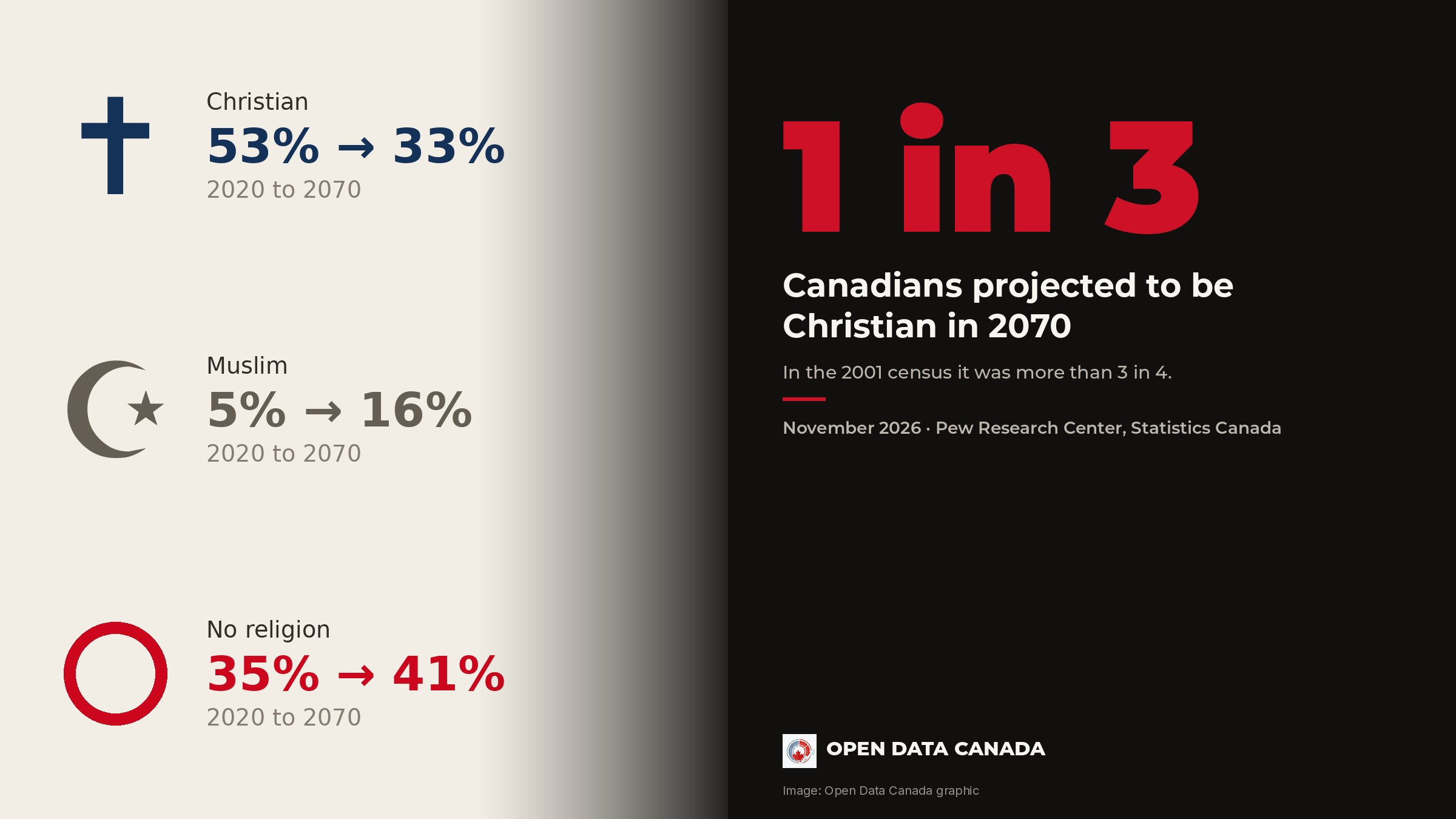
In 2001, about one in six Canadians told the census they had no religion. By 2021 it was more than one in three. Pew Research Center's new projections, released November 18, have that group becoming the country's largest around 2050, as the Christian share falls below half before 2030 and reaches one in three by 2070.
Pew's 2020 starting point uses estimates for Canada (53.3 percent Christian, 34.6 percent with no religion, 12.1 percent other religions) that match the 2021 census to one decimal. The projection then runs those groups forward with each one's age profile, birth rate, migration and the rate at which people leave or join a religion, assuming recent patterns hold.
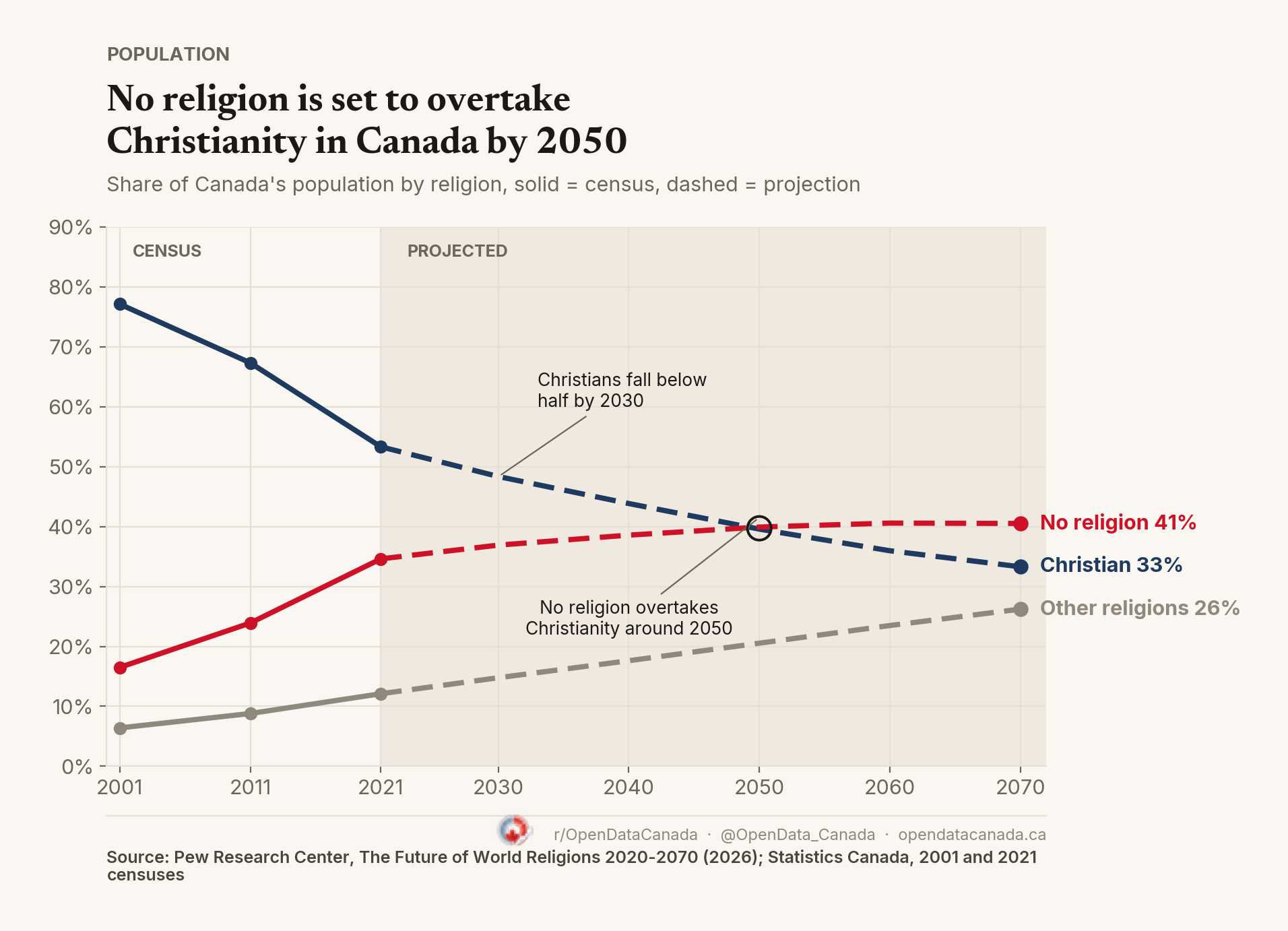
No religion takes the top spot around 2050
The two big lines cross around 2050, when each group sits near 40 percent. After that, Christians keep falling and the no-religion share flattens out. By 2070 the projection has about 17 million Canadians with no religion, 13.9 million Christians and 11 million followers of other religions, in a population of 41.9 million.
In raw numbers, that is 6.4 million fewer Christians than in 2020, while the country adds people overall. Across Canada and the U.S., Pew expects more Christian deaths than births because of an older age profile and low birth rates, on top of people who stop identifying with any faith.
| Group | 2020 | 2070 (projected) | Change |
|---|---|---|---|
| Christian | 20.4 million (53%) | 13.9 million (33%) | −6.4 million |
| No religion | 13.2 million (35%) | 17.0 million (41%) | +3.7 million |
| Muslim | 1.9 million (5%) | 6.5 million (16%) | +4.6 million |
| Hindu, Buddhist, Jewish and other faiths | 2.7 million (7%) | 4.5 million (11%) | +1.7 million |
Changes are calculated from unrounded figures, and shares may not add to 100 because of rounding.
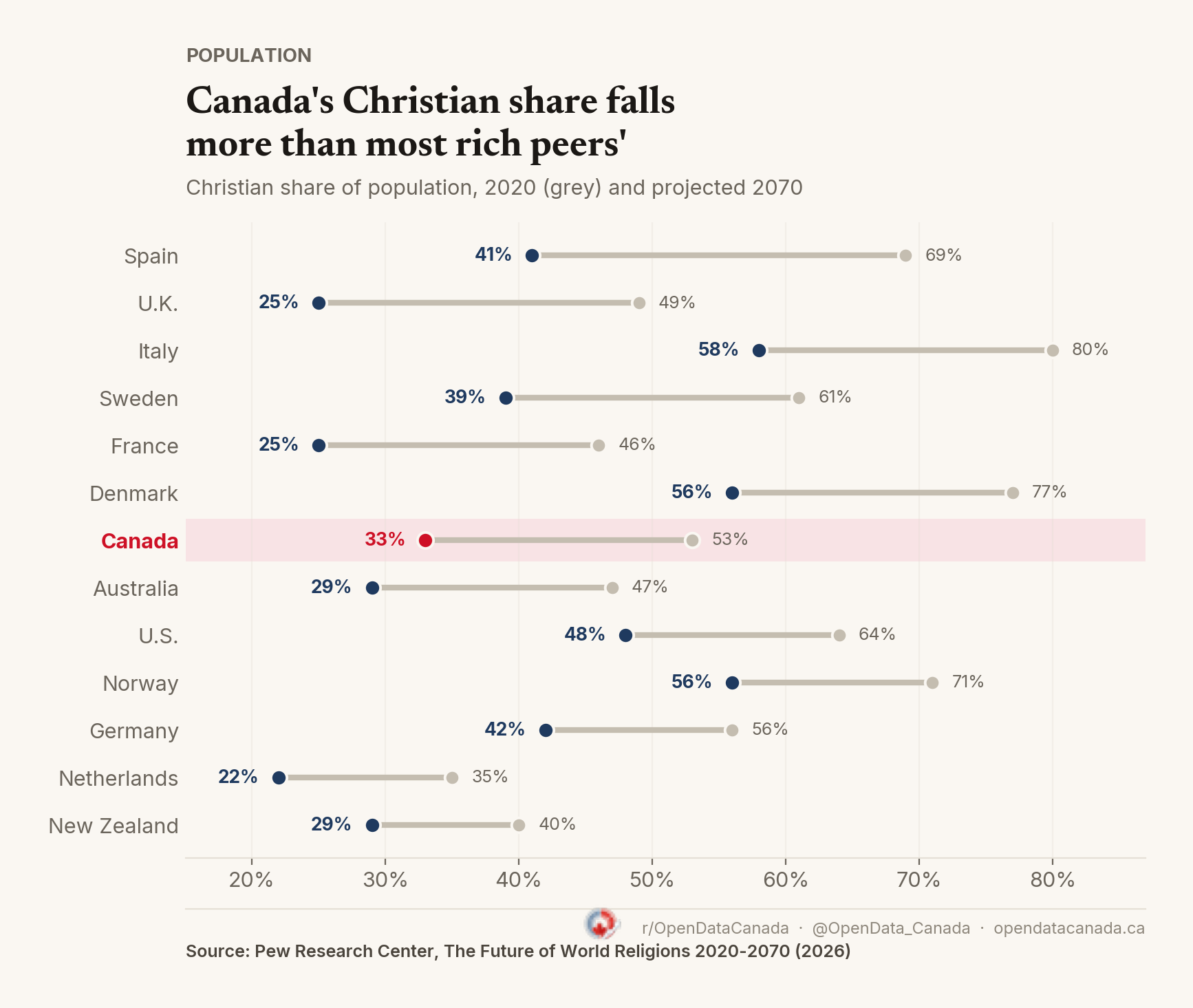
Canada changes more than most of its peers
Out of the 124 countries with at least 5 million people, Canada has the seventh-largest projected drop in its Christian share: 20 percentage points. Spain, the United Kingdom, Italy, Sweden, France and Denmark drop further. The United States drops 16 points, to 48 percent, and stays mostly Christian until the early 2060s.
The rise of no religion comes from people leaving religion
Pew ran two what-if scenarios for Canada, and they split the change into parts.
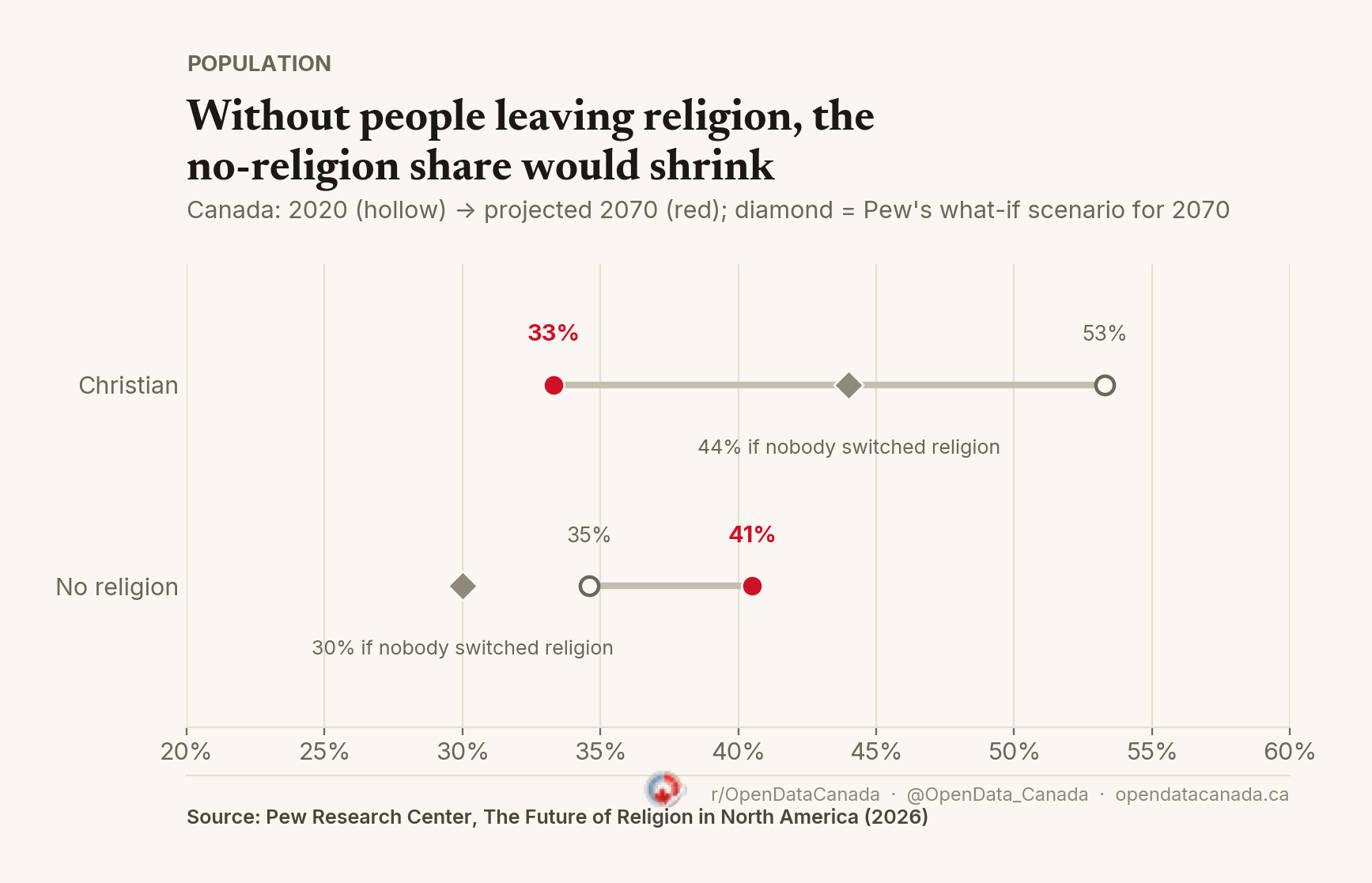
Switching accounts for 11 of the 20 points of Christian decline. If nobody switched religion from 2020 on, Pew projects Christians would still decline from 53 percent to 44 percent by 2070, from the other factors in the model: aging, births and migration. Continued switching accounts for another 11 points of decline, bringing the share to 33 percent. Without switching, the no-religion share would actually fall to 30 percent. Its growth in Canada depends mainly on adults leaving religion, not on births or immigration.
The growth of other religions works the other way. The largest of them is Islam: Pew projects the Muslim share rising from 4.9 percent of Canadians in 2020 to 15.6 percent in 2070. In a scenario with no migration at all, it would reach 8.4 percent, so migration accounts for about two-thirds of the increase. Pew calls a zero-migration world unrealistic and uses it only to measure migration's effect. Hindus are the other group Pew expects to grow mainly through migration. Because it depends on migration, this is the part of the projection most open to change.
The U.S. catches up
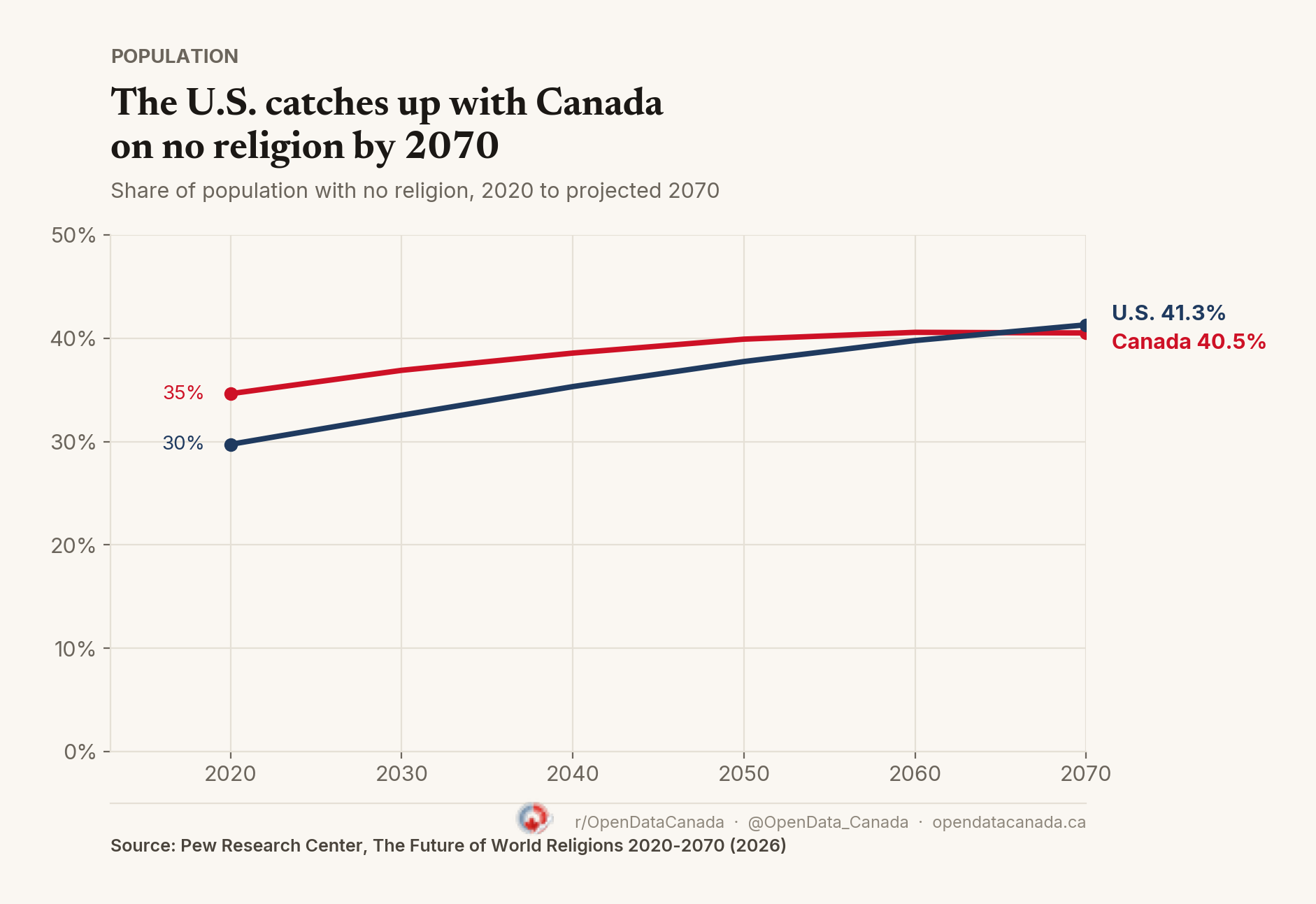
Canada starts 2020 five points more secular than the United States. By 2070 the gap is gone: 41.3 percent of Americans and 40.5 percent of Canadians are projected to have no religion. Canada's no-religion share flattens after 2060, while the American share keeps climbing.
The projection already trails reality on population
These are projections, not predictions. Pew assumes recent patterns in births, migration and religious switching continue, and draws on the United Nations' 2024 population data and global migration flow estimates.
That path is already behind. Pew's model expects Canada to reach 41.8 million people around 2050; Statistics Canada estimated 41.8 million on July 1, 2026. That gap does not show the religious shares are wrong, but it means the population behind them has moved faster than the model assumed, and the post-2021 surge in arrivals and the cuts to immigration targets since 2024 could each shift the result.
The direction is clearer than the destination. Canada's Christian share is projected to fall faster than any country's outside Western Europe, and people leaving religion, not immigration, are what put no religion on top.