Health · 5 min read
Ontario has fallen to last on public health-care spending per person
In 1991 public health-care spending per resident was higher in Ontario than in any other province. By 2024 it was the lowest, $622 below the Canadian average. Age differences explain only a small part of the gap. Hospitals, nursing homes and capital spending explain most of it.
Ontario's 2026 budget planned $101.2 billion in health-sector spending this year. The fall economic statement now puts it at $100.7 billion, after actual spending of $97.5 billion last year. It is the biggest health budget in the country, because Ontario has the most people. Divide it by those people and the picture flips.
In 2024, the latest year of actual figures from the Canadian Institute for Health Information (CIHI), public spending on health came to $6,141 per Ontarian. That counts money from all levels of government, mostly the province. That was the lowest among the ten provinces. Alberta was next at $6,548. The Canadian average was $6,763. Counting only provincial government money gives the same answer: Ontario $5,613, New Brunswick next at $5,968. CIHI's forecast for 2026 keeps Ontario last, at $6,734 against a national $7,426.
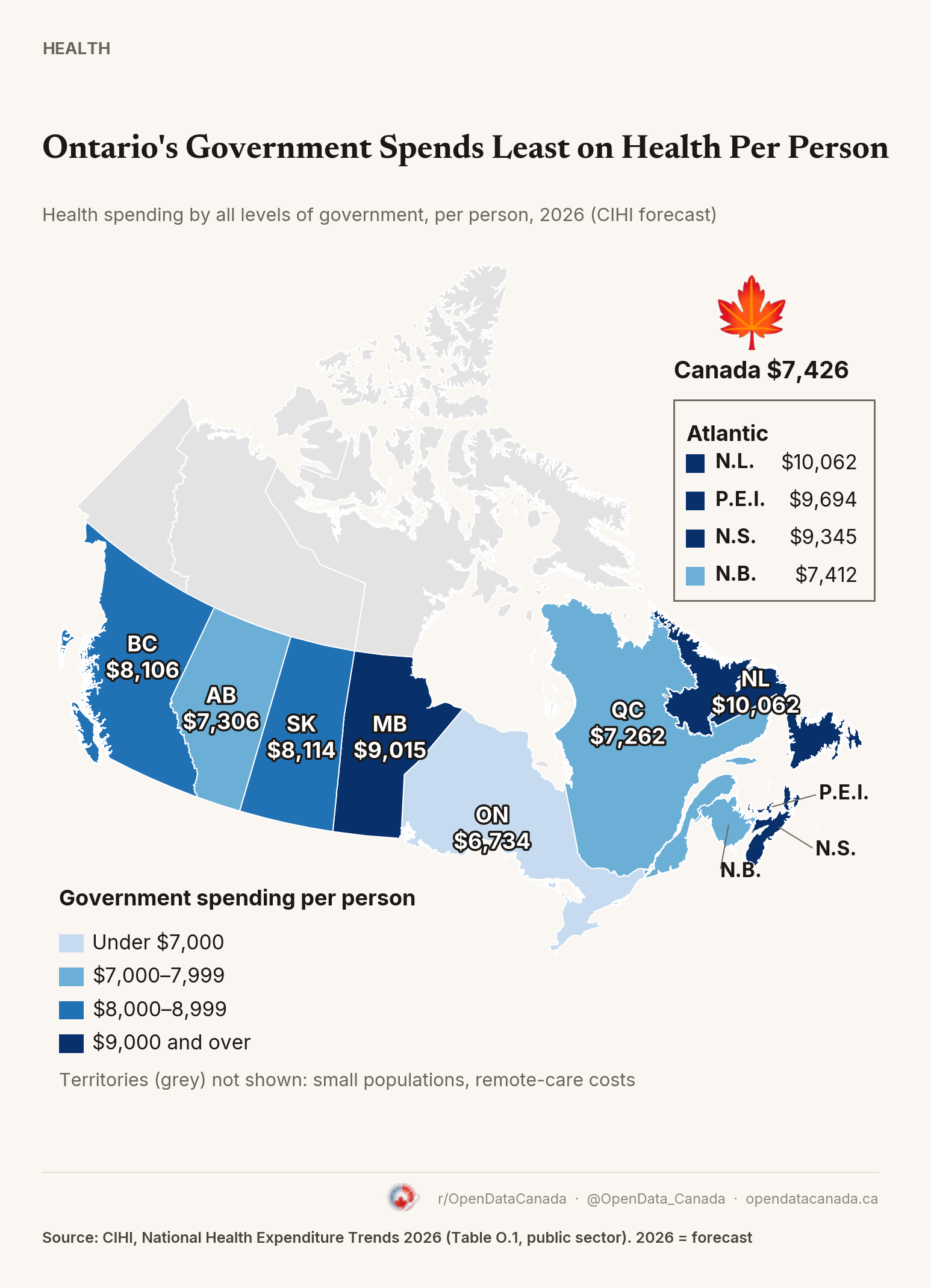
Ontario near the bottom is not news. CIHI's latest forecast also puts it last on total health spending per person in 2026, public and private combined. The comparison by Ontario's Financial Accountability Office, which uses Statistics Canada's government finance figures rather than CIHI's, ranks it second-lowest in 2024–25, just above New Brunswick. What gets less attention is how far Ontario fell to get here.
From first to last
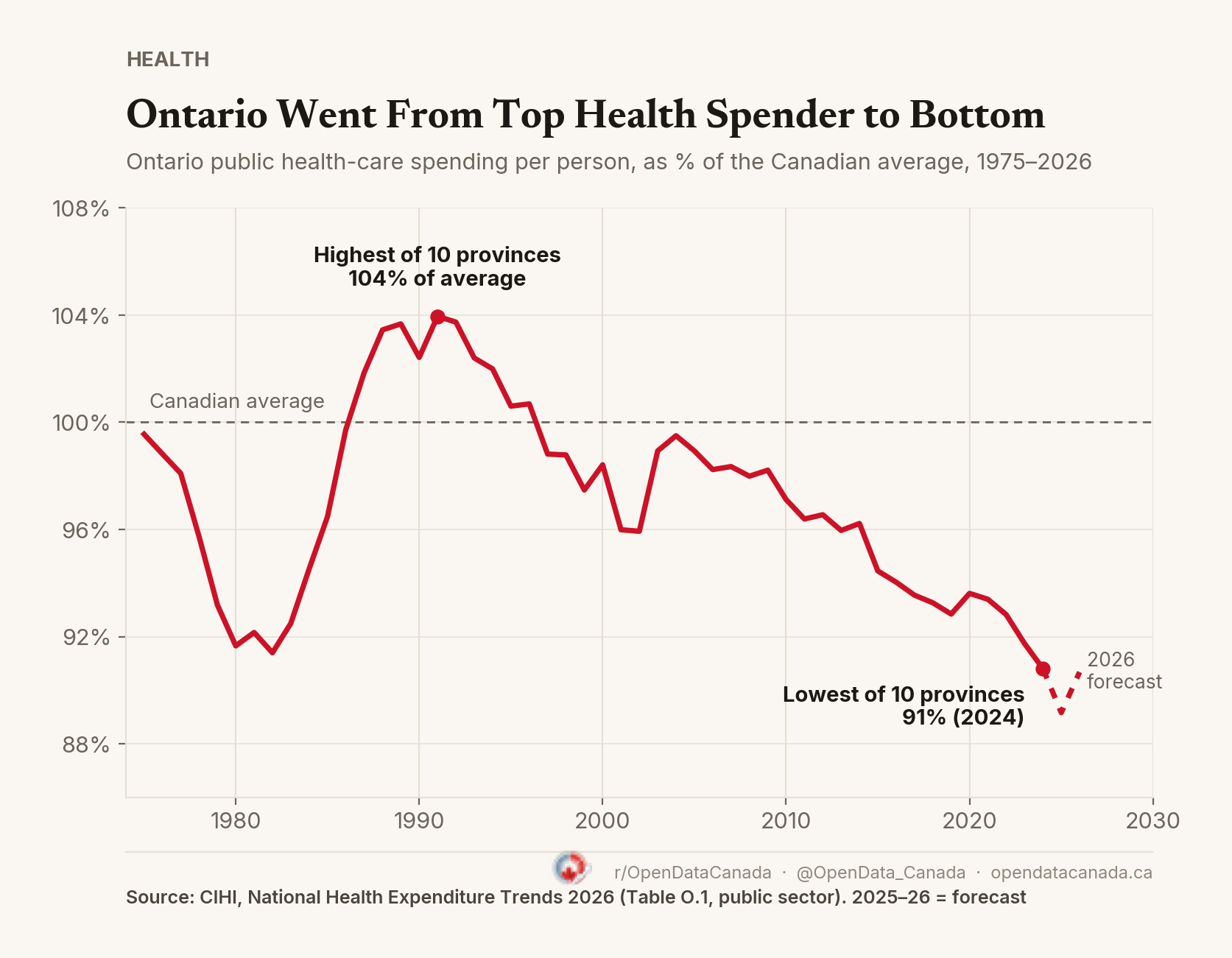
In 1991, public spending on health in Ontario came to $1,836 per resident, 4% above the Canadian average and the highest of any province. Saskatchewan and Manitoba were close behind. Atlantic Canada was at the bottom.
By 2024 Ontario was at 91% of the average, the lowest share in CIHI's records back to 1975. The early 1980s came close, at 91.4% in 1982, but that dip recovered within five years. This one has run for most of three decades.
The slide is not a quirk of who Ontario is compared with. Quebec's figures need some care: after its 2015–16 health and social services reform, CIHI began counting some spending it had previously left out, which breaks the series between 2014–15 and 2015–16. Take Quebec out of the comparison entirely and Ontario still falls from 102.5% of the rest of the country in 1991 to 91.2% in 2024. Count only provincial government money and the fall is the same, 104.2% to 91.4%.
Money that didn't keep up with people
Ontario's population has grown faster than the country's. Its share of Canadians rose from 37.2% in 1991 to 39.1% in 2024. In 2023 and 2024 alone the province grew by about 3% a year.
Its share of public health-care dollars went the other way, from 38.7% to 35.5%. Put together, roughly three-fifths of the fall in Ontario's relative spending reflects its shrinking share of public health-care dollars, and two-fifths its growing share of Canada's population.
The population figures themselves aren't the problem. CIHI's numbers line up with Statistics Canada's estimates to within a third of a percent in every year.
Not because Ontarians are younger
One possible explanation is age. Older people use far more health care, and Ontario is a little younger than the national average: 18.4% of its residents were 65 or older in 2024, against 19.0% for Canada.
That difference is small, and so is its effect. CIHI breaks spending down by age only for provincial government money, where Ontario's gap with Canada was $531 per person in 2024. A younger population accounts for $41 of it, about 8%. The remaining 92% reflects lower spending per person within age groups.
Adjusting for age does change one thing. New Brunswick, which has an older population, drops just below Ontario once ages are evened out. Applying each province's age mix to the Canadian population, provincial government spending in 2024 comes to $5,543 per person in New Brunswick and $5,657 in Ontario, against $6,143 for Canada. On that measure Ontario is second-lowest, not last, and still $486 below the national figure.
Rural living is another possible explanation, since care costs more to deliver away from cities. Ontario is the most urban province, with about 1 in 9 residents outside a population centre in 2021. Today the more rural provinces do tend to spend more per person. In 1991 the pattern ran the other way: the more rural provinces spent less, and Ontario, the most urban, spent the most. A province's geography barely changes in thirty years, so it cannot explain Ontario's fall. Other measures of how urban a province is, such as population density or the share of residents in cities of 100,000 or more, do not predict spending reliably either.
Catch-up explains some of the slide. The provinces that started lowest in 1991 have gained the most since, and Ontario, which started near the top, had the most room to fall. But that pattern predicts a change of about one percentage point for Ontario, not the 13 points it lost. With ten provinces, none of this can be tested precisely.
Where the gap is
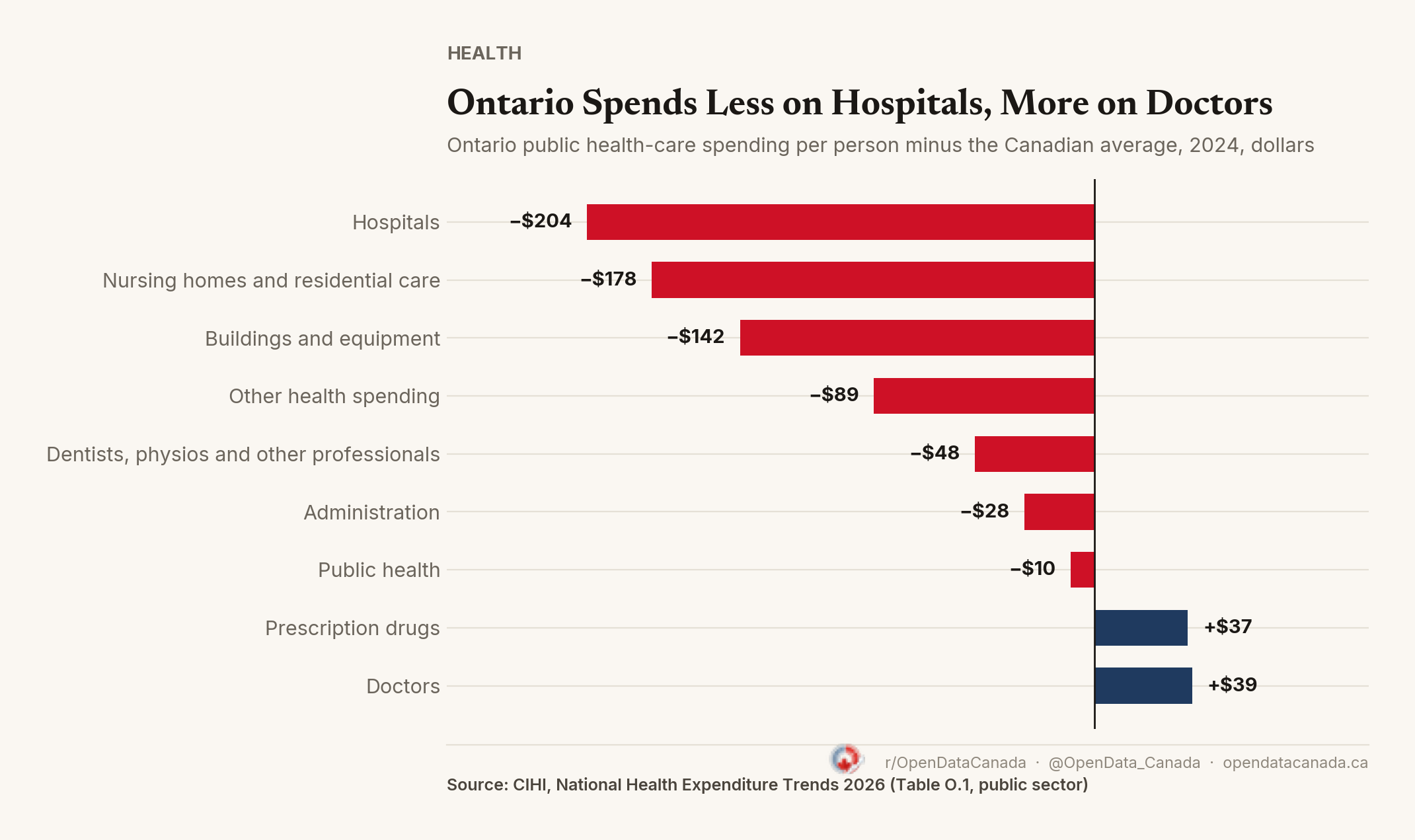
Ontario doesn't spend less across the board. It spends $39 more per person than average on doctors and $37 more on prescription drugs.
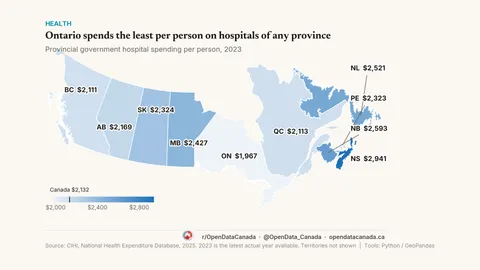
The shortfall is concentrated in hospitals and residential care. Ontario spent $204 less per resident on hospitals in 2024, $178 less on nursing homes and other residential care, and $142 less on buildings and equipment, though CIHI's capital estimates are rougher than the rest. Those three account for about four-fifths of the total gap. Ontario already had the lowest hospital spending of any province in 2023.
Ontarians pay more themselves
Some of the difference shows up in household budgets instead. CIHI forecasts private spending, on insurance, dental care, drugs and out-of-pocket costs, at $3,103 per Ontarian in 2026, against $2,633 in Quebec.
That extra private spending nearly closes the gap on total spending. Counting both public and private money, Ontario ($9,838) and Quebec ($9,895) are about level in 2026. The difference is small, and both figures are forecasts.
What the numbers can't say
Spending less isn't the same as getting worse care, and these figures don't measure wait times or outcomes. Provinces also sort some services differently between health and social budgets, which CIHI flags. And Ontario's spending is growing: CIHI forecasts a 7% rise in 2026. That follows 2.5% in 2025, and it rests on budget plans rather than spending already done.
None of that changes the ranking. Ontario ranked last in 2024, spending $407 less per resident than Alberta, the next-lowest province. Its population also keeps growing faster than the rest of the country's. Ontario may have a record health budget, but its public spending per resident is still the lowest in Canada.