Budget 2026
Ottawa spends $111.53 for every $100 it collects. Here is where it all goes
The 2026 federal budget plans $602.6 billion in spending against $540.3 billion in revenue. Debt interest now exceeds the Canada Health Transfer, and the largest single measure is a $36-billion business tax deduction.
Finance Minister François-Philippe Champagne tabled Budget 2026 on November 5. Strip away the announcements and it is a plan to collect $540.3 billion in the fiscal year that runs from April 2026 to March 2027, spend $602.6 billion, and borrow the $62.3 billion difference.
Put another way, for every $100 that comes in, Ottawa spends $111.53. The charts below follow that money in, out, and forward to 2030-31, using the budget's own tables. For what voters said they wanted from it, see what Canadian voters want more spending on.
Where the money comes from
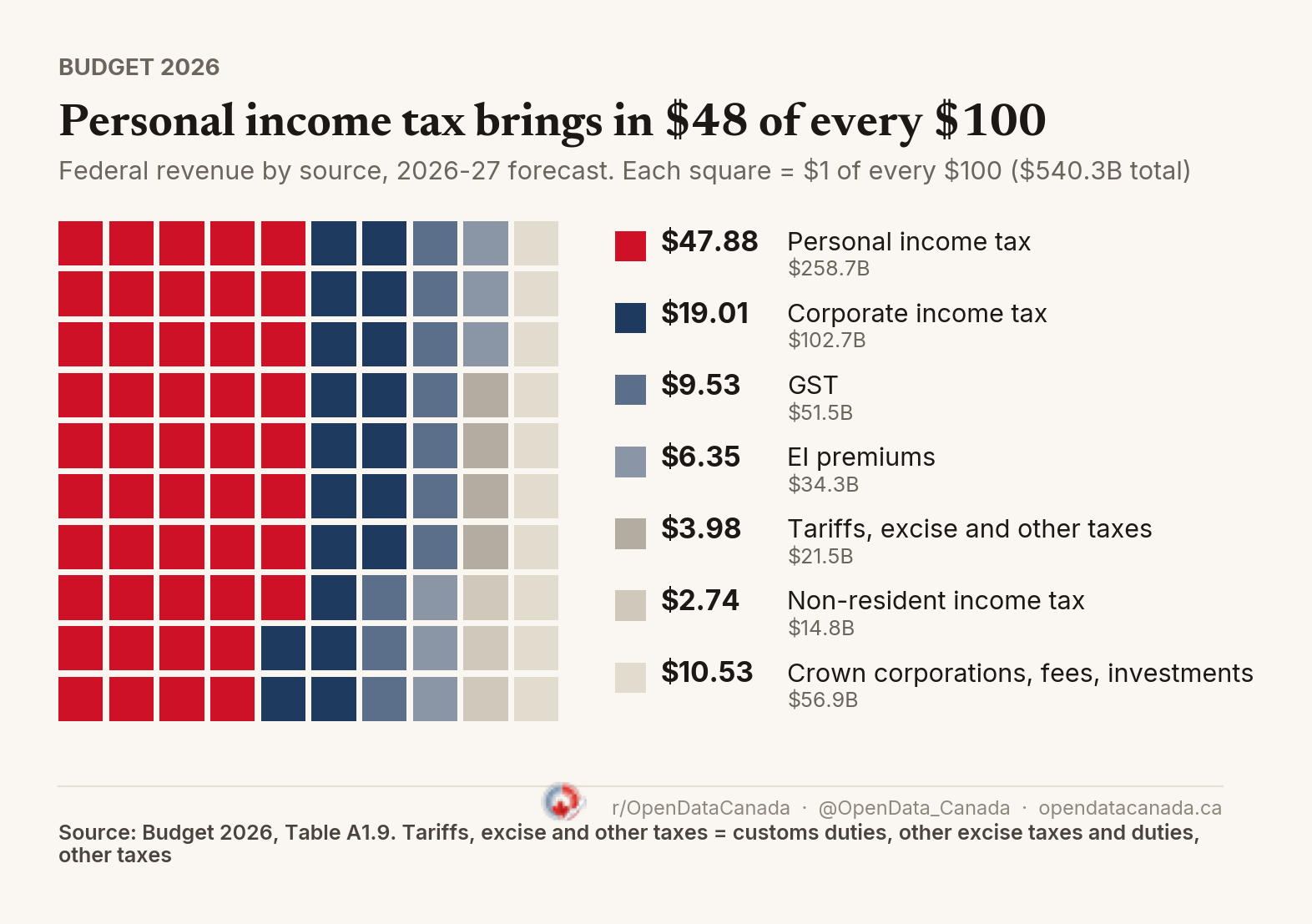
Personal income tax does most of the lifting: $258.7 billion, or about $48 of every $100. Corporate income tax brings in $102.7 billion, the GST $51.5 billion, and Employment Insurance premiums $34.3 billion. Everything else, from customs duties to Crown corporation profits, makes up the rest.
Where it goes
Revenue isn't earmarked. It goes into one pot, gets topped up with borrowing, and flows out in four streams:
- Direct program expenses, $272.4 billion. About $150 billion runs more than 100 departments and agencies, the military included. The other $122.4 billion is grants, subsidies and other transfer payments those departments hand out.
- Benefits paid to people, $153.4 billion. Old Age Security is the biggest single cheque at $89.4 billion, followed by Employment Insurance benefits ($32.9 billion) and the Canada Child Benefit ($31.2 billion).
- Transfers to provinces, territories and municipalities, $116.9 billion. The Canada Health Transfer is $57.4 billion and equalization $27.2 billion.
- Interest on the debt, $60.2 billion. That's more than twice what equalization costs.
These four streams add up to $602.9 billion. The budget's published total is $602.6 billion, after a $0.4 billion pension accounting gain and rounding.
Twenty-three years of red ink
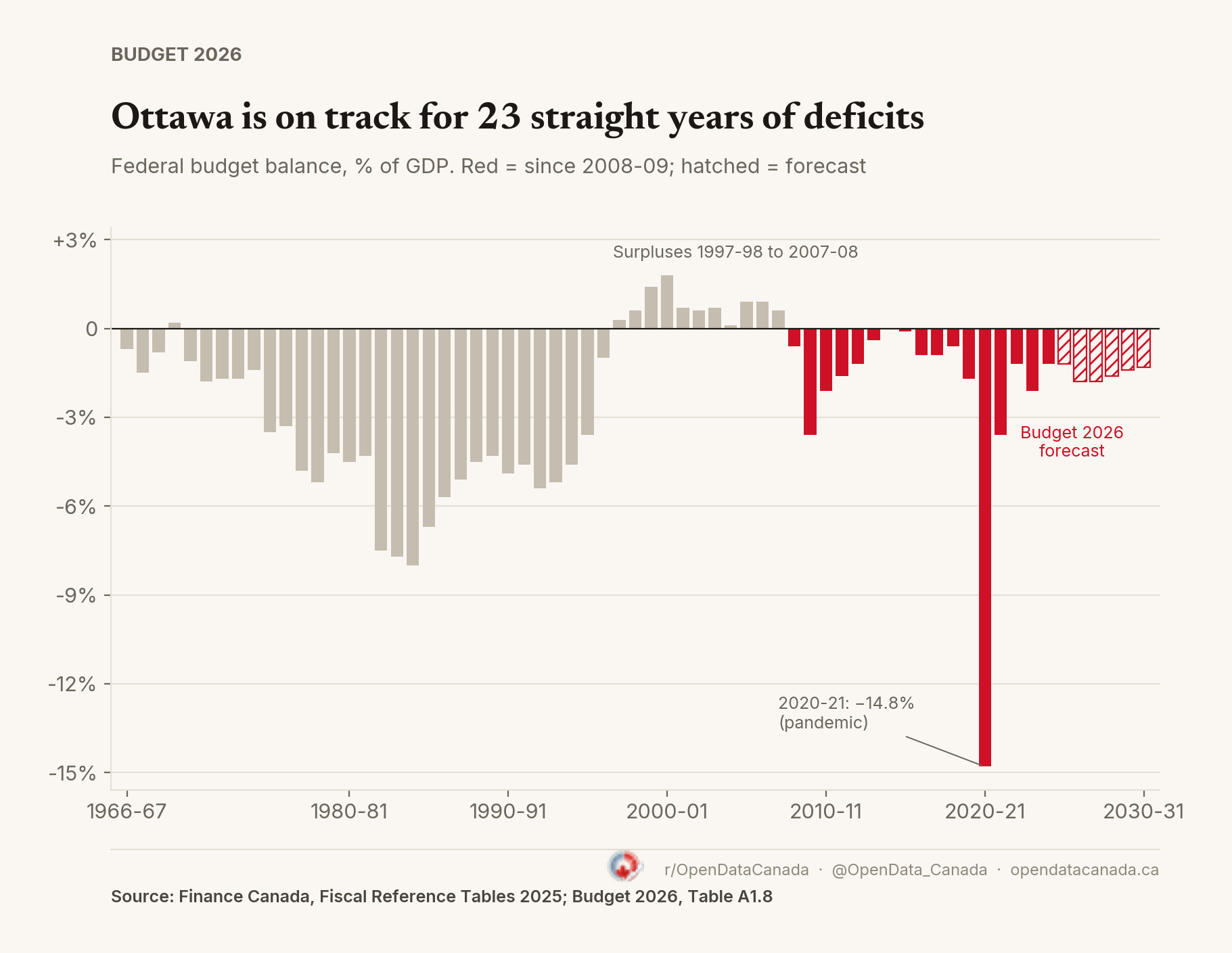
Ottawa last balanced its books in 2007-08, the end of an 11-year run of surpluses. The budget forecasts a deficit every year through 2030-31, which would make 23 straight years.
As a share of the economy, the deficits are modest next to the 1980s or the pandemic year, when the shortfall hit 14.8% of GDP. The forecast never gets back to zero, though. In 2030-31, the last year in the plan, the deficit is still $52.9 billion.
The $34 billion improvement mostly happened last year
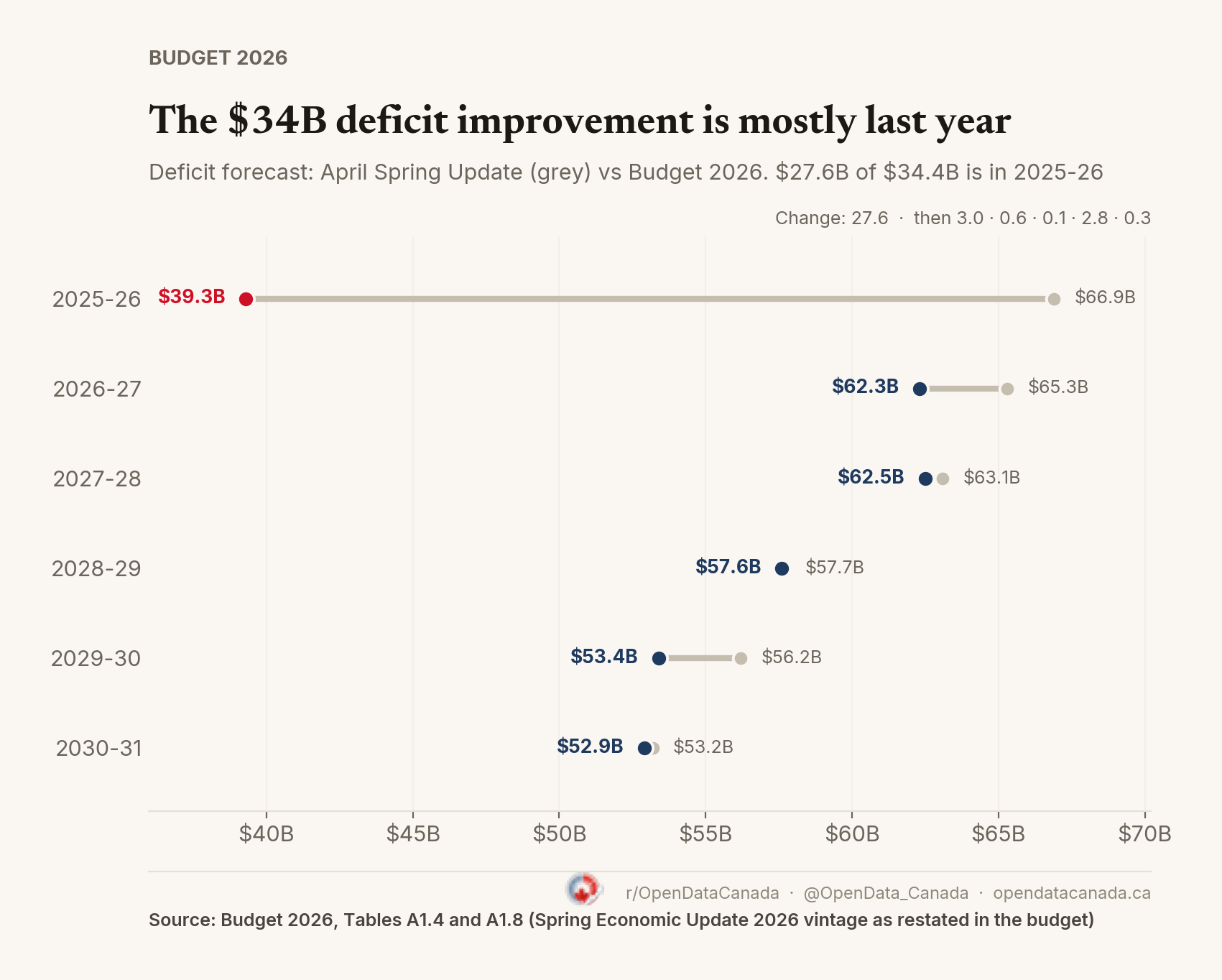
Compared with the Spring Economic Update in April, the budget's deficits are $34.4 billion smaller over six years. That sounds like a turnaround until you see when it happens. $27.6 billion of it comes from 2025-26, the fiscal year that ended in March. The deficit for that year is now estimated at $39.3 billion, down from the $66.9 billion projected in April.
The five years still ahead improve by $6.8 billion combined. Part of that comes from a better economy, including oil now expected to average US$85 a barrel in 2026 against US$73 in April. Part of it comes from a decision to lower forecast department spending by about $12.4 billion a year, which the budget says "better aligns the forecast with the expected timing and level of spending." That reduction isn't tied to any named program.
Interest now costs more than the Canada Health Transfer
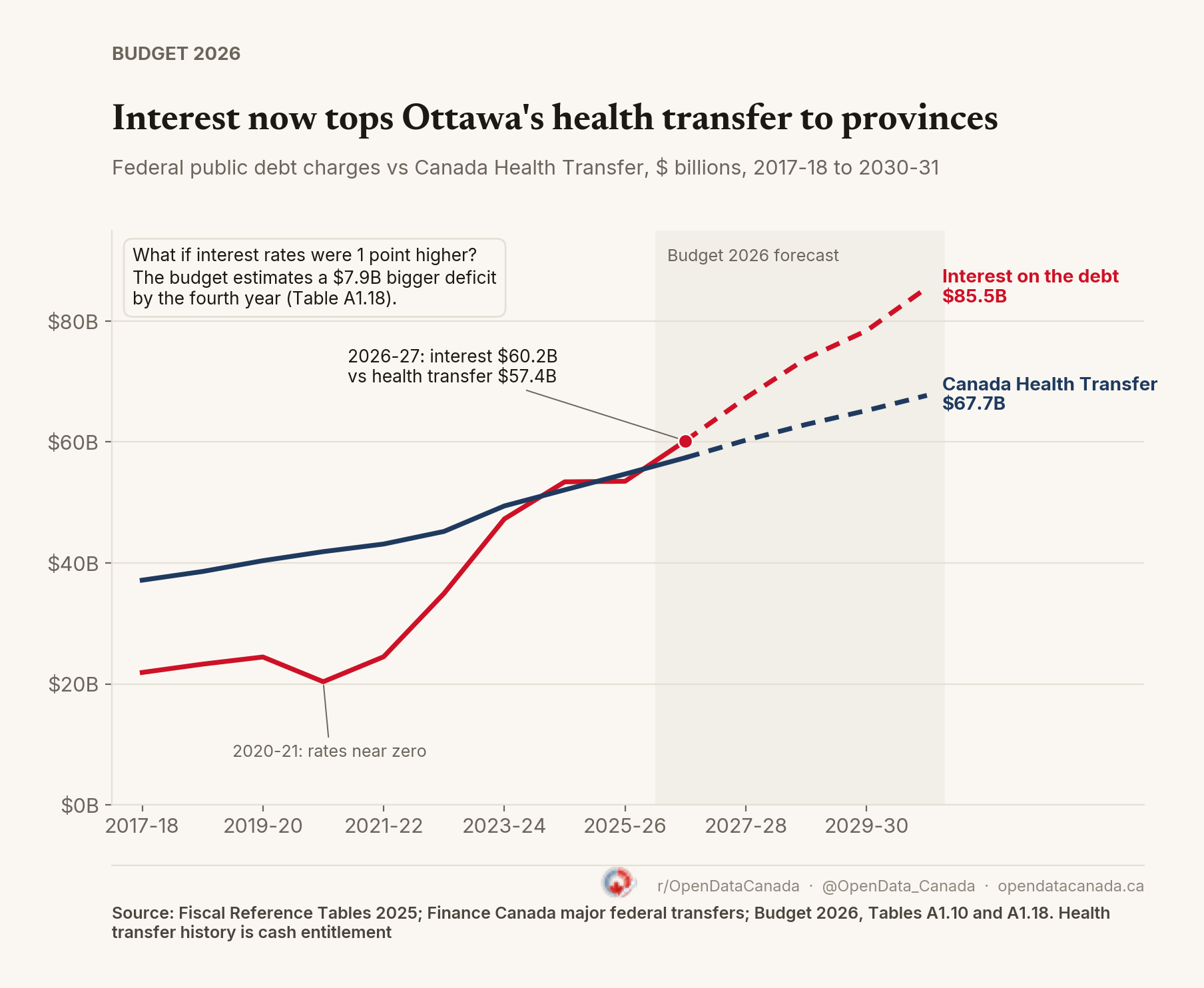
In 2020-21, with rates near zero, Ottawa paid about $20 billion in interest. This year it pays $60.2 billion, more than the $57.4 billion Canada Health Transfer that helps fund every province's hospitals and doctors.
The gap widens from here. By 2030-31, interest reaches $85.5 billion against $67.7 billion for the health transfer. Interest is also the spending line the government controls least. The budget's own sensitivity table says a sustained one-point rise in all interest rates would leave the deficit $7.9 billion bigger by the fourth year, after higher interest income is counted. Its rate path comes from a survey of private economists who expected the Bank of Canada to hold through 2026 and raise twice in 2027. The Bank raised on October 28, earlier than that.
The budget's biggest single measure is a business tax break
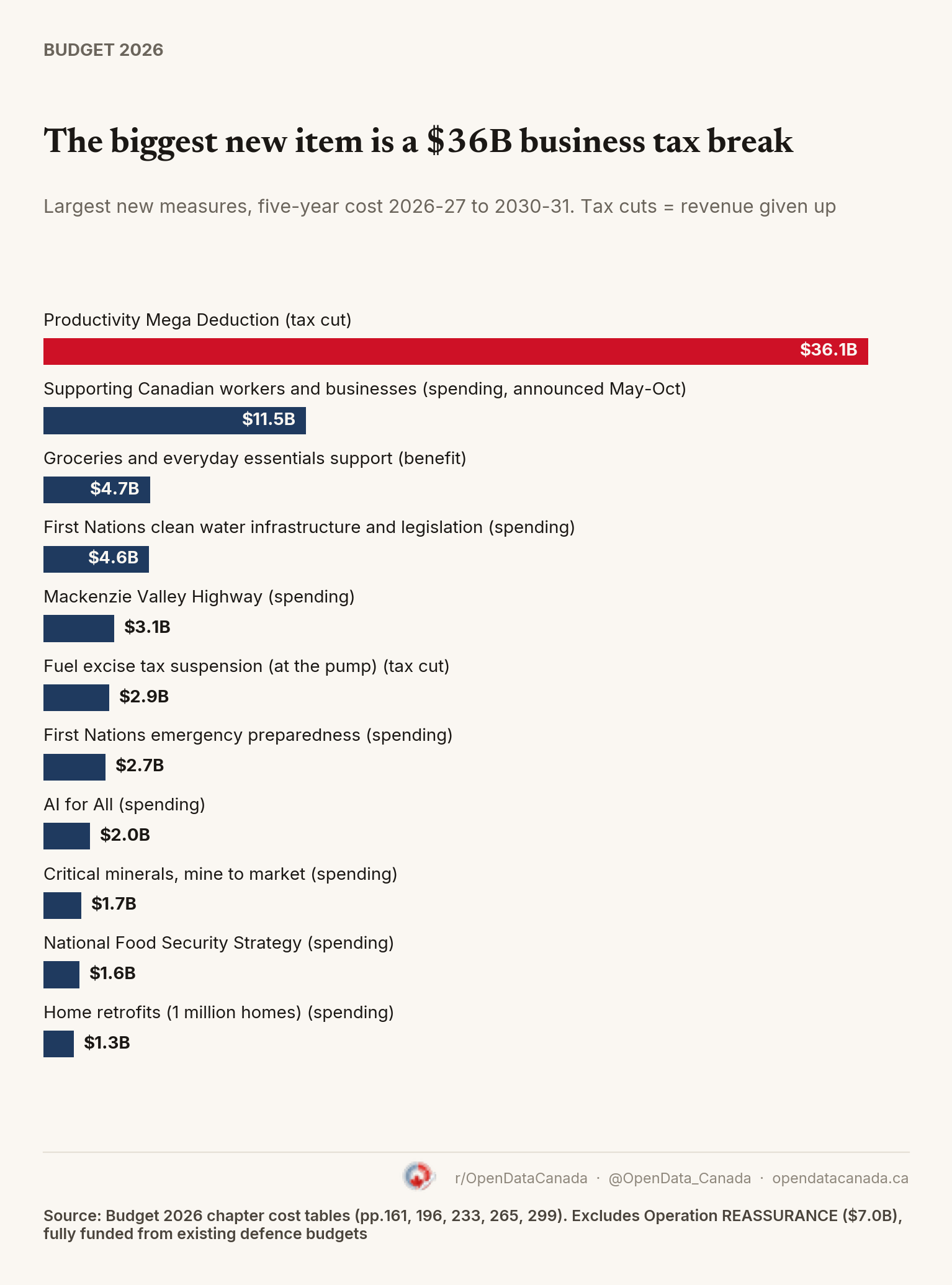
The Productivity Mega Deduction, announced September 15 and costed for the first time in this budget, lets businesses write off the full cost of new equipment and other capital in the year they buy it, instead of over many years. About two-thirds of business capital will qualify, up from roughly 15% before. Over five years it costs $36.1 billion in tax not collected, more than three times the next-largest item.
The budget estimates it will cut the overall tax rate on a new business investment (the marginal effective tax rate) from 13% to 6.4%, less than half the U.S. rate. It also books the deduction as a "capital investment," which is how the budget can say its deficits will be "fully accounted for by capital investments" from 2027-28. The money still has to be borrowed either way.
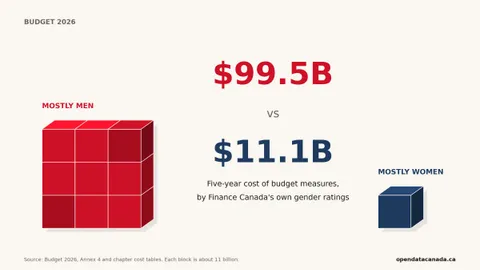
The budget's own gender and income analysis (Annex 4) rates the Mega Deduction as mostly benefiting men and higher-income people. It rates the new capital gains exemption, which lets founders and investors shelter up to $15 million in gains, as "strongly regressive": the benefit goes mostly to high-income people. Add up the dollars behind those ratings and 99.5 billion goes to measures rated mostly men, against 11.1 billion for women.
What households get
The measures aimed directly at household budgets are smaller and mostly temporary. Only the first is new in this budget; the other two were announced in the fall and are now in the fiscal plan:
- Groceries and Essentials Benefit top-up. A one-time payment in early 2027 worth 50% of the regular benefit: up to $339 for a single person and $679 for a couple with two children. The supplement costs $4.1 billion; the $4.7 billion in the chart above also covers food support for remote northern communities. Annex 4 rates it "strongly progressive."
- Fuel excise tax (announced September 2). The suspension that began in April is extended to January 31, 2027, then the tax comes back at half rate until March 31. After that, the full tax returns. The budget puts the saving at up to 10 cents a litre on gasoline.
- Heat pump rebate (announced October 8). $2 billion to help up to 820,000 households install a heat pump. The budget says families switching from oil, propane or electric baseboard heat save an average of over $1,400 a year.
Debt holds steady as a share of the economy
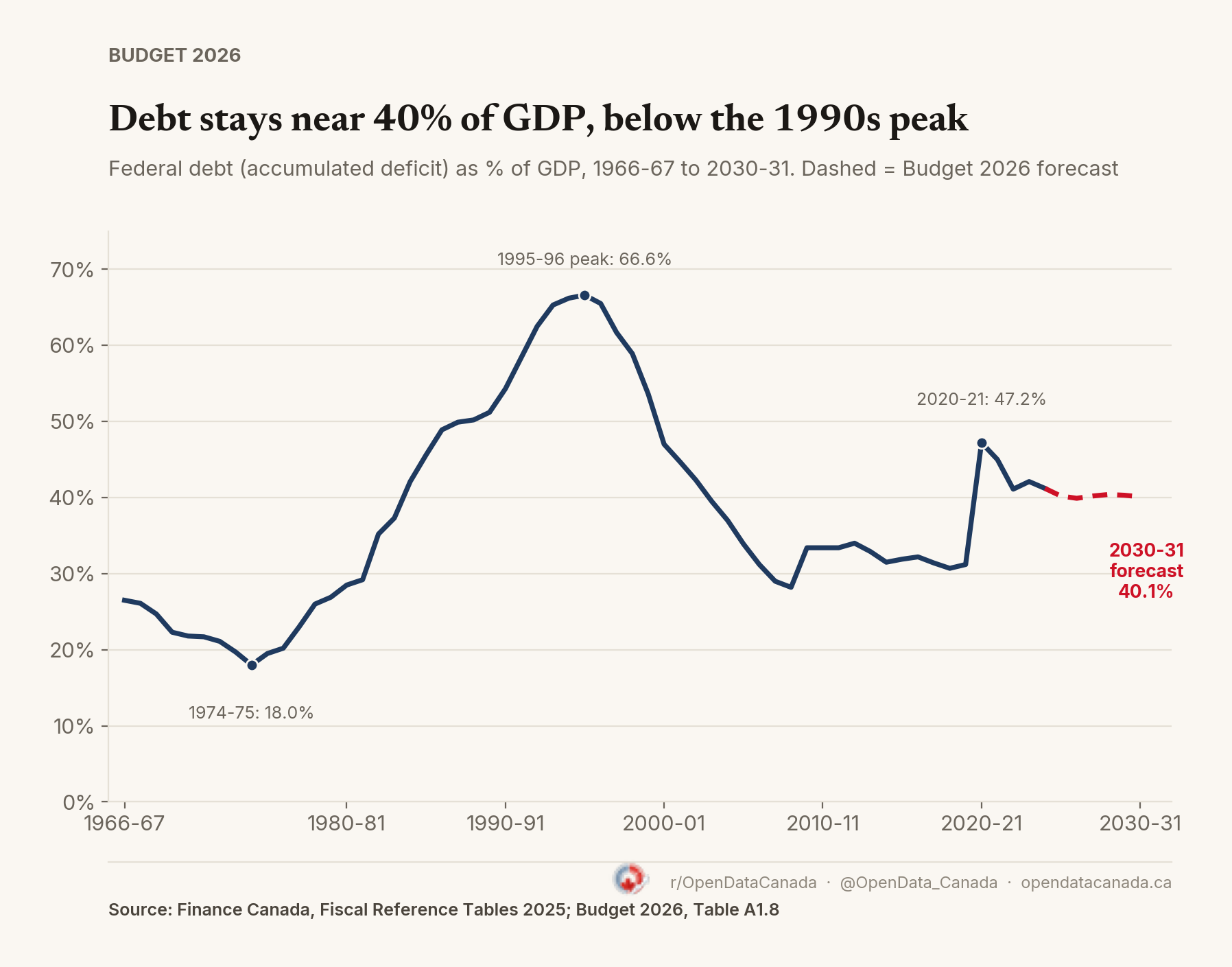
The government's fiscal anchor is federal debt as a share of GDP, and by that measure the plan holds: 39.9% this year and 40.1% in 2030-31, far below the 66.6% peak of the mid-1990s. In dollars, net debt grows from $1.54 trillion to $1.92 trillion over the same five years.
That's the trade the budget makes. The debt ratio stays flat only because the economy is forecast to grow as fast as the debt. The interest bill doesn't wait for the ratio. It rises every year of the plan, and by 2030-31 it will take about $14 of every $100 Ottawa collects.