Health · Medical assistance in dying
1 in 20 Canadians who died in 2024 received MAID
16,499 people received medical assistance in dying in 2024. That is about three times the 2019 number, but the increase over 2023 was the smallest since federal reporting began.
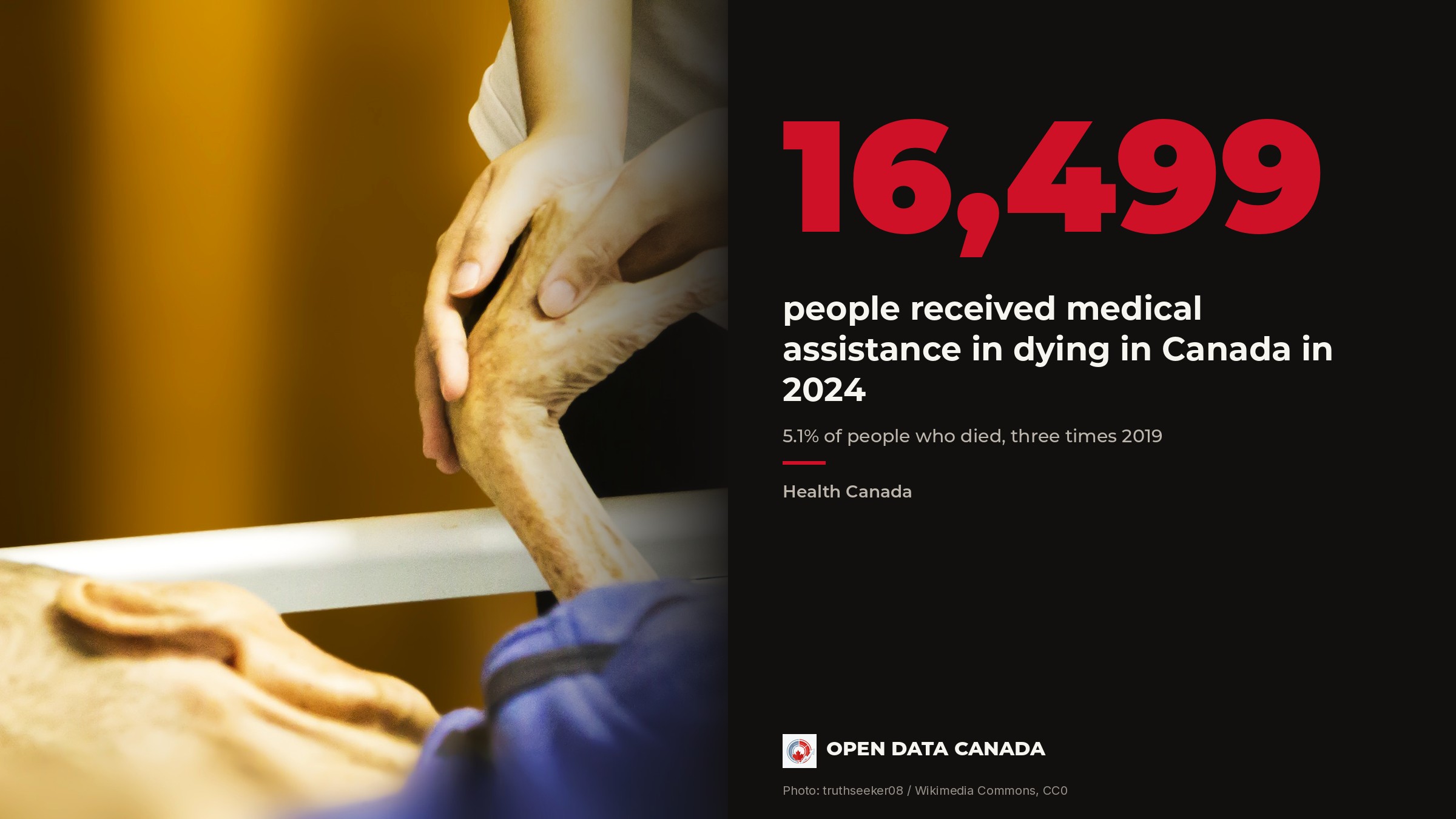
In 2024, 16,499 people in Canada received medical assistance in dying, usually called MAID. That is 5.1 percent of the people who died that year, about 1 in 20. Since MAID became legal in 2016, 76,475 people have received it.
The number keeps rising, but more slowly. It was 5,461 in 2019, about a third of today's figure. The yearly gain peaked at 3,133 in 2022. In 2024 it was 1,072. Measured as a percentage, growth fell from 36.8 percent in 2020 to 6.9 percent in 2024.
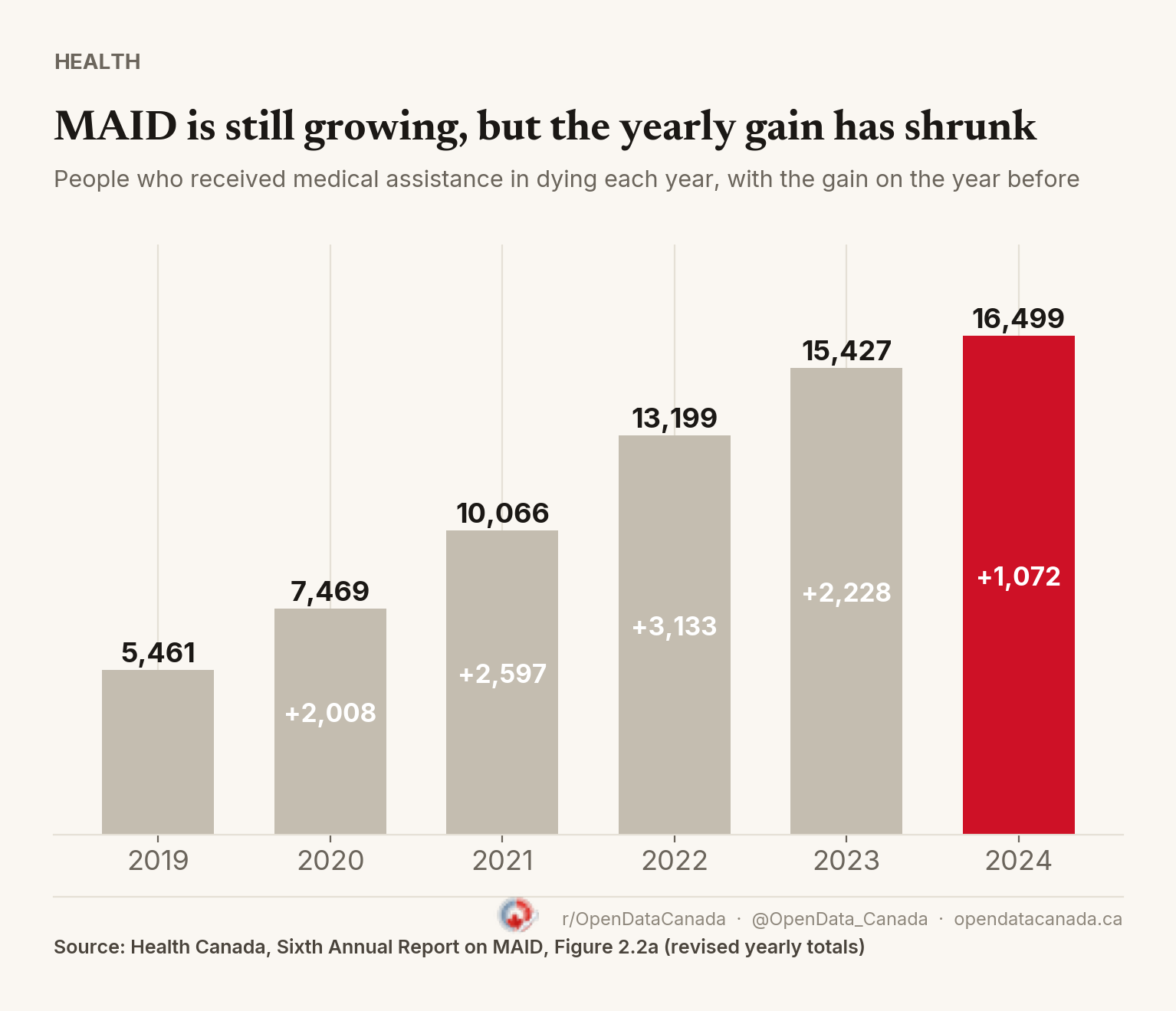
Health Canada says the data suggest the number of cases is "beginning to stabilize". It adds that it will take several more years before long-term trends can be conclusively identified.
Why this week matters
On 7 October, Justice Minister Sean Fraser said Canada will not go ahead with the planned expansion of MAID to people whose only condition is mental illness. The government says it will table a bill this fall to keep them excluded indefinitely. The bill is also expected to allow advance requests, where someone agrees to MAID while they are still able to make the decision, in case an illness later takes it away. Provinces would decide whether to offer them.
Under the current law, the mental-illness exclusion ends on 17 March 2027. The government says the new bill would replace that temporary exclusion with one that has no end date.
People whose only condition is a mental illness are not eligible today, so they don't appear in Health Canada's numbers. The reports also don't count people who had a mental illness alongside another condition: mental disorders are grouped with frailty, diabetes and chronic pain in an "other conditions" category, reported in about 1 in 4 cases in 2024. So there is no public number for how many people the debate affects today.
What the reports do show is how often psychiatrists were brought in. About 4.4 percent of 2024 cases were Track 2: people whose natural death was not reasonably foreseeable and whose requests need extra checks. When assessors asked other health professionals for advice in those cases, psychiatrists made up 15.5 percent of the people consulted, against 3.1 percent in Track 1. Psychiatrists are also called in for illnesses such as Parkinson's or Huntington's disease, so this is not a count of people with mental illness.
What conditions are behind MAID cases?
Cancer was the most commonly reported condition, in about 61 percent of 2024 cases. Doctors and nurse practitioners can report more than one condition, so the shares add up to more than 100 percent. Heart conditions were reported in about 17 percent.
Quebec stands out
Quebec had 5,998 MAID cases in 2024, more than Ontario's 4,944, even though Ontario has more people. Quebec accounts for about 36 percent of all cases in Canada. It has had more cases than Ontario every year since 2021.
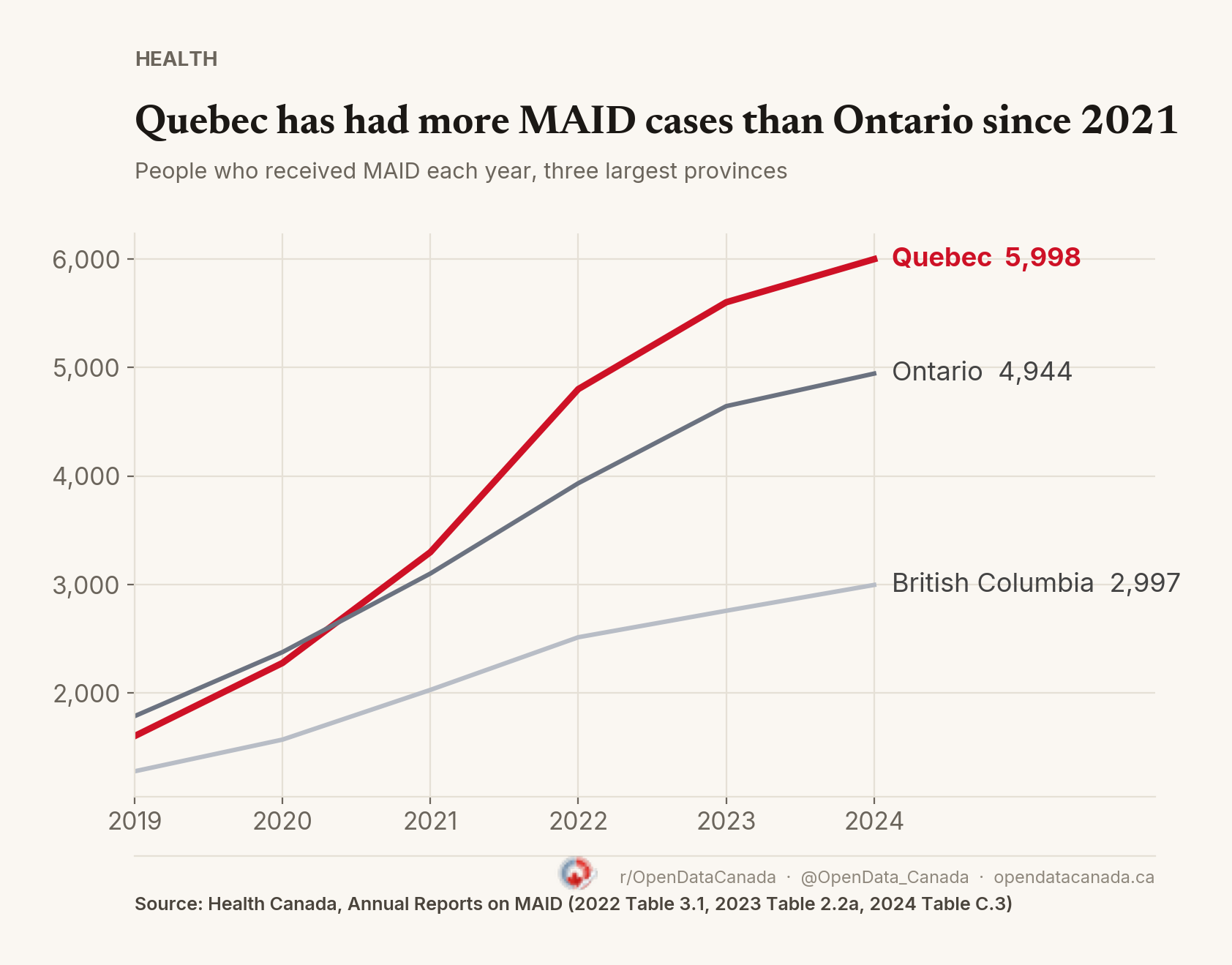
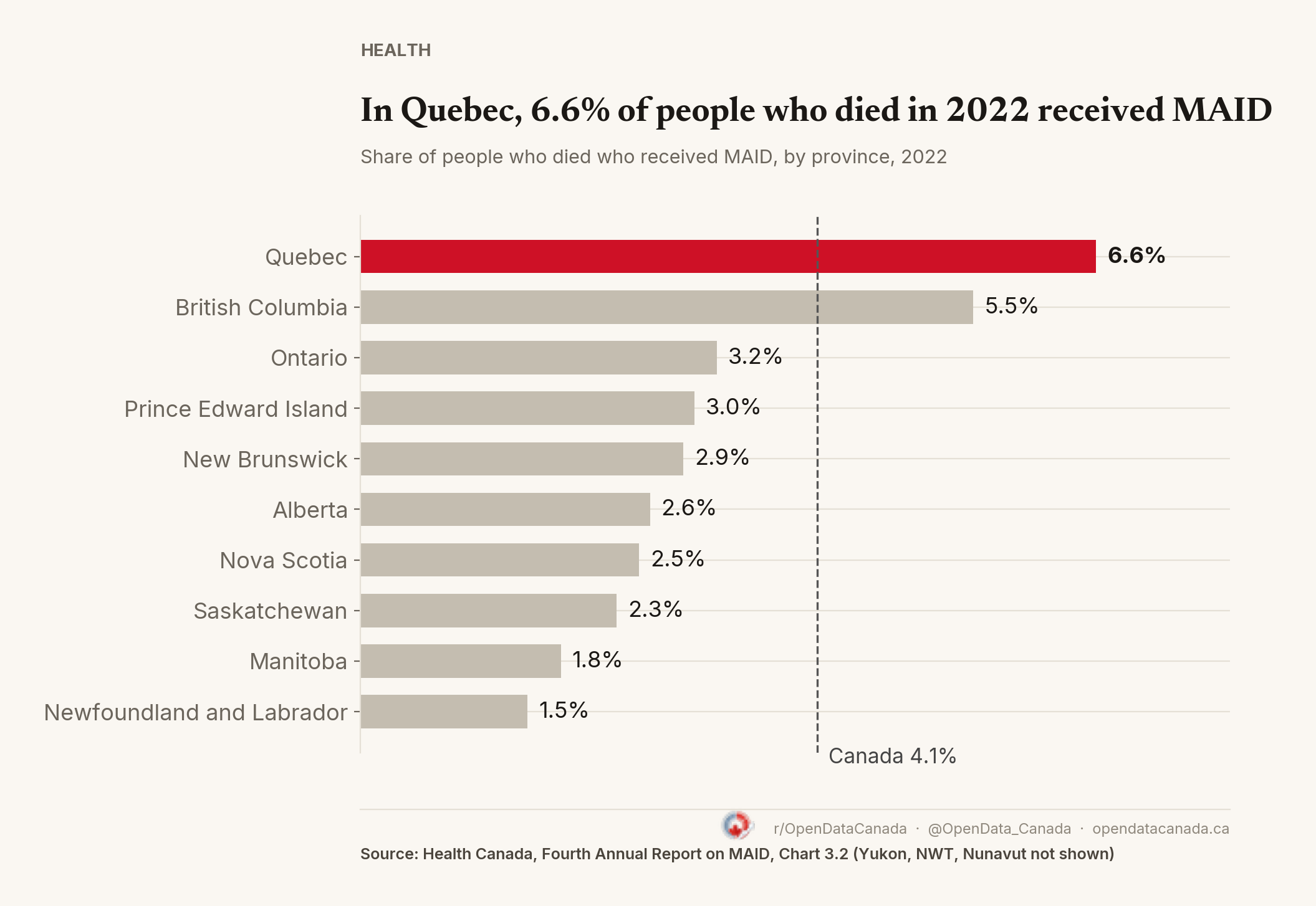
Quebec's own MAID law took effect in December 2015, six months before the federal law in June 2016. Quebec and British Columbia had the highest MAID rates in every year Health Canada published provincial rates, 2019 to 2022. Health Canada ties this to "the socio-political dynamics of these two jurisdictions," and says the number of available MAID practitioners could also be a factor.
Together, Quebec, Ontario and British Columbia had nearly 85 percent of Canada's MAID cases in 2024.
If you or someone you know is thinking about suicide, call or text 9-8-8, any time.
Related: Recorded bedsores in Canadian hospitals are 2.7 times their 2014 level, another Health Canada-era look at hospital care.